File Returns First: Win HMRC Time to Pay Approval as a UK Director

Yes, HMRC can agree a Time to Pay instalment plan if you cannot pay your tax bill by the due date but can genuinely afford the repayments. File any outstanding returns first, then apply through the online service if you qualify, or call HMRC directly. Do this within the next few days rather than waiting for a demand letter, since HMRC treats early contact far better than a missed deadline.
TL;DR:
HMRC will consider a Time to Pay plan if you cannot pay your tax debt in full and genuinely can afford the recommended installments.
Applying early, filing all outstanding returns, and proposing realistic monthly payments with supporting evidence improve your chances of approval.
Arrangements typically last up to a year, with interest accruing on the deferred amount, and longer terms require exceptional approval.
Breaking or missing payments can lead to cancellation and enforcement actions, so maintaining current liabilities and transparent communication are crucial.
Using professional advice helps create credible proposals, especially for complex debts or previous arrangement breakdowns, increasing the likelihood of success.
Table of Contents
How long does a time to pay arrangement usually last, and what does it cost?
What happens if HMRC rejects your proposal or you miss a payment?
How Keystone Financial Advisory can help with time to pay proposals
How do you ask HMRC for more time beyond your original plan?
What actually improves your odds when negotiating with HMRC?
Does time to pay work alongside other HMRC support or debt options?
Who do you contact, and how do you keep the arrangement on track?
Will time to pay affect your future tax filings or credit rating?
What is HMRC time to pay and which taxes can it cover?
A Time to Pay arrangement is a tailored instalment schedule built around what you can actually afford, not what HMRC would prefer to collect. It covers most of the major tax categories a small business or individual might owe: Self Assessment, VAT, PAYE and employer National Insurance Contributions, Corporation Tax, and Construction Industry Scheme (CIS) deductions.
What it will not do is reduce the amount you owe. Interest keeps accruing on the outstanding balance throughout the arrangement, so a Time to Pay plan spreads the pain rather than removing it. HMRC’s own internal guidance frames these arrangements as case-by-case decisions built on objective criteria, with the debt expected to clear over as short a period as reasonably possible.
Who qualifies for an HMRC payment plan?
HMRC agrees to a payment plan when two things are true at once: you cannot pay in full by the due date, and you can realistically afford the instalments alongside your ongoing tax liabilities. That second condition trips up more applicants than the first.
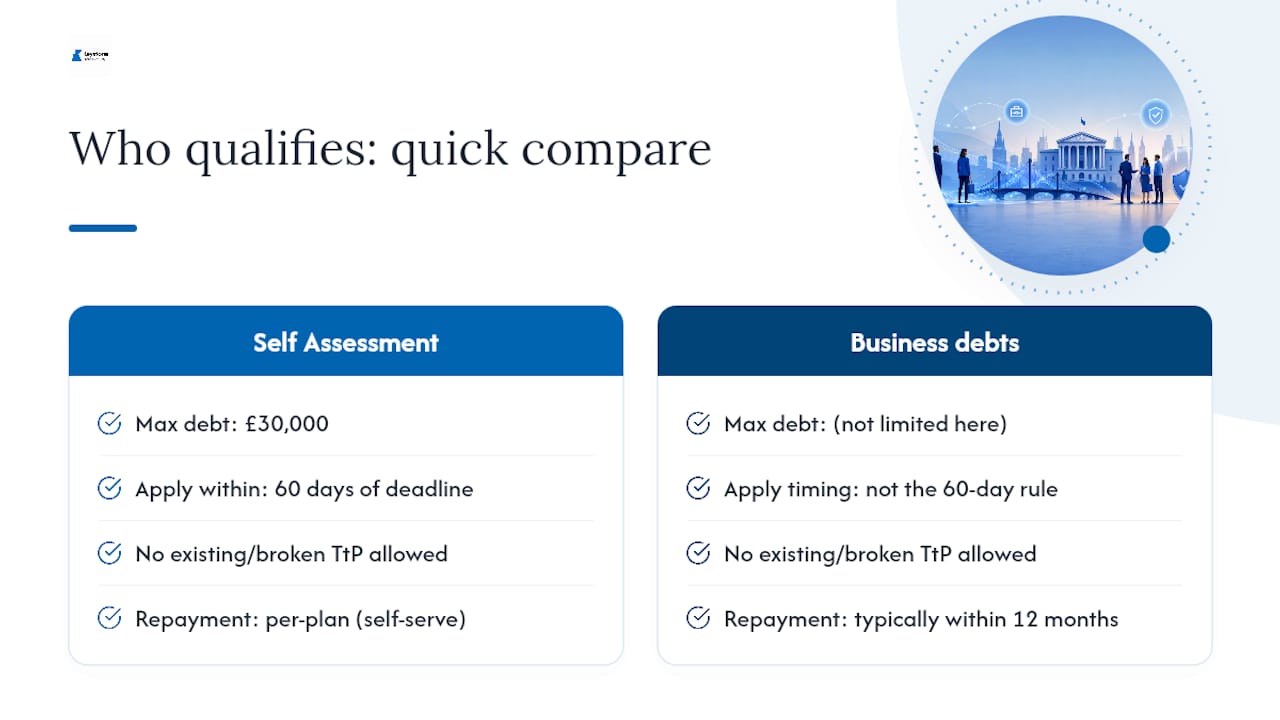
For Self Assessment specifically, the online self-serve route is available for debts up to £30,000, provided you apply within 60 days of the payment deadline and don’t already have another Time to Pay plan running or broken. Business debts, including VAT, Corporation Tax and PAYE, typically expect repayment within 12 months, and HMRC is explicit that it doesn’t act as a source of working capital. It expects you to have already tried commercial funding before asking for time.
One nuance worth knowing: HMRC treats PAYE and employee National Insurance differently from Corporation Tax. Because that money was deducted from staff wages on the government’s behalf, HMRC tends to negotiate on it with less flexibility than on Corporation Tax, which is the company’s own liability.
How do you apply for HMRC time to pay?
Timing decides more of this than most people expect. Applying the week a debt falls due, with returns filed and numbers ready, gets a materially better reception than a rushed call after a letter threatening enforcement.
File every outstanding return first. HMRC will not discuss a payment plan for a debt it cannot yet confirm, and unfilled returns are the single most common reason applications stall.
Check the online self-serve route. If you owe Self Assessment tax of up to £30,000 and are within 60 days of the deadline, you can set up an arrangement on GOV.UK by signing into your Personal Tax Account, without ever picking up the phone.
Call the right helpline for anything else. VAT, Corporation Tax, PAYE arrears, or Self Assessment debts above £30,000 generally need a phone conversation, either through the Self Assessment helpline or the Business Payment Support Service for company debts.
Propose a monthly figure and a term. Come with a number you can defend, not one you hope sounds generous.
Confirm the plan and set up a direct debit. HMRC will usually ask for a direct debit to keep instalments running automatically once terms are agreed.
Some straightforward VAT and business cases can now move through more accessible online screening, but anything that fails the automated affordability check gets redirected to a human review, which is a different process altogether.
How does HMRC assess whether you can afford it?
HMRC’s affordability assessment is essentially a stress test of your finances. It wants to see that you can cover the proposed instalments, meet new tax liabilities as they fall due, and still keep the business or household running. Vague reassurances don’t survive this check; numbers do.
Expect to be asked for an income and expenditure breakdown, and for a business, evidence that the underlying operation is viable rather than propped up indefinitely by unpaid tax. Prepare these before you call:
Three months of business or personal bank statements.
A profit and loss summary or management accounts.
A short cash flow forecast covering the proposed repayment term.
A list of significant assets and existing debts or creditors.
Your recent tax payment history with HMRC.
Pro Tip: Round your proposed monthly payment down, not up. HMRC would rather approve a plan you can sustain for twelve months than one you break in month three, and a broken arrangement is far harder to renegotiate than a modest one that succeeds.
How long does a time to pay arrangement usually last, and what does it cost?
Most arrangements run for several months up to about a year. Anything longer counts as exceptional and requires approval from a senior HMRC manager.
The cost isn’t the instalments themselves. It’s the interest that keeps building on top. Since 6 April 2025, HMRC’s late-payment interest rate has been the Bank of England base rate plus 4%, applied throughout the life of the plan. Some late-payment penalties can be paused while a Time to Pay arrangement is active, but the interest doesn’t pause with them. Ask HMRC for written confirmation of the exact terms once agreed. Verbal agreements are hard to enforce if a dispute arises later.
What happens if HMRC rejects your proposal or you miss a payment?
Missing an instalment is not a minor slip in HMRC’s eyes. Its internal guidance is blunt: a broken Time to Pay arrangement can trigger immediate cancellation and the resumption of full collection activity, including penalties that may have been paused and, for companies with serious arrears, the risk of a winding-up petition.
If HMRC rejects your first proposal outright, you’re not out of options. You can revise the figures and reapply with stronger evidence, ask for the case to be manually reviewed rather than relying on an automated decision, or bring in an accountant or insolvency practitioner to negotiate directly on your behalf. This matters especially online: the self-serve tool runs a binary pass or fail check, and failing it simply redirects you to a phone route where a human caseworker can take a more flexible view of your circumstances. A rejection from the online system is rarely the final word.
Checklist: what to prepare before you call or apply
Preparation is what separates an approved plan from a frustrating phone call that goes nowhere. Work through this order:
File all outstanding tax returns, even if you can’t pay what they show you owe.
Pin down the exact debt figure, including any interest already accrued.
Pull together three months of bank statements and a simple cash flow forecast.
Decide on a realistic monthly repayment figure and a term, ideally within 12 months.
Note down any attempts you’ve already made to raise funds commercially.
List other creditors and existing debts so HMRC sees the full financial picture.
Set up the direct debit once terms are agreed, and request written confirmation.
Honesty about your current liabilities matters more than most applicants realise. A documented, realistic plan gets approved far more often than an optimistic one, and it’s much easier to renegotiate a modest arrangement upward than to rebuild trust after a broken one.
How Keystone Financial Advisory can help with time to pay proposals
Preparing a credible Time to Pay proposal is largely an exercise in presenting the right numbers, in the right format, to the right HMRC team. An adviser can help founders and directors by building affordability assessments, drafting the income and expenditure figures HMRC expects, and handling direct conversations with HMRC on a client’s behalf where appropriate.
Bringing in an adviser tends to matter most when debts span multiple tax types, a previous arrangement has already broken down, or there’s a genuine risk of insolvency if talks go badly. In those situations, a second pair of eyes on the numbers, and someone who has negotiated with HMRC before, can shift the outcome. For directors managing Corporation Tax alongside other liabilities, it’s worth reading KeystoneFA’s guide to corporation tax payment deadlines before the debt builds further.
How do you ask HMRC for more time beyond your original plan?
An existing Time to Pay arrangement isn’t fixed in stone if your circumstances genuinely change, but you need to act before you miss a payment, not after. Contact HMRC as soon as you realise the current instalments are no longer affordable. Waiting until a payment bounces turns a renegotiation into a cancellation.
When you call, be ready to explain what’s changed since the original agreement. Perhaps revenue has dropped, a client has gone into administration, or a new tax liability has landed on top of the existing debt. HMRC will want an updated income and expenditure picture, essentially a fresh affordability assessment, before it agrees to extend the term or reduce the monthly figure.
There’s no guaranteed right to an extension. Each request is assessed individually against the same objective criteria used for the original application, so a second plan needs the same level of preparation as the first, arguably more, since HMRC will scrutinise why the initial figures didn’t hold up. If the shortfall stems from a one-off event rather than a structural problem with the business, say so clearly and back it with evidence.
If HMRC declines to extend, the options narrow quickly: pay what you can immediately to reduce the balance, ask for a formal review of the decision, or bring in an accountant to present the case differently. What you should never do is simply let a payment lapse and hope HMRC doesn’t notice. Silence is treated far more harshly than a difficult conversation.
What actually improves your odds when negotiating with HMRC?
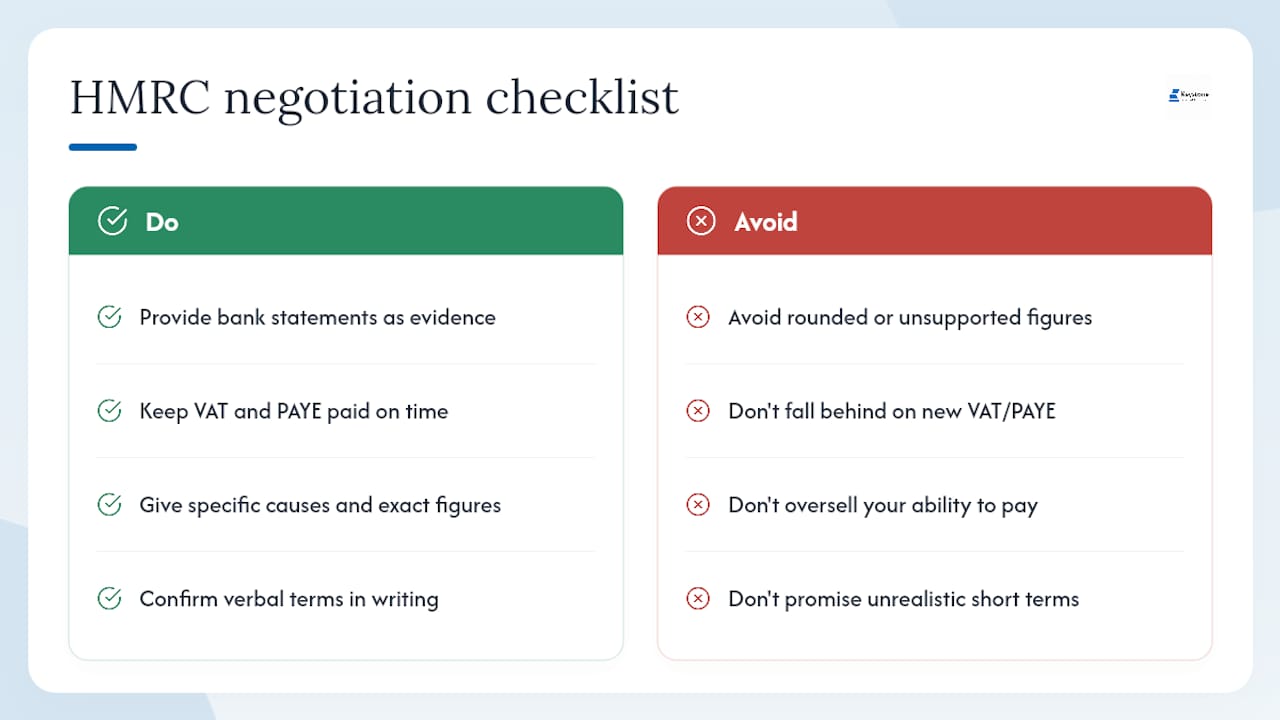
The single biggest factor in a successful negotiation is credibility. Caseworkers deal with hundreds of proposals, and figures that look rounded, optimistic, or unsupported by evidence get pushed back or handed to a stricter reviewer. A number backed by a bank statement lands very differently from a number backed by a guess.
Keep current liabilities current. Practitioners consistently flag falling behind on new VAT or PAYE payments while repaying old arrears as the most common reason a Time to Pay plan collapses, since it signals to HMRC that the underlying problem hasn’t actually been fixed. Paying this month’s VAT on time, even while still clearing last year’s debt, does more for your standing than almost anything else you can do.
Be specific rather than general when you talk to HMRC. Instead of saying the business has had “a difficult year,” explain that a named client went into administration owing a specific amount, or that a particular contract fell through in a particular month. Specificity signals that you understand your own numbers, which is exactly what the affordability assessment is testing for.
Don’t oversell your ability to pay to secure a shorter, more impressive-looking term. A twelve-month plan you complete without a single missed payment does more for your relationship with HMRC, and your credit standing, than a six-month plan you break in month four. If you’re negotiating on behalf of someone else, formal authority such as a power of attorney arrangement can make it clear to HMRC that you’re entitled to act and speak for the debtor, which speeds up otherwise cautious conversations.
Finally, put everything in writing once verbal terms are agreed. A confirmation letter or email from HMRC protects you if a dispute arises later about what was actually promised.
Does time to pay work alongside other HMRC support or debt options?
Time to Pay isn’t the only tool HMRC has, and it isn’t always the right one on its own. For businesses with genuinely unmanageable debt across several tax heads, it usually sits alongside, rather than instead of, other conversations about the company’s financial position.
If a business has fallen too far behind for a standard instalment plan to realistically clear the debt within HMRC’s usual timeframe, an insolvency practitioner may recommend a Company Voluntary Arrangement instead, which restructures debt across all creditors, not just HMRC. Time to Pay is designed for temporary cash flow pressure; a CVA or similar formal insolvency process is for structural, longer-term financial distress.
For individuals, Time to Pay can run alongside separate personal debt advice if tax arrears are just one part of a wider financial problem. HMRC won’t coordinate with other creditors on your behalf, so if you’re juggling tax debt with other borrowing, a mortgage adviser familiar with self-employed finances, such as Haven Mark Advisers, can help you see how a Time to Pay commitment sits against your wider borrowing capacity, particularly if you’re planning to remortgage or raise finance while the plan is active.
Directors should also be aware that HMRC treats attempts to raise commercial funding as a precondition for Time to Pay on business debts, not an alternative to it. The two work in sequence: try to fund the shortfall commercially first, then use Time to Pay for whatever gap remains. Trying to run both processes simultaneously without disclosing one to the other rarely goes well, since HMRC will ask directly whether other funding routes have been explored.
Who do you contact, and how do you keep the arrangement on track?
Once a Time to Pay plan is agreed, the contact point usually shifts from the general helpline to the Debt Management team handling your specific case, so keep the reference number from your original agreement to hand for every future call.
Communication during the plan matters as much as the initial negotiation. If a payment date is going to be difficult, call before the due date, not after. HMRC caseworkers have far more flexibility to adjust a plan proactively than to reverse a cancellation after the fact. Keep a written or emailed record of every conversation, including the name of whoever you spoke to and the date, since arrangements are sometimes reviewed by a different caseworker than the one who agreed them.
Set a calendar reminder a few days before each instalment is due, particularly if you’re paying manually rather than by direct debit. A missed payment caused by an administrative slip is treated exactly the same as one caused by an inability to pay, so don’t let a diary oversight undo months of a successful arrangement.
If your circumstances shift partway through, whether that’s an improvement that lets you clear the debt faster or a downturn that puts the current instalments at risk, contact HMRC directly rather than waiting for the next scheduled payment to reveal the problem. Businesses with more complex, multi-tax debts often find it worth having an accountant maintain that ongoing contact, since a consistent point of communication tends to build more trust with HMRC than a different person calling each time.
Will time to pay affect your future tax filings or credit rating?
A Time to Pay arrangement itself does not appear on your personal or business credit file, and it isn’t a public record in the way a County Court Judgment is. Agreeing one, on its own, doesn’t damage your credit rating.
Where it can affect your standing is indirect. If a Time to Pay arrangement breaks down and HMRC escalates to formal enforcement action, such as a distraint visit, a County Court Judgment, or in serious company cases a winding-up petition, that enforcement step can become visible to credit reference agencies and lenders. It’s the escalation that causes the damage, not the original payment plan.
Future tax filings aren’t affected in terms of deadlines or obligations. You still need to file Self Assessment returns, VAT returns, and Corporation Tax returns on the normal schedule while a Time to Pay plan runs, and missing a new filing deadline is treated as a fresh, separate problem on top of the existing arrangement. In fact, staying current with new returns and new liabilities is one of the conditions HMRC watches most closely when deciding whether to keep an arrangement running.
For businesses seeking finance while a plan is active, some lenders will ask directly whether the company has, or has had, a Time to Pay arrangement with HMRC. Disclosing it honestly, alongside evidence that payments have been made on time, tends to land better with lenders than a company failing to mention it and having it surface later during due diligence.
A director’s honest take on getting this right
The mistake I see most often isn’t dishonesty, it’s optimism. Directors propose repayment figures based on what they hope next quarter looks like, not what the last three months actually showed, and HMRC spots the gap immediately. Act the moment you know a bill is unaffordable, not the week before it’s due, and bring numbers that survive scrutiny rather than numbers that sound reassuring. If the debt spans several tax types or a previous plan has already failed, that’s the point to bring in professional help rather than trying one more call alone.
— Shoaib
Get professional support with HMRC negotiations
Professional advisors can provide founders and directors with a properly prepared affordability case built before contacting HMRC, drawn from real bookkeeping records rather than a guess at what the business can afford.
[
](www.keystonefa.co.uk)
Engagements typically start with a short review of your current tax position and outstanding filings, followed by an assessment of what a realistic Time to Pay proposal would look like for your business. From there, KeystoneFA can prepare the supporting figures, draft the proposal, and represent you directly in discussions with HMRC where that’s the right approach. This sits alongside the day-to-day bookkeeping, VAT filing, and Corporation Tax support that keeps future liabilities from becoming the next crisis. If HMRC debt is building and you want it handled properly rather than negotiated on the fly, visit KeystoneFA’s website to arrange an initial review.
This article is general information, not a substitute for advice from a qualified financial advisor. Consult a qualified financial professional about your own circumstances before acting on anything here.
FAQ
How late can I pay my tax bill before HMRC takes action?
There’s no fixed grace period. HMRC can begin enforcement soon after the due date passes, which is why contacting them before the deadline to discuss a payment plan matters far more than waiting to see what happens.
How do I apply for time to pay with HMRC?
File any outstanding returns, then use the online self-serve service if you owe Self Assessment tax of up to £30,000 within 60 days of the deadline, or call HMRC directly for VAT, PAYE, Corporation Tax, or larger Self Assessment debts.
What month do you pay tax in the UK?
Self Assessment balancing payments are due annually in January, with a second payment on account due mid-year. VAT, PAYE, and Corporation Tax deadlines vary depending on your accounting periods and filing frequency.
What happens if I don’t pay HMRC on time?
Interest starts accruing immediately at HMRC’s late-payment rate, penalties may follow, and HMRC can escalate to formal collection action, including debt recovery visits or, for companies, insolvency proceedings.
Can I get more than 12 months to pay my HMRC debt?
Arrangements beyond 12 months are possible but exceptional, requiring senior manager approval, and you’ll need strong evidence that a longer term is genuinely necessary rather than simply preferred.
Recommended