1 January 2026 deadline: FRS 102 leases checklist for UK SMEs

Revised Section 20 of FRS 102 requires lessees to bring most leases onto the balance sheet as right-of-use assets and matching liabilities, ending the old operating/finance split. The change applies for accounting periods beginning on or after 1 January 2026, following a mandatory modified retrospective transition. Short-term and low-value leases stay off-balance sheet, and lessor accounting barely changes.
TL;DR:
The new lease rules require most leases to be recognized on the balance sheet as assets and liabilities starting from January 2026, significantly increasing reported balance sheet size.
Small and short-term leases under 12 months or of low value can remain off-balance sheet, with FRS 102 allowing a broader low-value threshold than IFRS 16.
Transition involves a simplified modified retrospective approach, adjusting opening equity without restating previous years’ comparatives, and commonly reusing IFRS 16 models for efficiency.
Small businesses should focus on material leases that impact financial ratios, model these carefully, and rely on practical expedients for the smaller lease portfolio.
Ongoing lease accounting requires careful calculation of discount rates, handling of lease modifications, and detailed disclosures on lease liabilities and judgments in the annual notes.
Table of Contents
What the Periodic Review 2024 amendments change for FRS 102 leases
The Financial Reporting Council’s Periodic Review 2024 strips out the old distinction between operating leases and finance leases for lessees. Almost every lease now creates a right-of-use asset and a lease liability on day one, borrowing the logic that already governs IFRS 16.
That single change ripples through three statements at once:
Balance sheet: assets and liabilities both grow, often significantly, for businesses with property or equipment leases previously kept off-balance sheet.
Profit and loss: a single rent charge splits into depreciation on the right-of-use asset plus interest on the lease liability, typically front-loading the expense.
Cash flow statement: lease payments move largely into financing activities rather than operating activities, changing how operating cash flow reads to a lender or investor.
The same Periodic Review also tightens revenue recognition guidance and fair value measurement, nudging FRS 102 further toward IFRS-based principles overall. For businesses running software or subscription revenue models, the changes to revenue recognition land in the same reporting cycle and are worth reviewing alongside the lease amendments.
Who has to comply, and by when
FRS 102 applies to UK companies and other entities not required or choosing not to apply full IFRS or FRS 105 for micro-entities, which stays untouched by these lease changes. Timing splits into two effective dates:
1 January 2025: new supplier finance arrangement disclosures take effect.
1 January 2026: the lease accounting amendments, and the bulk of the Periodic Review 2024 package, apply to periods beginning on or after this date.
A December year-end business starts applying the new lease rules from 1 January 2026, reporting under the new regime for the year ending 31 December 2026. A March year-end business gets a little longer, starting from its year beginning 1 April 2026. Early adoption is permitted, but only if every amendment in the package is adopted together, not selectively.
Measuring the lease liability and right-of-use asset
The lease liability is initially measured at the present value of the remaining lease payments, discounted using the rate implicit in the lease where that is readily determinable, or the lessee’s incremental borrowing rate otherwise. The right-of-use asset generally mirrors that liability figure, adjusted for any lease payments made before commencement, lease incentives received, and initial direct costs incurred in setting up the lease.
Two recognition exemptions keep the model proportionate for smaller reporters. Short-term leases running 12 months or less can stay off-balance sheet, and so can leases of low-value assets, judged on the asset when new rather than the remaining lease term. FRC guidance confirms FRS 102 allows a broader low-value threshold than IFRS 16 permits, which matters for businesses leasing laptops, office equipment or small vehicles.
Several practical expedients soften the workload further:
A single discount rate applied to a portfolio of leases with similar characteristics, remaining terms and economic environment.
Hindsight applied when assessing lease term or assessing impairment at the date of initial application.
Reliance on an earlier onerous lease assessment rather than a fresh impairment review at transition.
Pro Tip: Don’t assess low value item by item from memory. Pull your fixed asset and lease register together first, then apply the threshold consistently across the whole portfolio. Inconsistent treatment of near-identical leases is one of the first things an auditor will query.
How the transition actually works
FRS 102 mandates a modified retrospective approach rather than full retrospective restatement, and the mechanics follow a set sequence.
Calculate the cumulative effect of applying the new lease rules to leases in place at the date of initial application, and post that adjustment directly to opening equity, not through profit and loss.
Leave comparatives untouched. The prior year’s reported figures stay as originally published, even though the current year’s presentation differs substantially.
Consider the IFRS 16 practical expedient if your group, or a parent, already prepares IFRS 16 calculations. ICAEW guidance confirms this expedient lets you reuse those figures rather than remodelling every lease from scratch, provided you disclose that you have used it.
Apply lease-by-lease expedients at the date of initial application, such as treating a lease with less than 12 months remaining as short-term, even if its original term ran longer.
Reusing existing IFRS 16 models, where a group already produces them, is often the single biggest time-saver available at transition.
Getting the ongoing numbers right
Choosing a discount rate is rarely straightforward for SME leases, where the rate implicit in the lease is hardly ever disclosed by the landlord. In practice, most preparers fall back on the lessee’s incremental borrowing rate, and a pragmatic approach for smaller businesses is to use the rate on their most recent comparable secured borrowing, documented clearly in the accounting policy note.
Lease modifications need care too. A genuine modification, such as extending the term or changing the leased space, usually triggers remeasurement of both the liability and the right-of-use asset. A simple rent review tied to an existing index, by contrast, is typically treated as a variable payment rather than a full remeasurement event.
Ongoing accounting also brings:
Depreciation of the right-of-use asset, usually straight-line over the shorter of the lease term or useful life.
Interest expense unwinding on the lease liability, front-loading total charges early in the lease term.
Impairment testing where indicators exist, interacting with any pre-existing onerous lease provision rather than duplicating it.
What changes for lessors
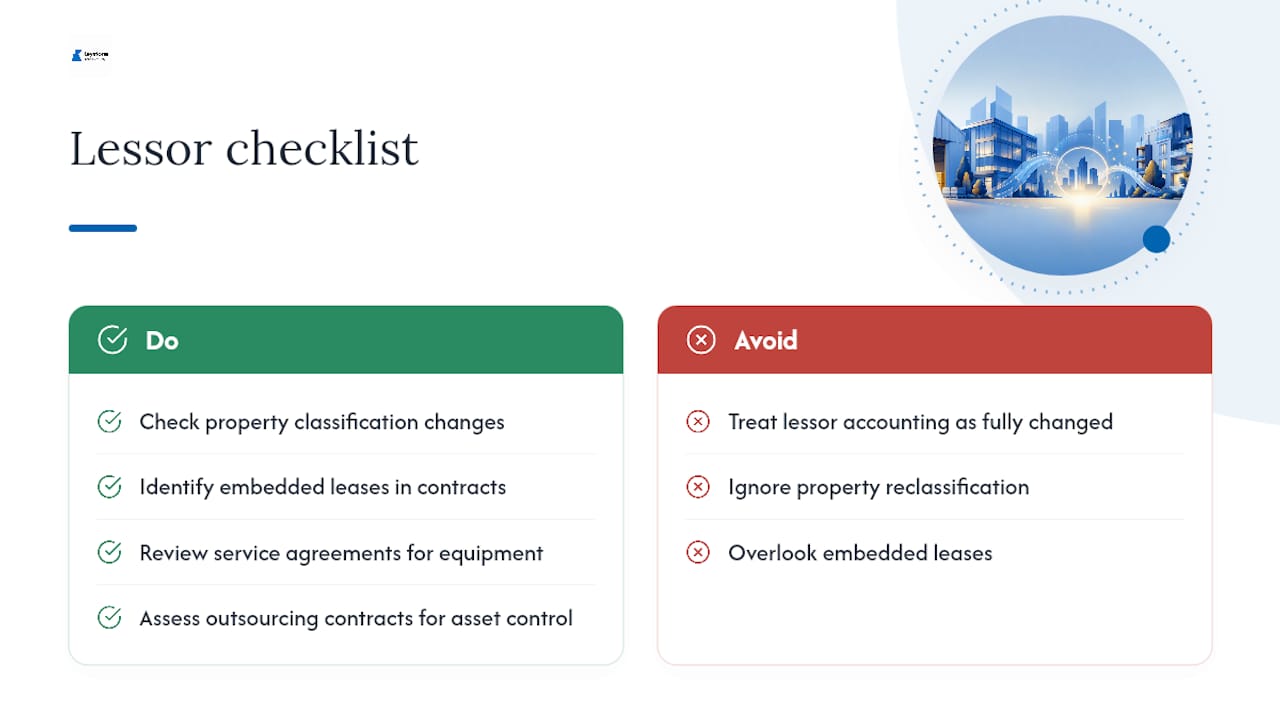
Lessor accounting under FRS 102 stays largely as it was before the Periodic Review 2024 amendments, still splitting between operating and finance leases from the lessor’s side of the contract. The bigger practical question for many businesses is scope. If a leased property is reclassified as investment property, or an investment property becomes an owner-occupied leased asset, that triggers a shift between Section 16 and Section 20 treatment. Contracts worth checking for embedded leases include service agreements bundling dedicated equipment, and outsourcing contracts where a specific, identifiable asset is effectively controlled by the customer.
A practical implementation checklist for UK preparers
Getting ahead of the 2026 deadline comes down to sequencing the work properly, not doing more of it at the last minute.
Build a complete lease inventory covering property, vehicles, equipment and any service contracts that might contain an embedded lease, capturing start date, term, payment schedule, break clauses and any renewal options.
Decide your modelling approach. Spreadsheet templates work for a handful of leases; businesses with a larger portfolio, or an existing accounting package with lease modules, should assess whether it’s worth activating that functionality rather than building manually.
Update accounting policies and controls, including who approves discount rate assumptions and how new leases get flagged to the finance team at signing, not at year end.
Review covenants and talk to lenders early. KPMG’s analysis flags that gearing, EBITDA and interest cover all move once leases sit on the balance sheet, and covenant definitions drafted years ago rarely anticipate that.
Pro Tip: Don’t try to model every lease with equal precision. For most SMEs, the leases that actually move your ratios are the top ten to twenty by value. Model those properly, apply the practical expedients to the smaller tail, and disclose the policy consistently.
What your disclosure notes need to say
Transition-year notes need to explain which practical expedients you applied and, where practicable, quantify the impact of adopting the amendments on opening equity and the balance sheet. Ongoing annual disclosures then settle into a steadier pattern.
A maturity analysis of lease liabilities by remaining term band.
Separate disclosure of depreciation and interest expense relating to leases, rather than a single blended rent figure.
The judgements applied in setting discount rates and assessing lease term, particularly where extension options are reasonably certain to be exercised.
Keep the technical detail in the notes and put any covenant commentary in the strategic report or directors’ commentary instead, where readers actually expect to find it. ACCA’s factsheet has worked examples of disclosure wording that hold up well as drafting templates.
What this means for UK SMEs and growing businesses
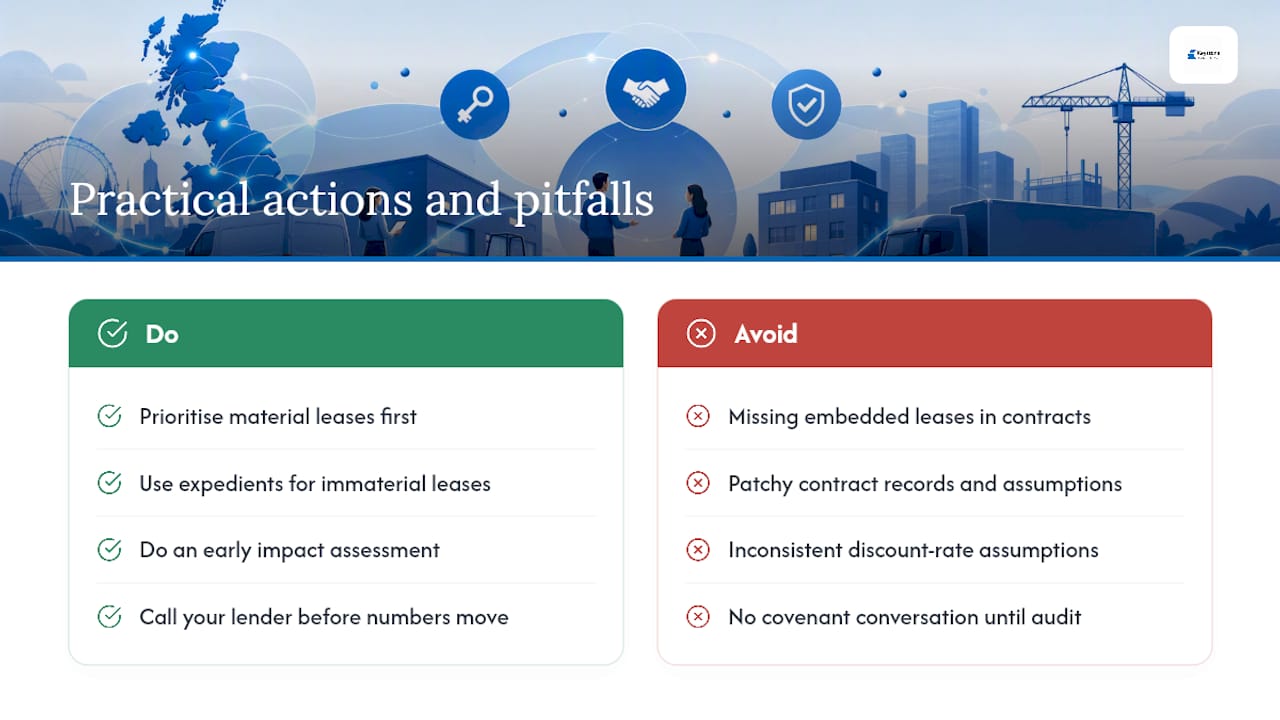
The leases that matter here are the ones that move your ratios, not every lease on the register. A business with a single warehouse lease and a handful of laptops has a straightforward job; one with a scattered property portfolio and several equipment leases needs to prioritise the material ones and lean on the expedients for the rest.
The recurring pitfalls are predictable: embedded leases missed inside service contracts, patchy contract records that make discount rate assumptions inconsistent, and no covenant conversation until the auditor raises it. An early impact assessment, and a phone call to your lender before your numbers move, saves far more audit friction than any last-minute fix.
— Shoaib
Get your lease transition sorted before the 2026 deadline
Modelling right-of-use assets, choosing defensible discount rates, and drafting audit-ready disclosure notes takes real technical judgement, and getting it wrong on a material lease portfolio is expensive to unpick later. Some accounting firms build that judgement into accounts preparation and year-end reporting work, backed by teams with experience in comparable transitions, to provide a proper impact assessment rather than a generic template.
[
](www.keystonefa.co.uk)
Before reaching out, pull together your lease contract list, payment schedules and any existing IFRS 16 calculations from a parent company, if they exist. That single step cuts weeks off the assessment. KeystoneFA offers flexible accounting packages at competitive monthly rates and scalable options as your business grows, alongside standalone audit readiness checks and accounts preparation support. Get in touch through the KeystoneFA site to start your lease impact assessment now.
This article is general information, not a substitute for advice from a qualified financial advisor. Consult a qualified financial professional about your own circumstances before acting on anything here.
Sources
FAQ
What are the changes to FRS 102 regarding leases in 2026?
Revised Section 20 requires lessees to recognise most leases on the balance sheet as a right-of-use asset and a lease liability, removing the old operating/finance lease distinction. It applies for periods beginning on or after 1 January 2026, with short-term and low-value leases still exempt.
How are leases accounted for under FRS 102?
Lessees measure a lease liability at the present value of future lease payments and recognise a matching right-of-use asset, then charge depreciation and interest separately over the lease term. Lessors continue applying the existing operating and finance lease distinction largely unchanged.
Who needs to comply with FRS 102?
Any UK entity applying FRS 102, rather than full IFRS or FRS 105 for micro-entities, must comply with the revised lease accounting rules. That covers most private UK companies, charities and LLPs preparing statutory accounts.
What are the key changes to leases in 2026?
The core change is that most operating leases move from being an off-balance sheet cost to an on-balance sheet asset and liability, which typically increases reported assets, liabilities and gearing. Businesses adopt this through a mandatory modified retrospective transition, adjusting opening equity without restating comparatives, as ICAEW’s guidance sets out.
Does KeystoneFA help with FRS 102 lease transition work?
Yes. KeystoneFA supports UK businesses with lease impact assessments, right-of-use modelling and disclosure drafting as part of its accounts preparation and audit readiness services, priced from £99 to £199 a month depending on the package chosen through the KeystoneFA site.
Recommended