25 business expenses HMRC allows limited companies to claim

TL;DR:
Limited companies can deduct 25 categories of expenses that are incurred wholly and exclusively for business purposes. Proper record-keeping and understanding of HMRC rules help directors minimize tax legally, avoiding non-allowable costs like entertainment, fines, and personal clothing. Accurate expense claims significantly reduce the corporation tax liability and should be reviewed regularly with professional advice.
Allowable business expenses are defined as costs a limited company can deduct from its revenue before calculating Corporation Tax. HMRC permits 25 distinct categories of deductible expenses for limited companies, each reducing your taxable profits directly. The core rule is straightforward: an expense must be incurred wholly and exclusively for business purposes to qualify. Directors who understand and apply these 25 deductible expenses UK rules correctly pay less Corporation Tax, legally and without dispute.
What are the 25 business expenses HMRC allows limited companies to claim?
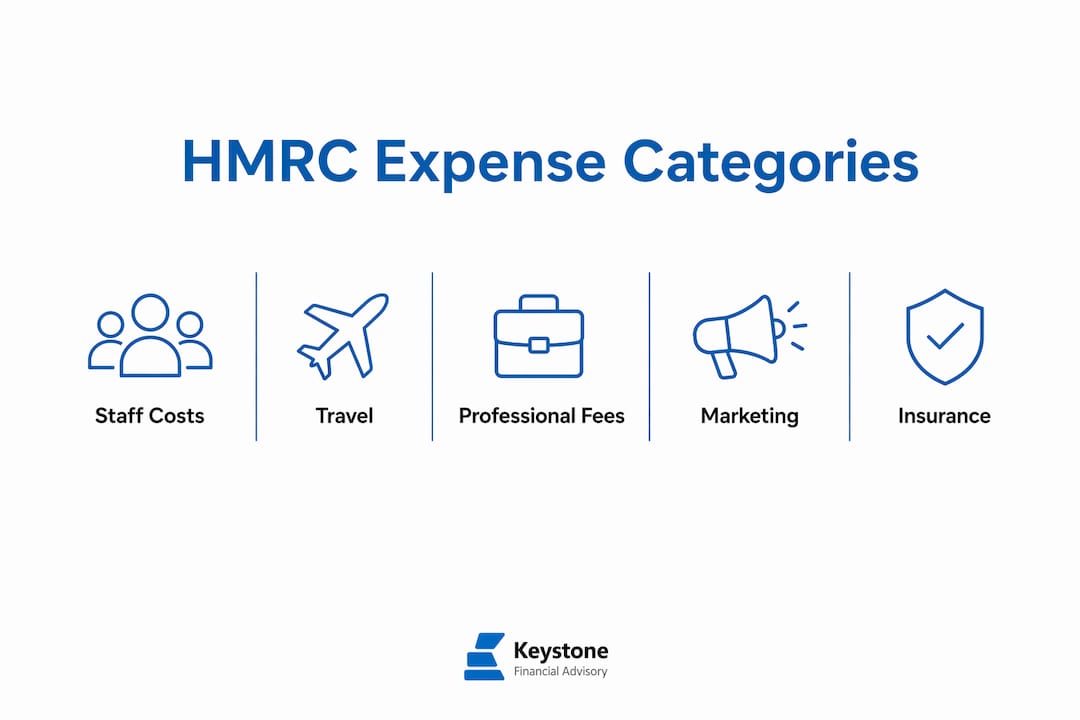
HMRC business expense claims fall into clear categories. The following 25 allowable expenses cover the most common and significant costs a limited company director can deduct.
Staff and employment costs
Staff costs including salaries, employer National Insurance contributions, and pension contributions are fully allowable. This means the total employment cost of every team member reduces your taxable profit. Recruitment fees and staff training costs also qualify.
Office and equipment costs
Office rent and rates: Rent paid on a business premises is fully deductible.
Office furniture and supplies: Desks, chairs, stationery, and printer consumables all qualify.
Software subscriptions: Monthly or annual fees for accounting software, project management tools, or cloud storage are revenue expenses and reduce profits immediately.
Phone and broadband: Business line costs are allowable in full.
Travel and transport
Business travel by train, bus, taxi, or car at HMRC-approved mileage rates is allowable. Commuting to a permanent workplace is not. Parking fees, tolls, and overnight accommodation for business trips all qualify. Mileage claims use HMRC’s approved rates: 55p per mile for the first 10,000 miles in a personal vehicle, then 25p per mile beyond that.
Professional fees
Accounting, legal, and consultancy fees are allowable when directly related to the business. This includes your accountant’s fees, solicitor costs for commercial contracts, and specialist consultancy. Personal legal costs, such as a director’s personal dispute, do not qualify.
Marketing and advertising
Costs for website hosting, paid advertising, social media management, printed materials, and PR campaigns are all allowable. Sponsorship payments with a clear commercial purpose also qualify.
Business insurance
Professional indemnity, public liability, and employers’ liability insurance premiums are allowable business expenses. Cyber liability and product liability cover also qualify where relevant to the trade.
Home office expenses
Directors working from home can claim a proportion of household bills. Home office costs are claimable either as a proportion of actual bills (heating, electricity, broadband) or via HMRC’s flat rate, depending on hours worked from home. The flat rate method is simpler but may produce a smaller deduction than actual costs.
Additional allowable expense categories
Expense category | Examples |
Bank charges and interest | Business account fees, loan interest on business borrowing |
Subscriptions and memberships | Professional body memberships, trade association fees |
Training and development | Courses, books, and conferences relevant to the current trade |
Charitable donations | Qualifying donations via Gift Aid or payroll giving |
Bad debts | Debts written off as irrecoverable in the accounts |
Research and development | Qualifying R&D costs under HMRC’s R&D relief scheme |
Uniforms and protective clothing | Branded workwear or safety equipment required for the role |
Health and safety costs | Risk assessments, first aid training, fire safety equipment |
Postage and courier costs | Sending goods or documents for business purposes |
Licences and permits | Regulatory licences required to operate the business |
Pro Tip: Keep a separate business bank account from day one. Mixing personal and business transactions is the single fastest way to create an HMRC dispute over which costs are genuinely allowable.
How does HMRC define ‘wholly and exclusively’ for expense claims?
The HMRC test for allowable expenses requires that every cost is incurred wholly and exclusively for business purposes. Dual-purpose costs, where a personal benefit also arises, are not automatically disallowed but must be apportioned correctly.
Apportionment of mixed-use costs
Directors can only claim the business percentage of mixed-use expenses. A mobile phone used 60% for business and 40% personally means only the business proportion is deductible. The same logic applies to a vehicle used partly for personal journeys or a broadband contract shared with family members.
Record-keeping requirements
HMRC requires directors to retain all expense records and receipts for at least 6 years after the end of the relevant accounting period. That 6-year rule covers Corporation Tax returns, VAT records, and payroll documentation. Failing to keep adequate records can result in HMRC disallowing claimed expenses during a compliance check.
Acceptable documentation includes:
Original receipts or digital scans
Bank and credit card statements
Mileage logs with dates, destinations, and business purpose
Contracts and invoices for professional services
Pro Tip: Use cloud-based receipt capture tools to photograph and store receipts immediately. A shoebox of paper receipts is not a compliant record-keeping system and creates real risk during an HMRC enquiry.
What are the common misconceptions when claiming limited company expenses?
The most costly misunderstanding directors make is treating capital assets as immediate expenses. A laptop purchased for £1,200 is not deducted from profits in the year of purchase.
Capital allowances versus revenue expenses
Capital assets such as laptops, machinery, and vehicles are subject to Capital Allowances, not immediate profit deduction. Revenue expenses like software subscriptions reduce profits in the period they are paid. The Annual Investment Allowance (AIA) does allow many capital purchases to be fully deducted in the year of purchase, but this is a separate mechanism from standard expense claims and has its own rules and limits.
Non-allowable expenses directors frequently attempt to claim
Client entertainment: Entertaining clients or suppliers is specifically excluded by HMRC, even when it has a clear commercial purpose.
Fines and penalties: Parking fines, HMRC late filing penalties, and regulatory fines are never allowable.
Commuting costs: Travel between home and a permanent workplace is personal expenditure, not a business expense.
Personal clothing: A suit worn to client meetings does not qualify. Only branded workwear or protective clothing is allowable.
Directors of close companies should also note that trivial benefits are capped at £50 per gift and a maximum of £300 per year. Gifts above these thresholds become taxable benefits.
How can directors practically maximise their allowable expense claims?
Claiming every legitimate expense requires a system, not just good intentions. Directors who manage this well do four things consistently.
Separate business finances completely. Use a dedicated business bank account and business credit card. This creates a clean audit trail and makes expense categorisation straightforward.
Maintain a mileage log. Record every business journey with the date, start and end point, purpose, and miles driven. HMRC expects this level of detail for mileage claims.
Review home office costs annually. Calculate whether the flat rate or actual cost method produces a larger deduction each year. The answer can change as your usage or bills change.
Claim eligible training costs. Courses and qualifications that update or maintain skills in your current trade are allowable. Training for an entirely new trade is not. This distinction matters and is frequently missed.
Work with a qualified accountant. The statutory accounts preparation process is where expense claims are finalised. An accountant who understands HMRC’s rules will identify claims you have missed and flag costs that would not survive scrutiny.
Pro Tip: Review your expense categories quarterly, not just at year end. Costs claimed in the wrong period or missed entirely are harder to correct once accounts are filed.
Key takeaways
Limited companies that claim all 25 HMRC-allowable expense categories, document them correctly, and apply the wholly and exclusively test consistently will achieve the lowest lawful Corporation Tax liability.
Point | Details |
25 allowable categories | HMRC permits 25 distinct expense types, from staff costs to home office and insurance. |
Wholly and exclusively rule | Every claimed expense must be incurred purely for business purposes or apportioned correctly. |
6-year record retention | All receipts and expense records must be kept for at least 6 years after the accounting period. |
Capital vs revenue expenses | Capital assets require Capital Allowances treatment; software subscriptions reduce profits immediately. |
Non-allowable costs | Client entertainment, commuting, personal clothing, and fines are never deductible. |
Why expense management is the most underrated tax tool for directors
Directors often focus on salary and dividend structures when thinking about tax efficiency. That focus is understandable, but it misses something significant. In my experience working with limited company directors, the biggest tax savings frequently come from expenses that were never claimed at all, not from restructuring remuneration.
The pattern I see repeatedly is this: a director runs a company for two or three years, files accounts, and pays Corporation Tax without ever having a proper conversation about what costs are genuinely allowable. Training courses, professional memberships, home office costs, and even relevant subscriptions go unclaimed because the director assumed they were borderline or simply did not know. Those missed claims add up to real money over time.
The other side of this is equally important. Claiming costs that do not meet HMRC’s test creates risk. An HMRC enquiry that disallows expenses can result in additional tax, interest, and penalties. The goal is not to claim everything possible. The goal is to claim everything legitimate, with the documentation to support it.
If you are unsure whether a cost qualifies, the answer is not to guess. Get specialist advice before filing, not after.
— Shoaib
How KeystoneFA helps limited company directors with expense claims
[
KeystoneFA works specifically with founders, directors, and growing businesses to make sure every legitimate expense is identified, documented, and claimed correctly. The team brings experience from top UK and Middle East firms, which means they understand both the technical rules and the practical realities of running a limited company.
Whether you need a tax consultation to review your current expense position or ongoing support with bookkeeping and Corporation Tax returns, KeystoneFA provides a personalised service rather than a one-size-fits-all approach. Directors can book a consultation online to get clear, specific advice on their allowable expenses and how to structure claims correctly for the current tax year.
FAQ
What expenses can a limited company claim against Corporation Tax?
A limited company can claim 25 categories of allowable expenses including staff costs, office costs, travel, professional fees, marketing, insurance, and home office costs. Each expense must be incurred wholly and exclusively for business purposes to qualify.
Is client entertainment an allowable expense for limited companies?
Client entertainment is not an allowable expense under HMRC rules, even when it has a clear commercial purpose. This exclusion applies regardless of the amount spent.
How long must a limited company keep expense records?
HMRC requires limited companies to retain all expense records and receipts for at least 6 years after the end of the relevant accounting period. Digital scans of receipts are acceptable.
Can a director claim home office costs through their limited company?
A director can claim home office costs either as a proportion of actual household bills or using HMRC’s flat rate method, based on hours worked from home. The most beneficial method depends on individual circumstances and should be reviewed annually.
Are capital assets like laptops claimable as business expenses?
Capital assets such as laptops are not immediately deductible as revenue expenses. They are subject to Capital Allowances treatment, though the Annual Investment Allowance may allow full deduction in the year of purchase under specific conditions.
Recommended