Corporation tax payment deadlines and how to pay on time

Corporation Tax is normally due 9 months and 1 day after your accounting period ends, and that date lands three months before your CT600 return is due. Miss it, and interest starts accruing even if your filing is perfectly on time.
Standard payers: 9 months and 1 day after the end of your accounting period, confirmed by HMRC’s own manual.
Large companies (taxable profits above £1.5 million): quarterly instalments, calculated against the instalment regime.
Filing (CT600): due 12 months after period end, separately from payment via Company Tax Returns.
Payment route: pay electronically and double check your 17-character payment reference before you hit send. It’s a detail KeystoneFA flags with every client because it’s the single most common cause of misallocated payments.
Key Takeaways
Corporation Tax payment falls due 9 months and 1 day after your accounting period ends, three months before the CT600 filing deadline, and getting the payment reference and method right matters as much as the date itself.
Point | Details |
Know your deadline | Payment is due 9 months and 1 day after your accounting period ends, separate from the 12-month CT600 filing date. |
Watch the £1.5m threshold | Profits above £1.5 million usually mean quarterly instalments, with the threshold reduced by associated companies. |
Choose the right payment method | Faster Payments or CHAPS clear fastest; Bacs needs three working days planned in advance. |
Verify the payment reference every time | The 17-character reference changes each accounting period, and saved payee details don’t update automatically. |
Get ahead of shortfalls | Contact HMRC before the deadline if you can’t pay, and ask about Time to Pay arrangements early. |
Build payment readiness into routine reviews | KeystoneFA reconciles management accounts against instalment schedules quarterly, reducing interest and penalty risk. |
Table of Contents
Who the corporation tax payment deadline applies to
Most companies fall into one bracket: taxable profits up to £1.5 million, paying the full bill 9 months and 1 day after the accounting period closes. Cross that £1.5 million threshold and you move into quarterly instalments instead, with the bar reduced if you have associated companies splitting the allowance between them. Go above £20 million and the instalment dates shift earlier still, a rule that also carries specific carve-outs for ring-fence activities.
Your accounting period usually mirrors your statutory accounts, but Corporation Tax rules cap it at 12 months, so a longer trading period splits into two separate periods for tax purposes. New companies and those changing their year-end need to work this out carefully, since it changes both the payment date and the instalment threshold calculation.
A company with a 31 December year-end pays by 1 October the following year, nine months and one day later.
The CT600 for that same period isn’t due until 31 December, a full three months after payment.
If associated companies exist, the £1.5 million threshold gets divided between them, which can pull a business into instalments earlier than expected.
How to work out how much you owe
Start with taxable profits for the accounting period: total income less allowable expenses and capital allowances. From there, apply any loss reliefs, group reliefs, or R&D reliefs your business qualifies for, then apply the current statutory Corporation Tax rate to what’s left.
If you’re paying by instalments, estimate the full year’s liability early and split it into four roughly equal payments — fractional CFO and financial planning services can support this process to improve accuracy and cash‑flow modelling as explained at Golden Path Digital’s fractional CFO services. Getting that estimate right matters more than most finance teams assume, because underpaying an instalment can trigger interest even before the final balance is due.
Calculate taxable profit: revenue minus allowable costs, capital allowances, and any reliefs.
Apply the current Corporation Tax rate to arrive at the liability.
For instalment payers, divide the estimated annual liability into quarterly amounts.
Revisit the estimate as real figures come in rather than working from a single forecast all year.
Pro Tip: Reconcile your estimate against management accounts a few weeks before each instalment date, not just at year end. A quarter’s underpayment compounds interest faster than most finance leads expect, and catching it early costs nothing.
Accepted payment methods and how long they take to clear
You cannot pay Corporation Tax by post. HMRC only accepts electronic methods, and each one behaves differently when your deadline is tight, particularly around weekends and bank holidays.
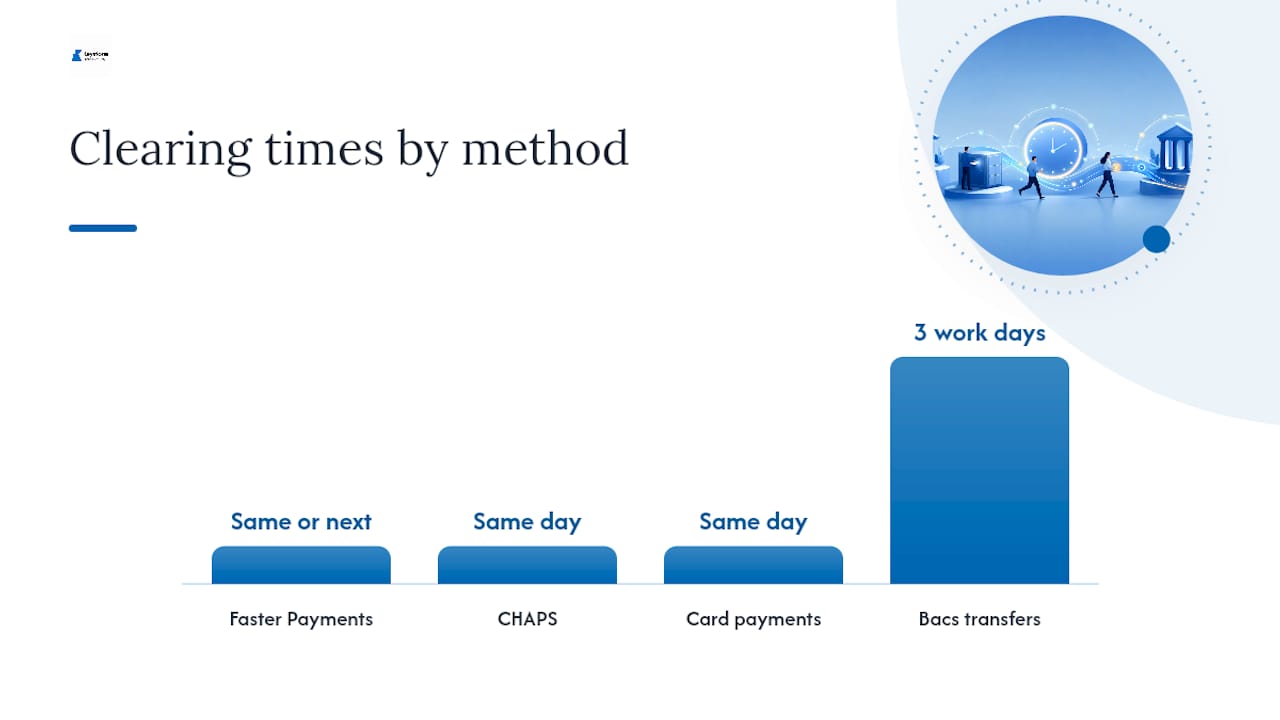
Faster Payments and CHAPS both tend to clear same day or next day, making them the safest choice when you’re paying close to the deadline. Bacs transfers usually take three working days to clear, so they need planning well in advance. Direct Debit setup takes time too, since HMRC needs the mandate registered before it can collect. Card payments carry a quirk worth knowing: HMRC records the payment date as the date you initiate it, not the date it clears, which makes a corporate card a genuinely useful option if your deadline falls on a Saturday or bank holiday Monday.
Payment method | Typical clearing time | Practical notes |
Faster Payments | Same day or next day | Best default choice near the deadline |
CHAPS | Same working day | Subject to your bank’s cut off time |
Bacs | Several working days | Needs initiating well ahead of the due date |
Direct Debit | Varies, mandate needed first | Set up in advance of the first payment |
Debit card | Same day, initiated date counts | No fee for personal debit cards |
Corporate credit card | Same day, initiated date counts | Non-refundable fee applies |
HMRC treats the initiation date as the payment date for card transactions, useful when the deadline lands on a non-banking day.
Paying in branch with a paying-in slip is still possible, but it’s the exception rather than the rule.
When large companies pay by quarterly instalments
Companies with taxable profits over £1.5 million usually pay in four equal instalments rather than one lump sum, and that threshold shrinks if you have associated companies sharing it. For a standard 12-month accounting period, the first two instalments actually fall before the period ends, which catches out businesses moving into this regime for the first time.
Take a company with a 1 January to 31 December accounting period. Its four instalments typically fall in months 7, 10, 13, and 16 measured from the start of that period, meaning the first payment is due while the year is still trading. That timing means your forecast needs to be reasonably solid well before your final numbers exist.
Confirm whether the £1.5 million threshold applies in full or is reduced by associated companies.
Estimate full-year liability early and divide it into four instalments.
Revise instalment amounts as forecasts firm up, and top up or claim back if early estimates prove wrong.
Very large companies with profits over £20 million follow earlier instalment dates under separate rules.
Common mistakes that delay or misallocate your payment
The single most frequent error is using last year’s 17-character Corporation Tax payment reference. That code changes every accounting period, and because banks often save HMRC as a payee, it’s easy to fire off a payment against the wrong period without noticing.
A second mistake follows naturally from the first: treating the CT600 filing deadline as the payment deadline. They’re not the same date. You can file on time and still owe interest because the payment itself arrived three months late.
Check the payment reference matches the current accounting period before every transfer, not just the first time you set up the payee.
Update saved bank payees rather than assuming the reference carries over automatically.
Separate your filing checklist from your payment checklist so one doesn’t get mistaken for the other.
Pro Tip: Keep one authoritative record of the current period’s payment reference, ideally in your accounting system rather than someone’s inbox, and check it against every payment before it’s sent.
What to do if you cannot pay on time
Contact HMRC as soon as you know there’s a problem, not after the deadline has passed. A Time to Pay arrangement is often available where the business has a credible plan and genuine short-term cash pressure, but HMRC expects to hear from you proactively rather than chasing you.
Interest builds from the due date regardless of whether your CT600 is filed correctly or on time, and late payment issues frequently trace back to cash-flow gaps that were visible weeks earlier. Faster Payments or a corporate card can buy a few days if funds are close but not quite there, though the card fee needs weighing against the interest you’d otherwise accrue.
Contact HMRC before the deadline passes, not after, and keep a written record of every conversation.
Ask specifically about Time to Pay if the shortfall is temporary and the business has a credible repayment plan.
Use Faster Payments or a corporate card as a stopgap where a few days makes the difference.
Pro Tip: Bring an adviser into the conversation with HMRC where the numbers are complex. A clear cash-flow forecast attached to the request tends to get a better hearing than a bare promise to pay.
What you need before you make the payment
Pull together everything below before you sit down to pay, rather than discovering a gap mid-transfer.
Access to your company’s HMRC online account, or the notice to deliver your return, to confirm the current 17-character payment reference.
Your calculated liability, and instalment amounts if you’re on the quarterly regime.
A payment method chosen with enough clearing time left before the deadline.
Correct HMRC bank details for the account you’re paying into, plus confirmation of any Direct Debit mandate already in place.
Why payment readiness has to be a quarterly habit, not a year-end scramble
Most of the errors covered here don’t come from ignorance of the rules. They come from treating Corporation Tax as a once-a-year event squeezed in around everything else. KeystoneFA’s approach treats it as an ongoing reconciliation: management accounts checked against instalment schedules, payment references verified against the live accounting period, and the payment route chosen with the deadline’s specific quirks in mind, weekends and bank holidays included.

Businesses that build this into a quarterly rhythm rarely face a late-payment scramble. The ones that don’t tend to discover the gap only when HMRC’s interest notice arrives.
How KeystoneFA keeps your corporation tax payment on track
Getting the timing right is one thing. Getting the amount right, every quarter, without a last-minute scramble, is another problem entirely, and it’s the one that catches out growing businesses most often. KeystoneFA builds period-end tax estimates and instalment forecasts into ongoing bookkeeping rather than bolting them on at year end, so the numbers you’re paying against are current, not a guess from six months ago.
[
](www.keystonefa.co.uk)
That means fewer surprises when an instalment date lands, cleaner HMRC allocations because reference numbers are checked before every transfer, and a smoother CT600 filing because the underlying figures have already been reconciled through the year. If you’d rather hand the calendar and the calculations to a team that’s already tracking year-end tax planning actions for similar businesses, get in touch through KeystoneFA’s accounting services and ask about a payment readiness review before your next instalment falls due.
Sources
For the definitive rules, go straight to HMRC and GOV.UK rather than relying on secondhand summaries. The core pages worth bookmarking are Pay your Corporation Tax bill, the instalment guidance for large companies, and CTM01800 for the technical detail on how due dates are calculated.
Gov
Save your company’s current payment reference somewhere your finance team can find it instantly. It changes every period, and that single habit prevents most of the errors covered above.
This article is general information, not a substitute for advice from a qualified financial advisor. Consult a qualified financial professional about your own circumstances before acting on anything here.
FAQ
When is Corporation Tax due for most UK companies?
Nine months and one day after the end of your accounting period, ahead of the separate 12-month CT600 filing deadline confirmed by HMRC.
What happens if my accounting period is longer than 12 months?
Corporation Tax rules cap accounting periods at 12 months, so a longer trading period splits into two separate periods, each with its own payment and filing dates.
Do all large companies pay Corporation Tax by instalments?
Companies with taxable profits above £1.5 million normally pay in quarterly instalments, with the threshold reduced where associated companies share the allowance.
Can I pay Corporation Tax by post?
No. HMRC only accepts electronic payment methods such as Faster Payments, CHAPS, Bacs, Direct Debit, or card payment.
What should I do if I can’t pay my Corporation Tax bill on time?
Contact HMRC before the deadline passes and ask about a Time to Pay arrangement. KeystoneFA can help negotiate terms and prepare the cash-flow forecasts HMRC typically asks for.
Recommended