Overdrawn director's loan accounts: common mistakes UK directors make

TL;DR:
Overdrawn director’s loan accounts in the UK can lead to significant tax penalties if not properly managed.
Monthly monitoring, formal documentation, and timely repayment are essential to avoid charges like Section 455 tax and benefit-in-kind liabilities.
An overdrawn director’s loan account is defined as a situation where a director has withdrawn more from their company than they have put in, leaving the company as a creditor. This is one of the most misunderstood areas of UK corporate tax, and the consequences of getting it wrong are significant. Under the Corporation Tax Act 2010, Section 455 charges, benefit-in-kind liabilities, and HMRC anti-avoidance rules all apply. Directors who treat company funds as a personal float without tracking withdrawals face unplanned tax bills, penalties, and compliance failures. Understanding the common mistakes with overdrawn director’s loan accounts in the UK is the first step to avoiding them.
What is Section 455 tax and how does it affect overdrawn loans?
Section 455 tax is a company-level charge that applies when a director’s loan remains outstanding nine months and one day after the company’s accounting year-end. The current rate is 33.75% of the outstanding balance for loans made before 6 april 2026, rising to 35.75% for loans made on or after that date. That rate increase makes 2026 a particularly costly year to leave a loan unresolved.
The charge applies to “close companies,” which are broadly defined as companies controlled by five or fewer “participators,” a term that typically includes directors and their associates. Most owner-managed businesses in the UK fall into this category. The Section 455 charge is not a permanent tax. Once the director repays the loan, the company can reclaim it. However, interest on late payment of the Section 455 charge is never refunded by HMRC, making it a permanent cost regardless of repayment.
Pro Tip: Set a diary reminder three months before your company’s year-end to review your loan account balance. That gives you time to repay or restructure before the nine-month deadline becomes a problem.
The nine-month deadline is calculated from the accounting period end date, not the calendar year. A company with a 31 march year-end must clear the loan by 1 january of the following year. Directors who miscalculate this date routinely trigger avoidable charges.
How do benefit-in-kind rules and the £10,000 threshold affect directors?
Benefit-in-kind charges are a personal tax liability, separate from the company’s Section 455 charge. They apply when a director’s loan balance exceeds £10,000 and the interest charged is below HMRC’s official rate, which stands at 3.75% for the 2025/26 tax year. The director is treated as having received a taxable benefit equal to the interest they should have paid.
The practical consequences are as follows:
The benefit-in-kind value is reported on a P11D form, submitted to HMRC by 6 july each year.
The director pays income tax on the benefit at their marginal rate.
The company pays Class 1A National Insurance Contributions on the same benefit at 13.8%.
The charge applies to the average loan balance across the tax year, not just the peak or closing figure.
Charging interest at or above HMRC’s official rate removes the benefit-in-kind charge entirely. However, charging interest does not prevent Section 455 tax until the loan itself is repaid. Directors sometimes assume that paying interest resolves all liabilities. It does not. Both charges can apply simultaneously if the loan remains outstanding beyond the deadline.
What are the common mistakes directors make with overdrawn loan accounts?
The most damaging overdrawn director loan mistakes are rarely dramatic. They accumulate quietly through poor habits and misunderstood rules.
Missing the nine-month deadline. Most directors fail to plan repayments ahead of the deadline, leading to unnecessary Section 455 charges and cash flow difficulties. The deadline is fixed and HMRC does not grant extensions.
Treating company money as personal funds. Directors who draw cash without recording it as salary, dividend, or a formal loan create unexplained withdrawals. HMRC enquiry teams challenge large unexplained withdrawals not documented as loans, and the burden of proof falls on the director.
Bed and breakfasting. This refers to repaying a loan just before the nine-month deadline and re-borrowing immediately afterwards. HMRC’s anti-avoidance rules block this. The 30-day rule and intention rule mean that repayments followed by re-borrowing within 30 days, or where re-borrowing was always intended, are ignored for Section 455 relief purposes.
Informally writing off the loan. Directors sometimes instruct their accountant to “write off” the balance without understanding the tax consequences. Writing off a director’s loan is treated as a deemed dividend under the Income Tax (Trading and Other Income) Act 2005, making it taxable income for the director and potentially subject to National Insurance if employment-related.
Poor documentation. HMRC requires contemporaneous evidence such as board minutes to support loan classifications. A loan without formal documentation can be reclassified as salary or a dividend, with entirely different tax consequences.
Pro Tip: Every director withdrawal should be recorded in your accounting software on the day it happens, not reconstructed at year-end. Reconstruction invites HMRC scrutiny.
How can directors proactively manage and correct overdrawn loan accounts?
Correcting an overdrawn loan account is straightforward when caught early. The options below are listed in order of practical preference.
Repay directly from personal funds. The cleanest solution. Repaying before the nine-month deadline eliminates the Section 455 charge entirely.
Declare a dividend. If the company has sufficient distributable reserves, a dividend can be used to offset the loan balance. The dividend must be properly documented with board minutes and a dividend voucher.
Pay a bonus or salary. This clears the loan but creates an income tax and National Insurance liability for the director. It is worth modelling both options before deciding. Understanding tax-efficient withdrawals from your company helps you choose the right method.
Charge interest at HMRC’s official rate. This removes the benefit-in-kind charge on loans above £10,000 but does not clear the loan itself.
Avoid circular movements. HMRC’s Targeted Anti-Avoidance Rule (TAAR) disallows Section 455 relief where loans are moved between associated companies to avoid taxation. Only legitimate commercial transactions qualify for relief.
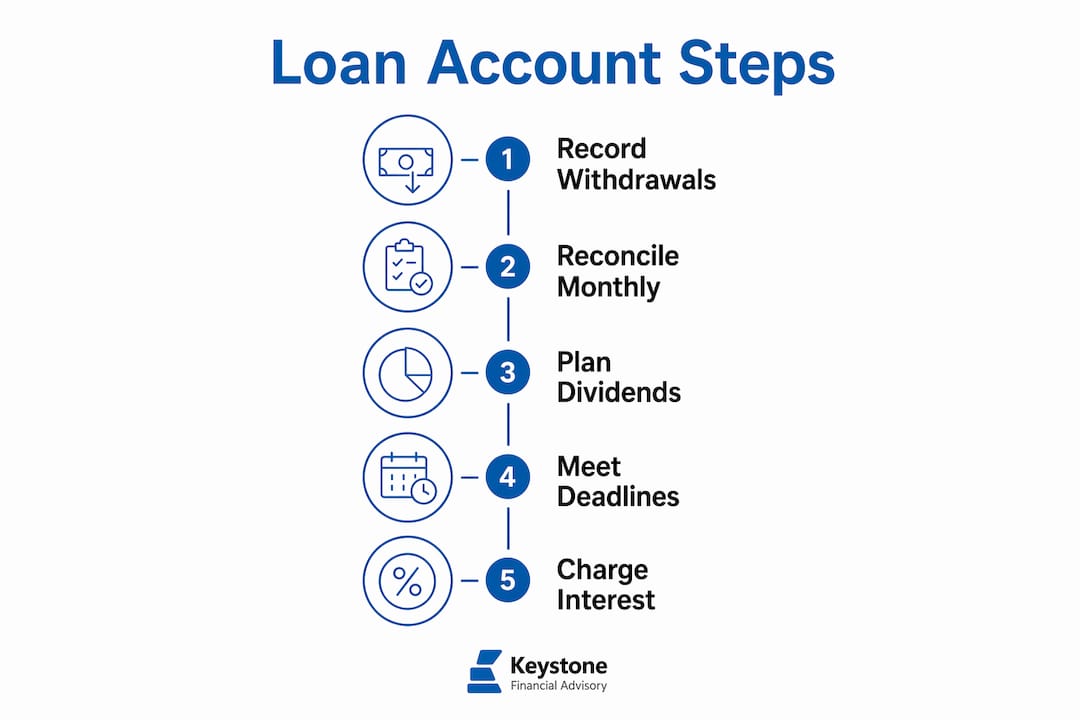
Monthly reconciliation of the director’s loan account, alongside dividend planning, is the single most effective habit directors can adopt. Reviewing the balance only at year-end leaves no time to act before the deadline passes.
Key takeaways

Overdrawn director’s loan accounts trigger both company-level Section 455 charges and personal benefit-in-kind liabilities, and the most costly mistakes are almost always avoidable with monthly monitoring and proper documentation.
Point | Details |
Section 455 rate rising | The charge increases to 35.75% for loans made on or after 6 april 2026, up from 33.75%. |
Nine-month deadline is fixed | Repay or offset the loan within nine months and one day of year-end to avoid the charge. |
Benefit-in-kind threshold | Loans above £10,000 below HMRC’s 3.75% official rate trigger P11D reporting and Class 1A NIC. |
Bed and breakfasting is blocked | HMRC’s 30-day and intention rules disallow artificial repayments followed by immediate re-borrowing. |
Documentation is non-negotiable | Board minutes and formal loan agreements are required evidence; informal arrangements invite reclassification. |
What I have seen go wrong in practice
The directors I work with most often are not reckless. They are busy. They draw cash when the business needs it, intend to sort it out later, and then find “later” is six weeks past the nine-month deadline. The Section 455 charge arrives as a genuine shock.
The pattern I see most frequently is the year-end rush. A director realises in january that their loan account is overdrawn, attempts a repayment, and then re-borrows in february to cover personal expenses. HMRC’s anti-avoidance rules make that repayment worthless for Section 455 purposes. The charge stands.
The second most common error is the informal write-off. A director tells their accountant to “just clear it” without understanding that the write-off becomes taxable income. I have seen directors face income tax bills they were not expecting, on money they had already spent. The compliance oversights that create these situations are rarely intentional, but HMRC does not distinguish between negligence and deliberate avoidance when applying penalties.
My advice is simple. Treat your director’s loan account like a bank overdraft with a fixed repayment date and a penalty clause. Review it monthly. Document every movement. If the balance is growing, act before the deadline, not after.
— Shoaib
How KeystoneFA supports directors with loan account compliance
Managing a director’s loan account correctly requires more than good intentions. It requires timely planning, accurate records, and a clear understanding of the 2026 tax changes affecting Section 455 rates and benefit-in-kind rules.
[

KeystoneFA works with UK company directors to review loan account balances, model repayment options, and prepare the correct HMRC filings before deadlines pass. The team has direct experience with HMRC enquiries into director’s loan accounts and knows precisely what documentation is required to defend a position. Whether you need a one-off review or ongoing monthly support, KeystoneFA provides expert accounting advice tailored to your company’s structure and tax position. Getting ahead of the problem is always less costly than resolving it after the charge has been raised.
FAQ
What is a director’s loan account?
A director’s loan account records all money a director takes from or puts into their company outside of salary and dividends. An overdrawn balance means the director owes money to the company.
When does Section 455 tax apply?
Section 455 tax applies when a director’s loan remains outstanding nine months and one day after the company’s accounting year-end. The rate is 33.75%, rising to 35.75% for loans made on or after 6 april 2026.
What triggers a benefit-in-kind charge on a director’s loan?
A benefit-in-kind charge arises when the loan balance exceeds £10,000 and interest is charged below HMRC’s official rate of 3.75% for 2025/26. The director pays income tax on the benefit and the company pays Class 1A National Insurance.
Can I repay a director’s loan and then re-borrow immediately?
No. HMRC’s anti-avoidance rules, including the 30-day rule and the intention rule, block this arrangement. Repayments followed by re-borrowing within 30 days, or where re-borrowing was always planned, are disregarded for Section 455 relief.
What happens if a director’s loan is written off?
Writing off a director’s loan is treated as a deemed dividend and becomes taxable income for the director under the Income Tax (Trading and Other Income) Act 2005. It may also attract National Insurance if the write-off is employment-related.
Recommended