Company car vs personal car: UK limited company guide

TL;DR:
For most UK company directors, using a personal car with HMRC mileage claims is simpler and more cost-effective. Company cars are financially advantageous only for high-mileage or electric vehicle users, due to lower BIK rates. Accurate mileage records are essential to prevent HMRC reclassification and penalties.
Choosing between a company car and a personal car is one of the most consequential tax decisions a UK limited company director makes. The right answer depends on three factors: your annual business mileage, the vehicle’s CO2 emissions, and how much administrative complexity you are willing to manage. For most directors driving fewer than 11,000 miles a year on business, a personal car with HMRC mileage claims wins on simplicity and cost. For higher-mileage directors, particularly those considering electric vehicles, a company car can deliver significant tax savings under HMRC’s Benefit-in-Kind rules.
How does company car vs personal car tax work for UK limited companies?
The core difference between a company car and a personal vehicle comes down to how HMRC taxes each arrangement. A company car is owned or leased by your limited company and made available for both business and private use. That private use triggers Benefit-in-Kind tax, known as BIK, which is calculated using the vehicle’s P11D list price and its CO2 emissions band. A personal car, by contrast, stays outside the company’s balance sheet entirely. You simply claim mileage allowance payments for business journeys.

For the 2026/27 tax year, electric vehicles attract a BIK rate of just 4%, while petrol and diesel company cars are taxed at rates between 17% and 37%. That gap is enormous. A director driving a £40,000 electric company car pays BIK tax on £1,600 of notional income. The same director in a £40,000 petrol car at a 30% BIK rate pays tax on £12,000. The difference in annual tax liability, at the 40% income tax band, is roughly £4,160 per year.
Employers also carry a cost that directors often overlook. Class 1A National Insurance at 15% applies to the full BIK value of every company car. On that £12,000 petrol BIK, the company pays £1,800 in employer NI alone. That cost sits on the company’s books regardless of how much the director actually uses the car for business.
Pro Tip: An employee or director can make a capital contribution of up to £5,000 towards the P11D price of a company car. This reduces the taxable BIK value proportionally and lowers the ongoing tax bill for both the director and the company.
When is a company car financially better than a personal vehicle?
Company cars become cost-competitive when annual business mileage exceeds roughly 11,000 to 15,000 miles for small limited companies. Below 10,000 miles, the administrative and tax costs of running a company car typically outweigh the benefits. That threshold exists because a company car’s costs are largely fixed: lease payments, insurance, and servicing are covered by the company regardless of how many miles you drive. At low mileage, those fixed costs per mile are high. At high mileage, they spread out and the economics shift.
A company car makes the strongest case when:
The vehicle is fully electric, capturing the 4% BIK rate and reducing both personal tax and employer NI.
Business mileage consistently exceeds 12,000 miles per year, making fixed costs efficient.
The company wants consistent branding or a standardised fleet across multiple directors or employees.
The director’s personal finances benefit from the company absorbing all vehicle running costs.
For petrol and diesel vehicles at moderate mileage, the numbers rarely favour a company car for a small limited company. The BIK rates of 17–37% create a substantial personal tax charge that erodes the benefit of having the company pay for the vehicle.
What are the advantages of using a personal car with HMRC mileage claims?
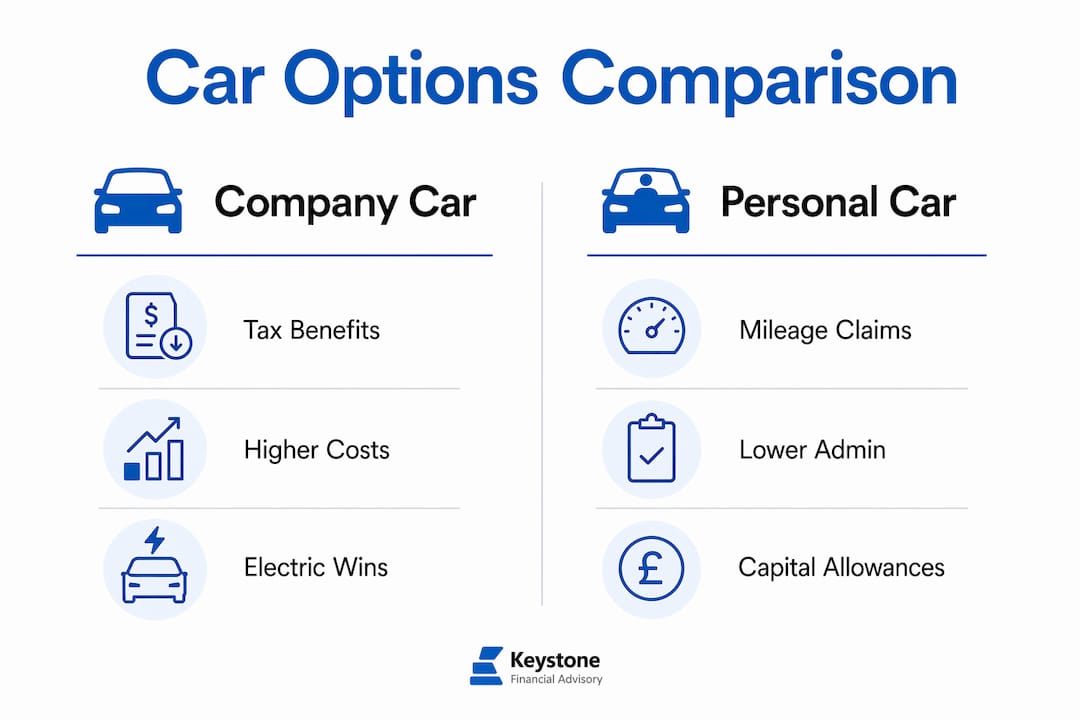
HMRC’s Approved Mileage Allowance Payments, known as AMAPs, allow directors to claim 55p per mile for the first 10,000 business miles each year, completely tax-free. Above 10,000 miles, the rate drops to 25p per mile. The company pays the mileage allowance as a business expense, deducting it from Corporation Tax. The director receives it tax-free. No BIK. No employer National Insurance. No fleet administration.
The personal car route suits most small limited companies because:
Administration is minimal. You log your business miles and submit a claim.
There is no BIK tax liability, regardless of the vehicle’s emissions or list price.
The company avoids Class 1A National Insurance contributions entirely.
Vehicle choice stays personal. You buy or finance the car you want without company involvement.
The main drawback is that the company cannot claim capital allowances on a personally owned vehicle. The director also bears all depreciation, insurance, and maintenance costs personally. At very high business mileage, the mileage rate may not fully cover the true running cost of an expensive or large-engined vehicle.
Accurate record-keeping is non-negotiable. HMRC scrutinises mileage claims without contemporaneous logs and will reclassify unsupported claims as taxable income. Commuting from home to your usual workplace does not count as business mileage, a distinction many directors get wrong.
Pro Tip: Keep a detailed mileage log recording the date, destination, purpose, and miles for every business journey. A simple spreadsheet or a mileage tracking app satisfies HMRC’s requirements and protects you in any enquiry.
How do running costs and administration affect the decision?
Running costs split very differently between the two arrangements. A company car means the limited company covers the lease or purchase finance, insurance, road tax, and servicing. Fuel for business journeys is reimbursed using HMRC Advisory Fuel Rates, with electric company cars using a separate Advisory Electric Rate. The director pays nothing out of pocket for the vehicle itself.
A personal car flips that model entirely. The director funds all vehicle costs personally. The company reimburses only the business mileage at the AMAP rate. That reimbursement is the company’s only vehicle-related expense.
The administrative difference is significant. Managing a company car requires:
Reporting the car to HMRC via a P46(Car) form when the benefit starts.
Including the BIK value on the director’s P11D each year.
Calculating and paying Class 1A National Insurance by 19 july each year.
Adjusting the director’s tax code through PAYE to collect income tax on the BIK.
A personal car with mileage claims requires only accurate mileage records and a straightforward expense claim. Accounting professionals favour personal vehicles for small and distributed teams precisely because the administrative overhead is so much lower. For a single-director limited company, the compliance burden of a company car scheme is rarely worth it unless the tax savings are clear and substantial.
The risk of getting it wrong is real. HMRC can reclassify mileage claims as taxable income if logs are incomplete or if personal journeys are included. That creates an unexpected tax bill and potential penalties. The only reliable defence is a contemporaneous mileage record that separates business from personal driving, kept at the time of each journey.
Key takeaways
For most UK limited company directors, the personal car with HMRC mileage claims is the simpler and more cost-effective choice unless business mileage is high or the vehicle is fully electric.
Point | Details |
Electric vehicles win on BIK | The 4% BIK rate for EVs in 2026/27 makes company car ownership genuinely tax-efficient for higher-mileage directors. |
Mileage threshold matters | Company cars become cost-competitive above roughly 11,000–15,000 annual business miles for small limited companies. |
Personal cars suit low mileage | The AMAP rate of 55p per mile is tax-free and avoids BIK and employer NI entirely below 10,000 miles. |
Administration costs are real | Company car schemes require P11D reporting, Class 1A NI payments, and PAYE adjustments that add compliance burden. |
Mileage logs are non-negotiable | HMRC will reclassify unsupported mileage claims as taxable income without a contemporaneous, detailed log. |
My honest view after advising UK directors on this
Most directors I work with assume a company car is the sophisticated, tax-efficient choice. The reality is more nuanced. For a director doing 6,000 business miles a year in a petrol car, a company car scheme creates more tax cost and more paperwork than it saves. The AMAP route is cleaner, cheaper, and far easier to manage.
Where I have seen company cars genuinely pay off is with fully electric vehicles and directors covering serious business mileage. A £45,000 electric car at 4% BIK is a different calculation entirely. The tax saving over three years can be substantial, particularly when you factor in the company absorbing all running costs.
The mistake I see most often is directors not keeping mileage logs. Commuting does not count. Client visits do. HMRC knows the difference, and so should you. A proper record of business expenses is the foundation of any vehicle claim, whether personal or company-owned.
My practical advice: if you drive fewer than 10,000 business miles a year and your vehicle is petrol or diesel, use the personal car route. If you are considering an electric vehicle and your mileage is high, model the numbers carefully with a tax adviser before committing. The right answer is always specific to your situation.
— Shoaib
How KeystoneFA helps directors make the right vehicle choice
Vehicle tax decisions sit at the intersection of personal tax, Corporation Tax, and HMRC compliance. Getting the calculation wrong costs money in either direction: too much BIK tax on a company car, or an unsupported mileage claim that HMRC rejects.
[
KeystoneFA works with UK limited company directors to model the real cost of both options, using your actual mileage, vehicle type, and tax position. The team has advised founders and growing businesses across the UK on tax-efficient vehicle decisions and the full range of director remuneration strategies. Whether you need a one-off review or ongoing tax planning support, you can book a consultation online and get a clear answer tailored to your company’s numbers.
FAQ
What is the BIK rate for electric company cars in 2026/27?
The Benefit-in-Kind rate for zero-emission electric vehicles is 4% for the 2026/27 tax year. This rate is scheduled to increase annually in subsequent years.
Is the HMRC mileage rate 55p per mile for all personal cars?
The AMAP rate is 55p per mile for the first 10,000 business miles in a personal car, dropping to 25p per mile above that threshold. Both rates are tax-free for the director.
Does commuting count as business mileage for tax purposes?
Commuting from home to your usual workplace does not count as business mileage under HMRC rules. Only journeys to temporary workplaces or client sites qualify.
When does a company car save more tax than mileage claims?
A company car typically saves more tax when annual business mileage exceeds 11,000–15,000 miles, or when the vehicle is fully electric and qualifies for the 4% BIK rate.
What records does HMRC require for mileage claims?
HMRC requires a contemporaneous mileage log recording the date, destination, business purpose, and miles for each journey. Claims without this evidence risk reclassification as taxable income.
Recommended