Stop Funding HMRC: Cash Accounting VAT Scheme for UK Businesses Under £1.35m

The VAT cash accounting scheme lets you pay HMRC output VAT only once a customer actually pays you, and reclaim input VAT only once you’ve paid your own suppliers. You can use it if your estimated taxable turnover is at or below the official eligibility threshold, and you must leave once turnover passes the regulatory exit limit. It usually helps businesses that invoice on credit and get paid late, but it slows down input VAT reclaims, so it isn’t automatically a win for everyone.
TL;DR:
The scheme benefits businesses with slow-paying clients by delaying VAT payments until cash is received but can increase cash flow gaps if suppliers are paid faster than customers pay.
Eligibility requires a VAT taxable turnover below £1.35 million for entry and less than £1.6 million for exit, with no recent VAT offenses or recent use of the Flat Rate Scheme.
Certain transactions, such as long-term payment plans or advance invoices, are outside the scheme, requiring separate bookkeeping on standard invoice basis.
Proper record-keeping must link payments to specific invoices, as HMRC expects clear, weekly cross-referencing to avoid reconciliation issues.
The scheme is best suited for net VAT payers dealing with credit sales, but it may backfire for import-heavy or reclaim-reliant businesses because of delayed input VAT claims.
Table of Contents
How the cash accounting VAT scheme works in practice
Standard VAT accounting, the invoice basis, taxes you on the value of an invoice the moment it’s raised, whether or not the customer has paid. The cash accounting scheme changes that timing entirely: you account for output VAT when payment lands in your account, and you reclaim input VAT only once you’ve paid your supplier. HMRC sets this out in VAT Notice 731, which governs the scheme’s mechanics.
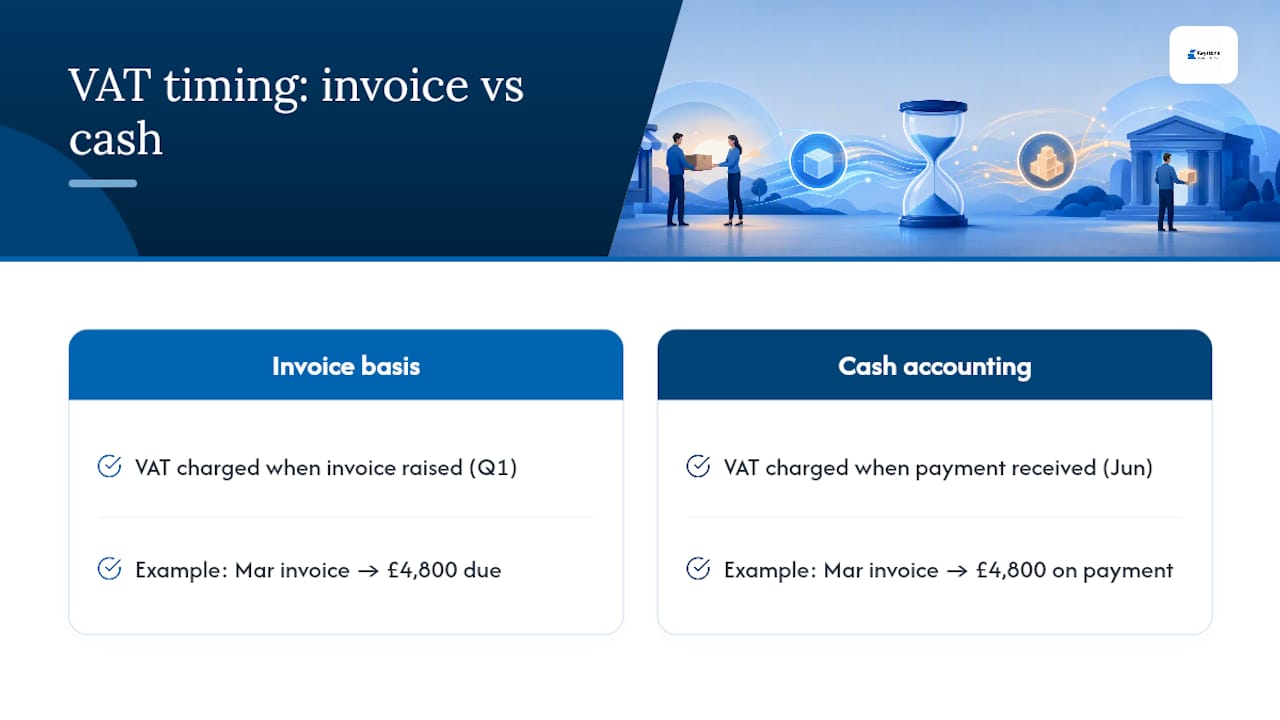
Picture a quarter where you invoice a client £24,000 plus VAT in March but the payment doesn’t arrive until June. Under invoice accounting, you’d owe £4,800 in VAT to HMRC for the quarter in which you raised the invoice, cash or no cash. Under cash accounting, that £4,800 liability doesn’t exist until the money actually hits your account, in the following quarter. For a business with a few slow payers, that gap can be the difference between a comfortable VAT bill and a scramble to cover it from a business loan or overdraft.
There’s a built-in safety net here too. If a customer never pays at all, you never owe the VAT on that invoice in the first place, giving you automatic protection against bad debts without the separate bad debt relief claim that invoice-basis businesses have to file. The trade-off runs the other way on purchases: you can’t reclaim input VAT the moment a supplier’s invoice lands, only once you’ve settled it, so if you pay your bills promptly but your customers pay slowly, the scheme can widen rather than close your cashflow gap.
Who can use the cash accounting scheme?
HMRC sets clear entry conditions, and it’s worth checking all of them before you switch, not just the turnover figure most guides quote.
Your estimated VAT taxable turnover for the next 12 months must be £1.35 million or less, excluding VAT itself.
You must already be VAT registered, with no outstanding VAT returns or payments owed to HMRC.
You must not have committed a VAT offence in the last 12 months, such as a penalty for evasion.
You cannot already be using the Flat Rate Scheme, since the two are mutually exclusive.
The forced exit threshold sits higher, at £1.6 million of annual taxable supplies, again excluding VAT. That gap between the £1.35 million entry ceiling and the £1.6 million exit ceiling is deliberate: it stops businesses hovering near the border from bouncing in and out of the scheme every quarter, according to GOV.UK’s eligibility guidance.
In practice, estimating your taxable turnover means looking forward, not back. Take your last twelve months of sales, adjust for any known changes, such as a new contract, a lost client, or a seasonal spike, and check the resulting figure sits comfortably under £1.35 million. If you’re close to the line, revisit the calculation every quarter rather than assuming last year’s numbers still apply. HMRC’s internal manual entry VCAS2050 confirms these are the statutory conditions for entry, and the same reference explains when HMRC can withdraw your right to use the scheme if your circumstances change.
Starting and leaving the scheme without tripping up
Switching in or out of cash accounting is simpler on paper than it sometimes proves in practice. Follow this sequence to avoid the most common mistakes.
Confirm eligibility first. Check your turnover estimate, outstanding returns, and any recent VAT offences against the conditions above.
Start at the beginning of your next VAT accounting period. There’s no separate application to HMRC. You simply begin applying cash accounting rules from that date, as confirmed in GOV.UK’s guidance on joining or leaving.
Ring-fence invoices raised before the switch. Any sale already accounted for under the invoice basis must not be taxed again under cash accounting when payment arrives. Tag these transactions clearly in your bookkeeping software so payments against old invoices don’t get pulled into the new cash basis by mistake.
Watch your turnover if you’re near £1.6 million. Once your taxable supplies exceed that figure, you must leave the scheme.
Report outstanding VAT correctly on exit. If your turnover exceeded £1.35 million in the last three months when you leave, you must account for and pay VAT on unpaid invoices straight away. Otherwise, HMRC typically allows you to spread the reporting of outstanding VAT over six months.
Getting step three wrong is the single most common error accountants see during a changeover, and it’s entirely preventable with a short checklist run before the first VAT return under the new method.
Transactions the cash accounting scheme can’t cover
Not every sale qualifies, even once you’re properly enrolled. A handful of transaction types sit outside the scheme by design, mainly because HMRC needs certainty on timing that a cash basis can’t guarantee.
Supplies with payment terms of six months or longer are excluded, since the delay defeats the point of matching VAT to cash flow.
VAT invoices raised in advance of the goods or services being supplied don’t qualify.
Hire purchase, conditional sale, and credit sale agreements fall outside the scheme.
Imports and goods moved out of customs warehousing, along with certain reverse-charge supplies, are excluded too.
If part of your business regularly deals in these excluded categories, you’ll need to run that segment on the standard invoice basis while the rest of your trading uses cash accounting, so your bookkeeping has to distinguish between the two from day one.
Bookkeeping rules that keep your VAT return accurate
Cash accounting only works cleanly if your record-keeping tracks payments against the right invoices, not just against a bank statement total. HMRC expects a clear audit trail linking each payment to the invoice it settles, and VAT Notice 731 is explicit that records must cross-reference the two.
A few allocation rules matter more than they first appear:
When a customer part-pays an invoice, you account for VAT on the proportion of the payment received, not the full invoice value.
Mixed-rate invoices, say, a bundle including both standard-rated and zero-rated items, need the payment split proportionately across those rates.
Card payments count as received on the date the sales voucher is created, not when the funds clear in your account, under the relevant VAT tertiary legislation.
If a cheque bounces, you don’t need to account for the VAT on that payment at all, since it was never actually received.
Payments collected by an agent or factoring company on your behalf still count as received by you on the date the agent gets the money, not when they forward it.
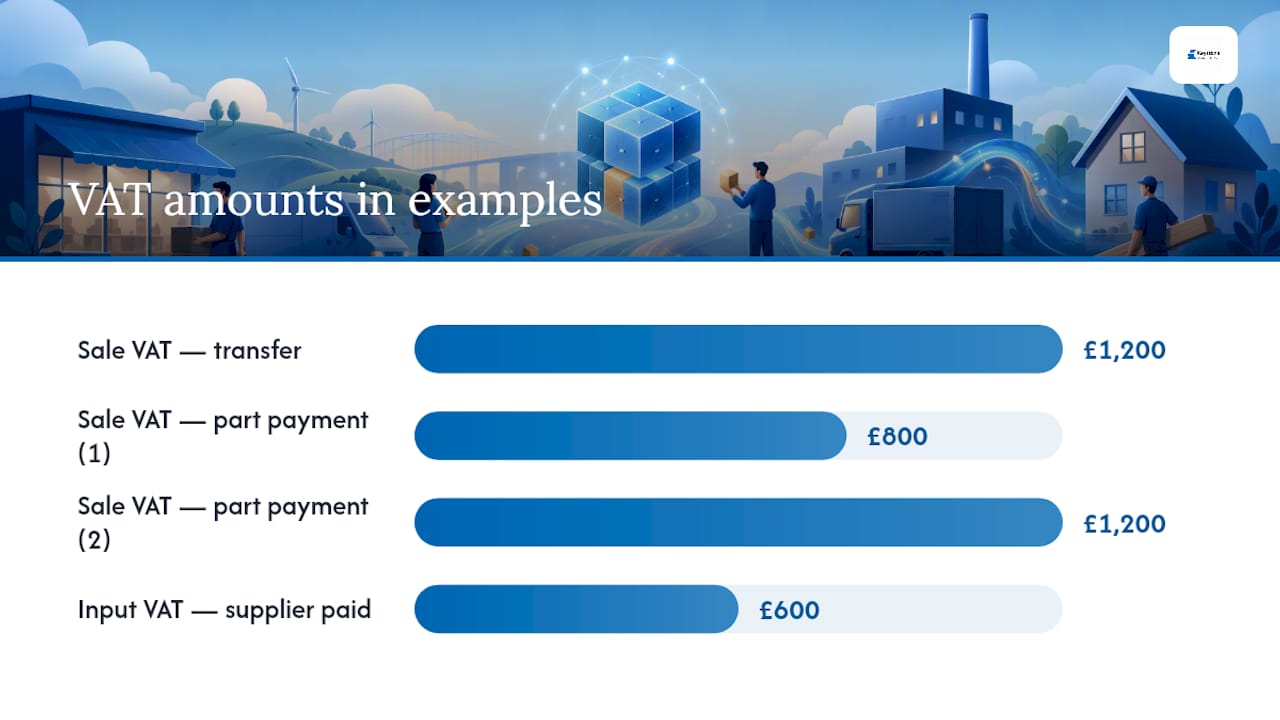
Here’s how that plays out across three common scenarios. First, a £6,000 plus VAT invoice paid in full by bank transfer: you account for the full £1,200 VAT in the quarter the transfer clears. Second, a £10,000 plus VAT invoice where the customer pays £4,000 upfront and the rest a quarter later: you declare £800 VAT in the first quarter and the remaining £1,200 in the next. Third, a supplier invoice for £3,000 plus VAT that you pay six weeks after receiving it: you can’t reclaim that £600 input VAT until the payment actually leaves your account, not when the invoice arrived.
Pro Tip: Set up your bookkeeping software to tag transactions by payment date rather than invoice date before your first cash-accounting VAT return. Retrofitting this after a quarter has closed is far more time-consuming than configuring it correctly from the start, and it’s the single change that prevents most reconciliation headaches.
Who gains the most, and where it can backfire
The scheme tends to suit businesses that sell on credit terms and are usually net VAT payers, meaning they collect more VAT than they reclaim in a typical quarter. A consultancy invoicing clients thirty or sixty days out, or a trades business waiting on staged payments, fits this pattern well: cash accounting means you’re never funding VAT on money you haven’t yet been paid.
It works less well for firms that are frequently in a VAT repayment position, reclaiming more than they charge, often because they’re capital-intensive or heavily import-reliant. If you’re regularly owed money by HMRC rather than owing it, delaying your input VAT reclaims until you’ve paid suppliers can actually starve your cashflow rather than protect it. According to the Small Business Commissioner, the benefit depends heavily on your specific invoice and payment patterns, not on business size or sector alone.
There’s also an administrative cost to weigh. Cash accounting demands closer tracking of payment dates against invoices than the invoice basis does, and mixed transaction types add complexity your bookkeeper needs to manage properly. For a business with a handful of large, slow-paying clients, that extra admin is a fair trade for the cashflow protection. For a business with many small, prompt-paying customers and no real late-payment problem, it may just be extra work for very little benefit.
Getting your VAT return right under cash accounting
The return itself doesn’t change shape, but the figures behind each box do. Box 1 output tax and Box 4 input tax now reflect payments received and paid, exclusive of VAT, rather than invoices raised and received. Box 6 and Box 7, your net sales and purchase values, follow the same cash-basis logic.
The most frequent reconciliation error accountants see is a business pulling invoice totals straight from its accounting software without checking which invoices actually had cash movement in the period. Software configured for invoice accounting by default will overstate your VAT liability if nobody’s adjusted the settings, so it’s worth confirming your system is genuinely reporting on a cash basis before you file.
HMRC expects you to retain records showing the date, amount, and invoice reference for every payment received or made, alongside your usual VAT records, for at least six years. Keeping a simple running log that cross-references bank transactions to invoice numbers, updated weekly rather than reconstructed at quarter-end, makes both your VAT return and any future HMRC check far less stressful.
Keystone’s view: when we recommend cash accounting
The cash accounting VAT scheme is often suitable for founders and growing SMEs who invoice on credit terms and regularly wait thirty, sixty, or ninety days to get paid. For businesses in that position, the cashflow protection can outweigh the extra admin. Caution is advised for businesses that import heavily or frequently claim input VAT refunds, where the scheme may be less beneficial.
Where a switch makes sense, support is available to assist with the transition, including setting up bookkeeping software correctly from day one, handling VAT filing under the new rules, running compliance checks before the first return is filed, and managing the changeover so pre-switch invoices are not double-counted.
— Shoaib
How KeystoneFA can help you switch with confidence
Working out whether cash accounting genuinely helps your cashflow, and then setting it up correctly in your bookkeeping software, is where most small businesses lose time or make costly errors. KeystoneFA handles both: VAT filing, day-to-day bookkeeping, and compliance reviews, all delivered by a small team rather than passed between departments at a larger firm.
[
](www.keystonefa.co.uk)
If you’re unsure whether your turnover pattern actually benefits from cash accounting, or you want the changeover done without the risk of double-accounting pre-switch invoices, that’s exactly the kind of diagnostic work our Flexible Accounting Services cover, priced from £99 to £199 a month depending on what your business needs. For businesses still working out their VAT registration position before any of this becomes relevant, our guide to UK VAT registration is a useful starting point. Get in touch through Keystonefa to book a review of your VAT position and find out whether the switch is worth making this quarter.
Primary sources and official guidance to consult
For the exact statutory wording behind everything covered here, go straight to the primary sources rather than relying on secondary summaries.
Gov, for entry and exit thresholds.
VAT Notice 731, for the full technical rules on timing and record-keeping.
HMRC internal manual, VCAS2050, for the statutory basis of entry conditions.
Small Business Commissioner commentary, for a practitioner’s read on real-world cashflow impact.
This article is general information, not a substitute for advice from a qualified financial advisor. Consult a qualified financial professional about your own circumstances before acting on anything here.
Sources
FAQ
What are the four main VAT accounting schemes?
UK businesses typically choose between standard invoice accounting, the cash accounting scheme, the Flat Rate Scheme, and Annual Accounting. You can’t combine cash accounting with the Flat Rate Scheme, and Annual Accounting changes your filing frequency rather than your VAT timing basis, so the two solve different problems.
What’s the difference between cash and accrual VAT accounting?
Accrual, or invoice, accounting taxes you the moment an invoice is raised, regardless of payment. Cash accounting taxes you only once payment is actually received or made, which is why it suits businesses dealing with slow-paying customers.
How do I reconcile VAT under the cash accounting scheme?
Reconciliation means cross-referencing every payment received or made against its original invoice, splitting part-payments and mixed-rate invoices proportionately. HMRC expects this audit trail as standard, as set out in VAT Notice 731, and keeping it updated weekly avoids a difficult reconstruction job at quarter-end.
How do I account for VAT on the cash receipts basis?
You declare output VAT in the period you actually receive customer payment, and reclaim input VAT in the period you actually pay your supplier, both exclusive of VAT. Card payments count as received on the date the sales voucher is raised, and a bounced cheque means no VAT is due at all.
Does KeystoneFA help businesses switch to cash accounting?
Yes. KeystoneFA supports the full transition, including bookkeeping software setup, VAT filing, and compliance checks, through its Flexible Accounting Services, priced from £99 to £199 a month.
Recommended