UK Directors: Limit Companies House Late Filing Penalties £150–£1,500

Companies House fines private companies between £150 and £1,500 for late accounts, doubling the charge for a second consecutive late year, with no discretion to waive it. Beyond the fine, persistent non-filing under the Companies Act 2006 can trigger prosecution, personal liability, and director disqualification. The only real exception is a company’s first set of accounts, where deadlines differ.
TL;DR:
If your company files even one day late, you are automatically subject to a fine of at least £150, with penalties increasing up to £1,500 for delays over six months.
Repeated late filings within consecutive years result in penalties doubling, so a second offense can raise a £375 fine to £750, or a £750 delay to £1,500.
First accounts give a maximum of 21 months from incorporation or three months after the reference date to file, often confusing new directors about accurate deadlines.
Ignoring notices or attempting late submissions can lead to prosecution, disqualification, or even strike-off, especially if non-filing persists over multiple periods.
Paying penalties early, filing online, and setting calendar reminders can significantly lower the risk of repeated late filings and associated legal consequences.
Table of Contents
Companies house late filing penalties: bands and real examples
Companies House applies a fixed scale to every private limited company that misses its filing deadline, and it doesn’t care why. The system is automated, so the penalty lands the moment the deadline passes, calculated from how late the accounts actually arrive.
For private companies, the bands run as follows:
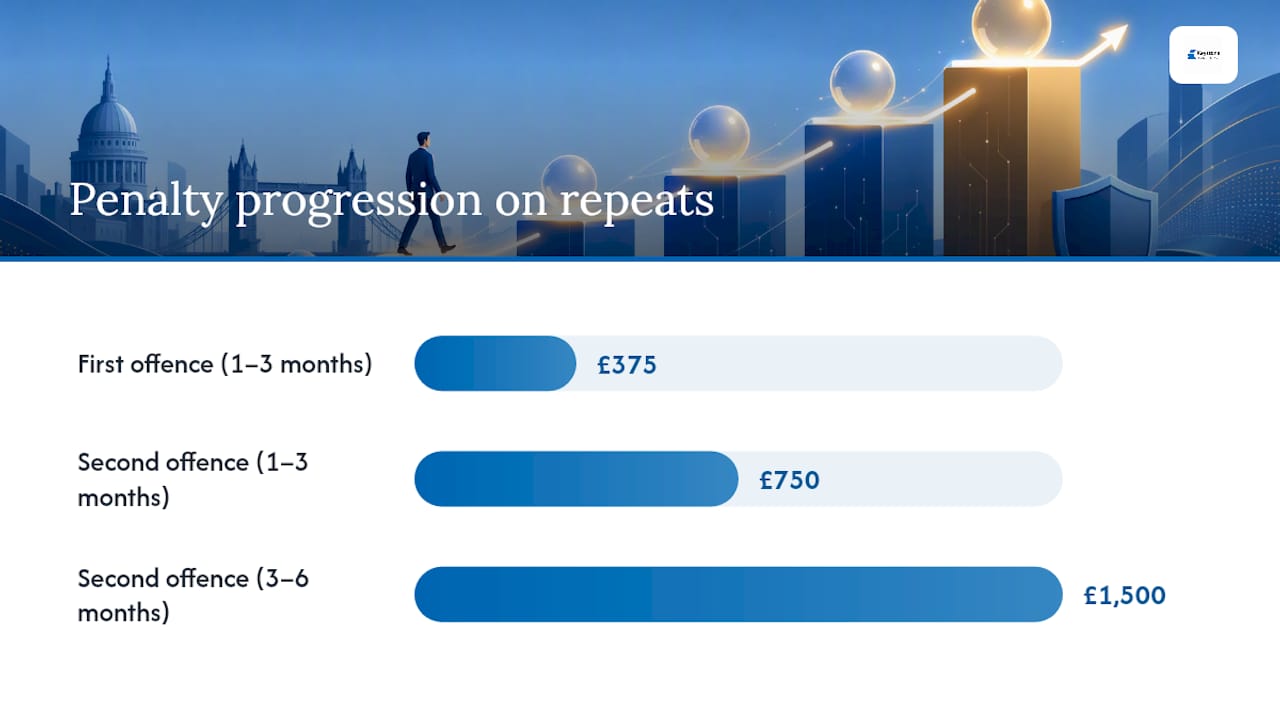
Up to 1 month late: £150
1 to 3 months late: £375
3 to 6 months late: £750
More than 6 months late: £1,500
Pro Tip: If you file even a single day late, you’re already in the first band. There’s no rounding down and no leeway for a weekend or bank holiday deadline.
Public companies face steeper bands, reaching several thousand pounds for the worst delays, reflecting their heavier reporting duties.
The doubling rule is where directors get caught out. If your company filed late last year and files late again this year, the penalty for the second offence doubles automatically. A company that was £375 late last year and repeats a 1 to 3 month delay this year pays £750, not £375. A company that drifts into the 3 to 6 month band for a second time faces £1,500 instead of £750. Companies House measures every day from the statutory due date, not from when you remembered.
When are your accounts actually due?
Confusion about deadlines is the single biggest cause of accidental late filing, particularly for new companies working through their first financial year.
First accounts carry their own rule: you generally have 21 months from the date of incorporation to file, or 3 months from your accounting reference date, whichever gives you longer. This dual calculation catches out founders who assume every company gets a flat 9-month window from day one.
After that first filing, the standard deadlines are:
Private limited companies: 9 months after the end of the accounting reference period
Public limited companies: 6 months after the end of the accounting reference period
Rejection matters as much as timing. If Companies House rejects your submission, perhaps for an unsigned balance sheet or a formatting error, the clock doesn’t stop. You’re still late if the corrected version arrives after the deadline, even if your first attempt was on time.
What happens if you never file at all?
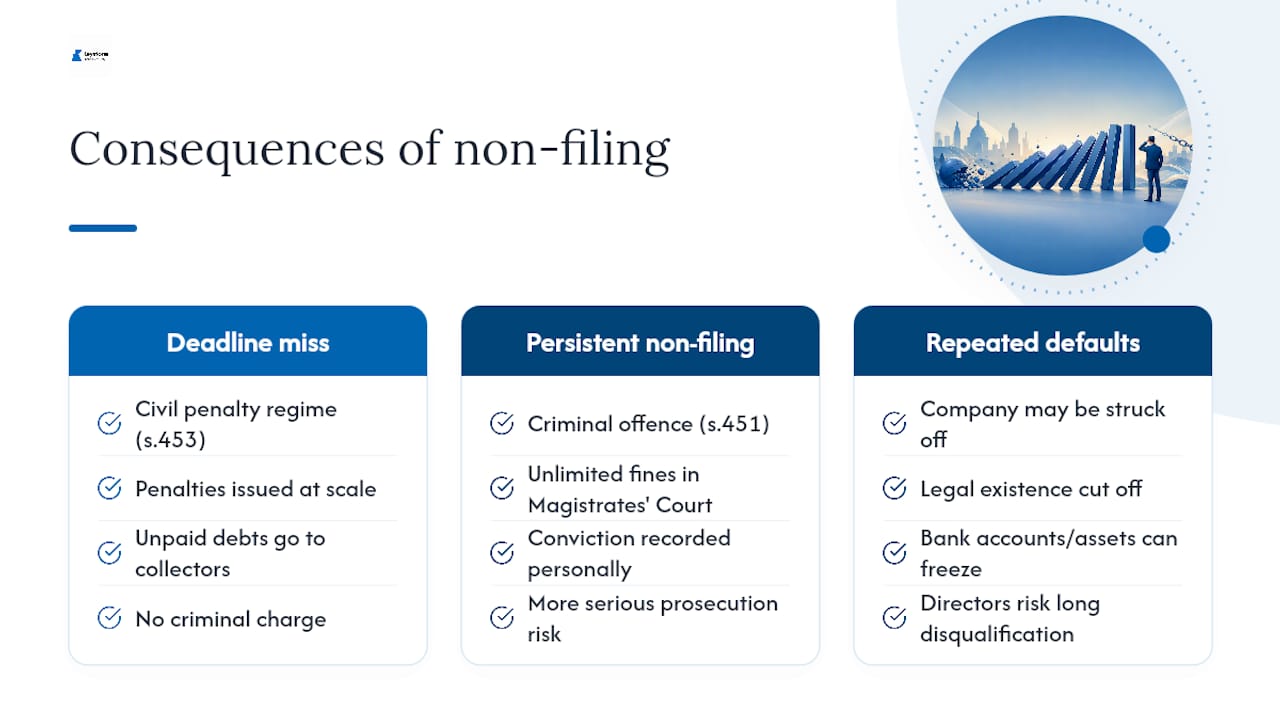
A missed deadline is a civil penalty problem. Persistent non-filing is a criminal one, and that distinction changes everything about how seriously you should treat a filing notice.
Section 451 of the Companies Act 2006 makes failing to file accounts a criminal offence, and section 453 sets out the civil penalty regime that runs alongside it. Directors prosecuted under these provisions can face unlimited fines in the Magistrates’ Court, and the conviction sits against them personally, not just against the company.
Repeated defaults escalate further. Companies House can move to strike the company off the register entirely, which cuts off its legal existence and can freeze its bank accounts and assets. Directors who rack up repeated convictions for filing failures risk disqualification, sometimes for years, which bars them from running any UK company during that period.
The scale of enforcement is not trivial: Companies House issued close to 300,000 penalties worth over £157 million in a single recent year. Unpaid penalties don’t simply disappear either. Companies House can pass the debt to collection agents, who pursue it like any other commercial debt.
How do you actually pay a penalty?
Once a penalty notice lands, you have clear options and a limited window to act.
Check the notice details first. Confirm your company number, the accounting reference period, and the amount charged match your own records before doing anything else.
Pay through the method that suits you. You can pay online for penalties issued from 30 March 2020 onwards, transfer by BACS quoting your company number as the reference, or in limited cases pay by cheque.
Contact Companies House if you need time. Instalment arrangements exist for companies that can’t clear the full amount immediately, but you need to request this before the debt is passed to collectors.
Ignore the notice and the debt escalates to a collections agency, which adds pressure and cost you avoid entirely by acting within the first few weeks.
Can you appeal a Companies House penalty?
You get one appeal per penalty, submitted through the online appeal form, and you need to make it count.
Successful appeals hinge on genuinely exceptional circumstances outside your control, not administrative oversight. Grounds that tend to work include:
Serious illness or death of the person responsible for filing, supported by evidence
A fire, flood, or IT failure that destroyed records shortly before the deadline
Postal or courier failures you can document, though this carries less weight since online filing removed most postal risk
Grounds that almost never work: forgetting the deadline, an accountant’s error, cash flow problems, or “we didn’t know.” Companies House and appeal adjudicators uphold only a small fraction of appeals submitted, so treat an appeal as a last resort rather than a routine escape route.
How to avoid a late filing penalty going forward
Prevention costs almost nothing. Recovery after the fact costs money, time, and sometimes your standing as a director.
Set your accounting reference date reminder the day accounts are filed, not the week before the next deadline.
Register for Companies House email alerts, which flag your upcoming deadline automatically.
File online rather than by post. Online filing confirms acceptance immediately, so you know straight away if something needs fixing.
Keep your bookkeeping current year-round, not just in the final weeks before the deadline, so accounts preparation isn’t a scramble.
If you’re already late, file the corrected accounts immediately, decide whether appealing is realistic given the grounds above, and gather any evidence now before memories or paperwork fade. A statutory accounts preparation guide can help you spot the errors that most often cause rejection.
Pro Tip: If you’ve delegated filing to a bookkeeper or accountant, ask them directly when the next deadline falls. The legal duty stays with you as a director regardless of who prepares the paperwork.
Bring in a compliance-focused accountant when your company has missed a deadline before, when you’re unsure which accounting reference date applies after a company restructure, or when you simply want someone checking the calendar so you don’t have to.
Keystone’s perspective: what actually reduces the risk
Directors rarely miss deadlines through carelessness. They miss them because bookkeeping falls behind during a busy quarter, and accounts preparation becomes a scramble against a date nobody flagged early enough.
At KeystoneFA, we build filing deadlines into ongoing bookkeeping rather than treating them as a once-a-year fire drill. That means digital tools that track your accounting reference date automatically, specialist review before submission catches the errors that cause rejections, and proactive reminders that arrive weeks before the deadline, not the night before. Persistent late filing carries real legal weight for directors personally, and the fix is rarely more effort. It’s usually just earlier visibility.
If you want a clear picture of where your filings stand, ask us for a compliance health check.
— Shoaib
Reduce your filing risk before the next deadline
Missing a deadline once is a fine. Missing it twice is a doubled fine, a note on your public record, and a harder conversation with lenders or investors who check Companies House before they check anything else. KeystoneFA is the alternative to scrambling every year end: our team handles day-to-day bookkeeping, accounts preparation, and Companies House compliance as part of ongoing support, so deadlines get tracked before they become penalties, not after.
[

](www.keystonefa.co.uk)
Plans are available with monthly fees scaled to the level of support a business needs, whether for bookkeeping alone or full compliance and tax planning. If you’ve had a close call with a deadline this year, or you simply want one less thing on your plate, get in touch through the KeystoneFA website and ask about a compliance health check before your next accounts are due.
Where this guidance comes from
This guide draws on official Companies House and legislative sources so you can verify the detail yourself:
Prepare annual accounts for a private limited company — penalty bands and doubling rule
Late filing penalties — deadlines and automatic penalty system
Pay a penalty to Companies House — payment methods
Companies Act 2006, section 453 — statutory basis for civil penalties
Appeal a penalty for filing your company accounts late — appeal process and grounds
This article is general information, not a substitute for advice from a qualified financial advisor. Consult a qualified financial professional about your own circumstances before acting on anything here.
Sources
FAQ
What are the penalties for late filing accounts in the UK?
Private companies face £150 for up to a month late, rising to £375, £750, and £1,500 for delays beyond six months, with penalties doubling for a second consecutive late year.
What happens if my company’s accounts are overdue at Companies House?
A penalty is issued automatically the day after the deadline passes, and continued non-filing can lead to strike-off, prosecution, or director disqualification.
How do I pay a penalty to Companies House for late filing?
You can pay online for penalties issued from 30 March 2020, by BACS quoting your company number, or by cheque in limited circumstances, and you can request instalments if needed.
What is the penalty for late filing of a confirmation statement?
Late filing penalties under this scale apply specifically to annual accounts; a missed confirmation statement doesn’t carry the same fixed fine but can instead lead directly to strike-off action against the company.
Can KeystoneFA help if I’ve already received a penalty notice?
Yes. KeystoneFA reviews your filing history, helps you decide whether to pay or appeal, and puts ongoing compliance support in place to prevent a repeat penalty.
Recommended