Save up to £10,500 with Employment Allowance for small employers

Employment Allowance lets eligible employers cut their annual employer Class 1 National Insurance bill by up to £10,500 for the 2026/27 tax year. It applies automatically against each pay run once you claim it, right up until you hit the cap or the tax year ends. The catch: you have to actively claim it every single year. It doesn’t roll over from the last one.
TL;DR:
Employers with multiple payroll schemes or connected companies must decide strategically which entity claims Employment Allowance to maximize savings, as only one claim per group is permitted.
The allowance does not automatically update; employers must actively submit or update their claim each tax year through relevant payroll submissions to avoid losing potential benefits.
The £10,500 cap for 2026/27 applies regardless of increases in employer NIC liability, and any remaining allowance cannot be carried forward to future years.
Claiming the allowance effectively reduces employer NIC liabilities as shown on HMRC accounts but does not result in direct cash payments or refunds.
The removal of the £100,000 NIC bill threshold in April 2025 widened eligibility, allowing more growing businesses to qualify for the allowance if they previously exceeded the old limit.
Table of Contents
What does Employment Allowance actually cover?
Employment Allowance only reduces employer Class 1 National Insurance contributions, the secondary NICs you pay on top of your staff’s wages once earnings cross the secondary threshold. It doesn’t touch Class 1A NICs (paid on benefits in kind) or Class 1B NICs (linked to PAYE Settlement Agreements). If your business runs a benefits scheme or a PSA, that liability sits outside the allowance entirely and still needs settling separately.
The mechanics are straightforward once you’ve claimed. Your payroll software automatically offsets a portion of your employer NIC liability against the allowance on every pay run, whether that’s weekly, fortnightly, or monthly, until either the £10,500 cap is used up or the tax year finishes, whichever comes first.
A few practical points worth knowing:
It’s not a cheque or a refund landing in your account. It reduces what you owe HMRC through PAYE, so the benefit shows up as lower liabilities rather than incoming cash.
You can check exactly how much of the allowance you’ve used, and what’s left, through your HMRC online account, which tracks the running total against your Employer Payment Summary submissions.
If your total employer NIC bill for the year is below £10,500, you simply won’t use the full allowance. It doesn’t carry forward.
Get this wrong and you either overclaim (and have to correct it) or leave money on the table because nobody checked the running total against actual liability.
Who qualifies for Employment Allowance?
Most small and medium employers qualify, but the exclusions catch people out more often than the eligibility rules do. Since April 2025, the previous £100,000 employer NIC threshold that used to bar larger employers from claiming has been removed, which widened access considerably for businesses that had grown past that old ceiling.
You can claim if you’re:
A limited company, sole trader, or partnership with employees on payroll
A registered charity
A community amateur sports club
An employer of care or support workers, even in a domestic household setting
You cannot claim if:
You’re a public body carrying out mostly public functions (local councils, NHS bodies, and similar)
Your company has only one employee paid above the secondary threshold, and that employee is also a director. Single director companies are explicitly excluded under this rule
You employ someone for personal, household, or domestic work, unless that person is a care or support worker
Certain deemed payments under IR35 or service company rules apply to your only employee
One detail that trips up a lot of directors: if a second employee joins partway through the year and starts earning above the threshold, the single director exclusion may no longer apply from that point. Timing matters here, and it’s worth flagging to whoever runs your payroll the moment your headcount changes.
There’s also a de minimis state aid check for employers operating in sectors like agriculture, fisheries, or road freight, where allowance amounts count against state aid limits. Most standard small businesses never bump into this, but it’s worth a quick check if you operate in one of those industries.
How do I claim Employment Allowance from HMRC?
Claiming isn’t complicated, but it does require an active step. Nothing happens automatically.
Confirm eligibility first. Run through the checklist above before you touch payroll software, since claiming when you’re excluded (most commonly the single director trap) creates a correction headache later.
Submit an Employer Payment Summary (EPS). Most payroll software includes a simple toggle for this. Set the Employment Allowance indicator to ‘Yes’ and submit the EPS to HMRC as part of your normal RTI reporting.
No payroll software? Use HMRC’s Basic PAYE Tools, which is free and built for exactly this scenario, or file a paper RT5 form in the rare cases where that’s necessary.
Watch the RTI submissions. Once the indicator is set, your allowance should start reducing employer NIC automatically from the next pay run. Check an early payslip or your HMRC online account to confirm it’s actually applying.
Backdate if you missed it. You can claim for up to four previous tax years if you were eligible but never claimed, though the rules and caps that applied in those earlier years still govern what you can recover.
Pro Tip: Set a calendar reminder for the first week of every tax year to check the Employment Allowance indicator on your EPS. HMRC’s own guidance is blunt about this: the allowance is never applied by default, and a huge number of eligible employers simply forget to reactivate the claim after a payroll system change or a new accountant takes over.
What happens with connected companies and multiple payrolls?
Group structures and multi-payroll businesses need to make a genuine decision here, not just default to whichever entity happens to run payroll first.
Connected companies get one claim between them. If your business is connected to another company (shared control, common ownership, or similar), only one of you can claim the allowance. Splitting it or double claiming across connected entities isn’t permitted.
Choosing which entity claims is a real strategic decision. The company with the higher employer NIC liability generally extracts more value from the £10,500 cap, so it’s worth modelling actual payroll costs across the group before defaulting to the parent company or the oldest PAYE scheme.
Multiple payrolls, same employer, one claim. If you run more than one PAYE scheme within a single business (common with separate divisions or regional payrolls), you can only apply Employment Allowance against one of them.
Stopping a claim mid-year is possible. If your circumstances change (you become a single director company, for instance, or you’re acquired by a connected group already claiming), you need to switch the EPS indicator to ‘No’ and stop applying the allowance from that point.
Get the connected company decision wrong and HMRC will eventually query it, usually after both entities have already banked the saving.
Worked example and where employers go wrong
A small limited company running five staff, with a combined employer NIC liability of roughly £11,000 across the tax year, can offset the full £10,500 allowance against that bill, cutting the actual NIC payment down to around £500. For a business that size, that’s a genuinely material saving, often enough to cover a chunk of a bookkeeping subscription or an extra month of software costs.
The pitfalls we see most often at KeystoneFA aren’t complicated, they’re just easy to miss:
Employers assume the allowance applies automatically because they claimed it last year. It doesn’t roll forward. Every tax year needs its own active EPS submission with the indicator set to ‘Yes’, and skipping that step means paying full employer NIC with no allowance at all.
Other recurring errors: claiming against the wrong payroll in a multi-scheme business, overlooking a connected company that’s already claimed, and not revisiting eligibility when a company drops to a single paid director partway through the year.
Pro Tip: If your group structure changed in the last four years, or you’re not certain the right entity claimed, get a proper review done before you assume you’ve missed the boat. Backdated claims are genuinely recoverable.
Does Employment Allowance interact with other NICs reliefs?
Yes, and the order of operations matters more than most employers realise. Employment Allowance sits alongside several other NICs reliefs rather than replacing them, and the interaction usually works in the employer’s favour if it’s set up correctly.
Employer NIC holidays for hiring veterans, apprentices under 25, and employees under 21, for example, reduce the secondary threshold liability first. Employment Allowance then applies against whatever employer NIC liability remains after those specific reliefs have already reduced it. In practice, a business that qualifies for both an under 21 NIC exemption and Employment Allowance could end up with a very small residual employer NIC bill, or none at all, depending on headcount and pay levels.
Freeport and Investment Zone employer NIC reliefs work on a similar principle: they reduce liability on eligible employees first, and Employment Allowance then mops up what’s left across the rest of the workforce. The reliefs aren’t mutually exclusive, but claiming them in the wrong sequence in your payroll software can produce an inaccurate running total, which is usually where confusion creeps in when an employer reviews their HMRC account mid year.
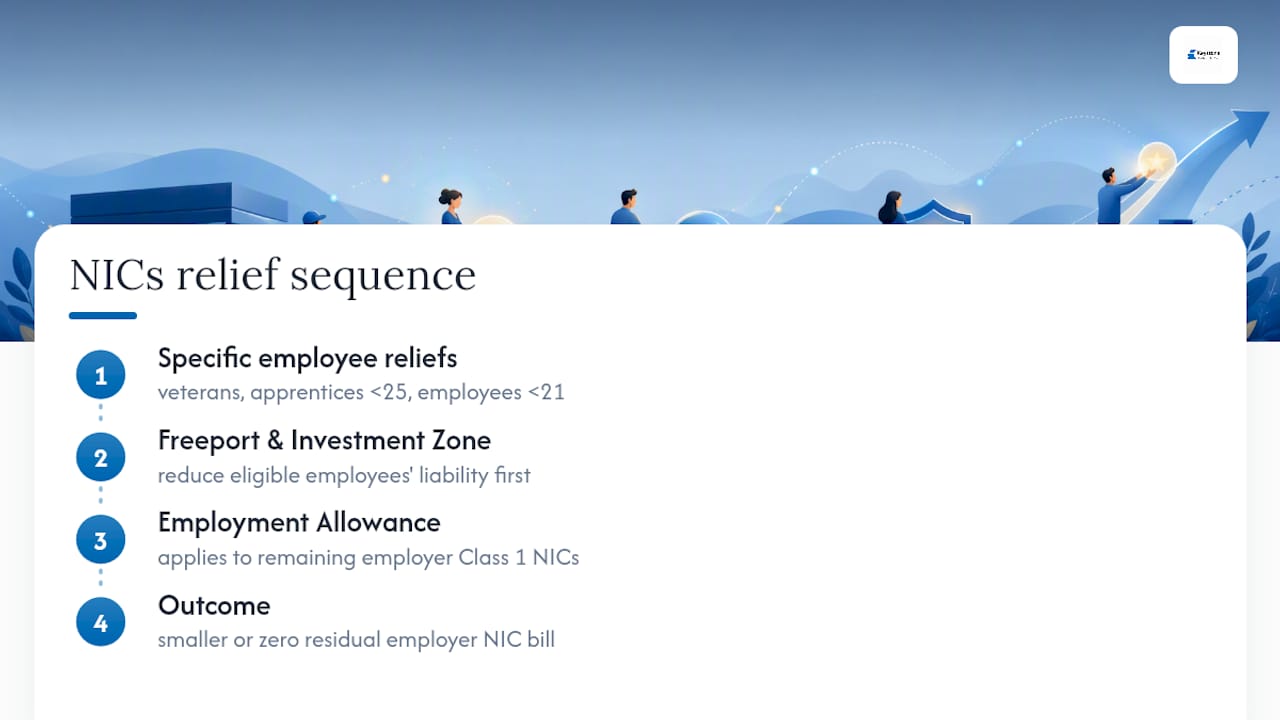
The practical takeaway is that if you’re already using another NICs relief, don’t assume Employment Allowance is redundant. It almost always still has a role to play on top, and the combined effect can be worth checking properly rather than assuming your payroll software has modelled it correctly by default.
How much does this really move the needle on your tax planning?
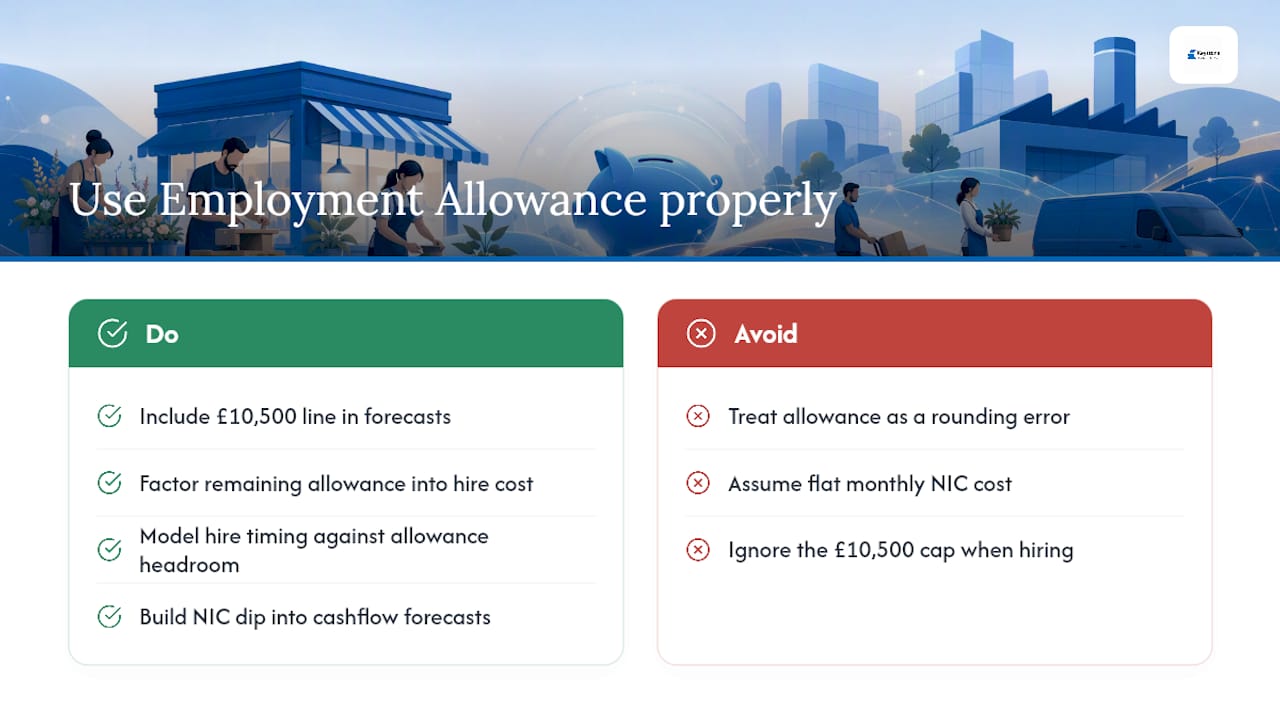
For a genuinely small employer, £10,500 can be the difference between a break even payroll month and a loss making one. It’s rarely the headline figure in annual tax planning conversations, but it deserves a proper line in the forecast rather than being treated as a rounding error.
The allowance changes the maths on hiring decisions too. A business weighing up whether to bring on a fourth or fifth employee should factor the remaining allowance into the true cost of that hire, since the effective employer NIC cost of a new starter can be materially lower if there’s still headroom under the £10,500 cap. Businesses that model this properly sometimes find they can afford a hire a few months earlier than they assumed.
It also affects cash flow forecasting more than founders often expect. Employer NIC is usually one of the more predictable monthly outgoings, so a full allowance smooths that cost across roughly the first several pay runs of the tax year, depending on payroll size, before the cap is reached and NIC returns to its normal level. Building that dip and rebound into a cash flow forecast, rather than assuming a flat NIC cost every month, avoids an unpleasant surprise later in the year when the allowance runs out and the full liability resumes.
What recent changes should employers know about?
The most significant recent change is the removal of the £100,000 threshold that used to exclude larger employers from claiming. Before April 2025, any business with an employer NIC bill above that figure in the previous tax year was locked out entirely. That cap no longer applies, which means a meaningfully wider pool of growing businesses can now claim who couldn’t before.
For employers who scaled past that old threshold in recent years and assumed they were permanently excluded, it’s worth revisiting eligibility now rather than carrying an outdated assumption forward. A business that grew its headcount and payroll cost between 2023 and 2025 might have written off Employment Allowance entirely, when it’s now perfectly eligible.
Beyond that specific change, the allowance figure itself is reviewed and can move at each Budget, so the £10,500 cap for 2026/27 shouldn’t be assumed to hold indefinitely. Employers who build Employment Allowance into multi-year financial models should treat the figure as a variable to check annually against GOV.UK’s rates and thresholds guidance, rather than baking in a fixed number for future years.
Keystone’s perspective: getting this right every year
At KeystoneFA, we treat Employment Allowance as a standing item in every annual payroll review, not a one off tick box. That covers checking the EPS indicator, confirming which entity should claim in a group structure, and flagging backdated opportunities where a client missed a year. If you’re unsure whether your business is claiming correctly, it’s worth asking us to run a review.
— Shoaib
How KeystoneFA helps you claim with confidence
Getting Employment Allowance right isn’t just about ticking the EPS box once. It’s about knowing which entity in a group should claim, catching a missed year before the four year backdating window closes, and making sure your payroll software is actually applying the saving pay run by pay run rather than assuming it. That’s the gap between a business that quietly loses £10,500 a year and one that banks it properly.
[
](www.keystonefa.co.uk)
KeystoneFA’s payroll and compliance team handles the full process for founders and small business owners: an initial eligibility review against the current rules, EPS setup or correction on your existing payroll software, and a check of whether backdated claims for previous tax years are worth pursuing. We also model which company should claim where a connected group structure is involved, since that decision alone can be worth thousands depending on payroll size. If you employ family members or are weighing up payroll structure more broadly, our note on employing family members in a UK business is worth a read alongside this.
If you want a proper review of your current claim, or you suspect you’ve missed a year, get in touch through KeystoneFA’s accountancy services and we’ll walk through it with you.
Sources
For the full legal detail behind everything covered here, go straight to the source. GOV.UK’s eligibility guidance covers exclusions in full, while HMRC’s internal manual on claiming explains the active claim requirement in more depth. Employers dealing with right to work checks alongside payroll setup may also find MNS Solicitors’ guide to UK job offer visas useful.
This article is general information, not a substitute for advice from a qualified financial advisor. Consult a qualified financial professional about your own circumstances before acting on anything here.
FAQ
How much is Employment Allowance now?
For the 2026/27 tax year, Employment Allowance is worth up to £10,500 per eligible employer, offset against employer Class 1 National Insurance.
Who is not eligible for Employment Allowance?
Public bodies performing mostly public functions, companies where a single director is the only employee paid above the secondary threshold, and most domestic employers (unless employing a care or support worker) cannot claim.
How much is Employment Allowance in 2026?
The figure for the 2026/27 tax year is £10,500, the same cap that applied following the removal of the previous £100,000 eligibility threshold.
How do I claim Employment Allowance from HMRC?
Set the Employment Allowance indicator to ‘Yes’ on an Employer Payment Summary submitted through your payroll software, or use HMRC’s Basic PAYE Tools if you don’t have payroll software.
Can I backdate a missed Employment Allowance claim?
Yes, you can claim for up to four previous tax years if you were eligible but didn’t claim, subject to the rules that applied in each of those years.
Recommended