HMRC's rising Corporation Tax compliance: what SMEs must do now

TL;DR:
HMRC has increased its Corporation Tax enforcement activities, with small businesses now bearing most of the compliance burden.
Proactive record-keeping and early disclosure can significantly reduce penalties if contacted by HMRC.
HMRC has significantly stepped up its Corporation Tax compliance activity, and small businesses are bearing the brunt of it. Small businesses now account for 62% of the total UK tax gap, with Corporation Tax representing a significant share of that gap overall. If you run a limited company, the probability of receiving an enquiry or compliance intervention is higher than it has been for years.
Three things to do this week:
Check your records are complete, dated, and match your last filed return.
Confirm your agent authorisation is current so your accountant can respond on your behalf without delay.
Consider voluntary disclosure if you suspect an error in a prior return — HMRC treats proactive disclosure far more favourably than discovered errors.
The National Audit Office (NAO), the Institute of Chartered Accountants in England and Wales (ICAEW), and HMRC’s own published statistics all point in the same direction: compliance enforcement is expanding, it is increasingly data-driven, and smaller companies are the primary target.
Table of Contents
What do the latest HMRC tax gap figures actually show?
The headline number from HMRC’s 2026 edition of Measuring Tax Gaps is striking. The total tax gap for 2024–25 sits at 6.4% of theoretical liabilities, with HMRC recording a record compliance yield of £48 billion in the same period. Corporation Tax accounts for a considerable portion of the total gap, and the gross Corporation Tax gap has risen from £12.9 billion in 2020–21 to a projected £23.5 billion in 2024–25.
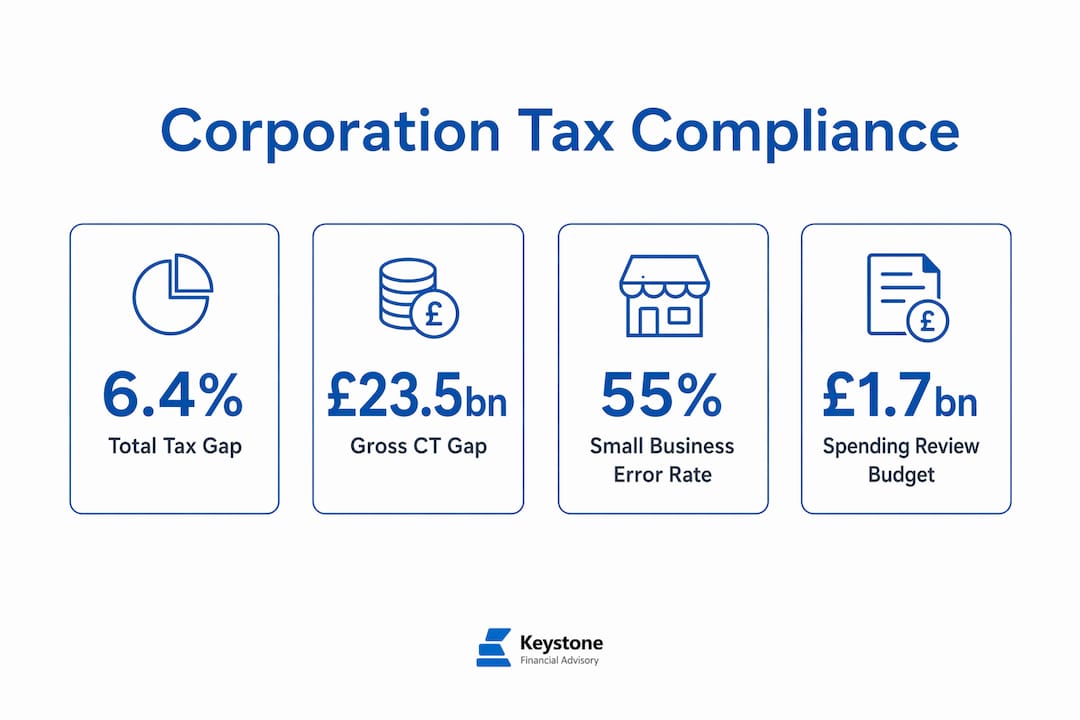
That trajectory matters because it has directly driven resourcing decisions. The Spending Review 2025 allocated £1.7 billion to HMRC specifically to hire more compliance staff. More officers means more cases opened, faster.
HMRC measures two related but distinct things. The gross tax gap is the estimated difference between what should theoretically be paid and what is actually collected. Compliance yield is the additional tax HMRC recovers through its enforcement activity. Both are rising, which tells you the problem is growing and HMRC is getting better at finding it.
Metric | Figure | What it means |
Total tax gap (2024–25) | 6.4% of liabilities | Persistent underperformance across all taxes |
Corporation Tax share of gap | 35% | CT is the single largest component, accounting for 35% of the total tax gap |
Small business share of total gap | 62% | SMEs drive the majority of the shortfall |
Gross CT gap (2024–25 projection) | £23.5 billion | Up from £12.9bn in 2020–21 |
Record compliance yield (2024–25) | £48 billion | Highest ever; reflects staff and data investment |
Spending Review 2025 HMRC allocation | £1.7 billion | Funds additional compliance officers |
Digitalisation is amplifying all of this. HMRC’s ability to cross-check returns and flag anomalies in small business submissions has grown considerably as more data flows through digital channels, a trend that Making Tax Digital (MTD) initiatives will accelerate further.
How HMRC’s Corporation Tax compliance activity works in practice
HMRC does not rely on a single method. Its enforcement draws on several overlapping programmes, and understanding which one has contacted you matters.
Random Enquiry Programme (REP): HMRC selects returns for full compliance checks at random. REP results feed the risk models that drive targeted activity — so even a “random” check has downstream consequences for how HMRC views your sector.
Risk-based enquiries: HMRC’s data systems flag returns that deviate from expected patterns. Unusually high expense ratios, large one-off deductions, or inconsistencies between VAT and CT returns all score risk points.
Targeted campaigns: HMRC periodically focuses on specific sectors or relief types — R&D tax credits have been a prominent recent example.
Wealthy and Mid-sized Business Compliance (WMBC): This directorate reported £2,126 million in Corporation Tax compliance yield in 2024–25 alone, as part of a total WMBC yield of £9,147 million. It targets more complex businesses and is expanding its reach.
Special measures and penalties: For persistent non-compliance, HMRC can apply enhanced monitoring, accelerated payment notices, or refer cases for criminal investigation.
Common enquiry triggers SMEs should recognise include: director’s loan accounts that are overdrawn or poorly documented (see overdrawn director’s loan account guidance), private expenses run through the company, home office claims without supporting calculations, and R&D credit claims lacking technical narratives.
Pro Tip: Document the commercial rationale for every significant decision at the time you make it. A dated board minute or email trail explaining why a cost was incurred for business purposes is worth far more than a retrospective explanation during an enquiry.

Why are small businesses disproportionately in HMRC’s sights?
The short answer is measurement and behaviour combined. The REP data showed that the proportion of small business CT returns containing errors rose from 20% in 2018–19 to 55% in 2022–23. Some of that increase reflects better measurement rather than worsening behaviour — HMRC’s methodological notes acknowledge that REP revisions materially affect estimates. But the underlying error rate is still genuinely high.
The behavioural drivers are predictable. HMRC’s own research found that only around 26% of SMEs said guidance was easy to find, and only around 22% found it easy to understand. When guidance is opaque, errors follow — particularly around reliefs, capital allowances, and the boundary between personal and business expenditure.
ICAEW has noted that HMRC’s cooperative compliance success with large businesses sets a benchmark that is increasing pressure on the department to apply similar high-touch approaches to complex mid-sized firms. The strategic direction is clear: what worked for large businesses will be scaled down to the next tier.
The NAO reinforces this. Its analysis shows high return on investment from targeted compliance activity, which gives HMRC a rational incentive to expand into higher-risk SME segments. When enforcement pays for itself many times over, the question is not whether HMRC will increase activity — it is how quickly.
What does an HMRC enquiry actually cost your business?
The financial exposure from a Corporation Tax enquiry goes well beyond any additional tax owed. Penalties are calculated as a percentage of the unpaid tax, and the category of behaviour determines the rate.
Failure to take reasonable care: 0–30% of the unpaid tax (unprompted disclosure reduces this significantly).
Deliberate understatement: 20–70% for unprompted disclosure, up to 100% for prompted.
Deliberate and concealed: up to 200% in the most serious cases.
Interest accrues on unpaid tax from the original due date, currently at HMRC’s late payment rate. For a company that has underpaid by £50,000 over two years, the combined interest and penalty exposure can easily exceed the original liability.
The operational cost is less visible but equally real. An enquiry typically runs for 12–24 months. During that period, your finance team or adviser spends significant time gathering documents, responding to information requests, and attending meetings. Cash flow is strained if HMRC raises an assessment and you need to pay before the dispute is resolved. Criminal referral is rare but possible where HMRC finds evidence of deliberate concealment.
Voluntary disclosure, made before HMRC opens a formal enquiry, consistently attracts the lowest penalty rates. That window closes the moment HMRC makes contact.
A practical checklist to reduce your enquiry risk right now
Work through this in order, or hand it to your adviser as a briefing document.
Reconcile your CT600 to your accounts. Every figure on your return should trace back to a specific line in your statutory accounts. Unexplained differences are the first thing an inspector looks for.
Review director’s loan accounts. Overdrawn balances at year-end attract a 33.75% Section 455 charge. Confirm the balance, the repayment date, and whether the charge was declared.
Validate relief and allowance claims. For R&D credits, capital allowances, and any creative industry reliefs, confirm you hold the supporting documentation — technical reports, asset schedules, and contractor invoices.
Check expenses against HMRC’s allowable list. Cross-reference your expense categories against HMRC-approved limited company expenses and flag anything that could be challenged as personal.
Sample your receipts. Pull 10 transactions at random from each expense category and confirm the receipt, the business purpose, and the VAT treatment are all correct.
Prepare a disclosure file. If you find an error, document it, quantify it, and speak to your adviser before contacting HMRC. A structured voluntary disclosure is far better than an unstructured one.
Voluntary disclosure made before HMRC opens an enquiry consistently attracts the lowest penalty rates available under Schedule 24 of the Finance Act 2007. The window closes the moment HMRC makes formal contact.
Pro Tip: Keep versioned working papers for every CT return — a dated spreadsheet showing how each figure was derived, with links to supporting documents. If an enquiry opens two years later, this alone can cut the time to closure by months and substantially reduces the risk of a “carelessness” penalty.
For further context on reducing your Corporation Tax bill legally, the principles of good tax planning and good compliance are the same: document everything, claim only what you can support, and review annually.
If HMRC contacts you: what to do in the first 28 days
Immediate dos and don’ts:
Do acknowledge receipt of HMRC’s letter within the stated deadline.
Do contact your accountant or tax adviser before responding substantively.
Do not send documents or explanations without your adviser reviewing them first.
Do not ignore the contact — HMRC can proceed to formal assessment if you do not respond.
A suggested timetable:
Days 1–3: Acknowledge the letter. Confirm your agent authorisation is in place. Brief your adviser.
Days 4–10: Gather the documents HMRC has requested. Typical first requests include the CT600, statutory accounts, and a breakdown of specific expense categories.
Days 11–20: Your adviser reviews the documents, identifies any issues, and prepares a response strategy. If errors exist, assess whether voluntary disclosure is still available.
Days 21–28: Submit the initial response. Keep it factual, complete, and limited to what was asked. Volunteering unrequested information rarely helps.
Internally, involve your finance director or bookkeeper immediately — they hold the transaction-level detail HMRC will want. If you use cloud accounting software such as Xero or QuickBooks, export and preserve the relevant period’s data before making any amendments.

Key takeaways
HMRC’s rising Corporation Tax compliance activity is directly targeting small businesses, which account for 62% of the total tax gap, making proactive record-keeping and early adviser engagement the most effective defences available.
Point | Details |
Scale of the problem | The gross CT gap reached a projected £23.5bn in 2024–25, up from £12.9bn in 2020–21. |
SME exposure | Small businesses account for 62% of the total tax gap; error rates in CT returns rose sharply per REP data. |
Voluntary disclosure | Disclosing errors before HMRC opens an enquiry attracts the lowest penalty rates under Schedule 24. |
Digital detection | HMRC’s cross-checking capability is growing; MTD-related data flows make anomalies easier to spot. |
KeystoneFA’s role | KeystoneFA offers CT health checks, bookkeeping, and HMRC representation to reduce enquiry risk for SMEs. |
The reality of compliance risk for growing businesses
There is a version of this story that gets told as pure statistics — gap percentages, yield figures, penalty bands. Those numbers matter, but they miss something advisers see repeatedly: the businesses that end up in the most difficult enquiries are rarely the ones doing anything deliberately wrong. They are the ones that grew quickly, outsourced their accounts to whoever was cheapest, and never had anyone sit down with them to explain what HMRC actually looks at.
The rise in the small business error rate from 20% to 55% in REP data is not primarily a story about fraud. It is a story about complexity outpacing capability. A founder running a £2 million turnover business is making dozens of financial decisions a month that have tax implications — expenses, director remuneration, loan accounts, asset purchases. Without someone who understands both the commercial reality and the HMRC framework, errors accumulate quietly.
What the ICAEW and NAO findings suggest is that HMRC is not just getting bigger; it is getting smarter about where to look. Cooperative compliance worked for large businesses because it created a structured relationship. The same logic, applied to complex mid-sized firms, means HMRC will increasingly expect businesses to demonstrate they have governance in place — not just that they filed on time.
The businesses that come through enquiries cleanly are almost always the ones that can produce a clear paper trail and a coherent explanation for every number. That is not a compliance burden. It is just good financial management, applied consistently.
How KeystoneFA can help you stay ahead of HMRC
The gap between filing a return and being genuinely prepared for scrutiny is where most SMEs are exposed. KeystoneFA works with founders and growing businesses to close that gap before HMRC does.
[
](www.keystonefa.co.uk)
Relevant services for businesses concerned about Corporation Tax compliance include: Corporation Tax health checks (reviewing your CT600 and supporting records for common risk areas), day-to-day bookkeeping that keeps your records enquiry-ready, proactive tax planning to reduce your CT liability legally, and direct HMRC representation if an enquiry opens. The team has experience across UK and international tax environments and works with businesses at every stage from early-stage startups to established SMEs.
For an initial call, have your last two CT600s, your most recent statutory accounts, and a note of any reliefs or allowances you have claimed, and consider using Advisor Tools & Calculators to help prepare your client packages efficiently. That is enough to identify the highest-risk areas quickly.
Book a compliance health check with KeystoneFA and get a clear picture of where you stand before HMRC comes looking.
This article is general information, not professional tax or legal advice. Confirm the current rules with HMRC or a qualified adviser for your specific situation.
Useful sources
The figures and analysis in this article draw on the following primary sources. All are publicly available and worth bookmarking if you manage Corporation Tax for a UK company.
HMRC: Tax gap 2024–25 estimated at 6.4% — Official statistics announcement covering the headline gap figure, small business share, compliance yield, and Spending Review resourcing. Published 2026.
HMRC: Measuring Tax Gaps — Corporation Tax chapter — Detailed breakdown of the gross CT gap by year and taxpayer segment, including REP findings. Official statistics.
HMRC: Methodological annex — Corporation Tax — Technical note explaining how HMRC constructs the small business model and applies REP data.
HMRC: WMBC compliance yield technical note — Directorate-level yield figures for 2024–25, including the £2,126m CT yield.
HMRC: Understanding experiences of dealing with Corporation Tax — GOV.UK research on SME experiences with CT guidance and agent use.
NAO: HMRC’s large business directorate doubles additional tax revenue secured — NAO press release on compliance yield ROI and cooperative compliance extension.
ICAEW: HMRC large business directorate sets benchmark for taxpayer engagement — Expert commentary on the strategic implications of HMRC’s compliance model. Published March 2026.
HMRC SME Action Plan 2025–2028 — HMRC’s stated strategic objectives for SME engagement and tax gap reduction.
FAQ
What is HMRC’s rising Corporation Tax compliance activity?
It refers to HMRC’s sustained increase in enforcement and enquiry activity targeting Corporation Tax underpayment, particularly among small businesses, driven by a growing tax gap and significant investment in compliance staff.
Why are small businesses more likely to face a CT enquiry now?
The proportion of small business CT returns containing errors rose from 20% in 2018–19 to 55% in 2022–23 per REP data, making SMEs the highest-risk segment and the primary focus of HMRC’s expanded compliance resource.
What triggers an HMRC Corporation Tax enquiry?
Common triggers include overdrawn director’s loan accounts, high or unusual expense ratios, unsupported R&D credit claims, and inconsistencies between VAT and CT returns — all areas where HMRC’s data-matching systems flag anomalies.
What are the penalties for Corporation Tax errors?
Penalties range from 0–30% of unpaid tax for failure to take reasonable care, up to 200% for deliberate and concealed understatement. Voluntary disclosure before HMRC opens an enquiry consistently attracts the lowest rates.
How can KeystoneFA help if I receive an HMRC enquiry?
KeystoneFA provides Corporation Tax health checks, bookkeeping, and direct HMRC representation for SMEs, helping businesses prepare their records, respond correctly, and minimise penalty exposure from the outset.
Recommended