Should you employ family members in your UK business?


TL;DR:
Employing family members in a UK small business is legal if employment laws are followed and official procedures are met. Clear documentation, fair pay, and equal treatment are essential to avoid legal and tax issues. Proper planning can make family employment both beneficial and compliant with HMRC and employment regulations.
Yes, you can employ family members in your UK small business, and done correctly, it can be genuinely advantageous. The arrangement is entirely legal provided you follow standard employment law and HMRC guidance without exception. The critical word there is “standard.” Family members get no special treatment under UK law, which cuts both ways: the same protections that apply to any employee apply to them, and the same obligations fall on you as their employer.
Before hiring a relative, make sure you can honestly say yes to all of the following:
The role is genuine, with a written job description and a real business need
Pay reflects the market rate for the work, not the relationship
You will register the family member for PAYE and issue payslips
National Minimum Wage applies in full, with no exceptions for limited companies
All company policies, including disciplinary and appraisal procedures, apply equally
You hold employer’s liability insurance that covers family employees
You have considered whether a workplace pension is required
If any of those points give you pause, read on before you proceed.
What are the legal and tax requirements for employing family members?
The legal framework for family members employment in the UK is straightforward: treat them exactly as you would any other employee. That means a written contract, PAYE registration, payslips, National Insurance contributions, and full compliance with working time regulations.
On pay, HMRC is clear. Wages paid to relatives are deductible as a business expense only when the amount is commercially reasonable and reflects actual work performed. Pay a family member significantly more than you would pay an unrelated person doing the same job, and HMRC can disallow the excess. The test is equal pay for equal value, nothing more.
The National Minimum Wage rate for workers aged 21 and over is £12.21 per hour for 2025/26. One narrow exemption exists: a family member living at the family home and helping informally with a family business run from that home falls outside National Minimum Wage rules. However, limited companies cannot claim this exemption because a company is a separate legal entity with no family of its own. If your business is a limited company, the minimum wage applies without exception.
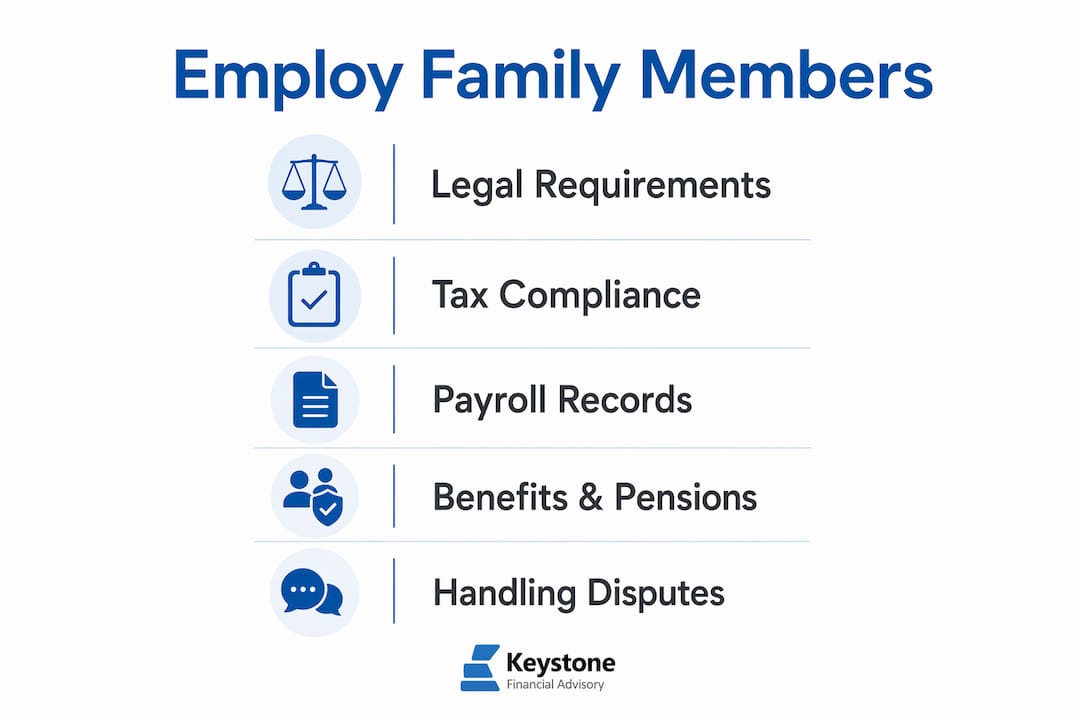
Keep payroll records meticulously. Document hours worked, pay rates, and any changes to terms. HMRC scrutinises family payroll arrangements, and clean records are your first line of defence.
Employing spouses and children: what you need to know
Spouses and civil partners can be employed legally, and there can be genuine tax efficiency if the arrangement is structured properly. If your spouse has unused personal allowance, paying them a salary up to that threshold means the income is tax-free for them, while remaining a deductible expense for the business. The arrangement must, however, follow proper PAYE procedures and reflect real work at a genuine market rate.
Children are a different matter. Those below school-leaving age face additional legal protections, including restrictions on working hours and the types of work they can do. If your business is a limited company and you employ a child in any capacity, the National Minimum Wage still applies. Common missteps include paying a teenager a nominal amount for occasional admin tasks without a contract or payslips. That arrangement will not survive HMRC scrutiny.
A few points specific to this area:
The role must be genuine. Paying a spouse to “manage social media” when they do nothing of the sort is not a legitimate arrangement.
Pay must reflect the actual hours and tasks involved, not a round number chosen for tax convenience.
Children employed in a sole trader or partnership context may fall under the family exemption, but only if they live at home and the business operates from that home. Limited companies get no such latitude.
Practical risks and considerations when hiring relatives
The legal risks are manageable. The human ones are harder.
Non-family staff may feel alienated when a relative joins the business, particularly if they perceive preferential treatment in pay, promotion, or working conditions. That perception, even when unfounded, can damage morale and expose you to discrimination claims. Keeping senior positions occupied by a mix of family and non-family members reduces this risk considerably.

Domestic disputes have a habit of following people into the office. A disagreement at home on Sunday can make Monday’s team meeting uncomfortable for everyone. The reverse is also true: a difficult performance conversation at work can strain a relationship that extends well beyond business hours.
The biggest mistake SMEs make is treating family employment as a tax planning exercise rather than a genuine recruitment decision. HMRC looks for exactly that pattern. A clear role definition and a documented recruitment process are your best protection.
Pro Tip: Keep a written record of why you hired the family member, what the role requires, and how the pay rate was determined. If HMRC ever questions the arrangement, that paper trail demonstrates a legitimate business decision rather than a personal one.
Other risks worth considering:
Paying a family member for a role they are not suited to wastes money and creates resentment among capable non-family staff
Failing to apply disciplinary procedures consistently to family members creates legal exposure
Over-reliance on family in senior roles can stifle the outside perspective a growing business needs
How to employ family members correctly: a step-by-step approach
Getting the setup right from the start saves considerable trouble later.
Define the role in writing. Write a job description that specifies duties, hours, and reporting lines before you approach the family member. This establishes that the role exists independently of the person filling it.
Set pay at market rate. Research what an unrelated person would earn for the same work. Pay at or near that rate, and document how you arrived at the figure.
Register for PAYE. Add the family member to your payroll through HMRC’s PAYE system exactly as you would any new employee. Issue a payslip every pay period.
Issue a written contract. The contract should cover pay, hours, holiday entitlement, notice periods, and disciplinary procedures. Formal written agreements signal to both parties that this is a professional arrangement.
Apply all policies equally. Performance reviews, absence management, and conduct procedures must apply to the family member on the same terms as everyone else. Equal application of company policies is the single most effective way to prevent discrimination claims.
Check pension obligations. If the family member meets the auto-enrolment criteria, you must enrol them in a workplace pension scheme.
Keep records. Retain payroll records, timesheets, appraisal notes, and any correspondence about pay changes. HMRC can request these, and gaps in documentation look suspicious.
For guidance on what your limited company can and cannot pay for on behalf of employees, the company expenses rules are worth reviewing alongside your payroll setup.
Family employment and business succession planning
Employing family members is often the first step towards a broader succession plan, but the two need to be managed separately. Bringing a son or daughter into the business as an employee gives them operational experience, which is genuinely valuable preparation for future ownership. The risk is conflating the two: assuming that employment automatically confers a right to inherit the business, or that future ownership justifies current overpayment.
Poor succession planning is one of the most commonly cited risks of family businesses. Excluding capable non-family managers from senior roles, or automatically elevating a family member regardless of performance, can leave the business structurally weak precisely when continuity matters most. A transparent succession plan, separate from the employment relationship, protects both the business and the family dynamic.
Employee benefits and pensions for family employees
Family members employed through your business are entitled to the same statutory benefits as any other employee: statutory sick pay, statutory maternity or paternity pay, and holiday entitlement under the Working Time Regulations. There are no reduced entitlements because of the relationship.
Auto-enrolment applies if the family member meets the age and earnings thresholds. Many small business owners overlook this, assuming family arrangements sit outside the pension rules. They do not. If your family employee earns above the auto-enrolment trigger and is aged between 22 and State Pension age, you must enrol them and contribute to their pension. The business structure you operate affects how pension contributions are treated for tax purposes, so it is worth understanding the distinction between sole trader and limited company arrangements.
How to handle disputes when family and work collide
Separating family and business matters is easier said than done, but the businesses that manage it well tend to treat the separation as a structural rule rather than a personal preference. That means using the same disciplinary and grievance procedures for family members as for anyone else, without exception.
When a dispute arises, address it through your formal process. Avoiding a difficult conversation because the employee is a relative lets problems compound until they affect the wider team. Conversely, handling a family member more harshly than you would a non-family employee to prove impartiality creates its own problems.
If the working relationship genuinely breaks down, you may need to end the employment. That process follows standard redundancy or dismissal procedures regardless of the personal relationship. Taking professional HR or legal advice before acting protects both the business and the family member’s rights.
Key takeaways
Employing family members in a UK small business is legal and can be tax-efficient, but only when the arrangement meets the same standards HMRC and employment law require of any other hire.
Point | Details |
Legal but not exempt | Family employees must have contracts, PAYE registration, and receive at least £12.21 per hour (aged 21+) for 2025/26. |
Limited companies get no exemptions | The National Minimum Wage family exemption does not apply to limited companies, which are separate legal entities. |
Pay must be commercially reasonable | HMRC can disallow wages paid to relatives if the amount exceeds what an unrelated person would earn for the same work. |
Equal treatment prevents legal exposure | Applying all company policies equally to family and non-family staff is the most effective protection against discrimination claims. |
Succession planning needs separation | Employment and future ownership are distinct arrangements; conflating them weakens both the business and the family relationship. |
FAQ
Can I legally employ family members in my UK business?
Yes. Employing family members is legal in the UK provided you follow standard employment law, register them for PAYE, pay at least the National Minimum Wage, and treat them the same as any other employee.
Can I employ my child to reduce my tax bill?
You can employ a child and deduct their wages as a business expense, but only if the role is genuine, the pay reflects actual work at a market rate, and proper PAYE procedures are followed. HMRC will disallow wages that appear to serve a personal rather than a business purpose.
Can I pay my spouse a salary through my business?
Yes, and it can be tax-efficient if your spouse has unused personal allowance. The salary must reflect real work at a commercially reasonable rate, and you must run it through PAYE. Paying a spouse a salary purely to shift income without genuine employment behind it will not satisfy HMRC.
Is it a good idea for family members to work together?
It can work well when roles are clearly defined, pay is fair, and professional boundaries are maintained. The risks, including staff resentment, discrimination claims, and personal disputes affecting the workplace, are real but manageable with the right structure in place.
Getting family employment right from the start is far easier than unpicking a poorly structured arrangement later. If you want to set up a compliant payroll, review your tax position, or plan a family succession properly, KeystoneFA works with founders and growing businesses across the UK to do exactly that.
[

](www.keystonefa.co.uk)
Recommended