Tax planning before your year-end: 7 actions to take

TL;DR:
Maximizing pension contributions and carefully timing capital expenditures can significantly reduce UK small business tax bills before year-end.
Strategic bonus approvals, bad debt write-offs, and prepaying expenses also help optimize tax deductions, while planning dividend timing and year-end dates influence personal and corporate tax liabilities.
What are the 7 year-end tax planning actions for UK small businesses?
Seven moves can meaningfully cut your Corporation Tax bill before your accounting period closes. Here they are, in order of impact.
Maximise employer pension contributions. Contributions are fully deductible against Corporation Tax and attract no National Insurance. The annual allowance for 2025/26 is £60,000 per person, and you can carry forward unused allowance from the previous three years.
Time capital expenditure carefully. Buying qualifying plant and machinery before year-end unlocks a 100% first-year deduction via the Annual Investment Allowance, offering a 100% first-year deduction on qualifying expenditure up to a substantial limit, with uncapped full expensing available on certain assets. The asset must be in use, not merely ordered.
Approve bonuses before year-end. Record the decision in board minutes before the period closes. The bonus must then be paid within nine months of year-end to secure the deduction in that period; pay later and the relief shifts to the period of actual payment.
Write off genuine bad debts. Debts specifically identified as irrecoverable, including those from insolvent customers, are deductible. General provisions are not.
Prepay allowable expenses. Annual software subscriptions, insurance premiums, and rent (where your lease permits) paid before year-end bring the relief into the current period. A full list of HMRC-approved expenses is worth reviewing before you close the books.
Claim R&D tax relief. For accounting periods beginning on or after 1 april 2024, the merged RDEC scheme applies to all companies, offering a 20% above-the-line credit. Loss-making SMEs with high R&D intensity may qualify for the Enhanced R&D Intensive Support rate.
Choose your year-end date thoughtfully. Aligning your year-end to manage profits below the small profits threshold can keep you in the lower Corporation Tax band. Bringing expenses forward or deferring income where possible gives you control over which period absorbs the liability.
Reviewing outstanding invoices before you close the period matters too. Accelerating or delaying revenue recognition directly affects which year carries the Corporation Tax charge.
How can you maximise employer pension contributions before year-end?
Employer pension contributions are one of the most tax-efficient tools available to a UK limited company. Every pound contributed reduces your Corporation Tax liability pound-for-pound, with no National Insurance on top.
Confirm the annual allowance for each relevant individual: £60,000 for 2025/26.
Check whether unused allowance from the prior three tax years can be carried forward to increase this year’s contribution.
Pay contributions before the accounting period ends; a contribution processed after year-end falls into the next period.
Keep documentation: board minutes or a formal resolution confirming the contribution decision protects the deduction if HMRC queries it.
Pro Tip: If cash flow is tight, even a modest contribution before year-end locks in relief at your current Corporation Tax rate. Coordinate with your personal pension position to avoid breaching the annual allowance inadvertently.
The KeystoneFA team, with experience across UK and Middle East practices, regularly identifies carry-forward opportunities that founders overlook. A quick review of the last three years’ pension records often reveals unused allowance that can be deployed before the period closes.

Should business owners use ISAs for personal tax planning?
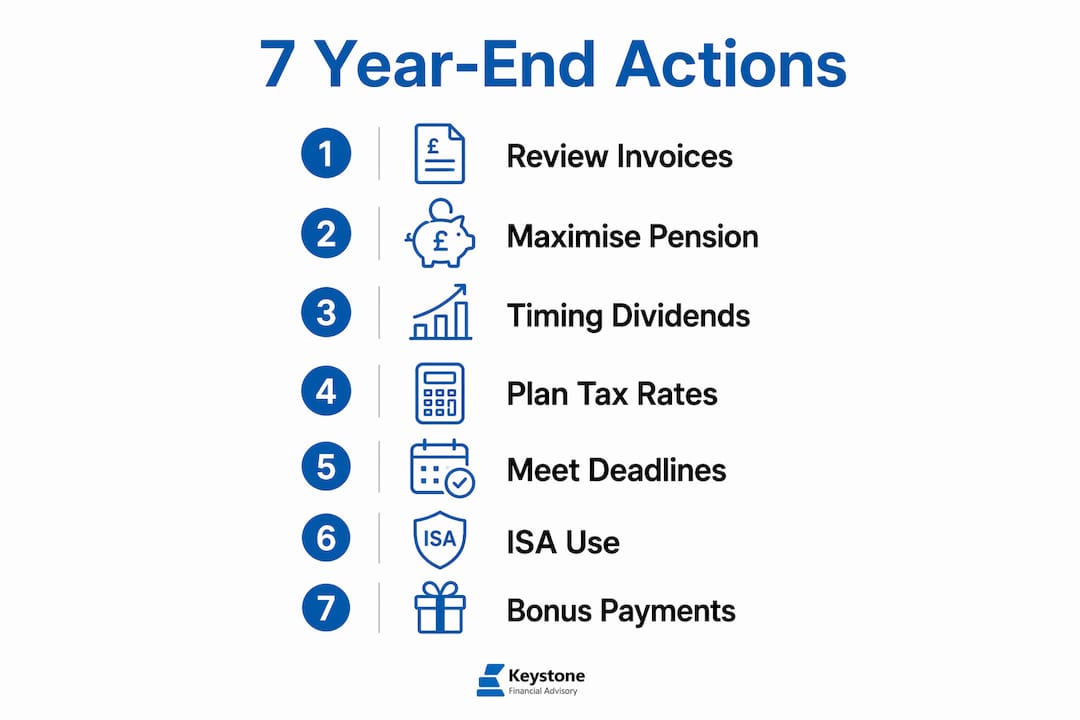
Business owners often separate company and personal tax planning, but the two interact. The annual ISA allowance lets you shelter investment returns from Income Tax and Capital Gains Tax entirely. Dividends drawn from your company and placed into a Stocks and Shares ISA grow free of further tax, making the ISA a natural complement to a dividend-led remuneration approach.
The Lifetime ISA is worth considering for owner-directors under 40, given the government bonus on contributions. Neither vehicle reduces your Corporation Tax bill directly, but both reduce the personal tax cost of extracting profits, which changes how much you need to extract in the first place.
How should you time dividend payments for tax efficiency?
Dividend timing is one of the more controllable levers in a founder’s financial year-end checklist. Dividends are paid from post-tax profits, so they do not reduce your Corporation Tax liability. What they do affect is your personal Income Tax position.
If you expect your income to fall in the next tax year, deferring a dividend until after 5 april can shift the liability to a lower-rate year. Conversely, if you have unused basic-rate band remaining before year-end, drawing a dividend now uses that band before it resets. Coordinating dividend timing with salary, pension contributions, and ISA subscriptions is where year-end tax advice from an adviser pays for itself.
What tax rate changes should you plan around for 2026?
Corporation Tax rates vary by profit bands, with a higher rate for larger profits and a lower rate for smaller profits, and a marginal relief rate applies between these thresholds. These rates have been confirmed for the current period, so planning around the £50,000 and £250,000 thresholds remains the core task for most small businesses.
For personal tax, the frozen Income Tax thresholds mean more directors are being pulled into higher bands as profits grow. Understanding where you sit relative to the basic, higher, and additional rate thresholds before year-end lets you make deliberate choices about salary, dividends, and pension contributions rather than discovering the liability after the fact. KeystoneFA’s guidance on reducing your Corporation Tax covers these interactions in detail.
What are the key deadlines for year-end tax filing?
Missing a deadline costs money. Here are the ones that matter for UK limited companies.
Corporation Tax payment: due nine months and one day after your accounting period ends.
CT600 filing: due twelve months after the accounting period ends.
Bonus payment window: nine months after year-end to secure the deduction in the prior period.
R&D tax relief claims: can be submitted up to two years after the accounting period ends, but earlier is better.
Confirmation statement and accounts: filed with Companies House within twelve months of the accounting period end.
Getting these dates into a calendar at the start of each year removes the scramble. Late Corporation Tax payments attract interest from HMRC, and late filing draws automatic penalties.
Key takeaways
Proactive year-end tax planning for UK limited companies requires acting before the accounting period closes, not after.
Point | Details |
Pension contributions | Pay before year-end for a full Corporation Tax deduction; the 2025/26 allowance is £60,000 per person. |
Capital allowances | Assets must be purchased and in use before year-end to qualify for the 100% AIA or full expensing deduction. |
Bonus timing | Board approval before year-end plus payment within nine months secures the deduction in that period. |
R&D credit | The merged RDEC scheme offers a 20% above-the-line credit for accounting periods from 1 april 2024. |
Key deadlines | Corporation Tax is due nine months and one day after year-end; CT600 filing is due twelve months after. |
FAQ
What is the pension annual allowance for 2025/26?
The annual allowance is £60,000 per individual for 2025/26. Unused allowance from the previous three tax years can be carried forward to increase contributions in the current period.
When must a bonus be paid to qualify for a Corporation Tax deduction?
A bonus approved in board minutes before year-end must be paid within nine months of the accounting period end. Payment after that window shifts the deduction to the period in which it is actually paid.
What does the merged RDEC scheme offer?
The merged RDEC scheme, which applies to accounting periods beginning on or after 1 april 2024, provides a 20% above-the-line credit on qualifying R&D expenditure for all companies.
Can I deduct general bad debt provisions?
No. Only debts specifically identified as irrecoverable, such as those owed by insolvent customers, qualify for deduction. General provisions against potential non-payment do not meet HMRC’s test.
How does KeystoneFA help with year-end tax planning?
KeystoneFA works with UK limited companies to identify and execute year-end tax planning opportunities, from pension contribution timing to R&D claims, drawing on experience across UK and Middle East practices.
Recommended