Outsourced finance function: when it fits and what it costs

An outsourced finance function is an external firm running your bookkeeping, reporting and finance leadership as a service, instead of you hiring that capability in house. It works best in a handful of clear situations:
You’re a founder losing evenings to invoicing and VAT instead of running the business.
You’re growing fast but not yet at the size that justifies a full finance team.
You need investor-ready numbers before a raise, or interim cover while you recruit.
Done well, it gets you senior financial oversight and the day-to-day delivery behind it for a fraction of what a permanent hire costs. The trade-off, covered later, is a slight loss of instant in-room context.
TL;DR:
Outsourcing is most suitable for businesses between £1m and £10m in revenue, especially when founders need senior oversight without full in-house staffing.
Typical costs for bundled services range from £1,200 to £5,000 monthly, while fractional CFO retainers generally cost between £2,500 and £8,000 per month.
Providers handle operational tasks such as bookkeeping and VAT, as well as strategic support like cashflow forecasting and investor reporting, but do not conduct statutory audits.
Choosing the right provider requires evaluating qualifications, independence, security measures, and clear transition plans, not just cost or awards.
Smooth handovers during provider switches depend on fully documented data and system access, ideally scheduled after key reporting deadlines.
Table of Contents
What does an outsourced finance function actually cover?
Providers typically split work into two tiers. The operational layer handles bookkeeping, accounts payable and receivable, bank reconciliations, payroll coordination, VAT returns and month-end close. The higher-value layer adds management accounts, cashflow forecasting, FP&A, board packs and fundraising support.
Products come in three shapes:
Bundled firm-with-team: one monthly bill, a small team covering the full operational stack.
Fractional CFO retainer: a named senior person for strategy, forecasting and investor relations, usually paired with someone else handling the operational grind.
Project work: a fixed-scope engagement for a specific need, such as a fundraise or systems migration.
One thing outsourcing never covers: statutory audit. Your outsourced provider prepares the books; an independent auditor signs them off. Confusing the two is a common and avoidable mistake, and it’s worth reading how audit readiness actually works before you assume your provider does both.
Who actually needs to outsource their finance function?
Revenue stage is the cleanest predictor of fit, though it isn’t the only one.
Pre-VAT and early revenue: a bookkeeper plus a part-time accountant usually covers it. Full outsourcing is often overkill here.
£1m to £3m: this is where a bundled outsourced finance function earns its keep. Founders are stretched thin and the numbers are getting too complex for spreadsheets.
£3m to £10m: the overlap zone. Some businesses stay on an outsourced bundle, others add a fractional CFO, others start building an in-house team. The revenue-stage framework from Accountancy Capital places the real decision point around £4m to £7m.
Beyond £10m: most businesses need someone in the building full time, for immediacy alone.
Outside pure revenue triggers, outsourcing also makes sense for interim cover when a finance hire leaves unexpectedly, or when a board demands investor-grade reporting faster than you can recruit for it.
Pro Tip: Don’t just ask “can we afford a hire yet?” Ask “who needs to answer the phone in the next ten minutes if a number looks wrong?” That question exposes whether you actually need in-house presence or just better outsourced reporting.

What are the real benefits of outsourcing accounting tasks?
The cost argument is the one everyone leads with, and it holds up. A full-time finance hire costs far more than salary alone once you add employer National Insurance, pension contributions and recruitment fees, and comparisons of outsourced CFO costs routinely show large annual savings against a permanent CFO once those extras are counted.
The maths that matters: you’re not comparing salary to retainer. You’re comparing one salary, one set of employer costs and one recruitment bill against a retainer that scales with you.
Beyond cost, the practical gains include:
Month-end that runs on documented processes instead of one person’s memory.
Modern software stacks that most small in-house teams never get round to adopting.
Predictable monthly budgeting instead of lumpy hiring and severance costs.
Cash discipline and investor-ready reporting that make the next raise easier.
The biggest hidden benefit is time. Founders get their evenings back, which can improve decision quality elsewhere in the business.
What are the risks of outsourcing your finance function?
Nothing here is free of trade-offs. An outsourced team, however good, won’t have the same instant commercial context as someone sitting three desks away who’s been in every sales meeting for two years. That’s the gap that eventually pulls growing businesses towards an in-house financial controller.
There’s also concentration risk: if your provider has a bad week, so do you. Ask about business continuity plans and what happens if your named contact leaves.
For businesses regulated by the FCA’s SYSC 8 outsourcing rules, the obligations are explicit and worth knowing even if you’re not directly regulated, because good providers build to this standard anyway:
The regulated firm remains fully responsible for the outsourced function, full stop.
Firms must retain genuine oversight, not just receive reports.
Suppliers must allow access to data and premises for audit purposes.
Contingency plans and clear termination rights are non-negotiable.
Insist on the same protections contractually, regulated or not: data access, defined service levels, and a clean exit clause.
How much does outsourcing your finance function cost?
Pricing splits fairly cleanly by product shape. A bundled outsourced finance function in the UK typically runs £1,200 to £5,000 a month, scaling with transaction volume and complexity. Fractional CFO retainers sit higher, generally £2,500 to £8,000 a month, and larger or more complex businesses often negotiate bespoke pricing above that.
The £3,000 to £5,000 overlap is where most buyers get stuck choosing between a fuller bundle and a named fractional CFO. The right call usually comes down to whether you need broader operational coverage or more focused senior strategic time.
Compare that against hiring: a permanent finance director’s salary plus employer NI, pension and recruitment fees typically dwarfs a year of outsourced fees. Watch for contractual uplifts too. Fundraises, M&A support and systems transformations are usually billed as separate projects on top of the retainer.
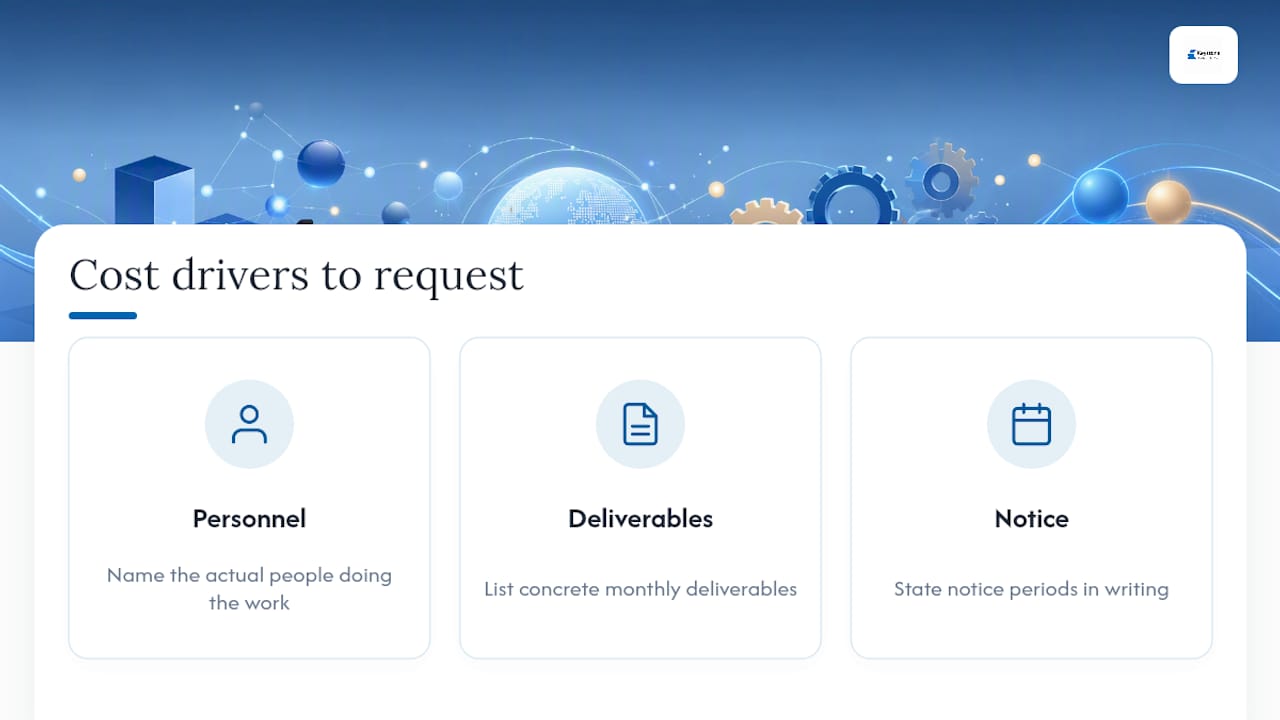
When comparing quotes, ask each provider to name the actual people doing the work, list concrete monthly deliverables, and state notice periods in writing. Vague scopes are where disappointment starts.
How do you choose the right outsourced finance provider?
Run a proper evaluation, not a gut-feel decision. Look for:
Relevant qualifications and sector experience with businesses your size and shape, not just impressive-sounding client logos.
Genuine independence from audit, so the same firm isn’t marking its own homework at year end.
Security and continuity capability, including what happens if your main contact is unavailable for a fortnight.
Named replacement plans, so a resignation on their side doesn’t become a crisis on yours.
In interviews, ask directly: who covers this account if my point of contact leaves? How quickly can we get raw data out if we switch providers? What does a typical 90-day onboarding actually deliver?
Red flags worth walking away from: long lock-in contracts with no exit, no defined service levels, no access to underlying working papers, or any hint that the same team preparing your books also wants to sign off your audit.
A well-run onboarding follows a diagnostic review, then a documented 90-day plan, then measurable improvement in month-end close times. If a provider can’t describe that arc, they haven’t done this before.

Pro Tip: Ask to see an anonymised 90-day plan from a past client. A provider with real process will have one ready. A provider without one is improvising.
How does handover work when you switch finance providers?
A clean handover protects continuity, especially if you’re mid-fundraise or reporting to a lender. Build your transition around this sequence:
Weeks 1 to 2: transfer working papers, reconciliations and system admin access; document current accounting policies.
Weeks 2 to 3: introduce the new provider to your external auditor and any lenders who need continuity assurance.
Weeks 3 to 5: run a short overlap period where the outgoing and incoming teams both have visibility on live numbers.
Weeks 5 to 6: confirm full data export, close out the old contract, and lock in the new reporting cadence.
Insist contractually on full data export in a usable format, not a PDF dump you can’t rebuild from. If you’re mid-reporting-period for investors, time the switch to land just after a reporting deadline, never during one.
How does Keystone Financial Advisory deliver this in practice?
Keystone Financial Advisory builds outsourced finance functions around exactly the scope covered above. Depending on stage, engagements combine:
Day-to-day bookkeeping, VAT filing and payroll management.
Management accounts, cashflow visibility and year-end reporting.
Tax planning and Companies House/HMRC compliance handled alongside the numbers, not as an afterthought.
CFO-level oversight for businesses approaching a raise or needing board-ready reporting.
The team combines modern accounting software with experience gained at larger UK and Middle East firms, brought into a smaller, more personal engagement. New clients typically start with a diagnostic review, move into a 90-day improvement plan, then settle into a steady-state retainer once month-end is running cleanly. It reads as a checklist worth revisiting alongside the types of accounting services suited to founders before deciding on scope.
What do founders usually get wrong about outsourcing finance?
The most common mistake isn’t choosing the wrong provider. It’s outsourcing without deciding what “good” looks like first, then blaming the provider when nobody agreed the target.
The second mistake is chasing the cheapest quote and getting exactly the responsiveness that price buys. Cost and speed of access move together. Decide which one you actually need before you sign anything.
— Shoaib
Ready to scope your outsourced finance function?
If you’ve read this far, you already know roughly which band you sit in, whether that’s a bundled service, a fractional CFO retainer, or something in between. The harder part is getting a quote that actually reflects your business rather than a generic package.
[
](www.keystonefa.co.uk)
KeystoneFA scopes engagements the way this article recommends you evaluate them: a proper diagnostic first, a 90-day plan with measurable month-end targets, then a steady-state retainer once things are running cleanly. No guessing at deliverables, no vague scopes to compare against a rival quote. If you’re a founder or growing business trying to work out whether a bundled service or a fractional CFO retainer fits your stage, get in touch with KeystoneFA to request a scoped quote based on your actual numbers, not a generic price list.
Key Takeaways
An outsourced finance function delivers senior financial oversight and day-to-day operational delivery at a fraction of the cost of a permanent in-house hire, with the trade-off of slightly reduced immediacy.
Point | Details |
Definition and fit | An outsourced finance function is an external firm delivering your finance operations and leadership as a service. |
Revenue triggers | Bundles suit £1m to £3m businesses; the £3m to £10m range is an overlap zone before in-house often takes over. |
Pricing bands | Bundled services run roughly £1,200 to £5,000 a month; fractional CFO retainers run roughly £2,500 to £8,000 a month. |
Regulatory obligations | Firms under FCA SYSC 8 rules must retain oversight, ensure data access, and keep contingency and termination rights. |
KeystoneFA’s approach | KeystoneFA scopes engagements through a diagnostic, a 90-day plan, and a steady-state retainer for founders and growing businesses. |
Sources
FAQ
What is outsourcing in finance?
Outsourcing in finance means paying an external firm to run some or all of your finance operations, from bookkeeping to CFO-level oversight, instead of employing that capability directly.
What are the FCA guidelines for outsourcing arrangements?
Under SYSC 8, regulated firms remain fully responsible for outsourced functions, must retain genuine oversight, ensure supplier access for audits, and have contingency and termination rights in place.
Is outsourcing a dying concept?
No. UK market pricing and demand for outsourced finance bundles and fractional CFO retainers show it remains an active, commonly used model, particularly for founders and growing businesses below roughly £8m to £10m in revenue.
How much does an outsourced CFO cost?
Fractional CFO retainers in the UK typically range from about £2,500 to £8,000 a month depending on scale, while larger or more complex businesses often negotiate bespoke pricing above that range.
Recommended