Timely Payments consultation 2026: what SA taxpayers must know

TL;DR:
HMRC plans to start collecting forecasted Self Assessment liabilities through PAYE from April 2029, based on a two-year-old return. This change aims to reduce late payments and better align tax bills with income timing, but it risks overcollection for fluctuating income sources. Taxpayers should review their last returns, update forecasts proactively, and consider how the new system may impact their cashflow.
HMRC is consulting on moving many Self Assessment payments in-year, collecting forecasted liabilities through PAYE each payday for those with sufficient PAYE income, with implementation targeted from April 2029. If you file a Self Assessment return and also receive PAYE income, this affects you first. The HMRC consultation page and the accompanying HMRC factsheet are the primary documents to read now.
Three immediate actions:
Check your PAYE status. If you have any employment or pension income alongside self-employment or property income, you are in the first wave.
Review your last filed return. Under the proposals, HMRC would base in-year collections on your return from two years prior, so knowing what that figure looks like is the starting point for any cashflow forecast.
Consider responding to the consultation. If you have irregular income, seasonal receipts, or concerns about overcollection, your response matters.
Statistic: Around one in five Self Assessment tax bills are currently paid late. That is the problem HMRC is trying to solve.
Pro Tip: Set a calendar reminder for the consultation closing date and block an hour to review your last two filed returns side by side. The gap between them tells you how exposed you are to a two-year-lag overcollection.
Table of Contents
What does the Timely Payments consultation actually propose?
The consultation, published on 23 June 2026, follows the government’s Budget 2025 announcement. Its formal scope covers two tracks: implementing in-year PAYE collection for SA taxpayers who have sufficient PAYE income (targeted from April 2029), and exploring more regular Payments on Account for SA taxpayers who do not have PAYE income.
HMRC’s core problem statement is straightforward. Tax is currently paid months, sometimes over a year, after the income that generated it was earned. The January balancing payment for a 2024/25 tax year liability, for instance, is not due until 31 January 2026. That gap creates large, sometimes unexpected bills and, as the data shows, a significant volume of late payment.
The policy goals the consultation sets out:
Reduce tax debt and the administrative cost of chasing late payments
Align payment timing more closely with when income is earned
Support taxpayer budgeting by spreading liability across the year
Protect vulnerable taxpayers through safeguards and transitional arrangements
Explore whether MTD quarterly updates could replace the two-year-old return as the basis for in-year payments
In January 2025 alone, approximately 1.1 million Payments on Account were missed, and 75% of those led to tax debt. That figure gives the consultation its urgency.
How would in-year collection actually work?
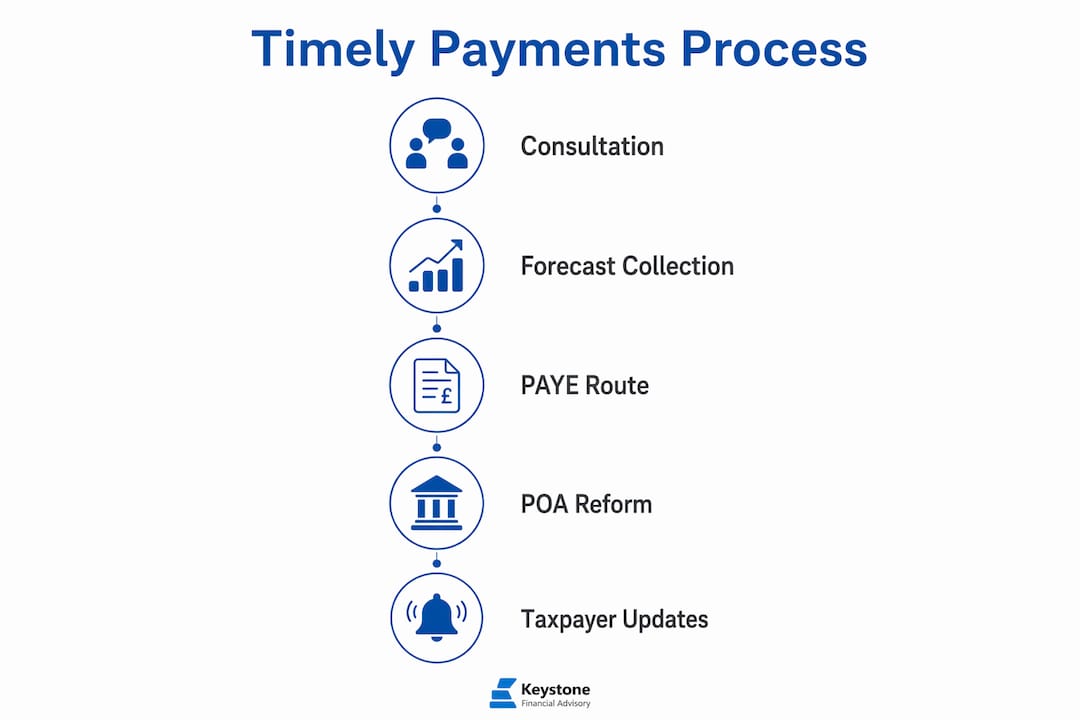
Two principal models are on the table. The first, and the one HMRC is furthest along on, is collecting forecasted SA liabilities through PAYE. The second is reforming Payments on Account for those without PAYE income.
The PAYE route
HMRC would calculate a forecasted SA liability based on your last filed Self Assessment return. Under the current proposal, that ordinarily means the return for the tax year two years prior to the collection year. That forecast would then be spread across your payslips, deducted each payday where your PAYE income is sufficient to absorb it. At the year-end, a reconciliation would correct any over or underpayment via a balancing payment or repayment.
Taxpayers would be able to update their forecast during the year if their circumstances change, though the mechanics of how easily that can be done are one of the key questions the consultation is asking.

Reformed Payments on Account
For SA taxpayers without PAYE income, the consultation explores moving from the current twice-yearly POA structure to more frequent payments, potentially monthly or quarterly, paid within the tax year and reconciled at year-end.
A simple worked example
Suppose your 2023/24 SA return showed a total tax liability of £6,000. Under the PAYE route, HMRC would use that figure as the forecast for 2025/26 collection. Spread across 12 monthly payslips, that is £500 per month deducted through your tax code. If your actual 2025/26 liability turns out to be £5,400, you receive a £600 repayment after filing. If it is £6,800, you pay a £800 balancing payment in January.
The data flow in brief:
Prior SA return filed (two years earlier)
HMRC calculates forecasted liability
In-year collection begins via PAYE coding or direct POA instalments
Year-end return filed; reconciliation produces balancing payment or repayment
Pro Tip: If your income has dropped significantly since your last filed return, contact HMRC or your agent now to discuss updating your tax code. Waiting until the system goes live in 2029 means two years of potential overcollection.
Which taxpayers and businesses will be affected?
The consultation is explicit that the PAYE route targets SA taxpayers with sufficient PAYE income first, starting from April 2029. SA-only taxpayers (sole traders, partners, and landlords without any PAYE income) are not in the initial cohort but are considered for the reformed POA track. The consultation is gathering views on what more frequent direct payments would look like for them.
Taxpayers with irregular or lumpy income face the sharpest cashflow risk. Someone who earns a large bonus in one year, or a landlord whose rental income fluctuates with voids, could find their in-year deductions based on an unrepresentative prior return. The two-year lag is the central concern here: a taxpayer whose income fell sharply in the intervening period effectively lends HMRC money until the year-end reconciliation corrects it.

Landlords and property income taxpayers are a particularly exposed group. Rental income can swing with void periods, rent arrears, or a property sale. Those with property income should read the landlord tax planning guidance alongside the consultation to understand how more frequent payments could affect their cashflow.
Employers, payroll providers, and pension providers face operational changes too. Coding notices will need to be processed accurately and promptly; errors or delays in code updates can mean incorrect deductions persist across multiple pay runs, creating either undercollection or an extended overcollection problem. The consultation asks specifically what support employers and payroll providers will need and what transitional arrangements are necessary.
What are the current late-payment penalties and how might they change?
Understanding the existing penalty regime matters because missed in-year instalments could trigger the same framework.
Current statutory penalties
Under the current rules for ITSA (set out in Finance Act 2009, Schedule 56), late payment penalties are charged at fixed intervals:
5% of unpaid tax at one month late
5% of tax still unpaid at six months late
5% of tax still unpaid at twelve months late
Interest also accrues on the unpaid amount from the date it becomes overdue. Under the reformed penalty regime being rolled out alongside MTD, the structure shifts to a proportionate model: no penalty if paid within 15 days, a first charge from day 16, and a second daily-accruing charge from day 31.
Timing | Penalty (reformed regime) |
— | No penalty |
16–30 days late | First charge: percentage of outstanding amount |
31+ days late | First charge plus second charge accruing daily |
Time to Pay agreed within 15 days | Penalties paused |
The factsheet confirms that late payment of a final SA bill can trigger percentage penalties at 30 days, six months, and twelve months, plus interest on the unpaid amount.
How Timely Payments interacts with penalties
If in-year PAYE deductions are missed because of a coding error or an employer’s payroll failure, the question of who bears the penalty risk is unresolved. The consultation is seeking views on safeguards precisely because the current penalty framework was designed around annual balancing payments, not monthly in-year instalments.
A missed January balancing payment today results in one penalty event. Under Timely Payments, a persistent coding error could theoretically create multiple missed-payment events across a year. HMRC has indicated it will consult on appropriate safeguards, but the detail is not yet settled.
Scenario comparison:
Today: Miss the 31 January balancing payment of £4,000. After 30 days, a 5% penalty (£200) applies, plus interest from 1 February.
Under Timely Payments (illustrative): A coding error means three monthly PAYE deductions of £500 are missed. The penalty and interest treatment of those missed instalments is one of the open questions the consultation is addressing.
Pro Tip: If you are already struggling with a current SA bill, a Time to Pay arrangement agreed within 15 days of the due date pauses penalties from the contact date. Do not wait for a penalty notice before calling HMRC.
What would the taxpayer experience look like in practice?
Three short scenarios illustrate the cashflow effects.
Scenario 1: Steady income
A marketing consultant earns £60,000 in employment and £8,000 from freelance work each year, consistently. Their prior return shows an SA liability of £3,200. Under Timely Payments, roughly £267 per month is deducted through their PAYE code. Their take-home pay falls by that amount each month, but there is no January bill. At year-end, if the freelance income is the same, the reconciliation produces a small balancing payment or nil. Cashflow impact: predictable and manageable.
Scenario 2: Falling income
A consultant whose freelance income dropped from £20,000 to £8,000 between the prior return year and the collection year faces a different picture. Their in-year deductions are based on the higher prior liability. They overpay throughout the year and wait until after filing to receive a repayment. That repayment could take weeks or months to arrive, meaning their cashflow is squeezed for an extended period.
Scenario 3: Lumpy income
A property developer receives a large payment on completion of a project in one year, then has minimal income the next. Their prior return shows a high liability; their actual liability in the collection year is much lower. Without updating their forecast, they face sustained overcollection and a repayment that only arrives after the year-end filing.
Reconciliation mechanics:
File your SA return after the tax year ends
HMRC calculates the difference between what was collected in-year and the actual liability
A balancing payment is due by 31 January if you underpaid; a repayment is issued if you overpaid
Repayment timing depends on HMRC processing; it is not instant
To keep forecasts accurate during the year, taxpayers will need to:
Contact HMRC or use an online form to update their forecast if income changes materially
Notify their agent so the agent can request a coding notice change
Keep records of any forecast update requests and the dates submitted
For MTD participants, the consultation asks whether quarterly MTD updates should replace the two-year-old return as the basis for in-year payments, which would reduce the lag significantly
What are the benefits and the risks?
The case for Timely Payments is real. Spreading liability across the year removes the shock of a large January bill, reduces the volume of tax debt, and aligns the UK with how most OECD countries collect income tax. For taxpayers with steady, predictable income, the change is largely administrative.
The risks, however, are concentrated in exactly the taxpayer profiles that already find SA most difficult.
Benefits:
Smaller, more frequent payments replace one large annual bill
Reduced risk of falling into tax debt through accumulated arrears
Better alignment between income receipt and tax payment
Potential for MTD users to use more current data, reducing the lag
Risks and concerns:
The two-year lag means collections are based on potentially unrepresentative prior income
Taxpayers with falling or irregular income face sustained overcollection until year-end reconciliation
Administrative burden on employers and payroll providers to process coding notices accurately
Agents face ongoing workload to update forecasts and request code changes throughout the year
MTD interactions are unresolved: the consultation is still asking questions, not providing answers
Practitioners, including the Association of Taxation Technicians, have raised concerns that a simpler quarterly POA model would achieve most of the consultation’s aims with considerably less administrative burden and lower risk of sustained overcollection for variable-income taxpayers.
Practical risk mitigation:
Run a forecast now comparing your last two filed returns to spot income volatility
Build a buffer fund equivalent to at least one quarter’s estimated SA liability
Engage an agent to manage forecast updates and coding notice requests proactively
If you use MTD-compatible software, check whether your provider is tracking the consultation’s MTD questions
Where is the consultation now and what happens next?
The consultation was published on 23 June 2026. Responses can be submitted via the GOV.UK consultation page. The closing date is stated on that page; check it directly as HMRC may update it.
Timeline:
June 2026: Consultation published; response period opens
Autumn/Winter 2026: Consultation closes; HMRC analyses responses
2027: Policy decisions confirmed; draft legislation expected in a Finance Bill
2028: Legislation enacted; transitional guidance published
April 2029: PAYE route goes live for SA taxpayers with sufficient PAYE income
Post-2029: Further changes for SA-only taxpayers, subject to separate consultation outcomes
Transitional arrangements are likely but not yet specified. HMRC has indicated it will consult on safeguards, support for employers, and phasing. The detail will emerge through the response process and subsequent policy statements.
Statistic: In January 2025, approximately 1.1 million Payments on Account were missed and 75% of those led to tax debt. That scale is the direct justification for the April 2029 implementation target.
What should you do right now?
You do not need to wait until 2029 to act. The decisions you make in the next 90 days, particularly around forecasting and responding to the consultation, will shape how well-prepared you are.
Immediate checklist:
Confirm your scope. Check whether you have PAYE income alongside SA income. If you do, you are in the first wave. If you are unsure whether you need to file at all, the SA filing obligations guide is a useful starting point.
Pull your last two filed returns. Compare the SA liabilities. If they differ significantly, you have a forecasting risk under the two-year-lag model.
Run a rough in-year forecast. Divide your expected SA liability by 12. That is the approximate monthly PAYE deduction you would face. Can your cashflow absorb it?
Set aside a buffer. Even before 2029, building a reserve equivalent to your estimated quarterly SA liability reduces the shock of any transition.
Speak to your agent or payroll provider. Employers and payroll providers need lead time to implement coding notice changes accurately. Early conversations matter.
Consider voluntary in-year payments. Nothing stops you from making voluntary payments towards your SA liability now, smoothing your January bill before the formal system changes.
Points worth raising in a consultation response:
The forecasting burden for taxpayers with irregular or seasonal income
Safeguards to prevent sustained overcollection where income falls
The ease (or difficulty) of updating forecasts online without agent involvement
Whether a cap should apply to PAYE collection as a proportion of PAYE income
Transitional arrangements for taxpayers moving into the new system
Alignment with MTD: should MTD users be able to base payments on quarterly updates rather than a two-year-old return?
Respond directly via the GOV.UK consultation page. For Time to Pay guidance if you are already in arrears, Citizens Advice provides a clear summary of your options.
For software, MTD-compatible tools that produce quarterly income summaries will be better placed to support forecast updates once the system goes live. Check whether your current bookkeeping software is on HMRC’s approved MTD list.
How can an accountant help you prepare for Timely Payments?
The practical burden of Timely Payments falls hardest on taxpayers with variable income and on those without an agent already managing their SA affairs. KeystoneFA’s team works directly with founders, sole traders, and growing businesses on exactly this kind of proactive tax planning.
Specific services relevant to the Timely Payments changes:
Cashflow forecasting and modelling: comparing prior returns, projecting in-year deductions, and identifying overcollection risk before it materialises
Forecast updates with HMRC: liaising with HMRC to adjust tax codes where income has changed materially
PAYE code liaison: working with employers and payroll providers to process coding notice changes accurately and on time
MTD alignment and software selection: helping clients choose and configure MTD-compatible software so that quarterly updates can feed into forecast adjustments
Time to Pay arrangements: representing clients in discussions with HMRC where cashflow difficulties arise, and negotiating instalment plans before penalties accrue
Consultation response drafting: helping clients articulate specific concerns about irregular income, safeguards, and transitional arrangements in their formal responses
Consider a landlord client with property income that varies by 30–40% year on year due to void periods and refurbishment costs. Under the two-year-lag model, their in-year PAYE deductions could be based on a peak-income year, creating significant overcollection in a low-income year. KeystoneFA would model both scenarios, identify the likely overcollection amount, submit a forecast update to HMRC, and advise on whether voluntary underpayment of the PAYE deduction is appropriate while awaiting a code change. That is the difference between reacting to a problem and preventing it.
For broader year-end tax planning steps that complement Timely Payments preparation, KeystoneFA’s published guidance covers the actions worth taking before your accounting year closes.
Pro Tip: If you have a landlord tax situation, the landlord tax relief guidance is worth reviewing alongside your SA forecast to ensure you are claiming every available relief before in-year collections begin.
Key takeaways
HMRC’s Timely Payments consultation proposes collecting forecasted Self Assessment liabilities in-year via PAYE from April 2029, using a two-year-old return as the default basis, with year-end reconciliation correcting any over or underpayment.
Point | Details |
One in five SA bills paid late | HMRC’s factsheet confirms approximately 1 in 5 ITSA bills are currently paid late, driving the April 2029 reform. |
Two-year lag is the key risk | In-year PAYE collections will be based on your return from two years prior; falling income means overcollection until year-end. |
1.1 million POAs missed in January 2025 | 75% of those missed payments led to tax debt, per the HMRC factsheet, justifying the scale of the proposed change. |
Respond to the consultation now | The consultation is open on GOV.UK; irregular-income taxpayers especially should submit views on safeguards and forecasting. |
KeystoneFA can model your exposure | KeystoneFA offers cashflow forecasting, PAYE code liaison, and Time to Pay support to help clients prepare for the 2029 changes. |
The case for pragmatic safeguards, not just smoother payments
The Timely Payments consultation is well-intentioned. Spreading SA liabilities across the year is genuinely better for most taxpayers than one large January bill, and the data on missed POAs makes a compelling case for change. But the design detail is where this reform will succeed or fail.
The two-year lag is the single biggest structural problem. Basing in-year collections on a return filed two years earlier is not a minor technical detail; it is a fundamental mismatch for anyone whose income moves around. A freelancer who had a strong year in 2023/24 but a quiet 2025/26 will be paying 2023/24 rates throughout 2025/26, then waiting months for a repayment after filing. That is not smoothing payments; that is advancing them at the taxpayer’s expense.
The consultation’s question about whether MTD users should be able to base payments on quarterly updates is the most promising idea in the document. If HMRC can build a system where MTD-compliant taxpayers update their forecast quarterly and the PAYE code adjusts accordingly, the two-year lag becomes a fallback for non-MTD users rather than the default for everyone. That would be a genuinely better outcome.
The points worth pressing in any consultation response: a simpler quarterly POA option as a minimum viable alternative for non-PAYE taxpayers; a clear, easy online process for updating forecasts without needing to call HMRC; explicit caps on how much of a taxpayer’s PAYE income can be absorbed by SA deductions; and a managed transition with at least one full tax year of parallel running before penalties apply to the new system.
KeystoneFA: practical help for Timely Payments preparation
Navigating a structural change to how your SA liability is collected is not something to leave until 2029. The forecasting work, the coding notice conversations, and the consultation response all need to happen now, and they are easier with an adviser who already knows your numbers.
[

](www.keystonefa.co.uk)
KeystoneFA works with founders, sole traders, and growing businesses across the UK on proactive tax planning and HMRC compliance. For Timely Payments specifically, the firm offers a readiness review that covers your cashflow exposure under the two-year-lag model, a forecast update submission to HMRC where your income has changed, and a structured consultation response covering the points most relevant to your situation. The team has worked with clients across the UK and the Middle East, and brings that breadth of experience to bear on UK-specific compliance challenges.
If you have irregular income, property receipts, or simply want to understand what your monthly PAYE deduction would look like from April 2029, get in touch with KeystoneFA for a tailored conversation. The earlier you model your exposure, the more options you have.
Useful sources
The primary documents for this consultation are published on GOV.UK. All links below go directly to the source material.
Timely Payments in Income Tax Self Assessment (ITSA) consultation — Published 23 June 2026. The full consultation document covering both the PAYE route and reformed POA options, including the questions HMRC is seeking views on. This is where you submit your response.
Timely payments in Income Tax Self Assessment factsheet — Published alongside the consultation. Contains the key statistics (one in five bills paid late; 1.1 million POAs missed in January 2025) and a plain-language summary of the proposals.
AccountingWEB: Timely payments — a sledgehammer to crack a nut? — Practitioner commentary including ATT analysis of the two-year lag risk and the case for a simpler quarterly POA model.
Mondaq: UK Government consults on plans to bring forward income tax payment dates — Summary of the operational implications for employers, payroll providers, and pension providers, and the safeguards the consultation is seeking views on.
Citizens Advice: Dealing with income tax arrears — Practical guidance on Time to Pay arrangements and enforcement options for taxpayers already in arrears.
Source | Type | What it covers |
GOV.UK consultation page | Primary / official | Full proposals, response portal, design questions |
GOV.UK factsheet | Primary / official | Key statistics, plain-language summary |
AccountingWEB / ATT | Practitioner commentary | Two-year lag risks, quarterly POA alternative |
Mondaq | Legal / professional | Employer and payroll operational impacts |
Citizens Advice | Consumer guidance | Time to Pay, enforcement, arrears options |
FAQ
What happens if I pay my Self Assessment tax bill late?
Late payment triggers interest from the first day overdue, plus penalty charges at 30 days, six months, and twelve months under the current rules. Contacting HMRC to arrange a Time to Pay plan before the 30-day mark can pause penalties from the date you make contact.
What is HMRC’s Timely Payments consultation?
It is a formal consultation published on 23 June 2026 seeking views on collecting forecasted SA liabilities in-year, primarily through PAYE for those with sufficient PAYE income, with implementation targeted from April 2029.
How long can HMRC pursue unpaid tax?
HMRC can generally assess and pursue unpaid Income Tax for up to four years from the end of the relevant tax year in cases of innocent error, and up to twenty years in cases of deliberate non-compliance. Interest and penalties continue to accrue on outstanding amounts throughout that period.
Will the new rules affect my Payments on Account?
For SA taxpayers with PAYE income, the PAYE route would replace or supplement the current POA structure from April 2029. For SA-only taxpayers, the consultation is exploring more frequent direct POAs but no changes have been confirmed yet.
How do I respond to the Timely Payments consultation?
Submit your response directly through the GOV.UK consultation page before the closing date stated there. If you want help drafting a response that reflects your specific income pattern, KeystoneFA can assist.
This article is general information about HMRC’s consultation proposals and does not constitute tax or legal advice. Confirm the current rules and how they apply to your situation with HMRC directly or with a qualified tax adviser.
Recommended