Late payment is silently killing UK small businesses

Late payment is the single greatest cash flow threat facing UK small businesses right now. A company can be profitable on paper and still miss payroll because cash is trapped in unpaid invoices. If you are owed money today, here are three things to do in the next 24–72 hours:
Check your aged receivables. Open your accounting software and list every invoice overdue by more than 14 days, sorted by value. Know exactly what you are owed and by whom.
Send a firm chase email today. Reference the Late Payment of Commercial Debts (Interest) Act 1998 and state that statutory interest will begin to accrue if payment is not received within seven days. Most clients pay when they realise you know your rights.
Update your 30-day cash forecast. Assume the three largest overdue invoices will not arrive this week. Can you cover payroll, VAT, and rent? If not, that is your emergency signal.
Government research published in 2025 confirms that late payment reduces business survival rates and suppresses investment. KeystoneFA works with UK founders and SME owners to set up the forecasting habits and chase processes that stop this from becoming a crisis.
Key takeaways
Late payment is an operational emergency for UK SMEs, and the businesses that survive it are those with tight invoicing processes, a weekly cash flow forecast, and the confidence to apply their legal rights under the Late Payment of Commercial Debts (Interest) Act 1998.
Point | Details |
Late payment scale | Sage/CEBR research estimates £112bn is locked in late invoices across UK small businesses. |
Your legal rights | Statutory interest of 8% plus the Bank of England base rate accrues automatically on overdue B2B debts under the 1998 Act. |
First 30 days | Run your AR ageing report, send a statutory interest warning, and update your 30-day cash forecast immediately. |
Prevention beats recovery | Shorter terms, deposits, Direct Debit mandates, and a credit check on new clients reduce late payment before it starts. |
KeystoneFA | Offers a structured cash flow review and monthly retainer service to help UK SMEs build the forecasting and chase processes that protect working capital. |
Table of Contents
How late payments are actually destroying UK small businesses
The core problem is the gap between profit and cash. A business can show a healthy margin in its accounts while simultaneously being unable to pay its suppliers, because the cash is sitting in someone else’s bank account. That distinction is not academic — it is the reason solvent companies go under.
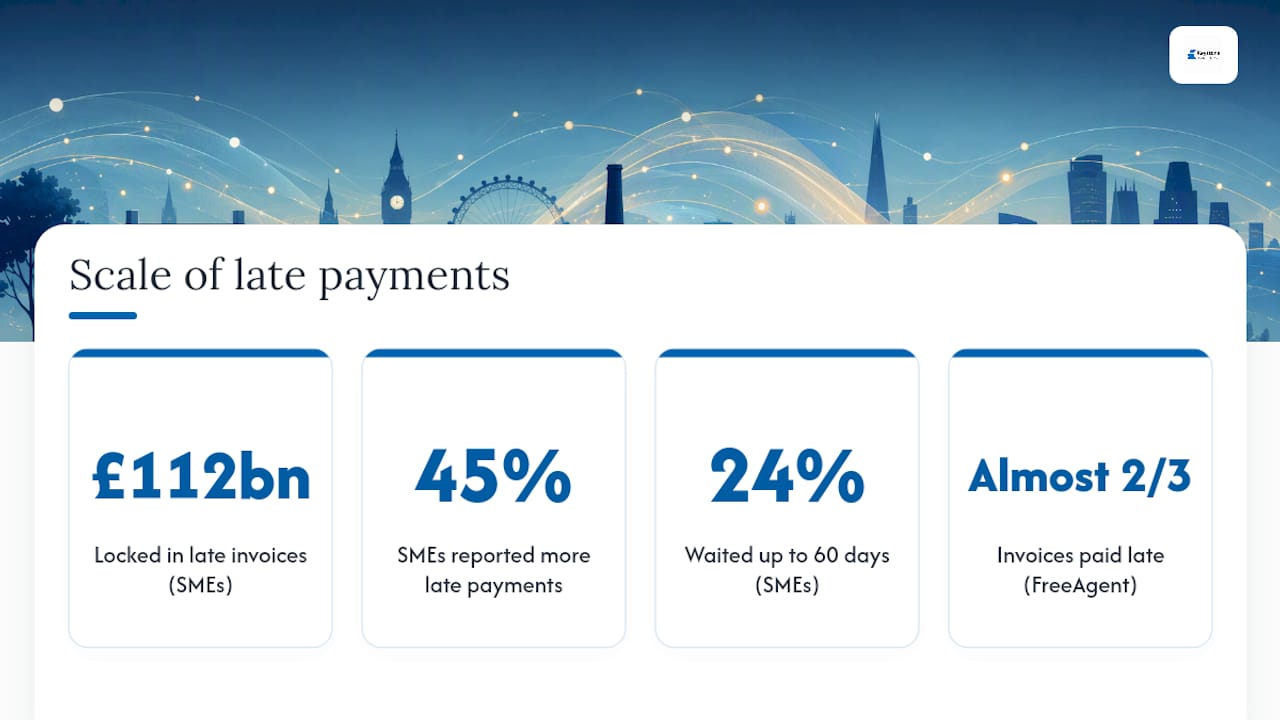
The scale is significant. Sage and CEBR research in 2025 estimated that addressing late payments could release a very large amount of working capital for small businesses, based on analysis of over 1.2 million invoices from Sage customers, with a large proportion paid late. A GoCardless and FSB survey of over 2,000 small businesses found that 45% reported more late payments than the previous year, with 24% waiting up to 60 days for payment.
£112 billion is estimated to be locked in late invoices across UK small businesses. Releasing even a fraction of that would transform the working capital position of millions of firms.
Consider what a single late invoice does in practice. A small marketing agency invoices £18,000 for a completed campaign. The client’s accounts payable team sits on it for 60 days. Meanwhile, the agency has already paid its freelancers, its software subscriptions, and its office costs. The owner delays paying their own supplier for print materials. That supplier, now short, delays paying their own staff. FreeAgent’s analysis found that almost two-thirds of invoices among its small business customers were paid late, with real knock-on effects on payroll and write-offs. The 2023 Prompt Payment and Cash Flow Review documented exactly this domino effect: cash flow pressure on one business causes knock-on payment failures to its suppliers.
Why do customers pay late, and where does your process leak cash?
Late payment rarely has a single cause. On the payer’s side, the most common reasons are administrative error (wrong PO number, invoice sent to the wrong contact), disputed work or deliverables, slow internal approval cycles, and — less charitably — deliberate delay to manage their own cash position. Large corporates are particularly prone to the last two.
On your side, the leaks are usually just as fixable. Slow invoicing is the biggest one: every day between completing work and sending an invoice is a day added to your payment wait. Vague payment terms (“payment due on receipt”) give clients room to interpret generously. Accepting only BACS transfers when a client’s AP system prefers a different method adds friction. Skipping credit checks on new clients means you discover their payment habits only after you have done the work.
The FSB’s practical cash flow guidance recommends shortening payment terms, requesting deposits, and offering online payment options as immediate improvements. The GoCardless/FSB report also found that automation and pull-based payments such as Direct Debit reduce late payments materially.
Quick checks to run on your accounts receivable process:
Are invoices sent on the same day work is completed or delivered?
Do your invoices state a specific due date (not just “30 days”)?
Do you accept card payments and bank transfer, not just BACS?
Do you run a basic credit check before taking on new clients above a threshold value?
Do you have a written payment terms clause in every client contract?
Pro Tip: Switch your invoicing day from the end of the month to the day work is completed. For many service businesses, this single change cuts average payment time by one to two weeks.
What does UK law give you to recover late payments?
The Late Payment of Commercial Debts (Interest) Act 1998 gives every qualifying B2B debt an implied right to carry statutory interest once payment is overdue. You do not need a court order to charge it. Gov.uk guidance sets the rate at 8% plus the Bank of England base rate for business-to-business debts, unless the contract specifies a different rate that amounts to a substantial remedy.
How to calculate statutory interest
Using the gov.uk worked example: on a debt of £1,000 with a Bank of England base rate of 0.5%, the annual statutory interest rate is 8.5%. That produces approximately 23p per day in interest. On a £10,000 invoice, the daily figure is roughly £2.33. It adds up quickly on larger debts.

Fixed compensation also applies automatically under the Act:
Debt amount | Fixed compensation |
Under £1,000 | £40 |
£1,000 to £10,000 | £70 |
£10,000 or more | £100 |
Steps to apply statutory interest
Record the original due date and the date payment was actually received (or today’s date if still unpaid).
Calculate interest from the day after the due date using the formula: (debt × statutory rate) ÷ 365 × number of days overdue.
Send a revised invoice or a separate interest invoice clearly stating the Act, the overdue period, the daily rate, and the fixed compensation amount.
Give the debtor 7 days to pay the revised total before escalating.
If no payment, send a formal letter before action stating your intention to use the small claims court (for debts up to £10,000) or a debt recovery agent.
Pro Tip: Contract terms can override statutory interest only if they provide a “substantial remedy” for the creditor. If a client’s standard terms attempt to reduce or exclude your right to interest, those clauses may be void. Take advice before accepting them.
A 30/60/90-day checklist to recover cash fast
Days 1–30: chase and triage
Run a full AR ageing report. Prioritise invoices over 30 days by value.
Send a professional chase email to each overdue client, referencing the Late Payment Act and your intention to add statutory interest after seven days.
Offer a payment link (Stripe, GoCardless, or bank transfer) in every chase email. Remove friction.
For invoices over 60 days old, follow up by phone the same day as the email.
Update your 30-day cash forecast with realistic collection assumptions, not optimistic ones.
Sample chase email opening: “I am writing regarding invoice [number] for £[amount], which was due on [date] and remains outstanding. Under the Late Payment of Commercial Debts (Interest) Act 1998, statutory interest is now accruing at [rate]% per annum. Please arrange payment within seven days to avoid further charges.”
Days 31–60: escalate and protect
Send a final demand to any client who has not responded, with a clear deadline and the total now owed including interest.
Consider withholding further work or deliverables until the account is settled. State this in writing.
Contact your key suppliers proactively. Explain the situation and negotiate extended terms rather than simply paying late without warning. Suppliers respond far better to a phone call than to a missed payment.
Review whether any milestone invoices can be raised earlier than planned.
Days 61–90: formal recovery
Issue a letter before action for any debt still unpaid. This is a formal legal step and often prompts payment without court involvement.
For debts up to £10,000, file a claim through the Money Claim Online small claims process.
For larger or more complex debts, engage a commercial debt recovery agent. Their fees are often recoverable from the debtor.
Review your client list. Any client who has paid late twice is a credit risk. Adjust their terms or require a deposit going forward.
Pro Tip: Keep your tone professional throughout. A firm, factual email that cites the law is more effective than an angry one, and it preserves the relationship if the client genuinely had a processing delay.
How to stop late payments before they start
Prevention is cheaper than recovery. The following measures, built into your standard client onboarding, will reduce the frequency and severity of late payment significantly.
Contract clauses to include:
A specific payment due date (e.g. “14 days from invoice date”), not “on receipt.”
An explicit interest and compensation clause aligned with the Late Payment Act.
Retention of title for goods supplied, where applicable.
A clause permitting you to suspend services for non-payment after written notice.
Payment design:
Shorten your standard terms. Thirty days is a cultural default, not a legal requirement. Many service businesses now use 14 days.
Require a deposit or retainer before work begins, particularly for new clients or large projects.
Invoice on milestones rather than at project completion. This spreads your cash exposure.
Offer Direct Debit via GoCardless or a similar provider for recurring work. Pull-based payments remove the client’s ability to delay.
Use e-invoicing where possible to reduce the “I never received it” excuse.
Customer onboarding checklist:
Run a credit check via Companies House or a credit reference agency for any new client above your threshold value.
Agree the invoicing schedule and acceptance criteria in writing before work starts.
Confirm the client’s AP contact, PO number requirements, and preferred payment method on day one.
What short-term finance options can bridge a cash gap?
When late payments create an immediate shortfall, short-term finance can buy time. The main options for UK SMEs are:
Invoice factoring: You sell your outstanding invoices to a lender at a discount (typically 70–90% of face value upfront). The lender collects from your client. Fast cash, but the client knows a third party is involved and fees reduce your margin.
Invoice discounting: Similar to factoring, but you retain control of collections. Usually available only to businesses with a track record and higher turnover.
Business overdraft: Flexible and familiar, but banks have tightened criteria. Best for short-term, predictable gaps rather than structural shortfalls.
Business credit card: Useful for small, immediate expenses while waiting for payment. Interest costs escalate quickly if balances are not cleared monthly.
Short-term business loan: Fixed repayment schedule. Useful when you know the cash gap has a defined end date (e.g. a large invoice expected in 45 days).
Decision signal: if you are using short-term finance to cover the same gap month after month, the problem is structural, not temporary. That is the point to bring in an adviser and fix the underlying process.
The 2025 GoCardless/FSB report found that many small businesses resort to short-term finance specifically because of late receipts, which adds cost and risk to an already stressed position. Using finance to bridge a one-off gap is reasonable. Using it as a permanent substitute for collecting your own money is not.
How KeystoneFA helps SMEs recover and protect cash flow
KeystoneFA works with UK founders and small business owners to build the financial controls that prevent late payment from becoming a crisis. The approach is practical and structured.
The KeystoneFA service flow:
Diagnostic: Review your current AR ageing, invoicing process, and payment terms to identify the fastest wins.
Forecasting setup: Build a rolling 13-week cash flow forecast in your accounting software (Xero, QuickBooks, or FreeAgent), with clear assumptions for collection timing.
Process optimisation: Tighten your invoicing schedule, chase templates, and escalation timeline so collections happen without you having to think about it each month.
Ongoing monitoring: Monthly retainer clients receive a regular cash flow review alongside their bookkeeping and compliance work, so problems surface before they become emergencies.
Accounting for pre-revenue startups and growing businesses requires the same discipline: know your numbers before the cash runs out, not after.
KeystoneFA’s team includes professionals with experience at top UK and Middle East firms, and the firm specialises in the kind of hands-on, digital-first accounting that founders and SME owners actually need. For a cash flow health check, visit the KeystoneFA website or contact the team directly.
What most advisers get wrong about late payment
The standard advice is to chase harder and invoice faster. That is not wrong, but it misses the deeper issue.
Late payment is a symptom of a process that was never designed to protect cash in the first place. Most small business owners set their payment terms once, when they started, and never revisited them. They invoice at the end of the month because that is what feels tidy. They accept BACS because that is what their first client used. None of these decisions were made deliberately — they just accumulated.
The businesses I see recover fastest from late payment pressure are not the ones who send the most aggressive chase emails. They are the ones who spend two hours redesigning their onboarding process: shorter terms, a deposit clause, a Direct Debit mandate for recurring work, and a weekly forecast review. One client moved their invoicing day from the last Friday of the month to the day work was signed off. Their average collection time dropped by 11 days. That is the equivalent of finding an extra month of cash in a year.
The moment I recommend immediate escalation or formal recovery is when a client has been unresponsive for more than 45 days and the debt represents more than 15% of monthly turnover. At that point, the relationship risk of chasing hard is lower than the survival risk of waiting.
KeystoneFA’s cash flow review: what to expect
Cash flow problems rarely announce themselves in advance. A KeystoneFA cash flow review gives you a clear picture of where your money is, where it is going, and what to do in the next 30 days.
[
](www.keystonefa.co.uk)
The review covers your current AR position, your invoicing and chase process, your 30-day forecast, and any short-term finance options worth considering. Most clients leave with three to five specific changes they can implement immediately, plus a monthly monitoring framework that keeps the picture current.
KeystoneFA works on a monthly retainer model, so there are no surprise bills. The initial review is the starting point for an ongoing relationship, not a one-off report. Book a cash flow review with KeystoneFA and get a clear plan within days, not weeks.
Sources
Use these sources when preparing statutory interest calculations, formal demands, or reviewing your payment policies:
This article is general information, not a substitute for advice from a qualified financial advisor. Consult a qualified financial professional about your own circumstances before acting on anything here.
FAQ
What is the small business late payment protection in the UK?
The Late Payment of Commercial Debts (Interest) Act 1998 gives UK businesses an automatic right to charge statutory interest at 8% plus the Bank of England base rate on overdue B2B invoices, plus fixed compensation of £40, £70, or £100 depending on the debt size.
Why do small businesses struggle with cash flow?
Profitable businesses can still face cash flow problems when payment is delayed, because cash is tied up in unpaid invoices rather than available in the bank. Late payment, slow invoicing, and weak credit controls are the most common causes.
How many UK businesses are owed money from late payments?
Sage and CEBR research in 2025 found that 44% of invoices among their customer base were paid late, while a GoCardless/FSB survey found 45% of small businesses reported an increase in late payments year-on-year.
Do cash flow problems cause most small business failures?
Cash flow issues are a leading cause of small business failure in the UK, as confirmed by government research showing late payment reduces business survival rates. A profitable business with poor cash flow management remains at serious risk of insolvency.
When should I get an accountant involved in my late payment problem?
Bring in an adviser when a single overdue debt exceeds 15% of your monthly turnover, when you are using short-term finance repeatedly to cover the same gap, or when you have no reliable cash flow forecast. KeystoneFA offers an initial cash flow review to diagnose the problem and set up the controls to prevent recurrence.
Recommended