Founders: Finish UK VAT Registration Without HMRC Follow Up

If your taxable turnover has passed £90,000 in the last 12 months, or you expect it to cross that line in the next 30 days, you must register for VAT now — either through the online service or by preparing form VAT1 for postal submission. Gather your UTR, business bank details and identity documents first. Keystone Financial Advisory sees most delays caused by missing paperwork, not HMRC processing times.
TL;DR:
If your turnover exceeds £90,000 in any rolling 12-month period, you must register for VAT promptly, regardless of your accounting or tax year.
You must register immediately if you expect to breach the £90,000 threshold within the next 30 days, with an effective date starting from that 30-day period.
Ensure all required documents, such as identity proof, bank details, and turnover evidence, are prepared beforehand to avoid delays during application.
Most registrations are completed online through the Government Gateway, but postal applications are necessary for more complex cases or group registrations, which take longer.
Incorrectly estimating turnover, missing deadlines, or providing incomplete evidence may lead to penalties or delays, emphasizing the importance of accurate preparation and possibly seeking expert advice.
Table of Contents
When must you register for VAT, and how do you calculate your effective date?
Two separate tests decide whether registration becomes compulsory, and mixing them up is one of the most common reasons founders miss their deadline.
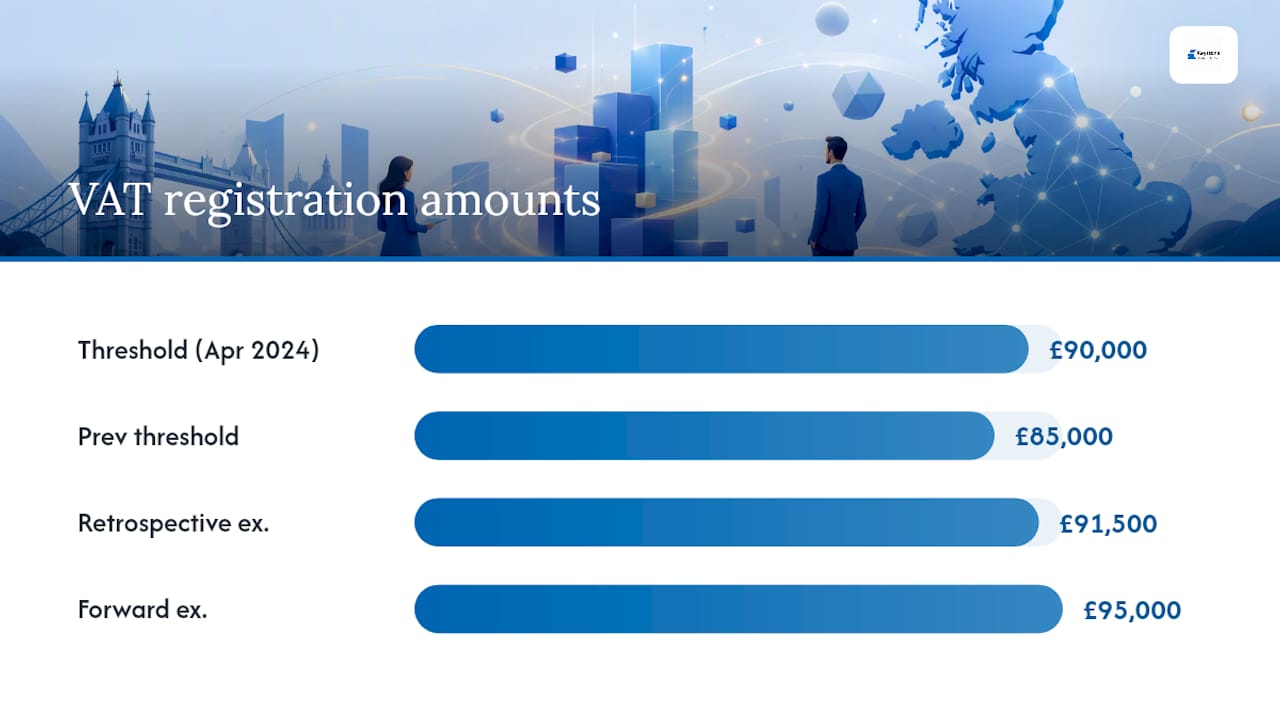
The first is backward-looking: if your taxable turnover for any rolling 12-month period exceeds £90,000, you must register. This isn’t your accounting year or tax year. It’s a rolling window you’re meant to check every month, which trips people up when a strong quarter pushes them over without an obvious “trigger” moment. The second test looks forward: if you expect your turnover to exceed £90,000 in the next 30 days alone, you must register immediately, and your effective date becomes the start of that 30-day period rather than the date you actually apply. The current threshold of £90,000 has applied since 1 April 2024, up from £85,000 previously.
Two quick examples make the difference concrete:
Retrospective test: A consultancy’s rolling 12-month turnover hits £91,500 on 15 June. Registration is compulsory, and the application must go in by the end of July, with an effective date of 1 August.
Forward test: A business signs a contract on 3 March worth £95,000, to be delivered within the next 30 days. It must register immediately, with an effective date of 3 March, the day it realised the threshold would be breached.
Special cases add wrinkles worth knowing about. A non-established taxable person (a business with no UK establishment making taxable supplies here) must register regardless of turnover, from their first sale. If you’re taking over an existing VAT-registered business, you may inherit its VAT obligations depending on how the transfer is structured. And if a one-off spike pushes you over the threshold temporarily, GOV.UK guidance allows you to apply for a registration exception if you can show turnover will drop back below £90,000 within the next 12 months.
What documents and information do you need before you start?
HMRC won’t process an application with gaps, so pull everything together before you open the registration form rather than mid-way through.
At minimum, you’ll need your Unique Taxpayer Reference (UTR), National Insurance number if you’re a sole trader, your company registration number if you’re a limited company, business bank account details, and an estimate of your turnover for the next 12 months. Limited companies also need details of company officers, while sole traders and partnerships need personal identity evidence for each partner.
Photocopies (not originals) of passports or driving licences for identity checks
A physical trading address, since HMRC generally won’t accept a PO Box as your principal place of business
Bank statements or a void cheque confirming your business account details
Evidence of turnover, such as invoices or contracts, if you’re registering under the 30-day forward test
Non-established taxable persons typically need form VAT1C, businesses with multiple related entities may need VAT50/51 for group registration, and land and property transactions sometimes require VAT5L. If you’re unsure which applies, the VAT1 notes walk through each supplementary form and when HMRC expects it. The requirements also differ depending on whether you’re set up as a sole trader or limited company, so check which category your business falls into before assembling documents.
Pro Tip: Scan your identity documents in advance and save them with a clear naming convention (e.g. “Surname_Passport_2026”) — HMRC often asks for supplementary evidence weeks after the initial submission, and a scramble to find the right file is what actually causes most delays.
How do you register for VAT step by step?
Most businesses register online, and the process is faster than people expect once the paperwork is ready. Here’s the order that avoids the common stumbling points.
Set up your Government Gateway account. If you already have one for Self Assessment or Corporation Tax, you can use it. If not, creating one takes about ten minutes and requires an email address and basic identity verification.
Gather your documents before opening the form. The online VAT registration service does not let you save large attachments partway through in every case, so have your UTR, company number, bank details and turnover figures to hand.
Work through the online sections. You’ll be asked about your business activity, turnover history, bank details, and your requested effective date. The system does allow save-and-return for most sections, but don’t assume every field carries over cleanly if you close the browser mid-session.
Use paper VAT1 only when required. Postal registration is for exceptions: non-established taxable persons, businesses joining the agricultural flat-rate scheme, or complex group registrations that the online system can’t handle. Posted applications typically take longer to process and should be sent well ahead of your effective date deadline.
Appoint an agent if you’d rather not handle it directly. This requires HMRC authorisation, usually through form 64-8 or the online agent authorisation process, after which your appointed accountant can submit and manage the registration on your behalf.
Processing usually takes a matter of weeks rather than days, though HMRC doesn’t publish a fixed guarantee. During that waiting period, you’re legally required to account for VAT from your effective date, even though you don’t yet have a VAT number to put on invoices. Most businesses issue invoices marked “VAT registration pending” and reissue proper VAT invoices once the number arrives.
What happens after you register for VAT?
Once HMRC approves your application, you’ll receive a VAT registration certificate confirming your VAT number, your effective date, and your first return period. This typically arrives within 30 working days, though busier periods can stretch that out.
From there:
Sign up for your VAT online account using your Government Gateway credentials, then add VAT as a service linked to your business tax account.
Making Tax Digital for VAT applies automatically the moment you register, unless you hold an approved exemption. MTD guidance requires digital record-keeping and return submission through compatible software rather than manual entry on the HMRC portal.
Returns are usually filed quarterly, with payment due one calendar month and seven days after the end of each accounting period.
Registration threshold callout: the £90,000 threshold has applied since 1 April 2024, up from £85,000 the year before, and it’s reviewed periodically rather than fixed indefinitely.
What mistakes trigger VAT registration penalties?
The most expensive mistakes are almost always avoidable. Miscalculating turnover by including non-taxable supplies, giving a PO Box as your trading address, or submitting incomplete identity evidence are the three that cause the most rework.
Confusing turnover with profit, which leads to registering too late or too early
Listing a PO Box or virtual office as the principal place of business
Submitting identity documents that don’t match the business name on file
Missing the 30-day forward-test deadline because turnover was reviewed only annually
Late registration doesn’t excuse you from the VAT you owed from your correct effective date. HMRC can charge penalties on top of the VAT itself, calculated by reference to how late the registration was and how much was owed in the interim, as the VAT1 notes make clear when explaining the declaration you sign.
Pro Tip: If a genuine one-off spike pushed you over the threshold temporarily, apply for a registration exception rather than registering reluctantly — HMRC’s exceptions process exists precisely for this, and its VAT helpline can talk you through eligibility before you submit anything.
What should you check the day before you submit?
A short pre-submission review catches most of the errors that otherwise cause HMRC to write back asking for clarification, which adds weeks to the process.
Confirm your rolling 12-month turnover figure against actual invoices, not estimates
Check that all identity photocopies are recent, legible, and named consistently
Verify your bank details match the account name registered with your business
Double-check your trading address is a genuine physical location, not a PO Box or virtual office
Keep every submitted document in a dedicated, clearly labelled folder. If HMRC later opens a compliance check, being able to produce the exact file you submitted, unchanged, saves considerable back-and-forth.
If your turnover calculation involves multiple income streams, seasonal contracts, or a recent business restructure, that’s usually the point where a founder benefits from a managed registration rather than a DIY one — the risk isn’t the form itself, it’s misjudging the effective date.
That’s typically the signal to bring in an adviser like Keystone Financial Advisory rather than push through alone: complex ownership structures, NETP status, or turnover that’s genuinely hard to forecast.
A founder’s view on getting VAT registration right first time
Most clients I’ve worked with weren’t worried about the VAT1 form itself. They were worried about applying for the wrong effective date and either overpaying or underdeclaring VAT for months without realising it. That’s the part people underestimate: registration isn’t really an admin task, it’s a forecasting exercise dressed up as one.
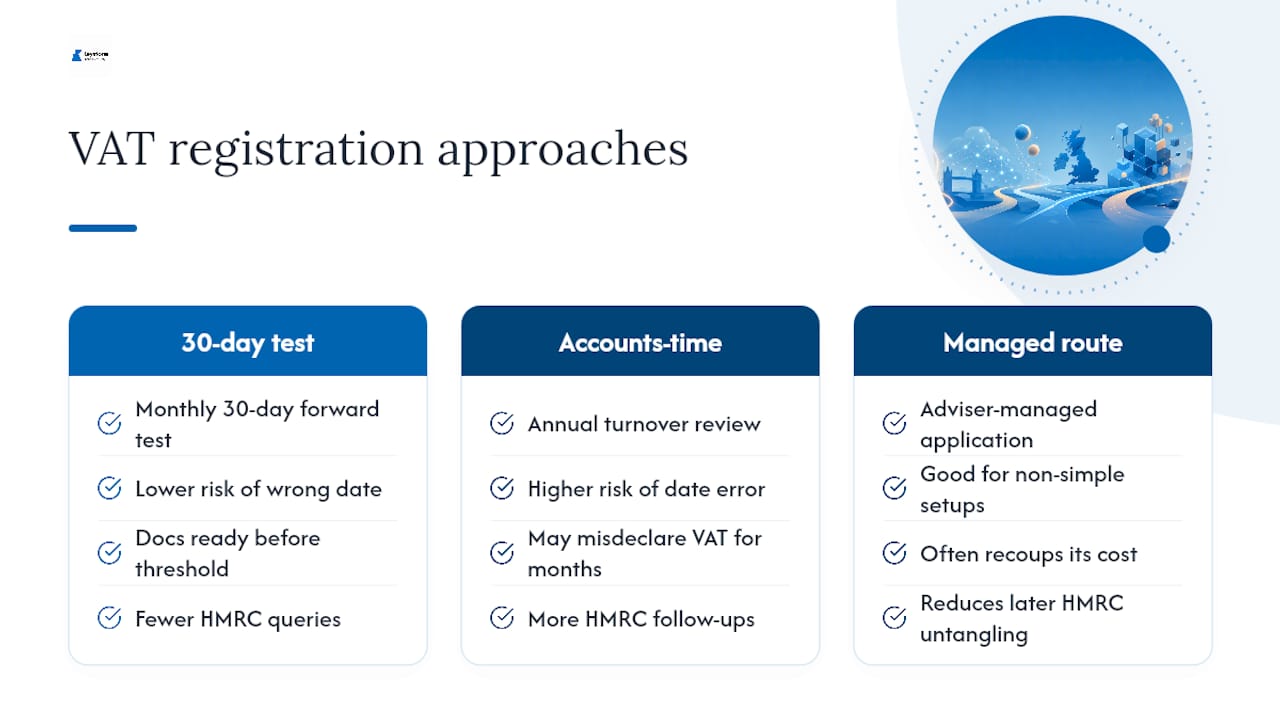
The businesses that sail through are the ones that treat the 30-day forward test seriously rather than reviewing turnover once a year at accounts time. One client had documents ready two days before their forecast tipped over £90,000, and the registration went through without a single follow-up query from HMRC.
If your situation involves more than a straightforward sole trader setup, a managed route through Keystone Financial Advisory usually pays for itself in the time it saves untangling HMRC queries later.
— Shoaib
Let Keystone Financial Advisory handle your VAT registration properly
KeystoneFA gets your VAT registration filed correctly the first time, with no follow-up queries from HMRC over missing documents or a misjudged effective date. Where most founders lose time reworking a rejected VAT1 or backtracking on turnover figures, Keystone’s team calculates your effective date, assembles the right supporting evidence, and files it whether that’s online or by post.
[
](www.keystonefa.co.uk)
Beyond registration, Keystone handles ongoing Making Tax Digital compliance, quarterly VAT returns, and the wider bookkeeping that keeps your VAT position accurate all year, not just at the point of application. That matters because a registration done well but followed by inconsistent record-keeping tends to unravel at the first HMRC compliance check. If VAT registration is on your to-do list this month, get in touch with Keystone Financial Advisory to have it handled properly rather than fitted around everything else you’re managing.
Sources
FAQ
Is it worth a small business being VAT registered?
Voluntary registration below the £90,000 threshold can help you reclaim VAT on purchases and present a VAT-registered image to clients, though it adds administrative work and may make your prices less competitive to non-VAT-registered customers.
How much does it cost to become VAT registered in the UK?
Registering directly with HMRC through GOV.UK costs nothing. Costs only arise if you hire an accountant or adviser like Keystone Financial Advisory to manage the process and ongoing filing for you.
What are the rules for registering for VAT in the UK?
You must register if your taxable turnover exceeds £90,000 over the past 12 months, or if you expect it to exceed that figure in the next 30 days alone, as set out in GOV.UK’s registration guidance.
How much money do I need to earn to be VAT registered?
Registration becomes compulsory once your taxable turnover passes £90,000 in a rolling 12-month period, though you can register voluntarily at any turnover level if it suits your business.
Recommended