Avoid Backdated VAT: UK £90,000 Threshold for Small Businesses

Register for VAT within 30 days of your rolling 12-month taxable turnover passing £90,000, or you’re liable from the date you should have registered. That’s the compulsory threshold as it stands for the 2025/26 tax year. You can also register voluntarily below that figure if it suits your business, but once you’re over £90,000 it stops being a choice.
TL;DR:
Businesses should monitor their rolling 12-month taxable turnover monthly to avoid automatic registration from crossing the £90,000 threshold.
Registering voluntarily allows reclaiming input VAT on costs incurred up to four years earlier, making timing decisions crucial.
Deregistration is possible when turnover forecasts fall below £88,000, but holding assets with VAT exceeding £1,000 at deregistration incurs extra costs.
Cross-border trade with Northern Ireland or specific schemes like distance selling can trigger registration thresholds outside the standard £90,000 limit.
Tracking only yearly turnover often leads to late registration and penalties; using the rolling 12-month total significantly reduces this risk.
Table of Contents
VAT threshold explained: what it means and the current figure
The VAT registration threshold is the point at which HMRC requires a business to charge VAT on its sales and start filing VAT returns. It isn’t a tax on profit or a badge for larger companies. It’s simply a turnover trigger, and once you cross it, registration becomes a legal duty rather than a decision.
The current threshold for taxable turnover in any rolling 12-month period is set for the 2025/26 tax year. It was raised in 2024 after a long freeze that had quietly pulled thousands of small businesses into VAT simply through inflation. The deregistration threshold, covered later, sits below the registration threshold.
What changed at the last update:
Registration threshold raised from £85,000 to £90,000
Deregistration threshold raised from £83,000 to £88,000
The £2,000 gap between the two figures was kept deliberately, to stop businesses bouncing in and out of registration around a single line
For context, the threshold stayed frozen at £85,000 from 2017 to 2024, meaning the real terms bar for registration fell every year inflation ran ahead of it. The 2024 rise was the first genuine easing in nearly a decade.
How to calculate taxable turnover: what counts and what doesn’t
“Taxable turnover” is a specific HMRC term, and misreading it is where most registration mistakes start. It is not your profit, your bank income, or your annual accounts figure. It’s the total value of everything you sell that falls within VAT’s scope, whatever rate applies.
Include standard-rated supplies – most goods and services, taxed at 20%.
Include reduced-rated supplies – items such as home energy, taxed at 5%.
Include zero-rated supplies – most food, children’s clothes, and books; these count towards the threshold even though no VAT is charged.
Exclude exempt supplies – most insurance, finance, and certain property rents sit outside VAT altogether and never count.
Exclude money you simply pass through, such as a disbursement collected on a client’s behalf rather than earned as income.
Exclude one-off capital asset sales, such as selling a van or old equipment, which HMRC treats separately from trading turnover.
Watch NETP status – non-established taxable persons (overseas businesses trading in the UK) have no threshold at all; they must register from their first taxable supply.
Distance selling into Northern Ireland from the EU, or relevant acquisitions under the Northern Ireland protocol, can carry their own registration triggers that ignore the £90,000 figure entirely. If any of your trade crosses that border, it’s worth checking the distance selling rules in VAT Notice 700/1 before assuming the standard threshold applies to you.
When you must register: the 12-month test and the 30-day rule
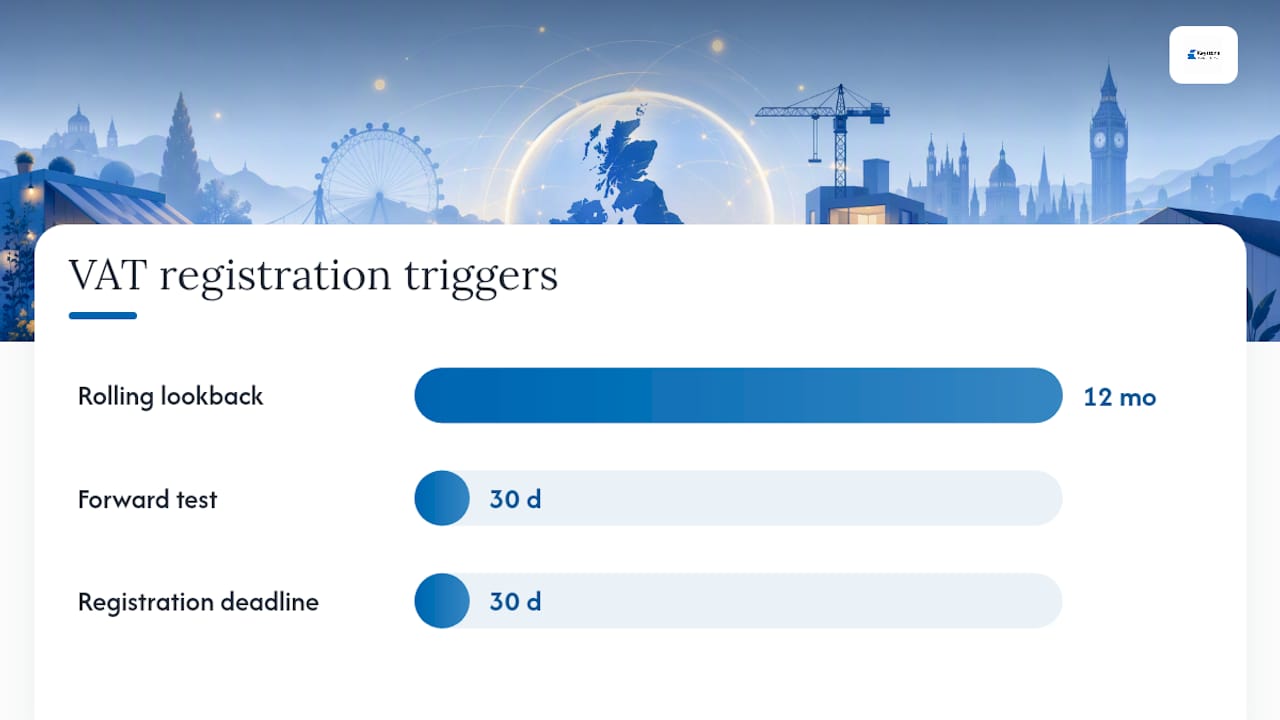
There are two separate triggers, and confusing them is the single most common way businesses register late.
The backward-looking test. At the end of every month, add up your taxable turnover for the previous 12 months. If it’s gone over £90,000, you must register within 30 days of the end of that month. This is a rolling calculation, not a calendar or financial year one, which is exactly why so many businesses trip over it.
The forward-looking test. If you know at any point that your turnover will exceed £90,000 in the next 30 days alone, perhaps because of one large contract, you must register immediately, not wait for month-end.
Backward test: 12 months of trading turnover exceeds £90,000
Forward test: a single 30-day burst will exceed £90,000 on its own
Registration deadline: 30 days from the trigger point
Effective date: the first day of the second month after the threshold is breached (backward test), or the date you realised (forward test)
Worked example: a consultancy’s rolling turnover hits £91,200 at the end of March. Registration is due by 30 April, and HMRC sets the effective registration date as 1 May.
One in three small businesses checks only their annual turnover figure rather than the rolling 12-month total, which is precisely the gap that leads to accidental late registration.
Voluntary registration: what you gain, what it costs
Voluntary registration means signing up before you’re legally required to, and for some businesses it’s a genuinely smart move rather than an unwanted compliance burden.
The main advantage is reclaiming input VAT. If you’re paying VAT on equipment, stock, software or professional fees, registering lets you claim that back, which matters most for businesses with heavy upfront costs or B2B clients who can reclaim VAT themselves anyway.
A freelance graphic designer selling to VAT-registered agencies barely notices the change. A hairdresser or a children’s tutor selling directly to the public feels it immediately.
Register voluntarily to reclaim VAT on setup costs before trading properly begins
Expect a pricing decision if your customers are mostly the public, not VAT-registered businesses
Use a VAT calculator to model the effect on your margins before deciding
Backdating makes voluntary registration more powerful than it first appears. You can reclaim VAT on goods bought up to four years before registration, provided you still hold them, and on services bought up to six months before, provided they relate to your taxable business activity.
Pro Tip: Choosing your registration date carefully, rather than defaulting to “today”, can pull genuine historic costs into recovery. A few weeks’ difference in the date you pick can change how much input VAT you’re able to claim back.
Deregistration: the £88,000 threshold and hidden costs
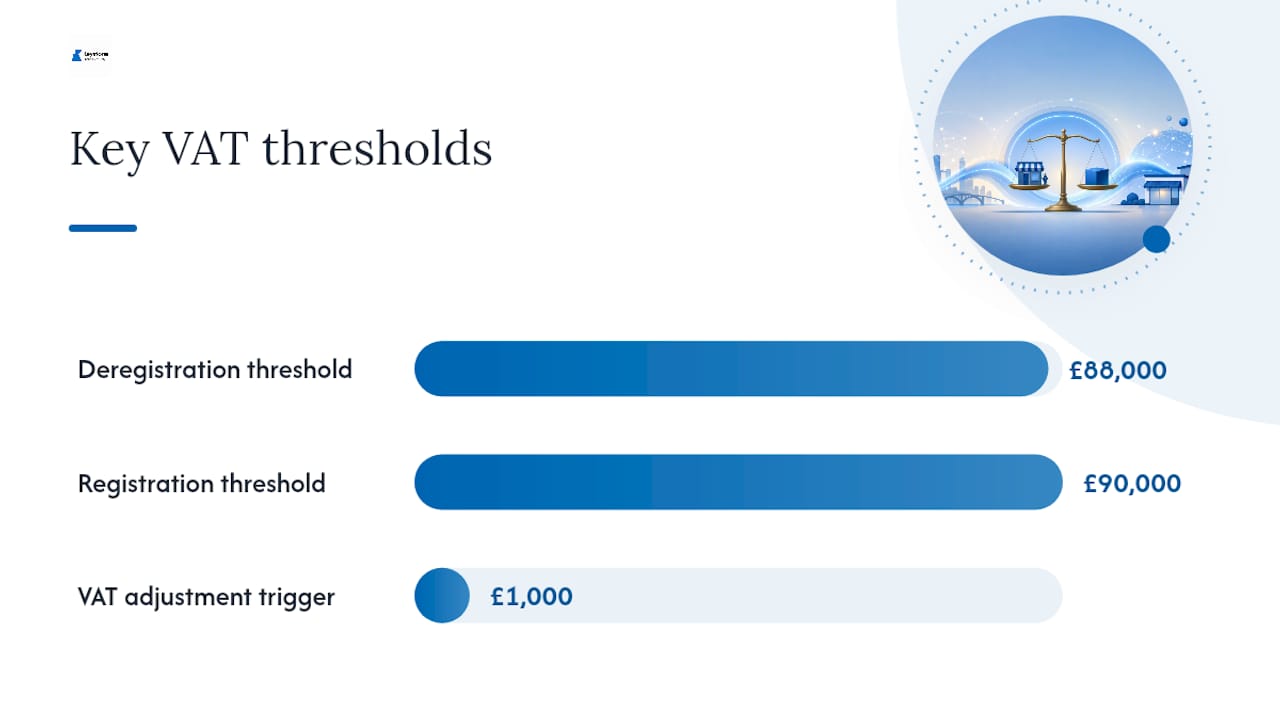
You can apply to deregister once your taxable turnover for the next 12 months is expected to fall below £88,000, the figure HMRC sets £2,000 below the registration threshold specifically to stop businesses cycling in and out of VAT every time turnover dips slightly.
Deregistering isn’t free of consequences, though. If you’re holding business assets, stock, equipment, or anything you claimed input VAT on, and the output VAT due on those assets at deregistration exceeds £1,000, HMRC requires you to account for it. That’s a common surprise cost people don’t budget for.
Confirm your 12-month forecast genuinely supports falling below £88,000
Value stock and equipment held at deregistration date and check the £1,000 threshold
Apply online or by post, and continue charging VAT until HMRC confirms your cancellation date
Other VAT thresholds small businesses run into
The £90,000 figure isn’t the only limit worth knowing. Several accounting schemes carry their own entry and exit points, and picking the wrong one can cost you money quietly for years.
Flat Rate Scheme: join with turnover of £150,000 or less; you must leave once turnover passes £230,000.
Cash Accounting Scheme: available up to £1.35 million in taxable turnover, useful for businesses that want to pay VAT only once customers actually pay them.
Annual Accounting Scheme: also capped at £1.35 million, letting you file one VAT return a year instead of quarterly.
Distance selling and relevant acquisitions: cross-border trade with Northern Ireland can trigger registration duties that ignore the standard threshold entirely.
The Flat Rate Scheme suits businesses with low input VAT, consultants or service providers with few reclaimable costs, but it’s worth comparing the flat percentage against what you’d actually owe under standard VAT before committing. Full eligibility details sit on GOV.UK’s VAT schemes pages, and they’re worth checking before you assume a scheme fits.
Your practical checklist as you approach the threshold
Run a monthly rolling total, not an annual one. Add the latest month, drop the oldest, and check the 12-month figure against £90,000 every time.
Keep clean records of every sale, split by standard, reduced, zero-rated and exempt supplies, so the calculation isn’t a scramble at month-end.
Flag any single contract or seasonal spike that could push you over the 30-day forward test on its own.
Speak to an adviser once you’re within roughly 10% of the threshold, bringing your sales ledger, bank statements and any large upcoming invoices.
Register online through your HMRC business tax account once the trigger is confirmed, and start issuing VAT invoices from your effective date.
Pro Tip: Set a calendar reminder for the first working day of every month to run your rolling total. It takes five minutes and it’s the single habit that prevents accidental late registration.
What we see go wrong, and how early advice pays for itself
The mistake we see most often at KeystoneFA is businesses tracking turnover against their financial year instead of the rolling 12 months, which means they miss the threshold by weeks without realising. Late registration then means backdated VAT owed, plus penalties, on sales you never charged VAT on in the first place.
The businesses that come to us before crossing the threshold, rather than after, almost always end up better off. Picking the right registration date can mean reclaiming input VAT on equipment or services bought months earlier, money that’s simply lost if you register reactively. If you’re within a few thousand pounds of £90,000, it’s worth having someone check your numbers now rather than after HMRC does.
— Shoaib
How KeystoneFA handles VAT monitoring and registration for you
KeystoneFA runs the rolling turnover calculation for clients so a threshold breach never arrives as a surprise. Rather than checking your books once a year and hoping nothing slipped through, we track your 12-month total monthly, flag likely breaches 30 days out, and help you pick a registration date that maximises input VAT recovery instead of defaulting to whatever date HMRC assigns.
[
](www.keystonefa.co.uk)
A first engagement typically starts with a review of your last 12 months of sales and any large contracts on the horizon, so we can tell you exactly where you stand against the £90,000 figure and whether voluntary registration might suit you sooner. From there, we handle the registration itself, set up your VAT filing routine, and keep monitoring turnover so you’re never caught out by a scheme threshold or a distance-selling rule you didn’t know applied. If you’re trading close to the threshold, or simply want someone else carrying that monthly check, get in touch with KeystoneFA and we’ll look at your numbers together.
This article is general information, not a substitute for advice from a qualified financial advisor. Consult a qualified financial professional about your own circumstances before acting on anything here.
FAQ
Do I need to pay VAT if my turnover is less than £90,000?
No. Below £90,000 of taxable turnover in a rolling 12-month period, registration is optional, though you can register voluntarily if it benefits your business.
Will the VAT threshold go up again in the UK?
The threshold rose from £85,000 to £90,000 in April 2024 after seven years frozen; any further rise would need a new government announcement, and none has been confirmed beyond the current 2025/26 figure.
How can I avoid hitting the VAT threshold unintentionally?
Track your rolling 12-month taxable turnover monthly rather than checking it annually, since the most common cause of accidental breaches is monitoring the wrong time period entirely.
What happens if I register for VAT late?
You become liable for VAT on sales from the date you should have registered, backdated, and HMRC can also charge a penalty depending on how late the registration is and how much VAT was due.
Recommended