HMRC's mandatory Direct Debit proposal for VAT and PAYE

HMRC is consulting on requiring most VAT-registered businesses and employers to pay their return liabilities by Direct Debit, and if the proposal becomes law, you will need a UK bank account with a mandate in place before the implementation date. This is not yet legislation — it is an active consultation, open until 16 August 2026 — but the scale is significant: the consultation estimates 2.4 million individuals and companies could be affected, out of 2.73 million businesses registered for VAT and PAYE as of March 2025.
Four things to know right now:
Who is in scope: VAT-registered businesses and PAYE employers, including sole traders and limited companies.
Timing of collections: HMRC would notify you no later than three working days before collecting, with collection typically shortly after the 22nd of the month.
The £20 million ceiling: The BACS technical limit means payments above £20 million cannot be collected by Direct Debit; those payers would need a specific exception.
Consultation deadline: Responses must reach HMRC by 16 August 2026. If you have operational barriers, now is the time to document them.
Table of Contents
What does HMRC’s consultation actually propose?
The consultation’s stated objective is straightforward: reduce late payment, misallocation of funds, and avoidable tax debt by automating how VAT and PAYE liabilities are collected. HMRC frames this as part of its broader debt-prevention strategy, where automation reduces misallocated payments and the administrative errors that create short-term debt.
The policy logic is that Direct Debit removes the manual step where businesses choose when and how to pay. Under the current system, a business can pay by Faster Payments, BACS credit transfer, CHAPS, or Direct Debit. HMRC argues that the manual methods create room for error: wrong references, late transfers, and payments credited to the wrong period. Mandating Direct Debit would close most of those gaps automatically.

Critically, this remains a consultation. HMRC is explicitly seeking evidence to design exceptions and safeguards before any legislation is drafted. That matters: businesses with genuine operational barriers have a real opportunity to shape the final rules, but only if they submit evidence before the deadline.
Which businesses and employers would be affected?
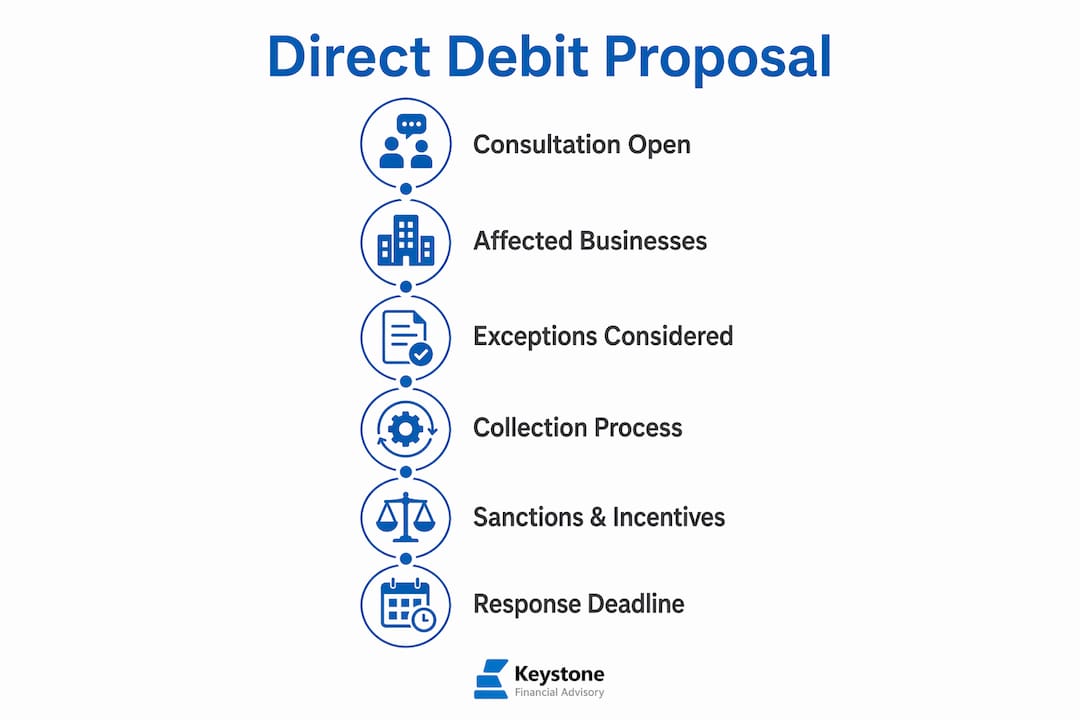
The proposal covers a wide range of taxpayers. Based on the consultation, the following categories are explicitly in scope:
VAT-registered businesses of all sizes, including sole traders, partnerships, and limited companies.
PAYE employers, whether they run payroll monthly or quarterly.
Large employers already required to pay electronically, who would move to Direct Debit specifically.
Individuals registered for both VAT and PAYE, such as director-shareholders running their own companies.
Agents and third-party submitters who file on behalf of clients, who would need to coordinate mandate arrangements with those clients.
One practical constraint worth flagging early: Direct Debit only works with UK bank accounts. Overseas entities without a UK account, or businesses that operate primarily through non-UK banking arrangements, would face a structural barrier the consultation acknowledges but has not yet resolved. If your business falls into that category, documenting it now is worthwhile.
The headline figure of 2.4 million affected taxpayers suggests this is one of the broader compliance changes HMRC has proposed in recent years. For context on how automated payment changes interact with your wider VAT compliance obligations, the mechanics matter as much as the mandate.
What exceptions are under discussion?
HMRC is not proposing a blanket rule with no carve-outs. Several categories of exception are either proposed or under active consideration, and the consultation specifically asks for evidence of barriers.
Exception category | Proposed treatment | What HMRC wants from you |
Payments above £20 million | Automatic exception (BACS technical limit) | Confirmation of payment size and alternative method used |
No UK bank account | Likely exception; details not finalised | Evidence of banking arrangements and operational constraints |
Digitally excluded taxpayers | Exception expected | Written description of circumstances |
Specific operational constraints | Under review | Quantified operational data, cashflow simulations, third-party letters |
Existing VAT 7-day extension | May be restricted to DD payers only | Evidence of reliance on the extension and cost of losing it |
The £20 million BACS limit is a hard technical ceiling, not a policy choice. Any single Direct Debit instruction above that threshold will simply fail at the clearing stage, so very large payers will need an alternative route regardless of what the final rules say.
The VAT 7-day extension is the subtler issue. Currently, businesses paying by Direct Debit get an extra seven days to pay their VAT return liability. The consultation floats restricting that extension to Direct Debit payers only. If you currently pay by Faster Payments and rely on that extension for cashflow timing, losing it would be an effective penalty even without a formal fine. Quantifying that cost now, in pounds and working days, is exactly the kind of evidence HMRC is asking businesses to provide.
How would Direct Debit collections actually work?
The mechanics are not new. HMRC already collects PAYE by Direct Debit for employers who have set up a mandate, and the consultation proposes extending that same process to VAT and making it mandatory for both taxes.

Here is how the collection sequence would work under the proposed rules:
Event | Timing |
HMRC notification sent | No later than 3 working days before collection |
Standard collection date | Shortly after the 22nd of the month |
Collection if return filed after 19th | 4 working days after filing date |
Quarterly payer collection | Aligned to quarterly return cycle |
The key difference from paying by Faster Payments is control. With Faster Payments, you initiate the transfer and choose the exact moment funds leave your account. With Direct Debit, HMRC initiates the pull after you file your return. That shift from push to pull has real implications for cashflow planning, particularly for businesses that time payments carefully around payroll or supplier runs.
Reconciliation is where most firms hit friction. HMRC’s automated Direct Debit references do not always match bespoke internal payment references, which can trigger false “failed payment” flags in accounting software. The fix is to test your mandate setup before any enforcement date and update your bank feed reconciliation rules accordingly.
Pro Tip: Set up a test Direct Debit mandate in a non-live period and run it through your bank reconciliation process end-to-end. Map the HMRC reference format to your chart of accounts before the mandate goes live, so automated collections post correctly from day one.
What sanctions and incentives is HMRC considering?
The consultation sets out three broad enforcement levers, and it is worth understanding each one clearly.
First, a direct penalty for using a non-Direct Debit payment method. The consultation explicitly raises this possibility without specifying the penalty rate. The detail will depend on consultation responses and the exceptions framework HMRC designs.
Second, restricting timing extensions to Direct Debit payers. As noted above, the VAT 7-day extension is currently available to Direct Debit users. Making it exclusive to them would create an indirect financial cost for businesses that continue using other electronic methods.
Third, operational restrictions on alternative payment methods for non-DD payers, though the consultation has not specified what form these would take.
Professional bodies have raised concerns about proportionality. The ICAEW flagged the consultation and encouraged members to submit evidence, noting that the 16 August 2026 deadline gives businesses a limited window to make their case. The ATT and ICAS have similarly highlighted the operational burden on smaller employers and agents who manage multiple client mandates.
The concern from practitioners is not that Direct Debit is a bad idea in principle. It is that a blunt mandate, applied without well-designed exceptions, could create compliance friction for businesses that already pay on time by other electronic means.
What does this mean for your business — a readiness checklist
Whether or not you plan to submit a consultation response, there are practical steps worth taking now.
Identify your current payment methods for VAT and PAYE. List every account from which you currently make these payments and note whether each uses Faster Payments, BACS credit, CHAPS, or Direct Debit.
Check UK bank account eligibility. Direct Debit mandates require a UK sort code and account number. If any payments currently come from a non-UK account, flag this as a potential barrier.
Identify payments above £20 million. If any single VAT or PAYE liability regularly exceeds this threshold, you will need an exception and an alternative payment route.
Run a cashflow simulation. Map your current payment dates against the proposed collection schedule (shortly after the 22nd, or four working days after filing). Identify any months where the shift in timing would create a cashflow gap alongside payroll or supplier payments.
Update internal payment approvals. If your current process requires a finance director or two-person sign-off before a payment is released, automated Direct Debit collection bypasses that control. Update your internal controls to reflect the change. Reviewing your company payment controls is a sensible step here.
Coordinate with your payroll bureau or agent. If a third party files your RTI returns, they need to know about the mandate setup. Ask them explicitly whether their software supports automated DD reconciliation.
Test a mandate setup. Set up a Direct Debit mandate in HMRC’s online account and run one collection through your bank reconciliation before any enforcement date.
Pro Tip: When presenting the cashflow simulation to a board or audit committee, track two simple KPIs: failed-collection rate (how often a DD instruction bounces) and payment misallocation incidents (how often a payment is credited to the wrong period). Both are measurable from your HMRC online account history and give the board a concrete picture of operational risk.
Template A — Direct Debit mandate readiness checklist (for finance or payroll teams):
[ ] UK bank account confirmed with sort code and account number
[ ] HMRC online account access verified for VAT and PAYE
[ ] Mandate set up and confirmed in HMRC online account
[ ] Bank reconciliation rules updated to match HMRC DD reference format
[ ] Cashflow model updated with new collection dates
[ ] Internal payment approval process updated to reflect automated collection
[ ] Payroll bureau or agent notified and mandate details shared securely
Template B — Suggested paragraph for a consultation response describing an operational barrier:
When sharing mandate details or consultation evidence with agents or payroll providers, use a secure email channel to avoid sensitive banking information being intercepted in transit.
How to respond to the HMRC consultation
The consultation is open until 16 August 2026. Responses should be submitted via the official HMRC consultation page. HMRC accepts written responses by email or post, with contact details published on that page.
HMRC is specifically asking for the following types of evidence:
In practical terms, that means:
A clear description of your current payment method and the operational reason for using it.
Quantified impact: extra staff hours, system change costs, or cashflow disruption in pounds.
Bank statements or treasury system screenshots showing technical constraints.
A cashflow simulation showing the effect of the proposed collection dates on your working capital.
A letter from your payroll provider or bank if the barrier is a third-party constraint.
The response should be owned by your finance director or payroll manager, with sign-off from a director or partner before submission. If you use a nominated agent, they can submit on your behalf, but the evidence should come from your business’s own records. A generic objection without supporting data is unlikely to influence the final exceptions framework.
What happens next and when?
The consultation opened in June 2026 and closes on 16 August 2026. After that, HMRC will analyse responses, and the government will publish its conclusions, typically within three to six months of a consultation closing. A policy decision would then feed into a Finance Bill, with implementation likely phased to give businesses time to set up mandates.
No implementation date has been announced. Given the scale of businesses affected, a phased rollout is probable, potentially starting with larger employers before extending to smaller businesses and sole traders. Watch the HMRC consultation page for the government’s response document, and subscribe to updates from ICAEW, ATT, or ICAS if you are a member, as they will publish summaries when the government responds.
For sole traders and individuals who are uncertain about their registration status and filing obligations, reviewing your self-assessment position is a sensible parallel step.
Key takeaways
The mandatory Direct Debit proposal for VAT and PAYE would affect an estimated 2.4 million businesses and employers, and the consultation closes mid-August 2026, giving you a narrow window to document operational barriers and shape the final rules.
Point | Details |
Consultation deadline | Responses to HMRC must be submitted by 16 August 2026 via the official consultation page. |
Scale of impact | An estimated 2.4 million individuals and companies are in scope, out of 2.73 million VAT and PAYE registrations. |
£20 million exception | Payments above the BACS technical limit of £20 million cannot use Direct Debit and will need a formal exception. |
Timing shift | HMRC notifies payers no later than 3 working days before collection, typically shortly after the 22nd of the month. |
KeystoneFA support | KeystoneFA can help you run a readiness review, prepare a cashflow simulation, and draft a consultation response before the August deadline. |
A practical perspective on what this really means
The instinct of many business owners will be to wait and see. That is understandable, but it is the wrong call here.
The consultation is not a formality. HMRC has explicitly said it needs evidence to design proportionate exceptions, which means the final rules will reflect what businesses actually submit. Firms that document their operational barriers clearly, with numbers attached, have a genuine chance of influencing whether an exception applies to them. Firms that say nothing will find the default rule applied to them regardless.
There is also a subtler point about internal controls. Direct Debit is a pull mechanism: HMRC initiates the collection after you file. For businesses with dual-authorisation payment controls, that is a structural change, not just an administrative one. A director who currently approves every outgoing payment needs to understand that, under mandatory Direct Debit, the approval happens at the point of filing the return, not at the point of payment. Boards and audit committees should be briefed on this shift before any implementation date.
The professional bodies are right to flag proportionality concerns. A business that already pays on time, every time, by Faster Payments, is not the problem HMRC is trying to solve. The consultation should acknowledge that, and the exceptions framework should reflect it. Whether it does will depend on the quality of evidence submitted.
How KeystoneFA can help you prepare
Navigating a compliance change of this scale is easier with a firm that already understands your payment processes, cashflow patterns, and HMRC obligations.
[
](www.keystonefa.co.uk)
KeystoneFA works with founders, employers, and growing businesses to handle exactly this kind of readiness work: reviewing your current VAT and PAYE payment methods, running a cashflow simulation to show the impact of the proposed collection dates, and drafting a consultation response that documents your operational position with the evidence HMRC is asking for. Unlike larger firms where this kind of project gets handed to a junior team, at KeystoneFA you work directly with experienced advisers who know HMRC compliance from the ground up.
If you have payments above £20 million, a non-UK banking arrangement, or internal controls that depend on manual payment authorisation, those are exactly the circumstances that warrant a structured response. Get in touch with KeystoneFA to book a readiness review before the 16 August 2026 deadline.
Useful sources and official links
HMRC consultation: Requiring payment of VAT and PAYE return liabilities by Direct Debit — the primary document; submit your response here.
HMRC tax debt strategy update — sets out the policy rationale for automation and debt prevention.
ICAEW summary and member guidance — professional body commentary and encouragement to submit evidence.
VATupdate consultation summary — secondary commentary corroborating consultation timings and scope.
Deloitte UK Tax Policy Map — Modernising tax debt collection — broader context on HMRC’s debt-collection modernisation programme.
HMRC’s tax debt strategy — GOV.UK — primary source on HMRC’s debt recovery powers and approach.
When submitting a consultation response, attach any cited evidence directly to your submission. HMRC has indicated that quantified, documented barriers carry more weight than general objections.
FAQ
What is the deadline for the HMRC Direct Debit consultation?
The consultation closes on 16 August 2026. Responses should be submitted via the official HMRC consultation page, with supporting evidence attached where relevant.
Will all businesses have to pay VAT and PAYE by Direct Debit?
The proposal covers most VAT-registered businesses and PAYE employers, but exceptions are under discussion for payments above the £20 million BACS limit, businesses without UK bank accounts, and digitally excluded taxpayers.
How much notice will HMRC give before collecting a Direct Debit?
HMRC would notify you of the collection date and amount no later than three working days before the funds are taken, with collection typically occurring shortly after the 22nd of the month.
What happens to the VAT 7-day payment extension?
The consultation proposes restricting the existing seven-day payment extension to Direct Debit payers only. Businesses currently relying on that extension while paying by Faster Payments should quantify the cashflow cost and include it in their consultation response.
How can KeystoneFA help with the Direct Debit proposal?
KeystoneFA offers readiness reviews, cashflow simulations, and consultation-response drafting for businesses affected by the proposal. Contact the team at keystonefa.co.uk to arrange a review before the August 2026 deadline.
This article is general information, not professional advice. Tax rules and consultation outcomes can change; confirm the current position with HMRC or a qualified adviser for your specific circumstances.
Recommended