How does VAT work for importing goods into the UK?

TL;DR:
Import VAT in the UK is calculated on the customs value, including duty, transport, and insurance costs.
Postponed VAT Accounting allows VAT-registered importers to declare and reclaim import VAT through their VAT return.
Import VAT is a value-added tax charged on goods brought into the UK from abroad, calculated on the customs value of those goods plus duty and transport costs. Understanding how VAT works for importing goods into the UK is non-negotiable for any importer. HMRC charges import VAT at 20% on most goods, mirroring domestic VAT rates. The two mechanisms that shape compliance are the £135 low-value threshold and Postponed VAT Accounting (PVA). Get either wrong and you face unnecessary cash flow pressure or an HMRC enquiry.
How is import VAT calculated for goods entering the UK?
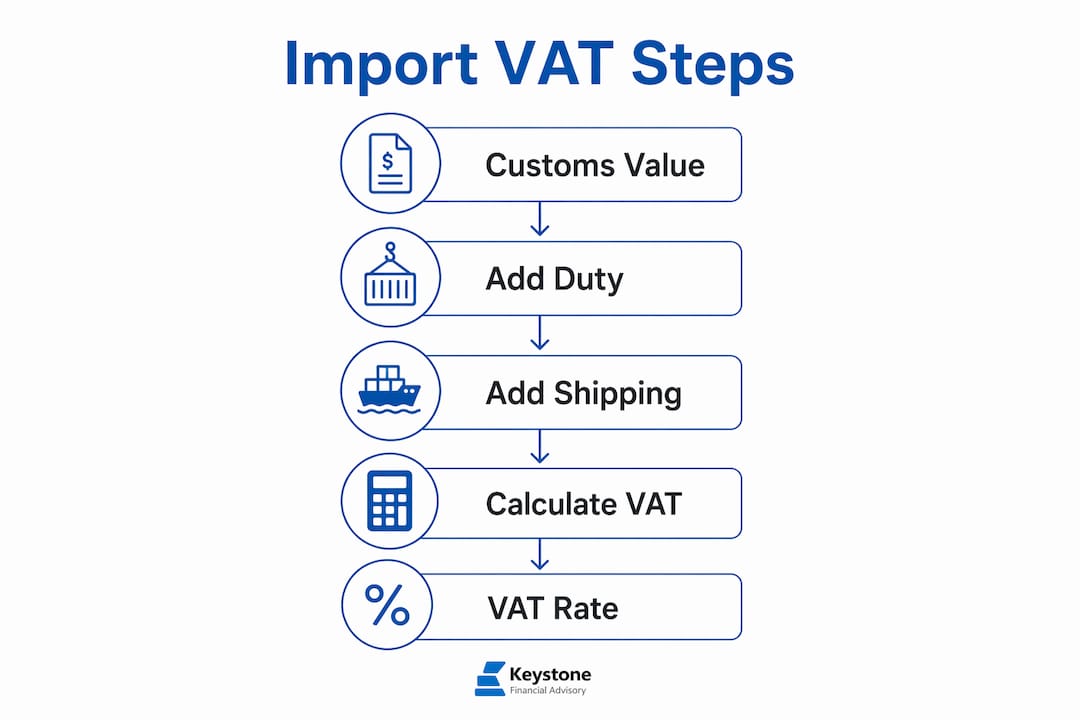
The VAT base for imported goods is not simply the purchase price. Import VAT is calculated on the customs value plus customs duty, transport costs, and insurance to the UK destination. The formula is: VAT base = customs value + duty + transport + insurance. Import VAT = VAT base × VAT rate.

A worked example makes this concrete. You import electronics worth £10,000. Customs duty is £500, and shipping plus insurance totals £300. Your VAT base is £10,800. At the standard 20% rate, import VAT is £2,160.
The VAT rate applied depends on the product category. Most goods attract the standard 20% rate. Some goods, such as children’s car seats and domestic energy, carry a reduced 5% rate. Others, including most food, books, and children’s clothing, are zero-rated. The rate mirrors what applies to the same goods sold domestically.
Import VAT and customs duty are separate charges. Customs duty is a trade tariff paid to HMRC and is not recoverable by VAT-registered businesses. Import VAT, by contrast, is reclaimable by eligible importers through their VAT return.
Component | Description | Example (£) |
Customs value | Agreed transaction price of goods | 10,000 |
Customs duty | Tariff applied at UK border | 500 |
Transport and insurance | Freight and cover to UK destination | 300 |
VAT base | Sum of above three components | 10,800 |
Import VAT at 20% | VAT base × 20% | 2,160 |
Pro Tip: Always confirm the commodity code for your goods before shipment. The code determines the duty rate and VAT classification, and an incorrect code can trigger a reclassification that changes your total landed cost significantly.
What is the £135 threshold and how does it affect VAT on imports?
The £135 threshold is a dividing line that changes where and how VAT is collected. Goods valued below £135 are subject to VAT at the point of sale, not at the UK border. The threshold is based on the intrinsic value of the goods and excludes transport and insurance costs, provided these are shown separately on the invoice.
The practical effect is significant for online sellers and marketplaces:
Below £135: The seller or online marketplace collects and accounts for UK VAT at checkout. No import VAT is charged at the border.
Above £135: Standard import VAT applies. The importer pays at the border or accounts for it via PVA.
Online marketplaces: Platforms facilitating sales of goods below £135 from overseas sellers are responsible for collecting and remitting UK VAT to HMRC.
Non-UK sellers: A non-UK business selling goods already in the UK at the point of sale must register for UK VAT immediately upon making sales, with no registration threshold equivalent to the domestic £90,000 limit.
The threshold rule catches many importers off guard, particularly those buying in small consignments. Splitting a large order into smaller shipments to stay below £135 does not reduce the total VAT liability. HMRC treats artificially split consignments as a single supply.
Pro Tip: If you are a UK VAT-registered business buying goods from an overseas supplier below £135, confirm whether the supplier has charged UK VAT at checkout. If they have not, you may have a compliance gap that needs correcting before your next VAT return.
How does Postponed VAT Accounting work for VAT-registered importers?
Postponed VAT Accounting is the mechanism that allows VAT-registered businesses to account for import VAT on their VAT return rather than paying it upfront at the border. Before PVA existed, importers paid VAT at the point of entry and then waited weeks to reclaim it. PVA eliminates that cash flow gap entirely.
The mechanics work as follows:
Declare PVA on the customs entry. Your customs agent must enter procedure code 1PVA on the import declaration. Without this code, VAT is charged at the border immediately, removing the cash flow benefit.
Receive your Monthly Postponed Import VAT Statement (MPIVS). HMRC makes this available through the Customs Declaration Service (CDS) portal each month. You must download it promptly.
Complete your VAT return. Enter the import VAT figure in Box 1 (VAT due) and Box 4 (VAT reclaimed) of your VAT return simultaneously. The net cash effect is zero for fully taxable businesses.
Retain the MPIVS as evidence. This statement replaces the older C79 certificate as the primary audit document for PVA claims.
Eligibility for PVA requires three things: active UK VAT registration, a GB EORI number linked to that VAT registration, and registration with the Customs Declaration Service. PVA is optional per shipment and requires no special authorisation from HMRC. You can choose to pay upfront on some imports and use PVA on others.
The older method, using a C79 certificate, remains valid for importers who pay VAT at the border. However, PVA is now the standard approach for most VAT-registered businesses because it preserves working capital.
Pro Tip: Set a calendar reminder on the first working day of each month to download your MPIVS from the CDS portal. Statements are only available for a limited period. Missing them creates reconciliation problems and potential HMRC scrutiny.
What compliance steps must importers follow to manage import VAT?
Import VAT compliance rests on documentation, timing, and accuracy. A single administrative error can delay a VAT reclaim or trigger an HMRC audit.
The core requirements are:
VAT registration and GB EORI linkage. A valid GB EORI number linked to your VAT registration is mandatory. Without it, goods can be held at the border.
Record retention for at least 6 years. HMRC requires businesses to keep MPIVS statements, C79 certificates, customs entries, commercial invoices, and transport documents for a minimum of six years. Good record-keeping practices are not optional.
Monthly MPIVS reconciliation. Download and reconcile your MPIVS against your customs declarations every month before completing your VAT return.
Correct procedure codes. Confirm with your freight forwarder or customs agent that 1PVA is applied on every declaration where you intend to use PVA.
Importer of record accuracy. Only the legal owner named on the customs declaration can reclaim import VAT. If a third party is named as importer, the VAT reclaim right sits with them, not you.
Error correction. If a statement is missing or a procedure code was entered incorrectly, contact your customs agent immediately. HMRC allows corrections through amended declarations, but delays compound the problem.
Working with an experienced customs agent or freight forwarder reduces procedural risk considerably. They carry responsibility for the accuracy of declarations they submit on your behalf.
Key takeaways
Import VAT in the UK is calculated on the customs value plus duty and transport costs, accounted for most efficiently through Postponed VAT Accounting, which requires correct procedure codes, monthly statement management, and six years of documented records.
Point | Details |
VAT calculation base | Add customs value, duty, transport, and insurance before applying the VAT rate. |
£135 threshold rule | Goods below £135 attract VAT at point of sale, not at the UK border. |
PVA cash flow benefit | PVA lets you declare and reclaim import VAT simultaneously, removing upfront payment. |
Procedure code accuracy | Code 1PVA must appear on every customs declaration to activate PVA correctly. |
Record retention | Keep MPIVS statements, invoices, and customs entries for at least six years. |
The import VAT mistake I see most often
Most importers focus on the VAT rate and miss the administrative detail that actually costs them money. The single most common error I encounter is a mismatch between who owns the goods and who is named as importer of record on the customs declaration. Only the named importer who owns the goods at the point of import can reclaim the VAT. If your supplier or freight forwarder is listed instead of your business, you lose the reclaim right entirely.
The second issue is procedure codes. Customs agents work at volume and occasionally default to standard codes rather than 1PVA. That single omission means you pay VAT at the border and wait to reclaim it, which defeats the purpose of PVA entirely. Brief your agent in writing before every shipment.
Digitisation through the Customs Declaration Service has made compliance more transparent, but it demands stricter administrative discipline in return. Businesses that download their MPIVS promptly each month and reconcile against their declarations rarely face HMRC problems. Those that leave it to the last minute before a VAT return deadline frequently discover discrepancies they cannot resolve in time.
PVA is genuinely one of the most useful cash flow tools available to UK importers. Use it consistently, document everything, and treat your monthly MPIVS as a financial record with the same seriousness as a bank statement.
— Shoaib
How KeystoneFA supports importers with VAT compliance
Managing import VAT correctly requires more than knowing the rules. It requires consistent processes, accurate documentation, and someone who knows what HMRC expects during an audit.
[

KeystoneFA works with founders, growing businesses, and international importers to handle VAT registration, Postponed VAT Accounting setup, and monthly compliance. The team reviews customs documentation, reconciles MPIVS statements, and ensures your VAT returns reflect your import activity accurately. For businesses new to UK importing or those scaling their import volumes, having an experienced adviser on hand removes the risk of costly procedural errors. Speak to the KeystoneFA team about tailored support for your import VAT obligations.
FAQ
What VAT rate applies to imported goods in the UK?
Most imported goods attract the standard 20% VAT rate. Reduced rates of 5% or 0% apply to specific categories such as domestic energy or children’s clothing, mirroring domestic VAT rules.
Do I need to register for VAT to import goods into the UK?
VAT registration is not required solely to import goods, but it is required to use Postponed VAT Accounting and reclaim import VAT. Non-UK businesses selling goods in the UK must register for VAT immediately upon making sales, with no minimum threshold.
What is the difference between import VAT and customs duty?
Customs duty is a trade tariff and is not recoverable. Import VAT is a tax charged at the same rate as domestic VAT and is reclaimable by VAT-registered businesses through their VAT return.
How do I reclaim import VAT using PVA?
Enter the import VAT figure in both Box 1 and Box 4 of your VAT return, using your Monthly Postponed Import VAT Statement as evidence. The net effect is zero for fully taxable businesses, preserving cash flow.
What happens if I miss downloading my MPIVS?
Missing your MPIVS creates reconciliation gaps and can prevent you from reclaiming import VAT for that period. Statements are available through the Customs Declaration Service portal and should be downloaded at the start of each month.
Recommended