Business entertainment tax treatment: what accountants need to know

Business entertainment costs are, as a general rule, not deductible for income tax or corporation tax purposes, and the VAT on them is normally irrecoverable. That is the position under section 45 of ITTOIA 2005 for unincorporated businesses and section 1298 of CTA 2009 for companies, backed by VAT Notice 700/65 on the VAT side. There are exceptions, but they are narrower than most business owners assume.
The general rule is that no deduction is allowed in calculating the profits of a trade for expenses incurred in providing entertainment or gifts in connection with the trade.
Before you post a single client lunch or corporate box invoice to the accounts, run through this checklist:
Staff entertainment aimed wholly at employees is usually deductible and the VAT usually reclaimable.
Trade of entertainment businesses (an events company entertaining its own clients as part of what it sells) fall under a specific exception in section 1299.
Overseas customers may allow a VAT reclaim, but only where the hospitality is reasonable and strictly for business purposes, not because someone flew in from Frankfurt and it felt rude not to buy dinner.
The default assumption should be: treat it as non-deductible for tax and block the input VAT, unless you can point to a specific exception that applies. Reclaiming VAT speculatively and hoping HMRC doesn’t ask is a poor strategy, because if the claim turns out to be wrong, you don’t just lose the deduction. You may need to account for output tax to correct it.
Key takeaways
Business entertainment is disallowed for tax and blocked for VAT by default under S45 ITTOIA 2005, S1298 CTA 2009 and VAT Notice 700/65, with only narrow exceptions.
Point | Details |
Default position | Treat entertainment as non-deductible and VAT as blocked unless a specific exception clearly applies. |
Staff entertainment exception | Genuine staff-only events are usually deductible and VAT is usually recoverable. |
Overseas customer exception | Only applies to customers not resident or trading in the UK, and only where there’s no private benefit element. |
Apportion mixed events | Split staff and non-employee attendance and document the method used, ideally at the point of booking. |
Get a professional review | KeystoneFA can review entertainment treatment and VAT reclaims as part of a bookkeeping or VAT health check. |
Table of Contents
What counts as tax treatment of business entertainment?
HMRC’s definition of “entertainment” is broader than most people expect. It covers any hospitality provided, whether that’s food, drink, accommodation, event tickets, or use of an asset like a yacht or a box at a football ground. The BIM45000 manual confirms that hospitality doesn’t need to be lavish to count. A £15 sandwich lunch with a supplier can technically be “entertainment” if it meets the underlying test.
Three conditions turn ordinary hospitality into business entertainment for tax purposes:
It’s provided in connection with the business.
It’s provided to someone who isn’t an employee (a client, supplier, business contact, or their guest).
It’s provided free of charge, with no obvious matching benefit flowing back the other way.
Meet all three and the cost is entertainment. Miss one, and it might fall into a different, more favourable category entirely.
Scenario | Category | Likely tax/VAT outcome |
Dinner with a client to discuss a contract | Business entertainment | Disallowed for tax; VAT blocked |
Christmas party for all staff | Staff entertainment | Usually deductible; VAT usually reclaimable |
Tea and biscuits at an internal meeting | Not entertainment (subsistence) | Deductible; VAT reclaimable |
Corporate box used to host clients at a match | Business entertainment | Disallowed for tax; VAT blocked; no capital allowances on the asset |
Networking dinner with a mix of staff and prospects | Mixed event | Apportion; staff portion may qualify, non-employee portion doesn’t |
The borderline cases cause the most trouble in practice. A “business visitor” who isn’t actually a customer, such as a journalist, a regulator, or a job applicant, doesn’t automatically make hospitality deductible just because they’re not on your payroll. And a mixed guest list, where three staff members host five clients at dinner, doesn’t become deductible just because employees were present. It gets apportioned, which we’ll cover shortly.
Are business entertainment expenses deductible for income tax and corporation tax?
No, not as a general rule. Section 45 of ITTOIA 2005 blocks the deduction for sole traders and partnerships, while section 1298 of CTA 2009 does the same job for companies. Both provisions say essentially the same thing: entertainment expenditure connected with your trade doesn’t reduce your taxable profits, full stop, unless a specific statutory exception applies.
The exceptions sit in section 1299 CTA 2009 (and the equivalent for unincorporated businesses), and there are really only two that matter for most businesses:
Staff entertainment. Costs incurred entertaining your own employees, such as a summer barbecue or an annual party, are deductible because the legislation carves employees out of the general block.
Trade of entertainment. If your business’s actual trade is providing entertainment (an events agency treating a client to a screening as a sales demonstration, for instance), the cost may be treated as part of the cost of your service rather than as disallowable entertainment.
Everything else defaults back to disallowed. That includes what HMRC calls “incidental expenditure”: costs connected to the entertainment itself, such as the invitation cards, a third-party events organiser’s fee, or transport laid on for guests. BIM45000 is explicit that incidental costs ride along with the main disallowance; you can’t strip out the venue hire and claim it separately just because it’s technically a different invoice.
Expenditure incidental to entertainment is also disallowed, and assets used for entertainment do not qualify for capital allowances.
In practice, that last point catches people out. If your company buys a box at a stadium primarily to entertain clients, you don’t just lose the running costs. The asset itself sits outside the capital allowances regime, because it’s treated as an entertainment asset from the outset.
On the accounting side, non-deductible entertainment still gets recorded as a genuine business cost in your profit and loss account. It’s a real expense, and it should appear there. The adjustment happens in your tax computation, where you add the disallowed entertainment back to your accounting profit before calculating the tax due. Missing that add-back is one of the more common reasons a corporation tax return gets queried, and it’s worth reviewing alongside broader work on reducing your corporation tax bill legally, because the two issues often surface in the same review.
Can you reclaim VAT on business entertainment?
Generally, no, if the recipient isn’t an employee. VAT Notice 700/65 sets out the core rule: input tax incurred on business entertainment provided to non-employees is blocked from recovery. That covers client meals, supplier hospitality, and most third-party entertaining, regardless of how clearly business-related the conversation was.
Work through this decision sequence before reclaiming anything:
Is the recipient an employee? If yes, VAT is usually recoverable, subject to the caveats below.
Is the recipient an overseas customer? If yes, and the hospitality is reasonable and strictly for business purposes, recovery may be possible.
Is there a private benefit attached? If the hospitality is provided partly because it’s polite or expected, rather than strictly necessary for business, a private benefit exists and recovery is blocked or an output tax charge applies.
Are staff and non-employees both present? If so, apportion the VAT rather than treating the whole event as one category.
Staff entertainment VAT is not automatically clean, either. Recovery can be lost if the event is exclusively for directors or partners rather than staff generally, or if employees are simply acting as hosts for a client event rather than being genuine attendees in their own right. An away-day for the whole team is one thing; a dinner where two directors take a client out and call it “staff entertainment” because employees technically attended is another.
Recipient type | VAT recovery position |
Employees (genuine staff events) | Generally recoverable |
Directors/partners only, exclusive event | Recovery usually blocked |
Non-employee clients or suppliers (UK) | Blocked |
Overseas customers, business purpose, no private benefit | May be recoverable |
Overseas customers with a clear personal/leisure element | Blocked; output tax charge may apply |
Mixed staff and non-employee event | Apportioned by attendee numbers or a more precise business-use measure |
Here’s a short worked example on the overseas point. Say your company spends £2,000 plus VAT (£400) hosting a genuine overseas client for a dinner tied directly to closing a supply contract, with no partner or spouse attending and no leisure add-ons. That £400 is a candidate for recovery. Add a weekend of sightseeing paid for by the company on top, and the private benefit element means HMRC guidance points towards blocking the reclaim, or requiring an output tax charge if you’ve already claimed it.
What are the key exceptions and special situations?
Three scenarios trip up otherwise careful finance teams more than most others.
The “trade of entertainment” exception only applies where entertainment genuinely is what you sell. A software company giving a client concert tickets as a thank-you doesn’t qualify just because the company happens to enjoy live music. A hospitality or events business demonstrating its own product to a prospective client is a much cleaner fit.

The overseas customer exception gets misread constantly. It applies to customers who aren’t ordinarily resident or carrying on a business in the UK, not to any contact who happens to be based abroad. A UK subsidiary of a US parent company, run and staffed in the UK, doesn’t automatically count as an “overseas customer” just because the invoice goes to Delaware.
Charging attendees or apportioning tickets changes the calculation entirely. If you charge a nominal fee for a corporate event, HMRC may view the transaction differently, because you’re no longer providing something entirely free of charge. This doesn’t automatically flip the whole cost to deductible, but it’s worth documenting precisely what was charged and to whom, since it affects both the entertainment test and the VAT position.
Pro Tip: If you’re on the VAT Flat Rate Scheme, you generally can’t reclaim input VAT on individual purchases at all, including entertainment, because the scheme works on a fixed percentage of turnover rather than itemised recovery. That removes the reclaim question entirely for most day-to-day costs, but it also means you shouldn’t assume Flat Rate Scheme membership gives you any special entertainment allowance. It simply changes how VAT is calculated, not whether entertainment is deductible for income tax or corporation tax.
How should you record entertainment costs in your accounts?
Getting the bookkeeping right at the point of entry saves a scramble at year end, and using the right accounts receivable software can help track event invoices and attendee charges efficiently. Best accounts receivable software for UK businesses highlights options tailored for these needs. Work through these steps as costs come in:
Post entertainment costs to a dedicated nominal code, separate from staff welfare, subsistence, and general marketing, so the year-end review doesn’t require re-analysing every invoice.
Tag each entertainment transaction with attendee details at the time of booking: who attended, their employment status, and the business purpose.
For mixed events, calculate and record the apportionment (staff versus non-employee) as a memo note against the transaction, not as a mental calculation you’ll try to reconstruct in nine months.
At year end, total the non-deductible portion and add it back in your tax computation, alongside any other disallowable expenses.
Reconcile VAT reclaimed during the year against what should have been reclaimed; correct any over-claims through your VAT return adjustments rather than leaving them unresolved.
On disclosure and reporting:
P&L presentation: entertainment appears as a genuine cost in the accounts; the tax adjustment happens separately in the computation, not by reclassifying the expense itself.
VAT return boxes: reclaimable staff VAT goes through as normal input tax; blocked non-employee VAT should never enter Box 4 in the first place.
Correcting past errors: if you discover VAT was reclaimed incorrectly on entertainment in a prior period, the fix is to adjust the return, and where appropriate, account for output tax, rather than leaving the error unadjusted and hoping it goes unnoticed.
Payroll and P11D: staff parties and social functions can be exempt from benefit-in-kind reporting under specific HMRC exemptions, but only within defined conditions around cost per head and availability to all staff. Entertainment aimed at clients doesn’t generally create a PAYE issue for the employees involved, since they’re not the ones receiving the benefit. It’s a corporate tax and VAT question, not a payroll one, in most cases.
If you’re also reviewing what genuinely counts as a claimable cost for the business, it’s worth reading alongside guidance on claiming meals and subsistence through a limited company, since the boundary between subsistence and entertainment is exactly where a lot of confusion starts.
Three worked examples: client meal, staff party, and an overseas client
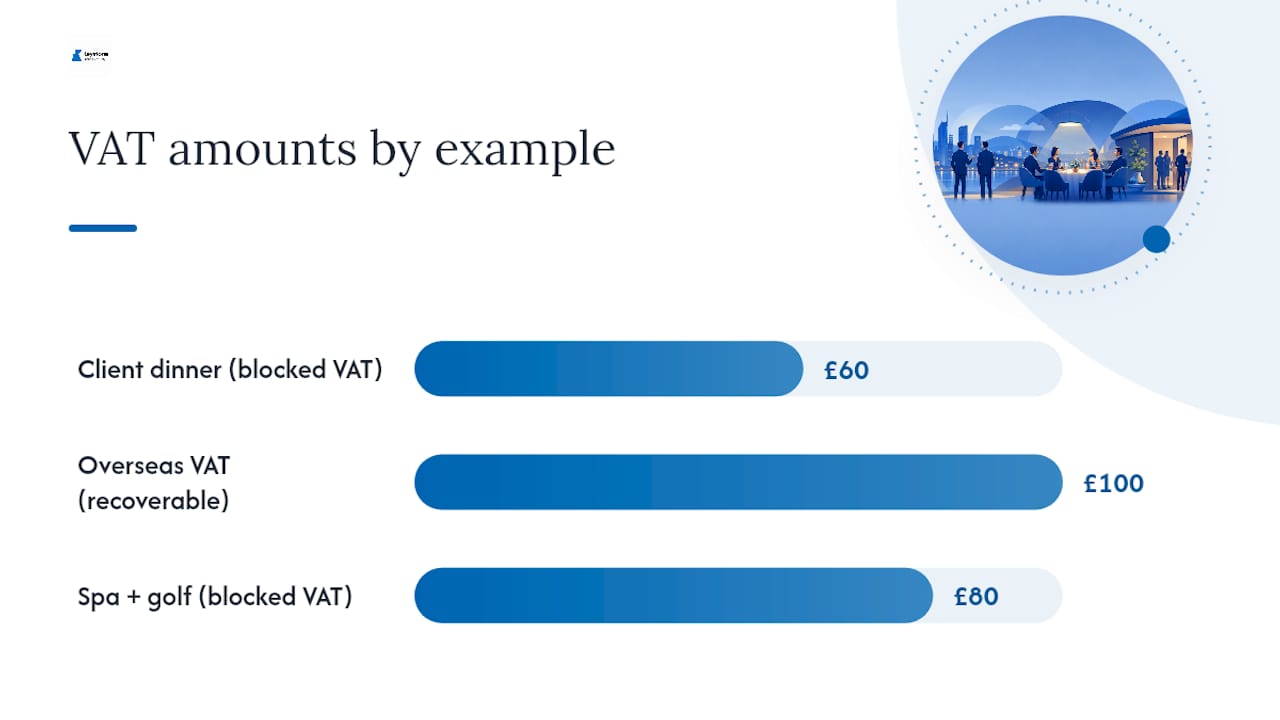
Example 1: Client dinner. Your company spends £300 plus £60 VAT taking a UK-based client to dinner to discuss an ongoing project. For corporation tax, the £300 is disallowed and added back in the computation. For VAT, the £60 is blocked entirely, because the client is a non-employee UK business contact with no overseas exception available. Outcome: £360 hits the accounts as a real cost, but delivers zero tax or VAT benefit.
Example 2: Staff Christmas party. You spend an amount on a party for staff, no clients or spouses of clients invited. This falls under the staff entertainment exception: the cost is deductible for corporation tax, and the VAT is generally recoverable, because every attendee is a genuine employee. There’s a separate, non-statutory practice around a per-head threshold for benefit-in-kind exemption purposes on annual staff functions, which is a P11D question rather than a corporation tax or VAT rule; where the spend slightly exceeds this threshold, it’s worth checking carefully rather than assuming the whole event is automatically exempt from benefit reporting just because it’s deductible for tax.
Example 3: Overseas client entertaining. You host a genuine overseas customer, resident and trading outside the UK, for a business dinner costing £500 plus £100 VAT, strictly tied to closing a deal, no partners or extended leisure activity involved. The overseas customer exception potentially allows recovery of the £100. Add a spa day and a round of golf worth £400 plus £80 VAT for the same visit, and the private benefit element means HMRC would likely view the additional element as blocking recovery, or triggering an output tax charge if it had already been claimed.
Document the attendee list with roles and apply a defensible, consistent apportionment method. HMRC’s own guidance treats a documented, headcount-based approach as reasonable where a more precise business-use measure doesn’t exist.
Before posting any entertainment-related claim, gather:
The invoice, itemised where possible.
A list of attendees with their employment status and, for overseas claims, their residency and business status.
A short note on business purpose (which deal, which relationship, what outcome was being pursued).
Evidence of the split where staff and non-employees both attended.
What common mistakes trigger HMRC enquiries?
The same handful of errors show up again and again in reviews and disputes.
Treating client meals as ordinary subsistence because “everyone does it,” rather than correctly categorising them as entertainment.
Failing to apportion mixed events, claiming full VAT recovery because some staff happened to attend a client dinner.
Mislabelling a UK-based contact as an “overseas customer” because they work for an international group, without checking actual residency and trading status.
Reclaiming VAT on entertainment assets, such as a corporate box, and then also claiming capital allowances on the asset itself.
Losing the attendee-level detail that would let you defend an apportionment months or years after the event took place.
HMRC enquiries into entertainment costs typically ask for the same documents: invitee lists, invoices, correspondence showing business purpose, and a breakdown of how any apportionment was calculated. If you can produce all four quickly and consistently, most queries close without escalation. If you can’t, an entertainment enquiry can drag into a wider review of expense claims generally, which is the outcome everyone wants to avoid.
Pro Tip: Keep entertainment records for at least six years, in line with general corporation tax record-keeping requirements, and store attendee lists alongside the invoice rather than in a separate system. A £200 dinner claim that takes twenty minutes to reconstruct three years later, because nobody noted who was there, costs more in time than it ever saved in VAT.
What would an accountant actually recommend?
Most guidance on this topic reads like a flowchart, and flowcharts are useful right up until you hit a genuinely ambiguous case, which happens more often than the tidy examples suggest. My honest position is this: when the facts are borderline, treat the cost as non-deductible and the VAT as blocked, unless you have a documented, defensible reason to do otherwise. It’s not because HMRC is unreasonable about it. It’s because the cost of getting it wrong (interest, potential penalties, and the time spent unpicking a VAT return) almost always outweighs the value of a marginal claim that was never certain in the first place.
Where I’d push back on the conventional advice is the temptation to lean hard on the overseas customer exception. It genuinely applies less often than people think, because most “overseas” contacts these days sit inside international group structures with a UK trading presence, which usually rules them out. Before you claim it, check residency and trading status properly, not just the address on the invoice.
Build apportionment into your process at the point of booking, not at year end. A quick note on the invitation (“6 staff, 4 clients, business purpose: renewal negotiation”) takes thirty seconds and saves an afternoon of guesswork later. For anything involving a mix of employees, overseas contacts, and genuine business purpose in the same event, it’s worth having someone independently review the treatment before you file, rather than after HMRC asks.
How KeystoneFA can review your entertainment tax and VAT treatment
Entertainment costs are one of the easiest categories to get subtly wrong, not because the rules are hidden, but because they require attendee-level detail that’s easy to skip when you’re focused on running the business. KeystoneFA works with founders and growing businesses to review exactly this kind of expense category: getting the corporation tax add-backs right, checking VAT reclaims against Notice 700/65 before they’re filed rather than after, and setting up bookkeeping systems that flag mixed-purpose events automatically instead of relying on memory nine months later.
[
](www.keystonefa.co.uk)
If you’re unsure whether a past claim was handled correctly, or you want apportionment built into your processes going forward, KeystoneFA can run a focused review of your entertainment and hospitality spend as part of a wider VAT and bookkeeping health check. It’s also worth checking against our note on personal versus business expenses through a limited company if entertainment spend has been mixed with director costs in the past. Get in touch through Keystone Financial Advisory to book a review and get a clear, documented position before your next VAT return or corporation tax filing.
Sources
The rules on business entertainment sit across a handful of primary sources, and it’s worth knowing which is legislation and which is HMRC’s own interpretation of it.
This article is general information, not a substitute for advice from a qualified financial advisor. Consult a qualified financial professional about your own circumstances before acting on anything here.
FAQ
Is business entertainment 100% tax deductible?
No. Business entertainment is generally 0% deductible for income tax and corporation tax under S45 ITTOIA 2005 and S1298 CTA 2009, unless a specific exception, such as staff entertainment, applies.
Is entertainment VAT 100% deductible?
No. Input VAT on entertainment provided to non-employees is normally fully blocked under VAT Notice 700/65. Staff entertainment VAT is usually fully recoverable, and overseas customer entertainment may be partly or fully recoverable if strictly for business purposes.
What entertainment can you claim on tax?
You can generally claim staff entertainment costs (such as a Christmas party for all employees) and, in narrow cases, entertainment that forms part of a trade whose business is providing entertainment. Client and supplier entertainment is normally excluded.
Is client entertainment ever deductible for business purposes?
Client entertainment is not deductible under the general rule in S1298 CTA 2009, regardless of how clearly business-related the meeting was. The exceptions are limited to staff entertainment and specific trade-of-entertainment situations, not general client hospitality.
Can a firm like KeystoneFA help review past entertainment claims?
Yes. KeystoneFA reviews bookkeeping and VAT treatment of entertainment costs, checks apportionment on mixed events, and corrects prior VAT returns where entertainment VAT was reclaimed incorrectly.
Recommended