Your profit and loss account is about to become public

From 1 April 2028, small and micro companies must file their profit and loss account with Companies House. There is an opt-out for public publication, but the detail of how to apply it is still being finalised. Abridged and filleted accounts are gone. For many directors, this may be the first time their revenue, costs, and margins must be filed with Companies House, though the published public register may not show them if the opt-out is applied.
Here is what you need to know right now:
The rule: Small and micro companies must file a full profit and loss account alongside their balance sheet. The option to file abridged accounts is removed entirely.
The date: Reforms take effect for filings from 1 April 2028. The original 2027 proposal was delayed following concerns from smaller businesses.
The opt-out: You may be able to opt out of having your P&L published on the public register, but you will still have to file it. The regulations governing exactly how to apply that opt-out are still pending.
The format: Paper and web filing routes for accounts will close. All submissions must be made via commercial software in the required digital financial reporting format.
Your next step: Check your accounting year-end date, confirm whether your next filing falls after 1 April 2028, and speak to your accountant or review your accounting software now.
Table of Contents
What is actually changing under the ECCTA?
The Economic Crime and Corporate Transparency Act 2023 (ECCTA) is the statutory basis for these changes. Parliament passed it to tighten what companies must disclose when they file annual accounts, and to give Companies House, HMRC, and law enforcement better tools to detect economic crime and tax evasion.
For small company directors, the practical effect is straightforward: the simplified filing routes you may have used for years are being removed. Abridged accounts and the option to file filleted accounts are abolished. Small companies will now be required to file a profit and loss account and a directors’ report. Micro-entities must file a profit and loss account, though no directors’ report is required for them.
The technical change is equally significant. From April 2028, all accounts must be submitted via commercial software in Inline XBRL (iXBRL) format. Companies House will close its free web filing and paper filing routes for accounts. If your current process involves downloading a PDF and uploading it through the Companies House portal, that route will no longer exist.
“Filing profit and loss accounts will allow Companies House, HMRC and law enforcement access to additional financial information to help identify and address economic crime.” — Changes to UK company law, GOV.UK
The policy intent is transparency. The practical consequence for directors is more disclosure, more technical filing requirements, and less flexibility about what you share.
Which companies does this affect?
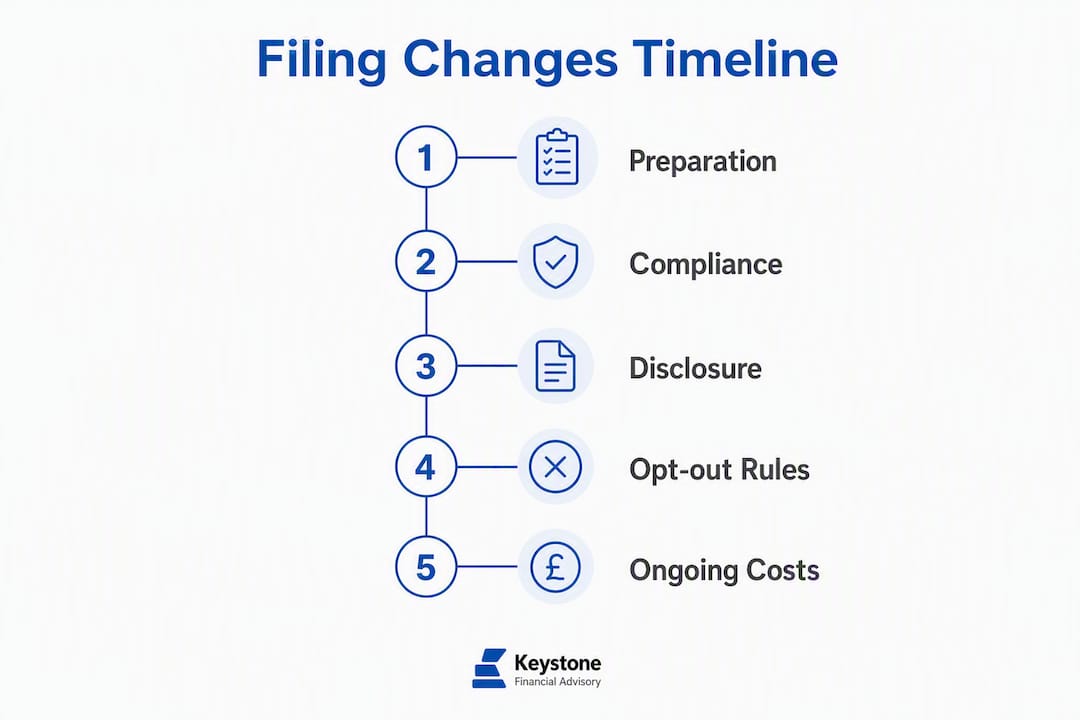
The changes apply to small companies and micro-entities registered in the UK. If you run a limited company, you need to know which category you fall into.
Micro-entity thresholds (must meet at least two of three):
Annual turnover: not more than £632,000
Balance sheet total: not more than £316,000
Average number of employees: not more than 10
Small company thresholds (must meet at least two of three):
Annual turnover: not more than £10.2 million
Balance sheet total: not more than £5.1 million
Average number of employees: not more than 50
The vast majority of UK limited companies fall within one of these two categories. If your company exceeds the small company thresholds, it is medium or large, and separate (though related) filing rules apply.
What changes for each size:
Micro-entities: Must file a balance sheet and a profit and loss account. No directors’ report required.
Small companies: Must file a balance sheet, profit and loss account, directors’ report, and an auditor’s report unless audit-exempt.
A practical example: a consultancy with £800,000 turnover, two employees, and a balance sheet of £200,000 qualifies as a micro-entity. Previously, it could file a balance sheet only. From April 2028, it must also file a P&L.
Pro Tip: Check your accounting reference date (ARD) on Companies House now. If your year-end is 31 March, your first affected filing will be for the year ending 31 March 2028, due by 31 December 2028. If your year-end is 30 September, the first affected filing is for the year ending 30 September 2028, due by 30 June 2029.

Does the opt-out mean your P&L stays private?
Not exactly. The opt-out is real, but it is narrower than many directors assume.
The government has confirmed that small companies and micro-entities must file their profit and loss account with Companies House, but may be able to opt out of having it published on the public register. The distinction matters. Filing and publication are two separate things. Even if you successfully apply the opt-out, your P&L will still exist on the register and will still be accessible to Companies House, HMRC, and law enforcement.
The problem is that the operational detail — how to apply the opt-out, what exactly can be withheld, and what the administrative process looks like — is still to be set out in secondary legislation and Companies House guidance. ICAEW has noted that the opt-out addresses commercial sensitivity concerns, but that the regulations confirming the detail remain awaited.
In practical terms, you should not plan your disclosure strategy around an opt-out mechanism whose rules have not yet been published. Treat the default position as full public disclosure and plan accordingly.
Pro Tip: Start documenting your commercial sensitivity rationale now, even before the regulations are published. A written record of why your P&L figures are competitively sensitive — pricing structures, margin data, client concentration — will support any future opt-out application and demonstrates that the decision was considered, not reactive.
What does public disclosure actually mean for your business?
The impact varies considerably depending on your sector and competitive position, but the risks are real across the board.

Commercial confidentiality. Your gross margin, cost of sales, and operating expenses will be visible to competitors, suppliers, and customers. A professional services firm with a 60% gross margin and low overheads tells a very different story to its clients than one with tighter margins. Pricing negotiations change when the other side knows your numbers.
Lending and credit. Banks and lenders already request management accounts, so the P&L itself is not new to them. What changes is that the information becomes freely available without a formal request. That cuts both ways: a healthy P&L builds credibility with lenders; a loss-making year is harder to contextualise when it sits on a public register without accompanying narrative.
Contractors and supply chains. Larger businesses conducting due diligence on suppliers will have access to P&L data they previously had to request. For small companies bidding on contracts, this can be an advantage if your finances are strong, or a vulnerability if they are not.
Administrative cost. Preparing a compliant iXBRL filing is more involved than a simple balance sheet submission. Expect additional time and cost at year-end. The exact amount depends on your accountant’s fee structure and your current bookkeeping quality, but directors whose records are not clean should expect the gap to be material.
The HMRC compliance picture adds another dimension: more detailed public accounts give HMRC a clearer baseline for compliance checks. Accurate, well-prepared accounts are your best protection.
How to prepare: a step-by-step checklist
The lead time between now and April 2028 allows time for year-end cycles, software transitions, and necessary bookkeeping improvements to meet disclosure requirements.
Confirm your accounting year-end and first affected filing date. Log into Companies House and check your accounting reference date. Work out when your first filing under the new rules will be due.
Review your current bookkeeping quality. Full P&L disclosure requires clean, categorised records. If your bookkeeping has been maintained at a level sufficient for a balance-sheet-only filing, it almost certainly needs work before it can support a compliant P&L.
Check your accounting software. Confirm whether your current package supports iXBRL tagging and can produce a compliant submission. FreeAgent, Xero, QuickBooks, and Sage all have iXBRL capabilities, but you need to verify that your specific subscription tier and configuration support the new filing format.
Speak to your accountant about iXBRL readiness. Ask specifically whether they can produce and submit iXBRL-tagged accounts, what their timeline looks like for year-end work, and whether their fees will change. Not all small accountancy practices have moved to iXBRL workflows yet.
Assess the opt-out question. Even without the final regulations, start identifying which elements of your P&L are genuinely commercially sensitive and why. This is groundwork for an opt-out application and for understanding your disclosure risk.
Review internal access controls. If your P&L will be filed (and potentially published), consider who internally has access to draft accounts and how that information is shared before filing.
Build the cost into your budget. A statutory accounts preparation engagement that now includes a full P&L and iXBRL tagging will cost more than a simplified balance-sheet filing. Factor this into your year-end budget.
ICAEW guidance is clear that early bookkeeping reviews and audit-readiness checks are the single most effective way to avoid last-minute pressure and cost.
How can an accountant help you navigate this?
The practical services an accountant provides here go well beyond simply preparing a set of accounts. The specific tasks relevant to these changes include:
Accounts preparation in iXBRL. Your accountant should be able to produce fully tagged accounts in the required format and submit them via compliant commercial software. Ask to see an example of an iXBRL filing they have prepared and confirm their software is on the Companies House approved list.
Bookkeeping clean-up. Many small companies will need a structured review of their chart of accounts and transaction categorisation before a full P&L can be prepared accurately. An accountant can scope this work and give you a realistic timeline.
Opt-out documentation. Once the regulations are published, your accountant can help you assess eligibility, prepare the rationale, and manage the administrative process. This is not a decision to make without professional input.
Liaison with Companies House. Filing queries, deadline extensions, and format questions are all areas where an experienced accountant saves time and reduces the risk of a rejected submission.
Questions to ask any accountant you are considering:
Do you currently produce iXBRL-tagged accounts for small company clients?
Which software do you use, and is it on the Companies House approved list?
What is your typical turnaround time from receipt of records to filed accounts?
How will your fees change under the new filing requirements?
An audit readiness check is a sensible starting point if you are unsure about the state of your records. It gives you a clear picture of what needs to be done before your first affected filing.
Key dates and how they map to your year-end
Year-end date | First affected financial year | Accounts filing deadline |
31 March 2028 | Year ending 31 March 2028 | 31 December 2028 |
30 June 2028 | Year ending 30 June 2028 | 31 March 2029 |
30 September 2028 | Year ending 30 September 2028 | 30 June 2029 |
31 December 2028 | Year ending 31 December 2028 | 30 September 2029 |
Core dates to know:
Original proposal: April 2027 (delayed following industry feedback)
Confirmed effective date: 1 April 2028
Lead time from announcement: approximately 21 months
Paper and web filing closure: from 1 April 2028
Subscribe to Companies House updates at gov.uk/guidance/companies-house-updates to receive notifications when the secondary legislation and opt-out regulations are published.
Key takeaways
From 1 April 2028, small and micro companies must file a profit and loss account with Companies House, iXBRL format is mandatory, and the opt-out for public publication is confirmed but its operational detail remains pending.
Point | Details |
P&L filing is mandatory | Small and micro companies must file a profit and loss account from 1 April 2028; abridged accounts are abolished. |
Opt-out is limited | You can opt out of publication, not filing; your P&L remains accessible to Companies House, HMRC, and law enforcement. |
Your numbers may not be public | Even if you apply the opt-out, your P&L is filed but may not be published on the public register. |
iXBRL is required | Paper and web filing routes close; all accounts must be submitted via commercial software with iXBRL tagging. |
Act now, not in 2027 | With 21 months of lead time, bookkeeping clean-ups and software checks should start this year, not the year before. |
KeystoneFA can help | KeystoneFA prepares iXBRL-compliant accounts, supports opt-out documentation, and offers fixed-price year-end engagements for small companies. |
What directors are getting wrong about this change
Most of the directors I speak to have heard something about Companies House reforms but assume the changes are minor or that their accountant will handle everything automatically. Neither assumption is safe.
The removal of abridged and filleted accounts is a structural shift, not a formatting update. For years, small companies could file a balance sheet and nothing else. That option is gone. The P&L you have been keeping internal — the one that shows your actual margins, your wage bill, your director drawings context — will now be part of a filed document. Even with an opt-out, it will be on the register in some form.
The second thing directors underestimate is the bookkeeping gap. A balance-sheet-only filing can survive on reasonably tidy records. A full P&L cannot. If your bookkeeping has been maintained at a minimal level, the cost of bringing it up to standard before your first affected filing is real, and it compounds if you leave it late. The companies that will find this most painful are those that start preparing in early 2028 rather than now.
The opt-out question is genuinely uncertain, and that uncertainty is itself a risk. Waiting for the regulations before doing anything is a reasonable instinct, but it should not stop you from documenting your commercial sensitivity rationale, reviewing your software, and having a frank conversation with your accountant about what the new filing will cost. Those steps cost nothing and buy you time when the regulations do land.
The 21-month lead time is there for a reason. Use it.
KeystoneFA helps you file compliantly and protect what matters
The new filing requirements mean more work at year-end, a mandatory switch to iXBRL software, and a decision about the opt-out that needs professional input. KeystoneFA handles all of it: full accounts preparation in iXBRL format, bookkeeping clean-ups ahead of your first affected filing, opt-out documentation once the regulations are published, and direct liaison with Companies House on filing queries.
[
](www.keystonefa.co.uk)
Unlike firms that treat year-end accounts as a commodity, KeystoneFA works with founders and small company directors throughout the year, so your records are in the right shape before the deadline arrives. Commercially sensitive numbers are handled with the same discretion you would expect from a firm that works with early-stage businesses where margin data genuinely matters.
To get started, request a readiness check from KeystoneFA. Bring your accounting reference date, your current software details, and any questions about the opt-out. The firm offers fixed-price engagements so you know the cost before work begins.
This article provides general information about upcoming Companies House filing requirements and is not a substitute for professional accounting or legal advice. Confirm current rules and deadlines with Companies House or a qualified adviser.
Useful sources
Companies House: accounts filing changes from April 2028 (GOV.UK)
Economic Crime and Corporate Transparency Act 2023: company accounts factsheet (GOV.UK)
Changes to UK company law: accounts (campaign.gov.uk)
Economic Crime and Corporate Transparency Act 2023 (legislation.gov.uk)
ICAEW: accounts changes confirmed for April 2028
ICAEW: The Economic Crime and Corporate Transparency Act
Subscribe to Companies House updates directly via GOV.UK to receive notifications when the secondary legislation and opt-out regulations are confirmed.
FAQ
What is a profit and loss account?
A profit and loss account (also called an income statement) records a company’s revenues, costs, and resulting profit or loss over a financial year. It shows whether the business made money, and how.
Which companies must file a P&L from April 2028?
Small companies and micro-entities registered in the UK must file a profit and loss account with Companies House from 1 April 2028, under changes introduced by the Economic Crime and Corporate Transparency Act 2023.
Can I stop my P&L from being visible to the public?
You may be able to opt out of public publication, but you will still be required to file the P&L. Companies House, HMRC, and law enforcement will retain access. The regulations confirming how to apply the opt-out are still pending.
What happens if I miss the filing deadline or submit incorrectly?
Late or non-compliant filings can result in financial penalties from Companies House and, in serious cases, prosecution of directors. Submitting accounts in the wrong format (for example, not in iXBRL) is likely to result in a rejected filing, which counts as a late submission.
How can I check whether my next filing is affected?
Log into Companies House and confirm your accounting reference date. If your financial year ends on or after 1 April 2028, that filing will be subject to the new rules. KeystoneFA can carry out a readiness check to confirm your position and identify any gaps in your records or software.
Recommended