New PM, new tax direction: what UK businesses should watch

Andy Burnham’s tax direction for 2026 is best described as targeted reprioritisation rather than a sweeping overhaul. The headline commitment is unchanged: no rises to main income tax rates, National Insurance, or VAT. What has changed is where the government is redirecting fiscal pressure, and a handful of those redirections carry real consequences for UK businesses. The Finance Bill 2026-27 draft legislation published on 13 July 2026 is the document that matters most right now, not the commentary swirling around it.
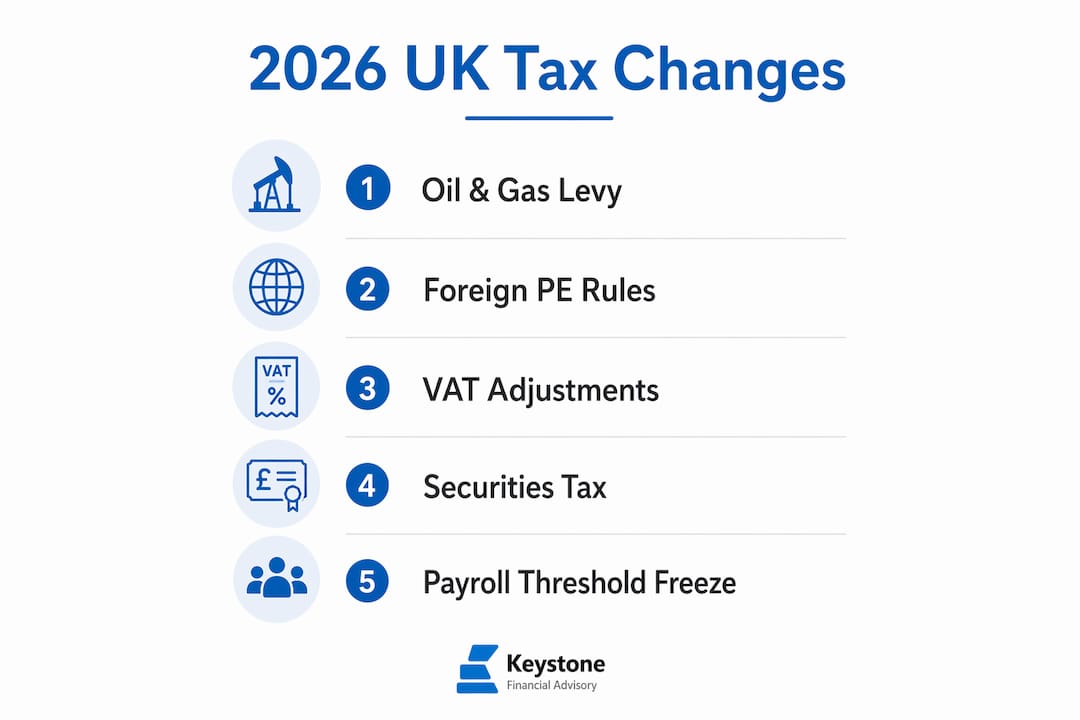
The immediate watchpoints for UK businesses in 2026:
VAT on household electricity has been cut, but business energy VAT stays at 20%. Do not assume any benefit flows through to your premises.
A 35% oil and gas revenue levy is confirmed in the Finance Bill, replacing the Energy Profits Levy after 31 March 2030.
A Securities Transfer Tax will replace stamp duties on shares from 2027.
The foreign permanent establishment (PE) exemption becomes mandatory from 1 January 2027, affecting any UK company with overseas branches.
Income tax and National Insurance thresholds remain frozen until April 2031, a quiet but compounding cost pressure on payroll.
Business rates cuts, capital gains tax reform, and inheritance tax changes are not confirmed. Wait for the Finance Bill to pass before acting on any of those.
The tone here is deliberate. Most coverage of a new Prime Minister’s first tax moves leans into speculation. This article does not. What follows is a clear account of what is law, what is draft, and what is still just being floated.
Table of Contents
What Burnham’s tax policies actually mean for your business
The most important thing to understand about the new PM’s approach is what it does not do. There are no increases to the main rate of corporation tax, no new VAT bands on general business services, and no emergency levies on most sectors. The policy direction is pragmatic: ease cost-of-living pressure on households, protect the territorial tax base, and modernise a few outdated frameworks. For most businesses, the direct impact is narrower than the headlines suggest.

VAT: the household cut that does not help your energy bill
The government cut VAT on household electricity, funded partly by cancelling the digital ID scheme. Business premises are explicitly excluded. If your company pays energy bills, the rate remains 20% unless you already qualify for the 5% reduced rate under existing qualifying-use rules. That reduced rate applies to businesses consuming below the de minimis threshold, but it is not applied automatically. More on that in the compliance section below.
The 35% oil and gas revenue levy
The Finance Bill introduces a permanent 35% oil and gas revenue levy replacing the current Energy Profits Levy, effective for accounting periods after 31 March 2030. If your business operates in or supplies the upstream oil and gas sector, this is a structural change to model now, not in 2029. The timeline gives breathing room, but the permanence of the levy changes long-term investment calculations significantly.
Securities Transfer Tax from 2027
Stamp duties on shares are being replaced by a new Securities Transfer Tax starting 2027. The practical effect for most SMEs is minimal in the short term, but businesses that regularly transact in shares, whether through employee share schemes, acquisitions, or investment rounds, should flag this with their advisers now. The mechanics of the new tax are still being consulted on through 7 September 2026.
Foreign PE exemption: mandatory from January 2027
This one catches companies off guard. Currently, UK-resident companies with foreign branches can elect whether to apply the PE exemption to their overseas profits and losses. From 1 January 2027, that election disappears. The exemption becomes mandatory, meaning foreign branch profits are exempt from UK corporation tax, but so are losses. Companies that have been using overseas losses to reduce their UK tax bill will lose that relief. Anti-avoidance rules apply to arrangements made on or after 13 July 2026.
Key confirmed tax changes at a glance:
Measure | Status | Effective date | Who is affected |
VAT cut on household electricity | Confirmed | 2026 | Households only; not businesses |
35% oil and gas revenue levy | Draft legislation | After 31 March 2030 | Oil and gas sector |
Securities Transfer Tax | Draft legislation | 2027 | Share transactions |
Foreign PE exemption (mandatory) | Draft legislation | 1 January 2027 | UK companies with foreign branches |
Income tax/NI threshold freeze | Confirmed | Until April 2031 | All employers and employees |
Practical differences by business size:
SMEs with no overseas operations and no exposure to oil and gas are largely insulated from the new levies. The threshold freeze is the most direct pressure point.
Larger enterprises with international structures need to model the PE exemption change urgently. The loss of upfront overseas loss relief is a material shift in how cross-border expansion is costed.
Businesses in professional services considering a sale or restructure should factor the Securities Transfer Tax transition into deal timelines. If you are thinking about selling a professional services business, the 2027 changeover is worth discussing with your adviser before any transaction.
What is confirmed, what is speculation, and why the difference matters
This is where most commentary goes wrong. A manifesto commitment and a floated idea are not the same thing, and treating them as equivalent leads to premature decisions.
Confirmed manifesto commitments:
No rise in the main rate of income tax
No rise in National Insurance rates
No rise in VAT
The personal allowance remains frozen at £12,570, with no immediate change announced by Burnham
Still being floated, not confirmed:
Business rates reform or cuts
Capital gains tax alignment with income tax rates
Inheritance tax restructuring
A property tax overhaul replacing council tax
None of the items in that second list have appeared in the Finance Bill 2026-27 draft. Analysts consistently advise waiting for formal legislative updates rather than restructuring on the basis of media speculation. The ICAEW makes the same point: the draft Finance Bill, not press commentary, is the authoritative source for compliance planning.
The fiscal constraints are real too. The government is operating under self-imposed spending rules that limit how aggressively it can cut taxes without finding offsetting revenue. Business rates reform, for instance, would cost significant revenue and requires a credible replacement mechanism. That is why it keeps being floated without landing in legislation.

Pro Tip: Before adjusting your tax structure in response to anything you have read in the financial press, check whether the measure has appeared in the Finance Bill 2026-27 draft. If it has not, it is not yet law and may never be. The technical consultation closes 7 September 2026, which is your window to submit concerns about draft clauses that affect your business.
Practical steps for businesses adapting to the new tax direction
The confirmed changes require action. The speculative ones require patience. Here is how to separate the two in practice.
Monitor the Finance Bill closely
The draft Finance Bill published on 13 July 2026 is the primary reference. The technical consultation period runs until 7 September 2026, after which clauses may be amended before the Bill is introduced to Parliament. Set a calendar reminder for the post-consultation update. If your business is affected by the PE exemption or Securities Transfer Tax provisions, consider submitting a response or having your adviser do so.
Claim the 5% reduced VAT rate on energy if you qualify
This is one of the most overlooked reliefs in UK tax. Businesses consuming energy below the qualifying threshold are entitled to the 5% reduced VAT rate on fuel and power, but it is not applied automatically. You must submit a VAT Declaration to your energy supplier confirming your qualifying use. Suppliers rarely prompt customers to do this. If your business has never submitted one, check your consumption figures against the threshold and act.
“Reduced-rate VAT for businesses applies only if usage thresholds are met, and suppliers rarely prompt claims. The declaration must be submitted by the business, not the supplier.” — GOV.UK VAT on fuel and power guidance
Account for the threshold freeze in payroll planning
The freeze on income tax and National Insurance thresholds until April 2031 is not a new rate rise, but it functions like one. As wages rise with inflation, more of your employees’ pay is pulled into higher tax bands without any change to the rates themselves. For businesses, this means higher employer NI costs over time as salary reviews push more employees above thresholds. Model this into your five-year payroll projections now rather than absorbing it as a surprise each April.
Operational steps for 2026-27:
Review your energy contracts and submit VAT Declaration forms where qualifying use applies
Audit any overseas branch structures for PE exemption implications before 1 January 2027
Flag share transaction plans to your adviser ahead of the Securities Transfer Tax transition in 2027
Update payroll models to reflect the threshold freeze through 2031
Resist restructuring for CGT, IHT, or business rates changes until they appear in legislation
Common risks to avoid:
Assuming the household VAT cut on electricity applies to business premises. It does not.
Treating speculative press coverage of CGT alignment as confirmed policy.
Failing to update accounting systems ahead of the mandatory PE exemption change.
Missing the 5% reduced energy VAT rate by not submitting the required declaration.
For a broader look at reducing your corporation tax bill within the current framework, there are legitimate strategies that remain fully available regardless of which speculative reforms eventually materialise.
KeystoneFA’s perspective on navigating Burnham’s tax policies
The businesses that handle policy transitions well tend to share one characteristic: they distinguish early between what requires action now and what requires monitoring. That sounds obvious, but in practice, the noise around a new Prime Minister’s first Finance Bill makes it genuinely difficult to hold that line.
At KeystoneFA, the team works with founders, growing businesses, and established SMEs across the UK, many of whom have been asking the same questions since Burnham’s appointment. The pattern is consistent: concern about CGT and IHT changes that have not yet materialised, and underpreparedness for the PE exemption reform that has.
Common challenges KeystoneFA helps clients address:
Identifying whether their energy consumption qualifies for the 5% reduced VAT rate and submitting the correct declarations
Modelling the payroll impact of the threshold freeze across multi-year salary plans
Reviewing overseas branch structures ahead of the mandatory PE exemption change in January 2027
Separating confirmed legislative changes from speculative proposals in financial planning conversations
Updating statutory accounts and reporting processes to reflect new compliance requirements
The team includes professionals with experience at top UK and Middle East firms, which matters when the policy environment is shifting. International structures, in particular, require advisers who understand both the domestic and cross-border dimensions of changes like the PE exemption reform.
Pro Tip: If your business has foreign branches and you have been using overseas losses to offset UK corporation tax, speak to an adviser before 13 July 2026 arrangements are caught by the anti-avoidance rules already in force. The transition window is narrower than it looks.
For businesses thinking about structure in the context of new tax rules, the sole trader vs limited company question is also worth revisiting under the current framework.
How new UK tax policies interact with international obligations
The PE exemption reform is the clearest example of where domestic tax policy and international obligations intersect. The government’s stated rationale is alignment with standard international practice: most territorial tax systems do not allow companies to claim relief for overseas losses while exempting the corresponding profits. Making the exemption mandatory brings the UK into line with that norm.
For businesses with operations in countries that have double tax treaties with the UK, the practical effect depends on how those treaties define “permanent establishment.” The Finance Bill uses the international meaning of the term in all cases, which reduces ambiguity but may catch structures that previously relied on a narrower domestic definition.
The Securities Transfer Tax reform also has an international dimension. The modernisation of the stamp taxes framework is partly designed to ensure the UK’s share transaction regime remains competitive with other financial centres post-Brexit. Businesses involved in cross-border M&A or investment activity should watch the consultation responses closely, as the final design of the tax will affect transaction costs on both sides of international deals.
Trade agreements signed since Brexit generally do not cover direct tax, so the new levies and reforms in the Finance Bill are unlikely to be constrained by treaty obligations. However, businesses operating under specific trade arrangements, particularly in sectors like energy where the 35% levy applies, should take legal advice on whether any investment protection provisions in bilateral agreements are relevant to their situation. Female entrepreneurs and growth-stage businesses navigating international expansion can find useful context on funding and structure in resources like this guide to UK business growth.
The broader point is that UK tax policy does not operate in isolation. Transfer pricing rules, the OECD’s Pillar Two global minimum tax (reflected in the Finance Bill’s Multinational Top-up Tax provisions), and bilateral treaty networks all interact with domestic changes. If your business crosses borders, the Finance Bill 2026-27 is not just a domestic compliance document.
KeystoneFA helps you plan through the noise
[

](www.keystonefa.co.uk)
Most of what you will read about Burnham’s tax direction over the coming months will be speculative. KeystoneFA’s value to clients in this environment is straightforward: cutting through that noise to focus on what is confirmed, what requires action, and what can safely wait.
The firm offers tailored accounting and tax advisory services for founders, startups, and growing businesses, with a team that has hands-on experience across UK and international tax frameworks. Whether you need help submitting VAT declarations for reduced energy rates, modelling the payroll impact of the threshold freeze, or reviewing your overseas branch structure before the January 2027 PE exemption deadline, the team works through the specifics with you rather than offering generic guidance.
If the Finance Bill 2026-27 has raised questions about your business’s compliance position or tax planning strategy, book a consultation with KeystoneFA to get a clear, grounded answer.
FAQ
What are the confirmed new tax rules for UK businesses in 2026?
The Finance Bill 2026-27 confirms a 35% oil and gas revenue levy (effective after 31 March 2030), a mandatory foreign PE exemption from January 2027, and a Securities Transfer Tax replacing stamp duties on shares from 2027. Business energy VAT remains at 20%.
Is the UK now one of the most heavily taxed countries?
The threshold freeze until April 2031 means more income is taxed at existing rates as wages rise, increasing the effective tax burden without changing headline rates. The UK’s overall tax-to-GDP ratio has been rising, though direct international comparisons depend heavily on which taxes are included.
What are the biggest tax mistakes business owners make right now?
The most common errors are assuming the household electricity VAT cut applies to business premises (it does not), failing to submit a VAT Declaration to claim the 5% reduced rate on qualifying energy use, and restructuring for CGT or IHT changes that have not yet appeared in legislation.
How does the income tax threshold freeze affect my business?
The freeze on income tax and National Insurance thresholds until April 2031 means employer NI costs rise gradually as wages increase, even without any change to the rates themselves. Businesses should model this into multi-year payroll forecasts to avoid absorbing it as an unexpected cost each year.
Should I act now on speculative tax reforms like CGT alignment?
No. Business rates cuts, CGT alignment, IHT reform, and property tax overhaul are not in the Finance Bill 2026-27 draft. Wait for formal legislative confirmation before restructuring. KeystoneFA advises clients to plan around confirmed changes and monitor the Bill’s progress through Parliament before acting on anything else.
Key takeaways
Burnham’s tax direction for 2026 is a targeted reprioritisation, not a broad rate shift, and the Finance Bill 2026-27 is the only reliable guide to what actually requires action.
Point | Details |
Business energy VAT unchanged | The household electricity VAT cut does not apply to business premises; the rate stays at 20%. |
Three confirmed structural changes | The 35% oil and gas levy, mandatory PE exemption, and Securities Transfer Tax are all in draft legislation. |
Threshold freeze compounds quietly | The income tax and NI freeze until April 2031 raises effective employer costs without changing headline rates. |
Speculative reforms need patience | Business rates cuts, CGT alignment, and IHT reform are not in the Finance Bill; do not restructure for them yet. |
KeystoneFA clarifies what needs action | KeystoneFA helps businesses separate confirmed legislative changes from speculation and plan compliance accordingly. |
Recommended