Credit control in business: a practical guide for UK owners


Credit control is the process that turns your sales ledger into actual cash. It covers everything from checking a new customer’s creditworthiness before you trade with them, to chasing an overdue invoice, to deciding when to hand a debt to a solicitor. Done well, it keeps Days Sales Outstanding (DSO) low, bad debts rare, and your working capital predictable. Done poorly, it turns profitable sales into a funding problem.
The Chartered Institute of Credit Management (CICM) frames credit control as safeguarding your investment in accounts receivable. Experian goes further, recommending that businesses combine pre-trade credit checks with a disciplined post-invoice collections process to cut late payments and bad debts. The single most effective way to reduce both is a repeatable process measured consistently against a handful of KPIs.
Here is what that looks like in practice:
Protect cash flow by converting receivables into reliable cash on a predictable schedule.
Limit credit risk through pre-trade checks and defined credit limits before you extend terms.
Reduce bad debt with a consistent chasing cadence and clear escalation triggers.
Measure performance using DSO, aged-debt buckets, and collection-effectiveness ratios.
Decide when to escalate based on pre-set thresholds rather than gut feel.
Key takeaways
Effective credit control protects cash flow by combining a consistent pre-trade assessment, prompt invoicing, a disciplined chasing cadence, and pre-set escalation triggers measured against DSO and aged-debt KPIs.
Point | Details |
Invoice on the day of delivery | Same-day invoicing with a payment link is the single fastest way to reduce DSO. |
Chase every overdue invoice | Businesses that chase 100% of overdue invoices are around 76% more likely to be paid within a week. |
Escalate on a schedule | Issue a letter before action by day 45–60; refer to an agency or court by day 90 before recovery odds fall sharply. |
Formalise at 25 invoices/month | Once you issue roughly 25 invoices per month, a manual process becomes unreliable; automate reminders and aged-debt reporting. |
KeystoneFA advisory support | KeystoneFA builds and runs credit control processes for UK SMEs, reducing owner time spent chasing and improving cash flow predictability. |
Table of Contents
What does credit control actually cover in your business?
Credit control is the day-to-day management of money owed to you by customers. It sits within the broader discipline of credit management, which also includes strategic decisions about which markets to enter, what credit policies to set, and how to price credit risk. Think of credit management as the policy layer; credit control is the operational layer that executes it.
The routine activities credit control covers include: onboarding checks on new customers, raising accurate invoices promptly, monitoring the sales ledger, sending payment reminders, chasing overdue accounts, logging disputes, and escalating debts that have not moved.
Who does this work depends on business size. In a micro-business, the owner handles it personally, often inconsistently. In a growing SME with 10–50 staff, a bookkeeper or office manager typically takes it on alongside other duties. Once invoice volumes rise or late payments become a recurring problem, a dedicated credit controller or an outsourced AR partner becomes the more reliable option. Larger firms have a credit control team sitting within the finance function, reporting to a financial controller or CFO.
The customer lifecycle gives credit control its natural shape: onboard → trade → collect → escalate. Each stage has its own checks and actions. Skipping the onboarding stage is where most bad debts begin, because by the time an invoice is overdue, you have already extended credit to someone you know little about.

Why credit control matters: benefits and risks to your business
The commercial case for credit control is straightforward. Predictable cash inflows let you plan payroll, pay suppliers on time, and avoid drawing on expensive overdraft facilities. Businesses with tight credit control also tend to have stronger relationships with lenders, because their accounts show a clean receivables ledger rather than a pile of aged debt.
Primary benefits of effective credit control:
Predictable cash flow and improved working-capital management.
Lower cost of finance, because you borrow less and for shorter periods.
Fewer write-offs, which directly protect your profit margin.
Stronger supplier relationships, because you pay on time when customers pay you.
Clearer credit decisions, because you have data on which customers pay reliably.
Risks of weak credit control:
DSO creep: your average collection period lengthens, quietly draining working capital.
Insolvency risk if a large debtor fails while you are carrying significant exposure.
Reputational damage from pursuing debts publicly or, conversely, from being seen as a soft touch.
Higher financing costs as you borrow to cover the gap between invoicing and collection.
A concrete example makes the cascade visible. A £40,000 invoice issued on 1 January with 30-day terms, but not chased until day 60, is now two months of working capital tied up. If that customer is also struggling, the recovery odds fall sharply. Industry data shows that businesses which chase 100% of overdue invoices are around 76% more likely to be paid within a week than those that chase selectively. The difference is not the relationship; it is the consistency.
Stat to note: Businesses that chase every overdue invoice are approximately 76% more likely to receive payment within a week compared with those that chase inconsistently.
What does an effective credit control process look like?
A credit control process is only as good as its consistency. Here is a practical sequence you can implement immediately.
Onboarding and credit checks. Before extending terms to a new customer, run a credit check via a provider such as Experian Business Express, collect trade references, and confirm the legal entity name and registered address. Set a credit limit based on what you find, not on the size of the order.
Agree terms in writing. Payment terms, late-payment interest (which UK law allows under the Late Payment of Commercial Debts (Interest) Act 1998), and accepted payment methods should appear on every contract and every invoice. Verbal agreements are almost impossible to enforce.
Invoice promptly and accurately. Raise the invoice on the day of delivery or completion. Include the customer’s purchase-order number, the correct legal entity name, a clear due date, and your bank details or payment link. A single missing field can delay payment by weeks.
Send a pre-due reminder. A brief, friendly message three to five days before the due date reduces late payments without damaging the relationship. Most customers appreciate the nudge; it also removes the “I never received it” excuse.
Run a consistent chasing cadence. On the due date, confirm receipt. At day 7 overdue, send a written reminder. At day 14, follow up by phone. At day 21, send a firmer written notice. Document every contact.
Handle disputes quickly. A disputed invoice stops the clock on your collection. Log disputes immediately, assign an owner, and set a resolution deadline. Unresolved disputes are one of the most common reasons a debt ages past 90 days.
Escalate on schedule, not on mood. Issue a formal letter before action by day 45–60. If there is no response or payment plan by day 90, escalate to an external collection agency or legal route. Recovery odds fall significantly beyond the 90–120 day window, so earlier escalation is almost always the right call.
Review monthly. Run an aged-debt report at the end of every month. Identify accounts that have moved into a worse bucket and decide the next action before the next cycle begins.
The single most important lever in this sequence is steps 4 and 5: early reminders and a consistent cadence. Most late payments are not malicious; they are administrative. A timely nudge from you is often all it takes.
Quick policy checklist:
Who owns each step (name or role, not “the team”).
Escalation triggers (days overdue, amount thresholds).
Accepted payment methods (BACS, Direct Debit, card).
Who authorises write-offs and at what level.
How do you assess credit risk before and during trading?
Pre-trade checks are the cheapest risk-management tool available. A credit report from Experian costs a fraction of what a bad debt costs, and it takes minutes. Experian recommends combining these pre-trade checks with disciplined post-invoice collections as a two-part approach to reducing late payments.
What to check before trading:
Company credit score and payment history via Experian Business Express or a comparable provider.
County Court Judgements (CCJs) registered against the business.
Filed accounts at Companies House (look at net assets, cash position, and whether accounts are overdue).
Trade references from two existing suppliers.
Confirmation of the legal entity name, registered number, and trading address.
Red flags that should trigger caution:
A sudden drop in credit score since the last check.
Multiple CCJs or a winding-up petition on record.
Erratic payment history with other suppliers.
Reluctance to provide trade references or a purchase-order number.
A very new company with no filed accounts and a large first order.
When red flags appear, require a deposit, upfront payment, or a personal guarantee before trading. It is easier to negotiate these terms before you start than after you have delivered.
KPIs to monitor during trading:
KPI | What it shows | Warning level and action |
Days Sales Outstanding (DSO) | Average days to collect payment | Rising trend over 3 months; review chasing cadence |
Aged-debt distribution | % of AR in 0–30, 31–60, 61–90, 90+ day buckets | More than 20% in 61+ days; escalate those accounts |
Bad-debt ratio | Write-offs as % of revenue | Above 1–2% for most SMEs; tighten onboarding checks |
Collection effectiveness index | % of collectible debt actually collected | Below 80%; review process and resource |
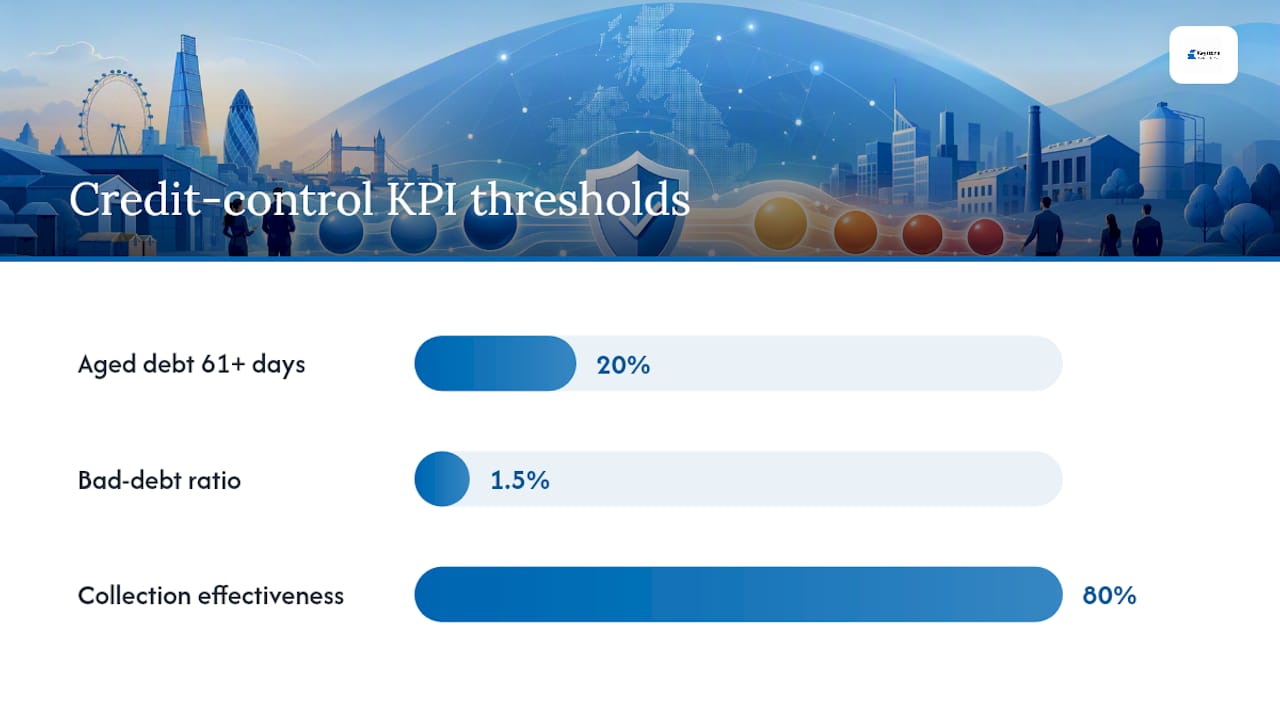
DSO is the headline number. If it is rising month on month, something in the process is breaking down, whether that is slow invoicing, weak chasing, or a cluster of problem customers.
What policy elements and everyday habits make credit control work?
Policy without habit is just a document. The businesses that collect reliably are those where credit control steps happen automatically, not when someone remembers.
A compact policy template covers:
Standard payment terms (30 days net is common in the UK; shorter terms are worth testing with new customers).
Credit limits by customer tier, reviewed at least annually.
Escalation triggers: who is notified when an account reaches 30, 60, and 90 days overdue.
Write-off authority: amounts below £X can be written off by the credit controller; above that requires a director sign-off.
Practical invoicing habits:
Invoice on the day of delivery, not at the end of the month.
Use a consistent invoice template with all required fields pre-populated.
Offer multiple payment methods: BACS, Direct Debit via GoCardless, and card payments via Stripe or a similar provider. The easier you make it to pay, the faster you get paid.
Send invoices by email with a read receipt or delivery confirmation, so “I never received it” is not a viable excuse.
Tone and wording for reminders:
Early reminders should be warm and assume good faith. “Just a quick note that invoice [number] for £[amount] is due on [date]” is enough. As the debt ages, the tone firms up, but it should never become aggressive until you have issued a formal letter before action. Aggressive language before that point damages the relationship and rarely speeds up payment.
Pro Tip: When chasing by phone, call before 10 AM or after 3 PM. Finance teams tend to be less distracted at those times, and you are more likely to reach the person who actually processes payments rather than a gatekeeper.
Automation adds real value for reminders and reporting, but keep manual oversight for disputes and for accounts where the relationship matters commercially. A reminder sent to a customer mid-dispute is a fast way to escalate a conversation you did not want to have.
Good record-keeping underpins all of this. Contracts, delivery notes, email confirmations, and signed purchase orders are your evidence if a dispute reaches a formal stage.

How do you manage late payers and escalate effectively in the UK?
Most late payments resolve before formal action is needed. The key is moving through the escalation sequence without hesitation when a customer stops responding.
The prescribed escalation sequence:
Friendly reminder (day 1–7 overdue): email or SMS, assume an oversight.
Follow-up call (day 7–14): speak to the accounts payable contact directly, confirm receipt and ask for a payment date.
Formal written reminder (day 14–21): letter or email on headed paper, state the overdue amount, the original due date, and that late-payment interest is accruing.
Letter before action (day 45–60): a formal notice stating that legal proceedings will follow if payment is not received within 7–14 days. This is a legal prerequisite for most court routes.
External recovery or legal action (day 90+): refer to a collection agency, issue a county court claim, or instruct a solicitor.
When to pause supply: Suspending credit or halting further deliveries is a legitimate commercial lever. Use it when a customer is significantly overdue and still placing new orders. It concentrates the mind. The trade-off is that it may end the commercial relationship, so reserve it for accounts where the overdue balance outweighs the future revenue.
Legal routes in the UK:
Gov available to businesses owed money in England and Wales, including letters before action, statutory demands, and county court claims. For debts under £10,000, the small claims track is the most practical route and can be issued online via HMCTS. For larger amounts, a solicitor’s letter or a High Court enforcement route may be more appropriate.
Decision checklist: recover, agency, or court?
Continue chasing in-house if the debt is under 60 days, the customer is communicating, and the amount is modest.
Refer to a collection agency if the debt is over 60 days, the customer has gone silent, and the amount justifies the agency fee (typically 10–25% of recovered sums).
Issue a county court claim if you have clear documentation, the customer is solvent, and the relationship is already over.
Write off if the customer is insolvent, the debt is small, and recovery costs exceed the likely return.
The Allianz Trade guidance on this distinction is useful: credit control is the ongoing process; debt collection is the escalation route when that process has failed. Conflating the two leads businesses to treat every overdue invoice as a legal matter, which is expensive and relationship-damaging.
When should you outsource credit control or hire in-house?
The honest answer is: earlier than most business owners think.
Signs you need extra resource:
You are issuing more than roughly 25 invoices per month and chasing is falling behind. Xero’s guidance uses this as a practical threshold for formalising credit control procedures.
Late payments are recurring across multiple customers, not isolated to one or two.
The owner is spending more than two hours a week on chasing, time that has a higher-value use.
DSO has been rising for three consecutive months without a clear reason.
You have had to write off a debt in the past 12 months that a credit check would have flagged.
Outsourcing scope and what to retain in-house:
Outsourced AR partners typically handle: automated reminders, phone chasing, dispute logging, aged-debt reporting, and pre-claim escalations. What you retain in-house: credit-limit decisions, write-off authorisations, and any customer conversation that has strategic commercial implications.
Pros of outsourcing:
Immediate capacity without a hire.
Consistent process applied to every invoice.
Specialist knowledge of escalation routes and legal prerequisites.
Cost is variable (pay per invoice or per recovered amount) rather than a fixed salary.
Cons:
Less nuance in customer relationships.
You need to brief the partner thoroughly on your tone and any sensitive accounts.
Quality varies; vet the provider’s references and ask for sample reporting.
Hiring triggers for an in-house credit controller:
Hire when monthly invoice volume is consistently above 50–75, when the outsourced cost exceeds a salary equivalent, or when the complexity of your debtor base (multiple currencies, complex contracts, regulated sectors) requires someone embedded in the business. The role should own DSO as a KPI, run the aged-debt review, and have a direct line to the finance director for escalation decisions.
For business owners who are also managing liquidity and income volatility, specialist advisers can help frame credit control decisions alongside broader cashflow and financing considerations.
What tools and automation support credit control?
Software does not fix a broken process. It amplifies whatever process you already have. So before you buy a tool, make sure the steps in the previous sections are defined and owned.
Core features to look for in AR and credit control software:
Automated reminder sequences triggered by due date and days overdue.
Aged-debt dashboards with drill-down to individual invoices.
DSO calculation and trend reporting.
Direct-debit collection via GoCardless or similar.
Card-payment links embedded in invoices.
Dispute logging with an owner and resolution date.
Escalation workflows that flag accounts for human review at defined thresholds.
When software adds clear value:
Volume is the primary driver. Once you are managing more than 25–30 active debtors, manual tracking in a spreadsheet becomes unreliable. Xero’s guidance recommends automation and aged-receivables monitoring at roughly this threshold. Software also adds value when consistency is the problem: if reminders go out late or not at all because someone forgot, automation solves that immediately.
When a manual process is still adequate:
If you have fewer than 15 customers, all on similar terms, and you know each accounts-payable contact personally, a well-maintained spreadsheet and a calendar reminder may be sufficient. The overhead of configuring and maintaining software is not trivial.
Implementation tip: Phase automation carefully. Start by automating reminders for one customer segment (for example, accounts under £5,000) and monitor the response rate for 60 days before rolling out to the full ledger. This lets you tune the tone and timing without risking a relationship-damaging message to your largest customer.
UK-relevant credit-reporting sources include Experian Business Express, Creditsafe, and Companies House for filed accounts. Each serves a slightly different purpose: Experian and Creditsafe provide scored credit reports; Companies House gives you the raw financial data to interpret yourself.
How a growing SME improved cash flow with structured credit control
Consider a UK-based professional services firm with 12 staff and around 80 active clients. When they engaged an adviser, DSO was sitting at 54 days against 30-day terms, and the owner was spending roughly three hours a week chasing payments personally.
The adviser’s first action was a policy document: standard 30-day terms on all new contracts, a credit limit of £5,000 for new clients without a credit check, and a chasing cadence with named owners for each step. Invoices moved from end-of-month billing to same-day issue on project completion.
Within 90 days, DSO had fallen to 38 days. The owner’s time spent on chasing dropped to under 30 minutes a week, because the process ran without prompting. Three clients with persistent late-payment patterns were identified through the aged-debt report and moved to upfront payment terms.
Concrete outcomes clients can reasonably expect from this approach:
Improved cash flow predictability within the first billing cycle.
A measurable reduction in DSO within 60–90 days of implementing a consistent chasing cadence.
Fewer disputes, because accurate, prompt invoicing removes the most common triggers.
Clearer credit decisions, because onboarding checks surface risk before it becomes a problem.
The SME Today adviser framework describes this shift well: combining automation for reminders and reporting with advisory discipline moves businesses from reactive chasing to proactive forecasting. That is the difference between knowing you have a problem at 90 days and knowing at 35.
For founders building this from scratch, the accounting for pre-revenue startups guide covers how to set up financial processes before revenue arrives, including early credit-term decisions.
One action to take this week
Invoice on the day you deliver, and include a payment link.
That single change addresses the two most common reasons invoices are paid late: they arrive after the customer’s payment run has already closed, and paying by BACS requires the customer to do more work than clicking a button. Same-day invoicing with an embedded card or Direct Debit link removes both friction points simultaneously.
To measure the effect, track the percentage of invoices paid within terms before and after the change. Most businesses see a noticeable improvement within the first two billing cycles. If DSO does not move, the delay is elsewhere in the process, which at least tells you where to look next.
How KeystoneFA can support your credit control
Getting credit control right is less about willpower and more about having the right process, the right tools, and someone who will hold the line when it is easier to let a payment slide.
[

](www.keystonefa.co.uk)
KeystoneFA works with UK founders, startups, and growing businesses to build credit control processes that actually run without the owner doing all the chasing. That means setting up your invoicing cadence, configuring automated reminders, running monthly aged-debt reviews, and advising on escalation decisions before a debt becomes a write-off. Clients typically see a measurable reduction in DSO within the first quarter, and most report spending significantly less time on payment chasing within 60 days of engagement.
If you want to know where your current process is losing money, start with a free initial review with the KeystoneFA team. No obligation, and you will leave with a clear picture of where your cash flow is leaking and what to fix first.
Sources
This article is general information, not a substitute for advice from a qualified financial advisor. Consult a qualified financial professional about your own circumstances before acting on anything here.
FAQ
What is the role of credit control in business?
Credit control manages the money customers owe you, from pre-trade checks and invoice issuance through to chasing and escalation. Its primary role is protecting cash flow by converting receivables into reliable cash while limiting bad-debt exposure.
What does a credit controller do in a company?
A credit controller runs the day-to-day collections process: raising and sending invoices, monitoring the aged-debt ledger, chasing overdue accounts, logging disputes, and escalating debts that have not moved within defined thresholds.
What are the five Cs of credit control?
The five Cs are a traditional credit-assessment framework: Character (the customer’s payment history and reputation), Capacity (their ability to repay from cash flow), Capital (their net asset position), Conditions (the trading environment and terms), and Collateral (any security offered). Definitions vary slightly by source, but these five dimensions are the most widely cited version in UK credit management practice.
What are the main responsibilities of a credit controller?
The core responsibilities are: setting and reviewing customer credit limits, issuing accurate invoices promptly, running a consistent chasing cadence, resolving disputes quickly, producing aged-debt and DSO reports, and escalating debts to external recovery when internal efforts have been exhausted.
Recommended