Why keeping business records matters for small businesses

TL;DR:
Maintaining organized business records is essential for maximizing deductions, defending claims, and ensuring compliance. Accurate documentation reduces audit risks and supports better financial decisions, safeguarding long-term growth. Using accounting software, digital tools, and consistent habits helps small business owners manage records efficiently.
Business record-keeping is defined as the systematic maintenance of organised documentation covering all financial transactions, tax obligations, and operational activities within a business. Why keeping business records matters becomes clear the moment HMRC questions a deduction: without contemporaneous records, even legitimate expenses can be denied in full. Tax Court Memo 2025–12 confirmed this, ruling against a taxpayer who lost major deductions because mileage logs were reconstructed after the fact rather than recorded at the time. Tools such as QuickBooks and Xero make daily documentation far more manageable for small business owners, and the consequences of skipping it are severe enough to threaten a business’s survival.
What key benefits do accurate business records provide?
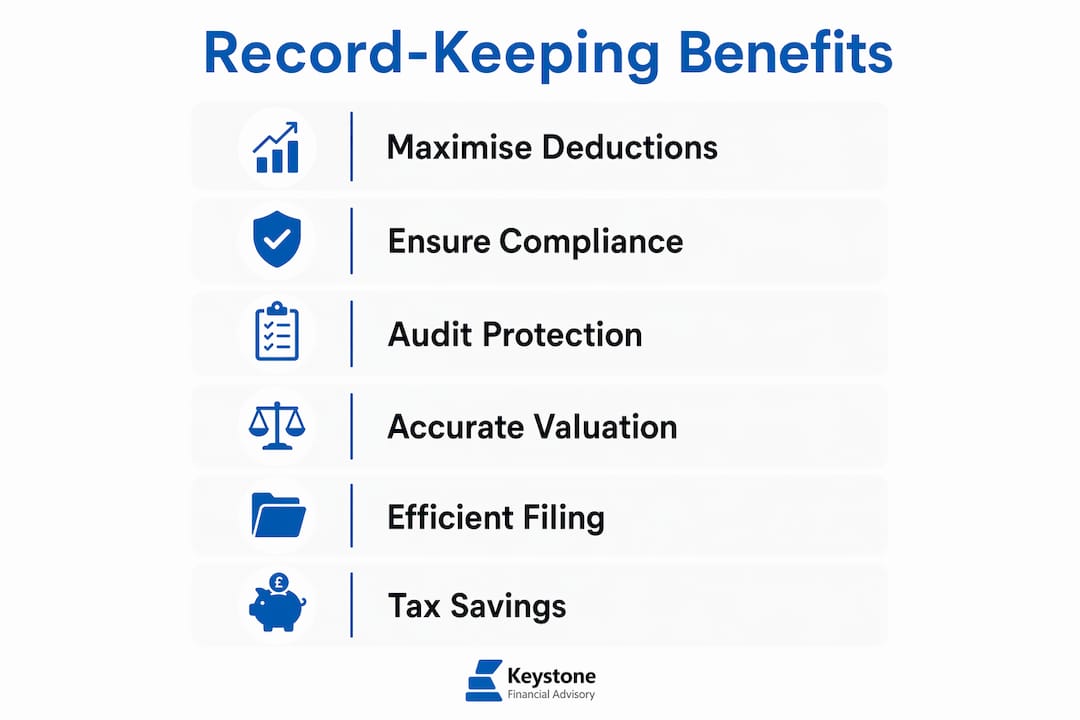
Accurate records deliver six concrete advantages that go well beyond avoiding fines. Understanding each one helps small business owners see record-keeping as a business asset rather than an administrative burden.
Good records help maximise the expenses you can claim and reduce your overall tax bill. Detailed evidence defends every deduction during an investigation or audit, and missing that evidence means the deduction disappears entirely.
Organised documentation also acts as a legal shield. Businesses with prompt records face fewer and shorter investigations than disorganised counterparts, because auditors can verify claims quickly and move on. That translates directly into lower professional fees and less disruption.
Beyond compliance, clear financial records support better decisions. When your profit and loss account, cash flow statement, and aged debtors report are current, you can spot a cash shortfall weeks before it becomes a crisis rather than days after.
Tax compliance: Accurate records maximise deductions and defend them under scrutiny.
Cash flow control: Up-to-date accounts reveal shortfalls before they become emergencies.
Audit readiness: Organised files reduce investigation length and associated costs.
Business valuation: Clean records enhance long-term valuation and exit readiness.
Financing access: Lenders and investors require verified financial history before committing funds.
Decision-making: Current data supports faster, more confident operational choices.
Pro Tip: Review your accounts monthly rather than quarterly. Monthly reviews catch errors while the context is fresh, and they turn tax preparation into a straightforward exercise rather than a stressful annual scramble.
How long must small businesses keep different types of records?
Retention periods are not arbitrary. They reflect the window during which HMRC, or a court can legitimately challenge a filing or claim. Getting this wrong means records disappear before they are needed most.
HMRC guidance for UK businesses requires most business records to be kept for at least six years from the end of the relevant accounting period.
Record type | Minimum retention period |
Employment tax records | 3 years from end of tax year |
Corporation tax records | 6 years from end of accounting period |
VAT records (UK) | 6 years |
Company statutory records | 6 years |
Contracts and legal agreements | 6 (simple contracts) –12 (deeds) years |
Organising records by year and category makes retrieval straightforward. A folder structure that mirrors your tax return, whether physical or digital, means you can locate any document within minutes rather than hours.
Pro Tip: Use cloud storage such as Google Drive or Microsoft OneDrive with automatic backup enabled. Cloud retention protects against fire, theft, and hardware failure, and it makes sharing documents with your accountant instant.
What common pitfalls do small business owners face in record-keeping?
The most damaging mistakes in record-keeping share one characteristic: they are all avoidable with consistent habits. Recognising them early prevents the financial and legal consequences that follow.
Many owners believe that a legitimate expense is automatically deductible. Tax Court Memo 2025–12 disproved this directly. The taxpayer held genuine business expenses but lost deductions entirely because contemporaneous mileage logs and clear receipts were absent. The court did not question whether the journeys happened. It questioned whether the records proved it.
Fragmented records create a second problem. When invoices live in email, receipts sit in a drawer, and bank statements are downloaded only at year end, the picture is incomplete. Incomplete pictures lead to denied tax benefits, and they also make it impossible to monitor cash flow accurately during the year.
Reconstruct nothing. Record mileage, expenses, and meeting notes at the time they occur, not weeks later.
Centralise everything. Use one system, whether that is accounting software or a structured folder, not multiple disconnected locations.
Categorise as you go. Assign each transaction to the correct account when it is entered, not during the annual review.
Keep supporting documents. Every entry needs a receipt, invoice, or bank statement to back it up.
Set a weekly slot. Fifteen minutes each week prevents the annual rush that causes errors and missed deductions.
The annual rush is the most common pitfall of all. Waiting until tax season to organise records increases both risk and workload. Monthly organisation is the practical alternative.
What tools and strategies help small businesses manage records effectively?
The right tools remove friction from record-keeping and make consistency far easier to maintain. Small business owners no longer need to rely on spreadsheets and paper files to stay compliant.
Accounting software such as QuickBooks and Xero connects directly to your bank account via a live feed. Every transaction imports automatically, and you categorise it with a single click. That removes the manual data entry that causes most errors in small business bookkeeping.
Apps and digital tools help businesses capture and store receipts securely. Apps such as Dext (formerly Receipt Bank) photograph a receipt and attach it to the matching transaction in your accounting software within seconds. The paper receipt can then be discarded, and the digital copy is stored with a clear audit trail.
Accounting software: QuickBooks or Xero for automated bank feeds and categorisation.
Receipt capture apps: Dext or similar tools to photograph and file receipts immediately.
Cloud storage: Google Drive or Microsoft OneDrive for long-term document retention with backup.
Invoicing integration: Link your invoicing tool directly to your accounting software to avoid duplicate entry.
Scheduled reviews: Block one hour each month to reconcile accounts and attach outstanding receipts.
Linking receipts to transactions monthly turns record-keeping into a routine rather than a crisis. The monthly habit also means your financial data is always current, which supports faster decisions and cleaner tax consultation conversations with your adviser.
Pro Tip: Ask your accountant to review your filing system once a year. A professional eye spots gaps before they become problems, and it costs far less than correcting a denied deduction after an audit.
Key takeaways
Accurate, contemporaneous business records are the single most effective protection against denied deductions, audit penalties, and poor financial decisions.
Point | Details |
Records prevent denied deductions | Missing contemporaneous logs cost taxpayers legitimate claims, as confirmed in Tax Court Memo 2025–12. |
Retention periods are legally fixed | Keep most UK records for six years. |
Monthly habits reduce annual risk | Linking receipts to transactions each month cuts errors and removes the year-end scramble. |
Digital tools make compliance easier | QuickBooks, Xero, and Dext automate categorisation and receipt storage with minimal effort. |
Clean records support business growth | Organised documentation improves valuation, financing access, and exit readiness. |
Records matter more than most founders realise
I have worked with founders who treated record-keeping as something to sort out before the tax deadline. Almost every one of them eventually paid for that mindset, whether through a denied deduction, a delayed loan application, or a business sale that stalled because the buyer’s solicitor could not verify three years of financials.
The thing that surprises most owners is how directly clean records affect business valuation. Incomplete documentation lowers company valuation and weakens exit strategy potential. A buyer or investor does not take your word for revenue figures. They verify them, and if the paper trail is thin, they either walk away or reduce their offer significantly.
The emotional relief of consistent record-keeping is also underestimated. When your accounts are current, an HMRC letter stops being frightening. You know exactly what you have, and you can respond quickly. That confidence changes how you run the business day to day.
Digital tools have removed most of the friction that made record-keeping feel burdensome. The mindset shift I recommend to every founder is simple: treat your records the way you treat your product. Both represent the value of your business, and both deserve regular attention.
— Shoaib
How KeystoneFA supports your record-keeping and compliance
Small business owners who work with a dedicated adviser avoid the most costly record-keeping mistakes before they happen. KeystoneFA provides accounting and advisory services built specifically for founders, startups, and growing businesses across the UK.
[
The KeystoneFA team covers everything from day-to-day bookkeeping and HMRC compliance to audit preparedness and proactive tax planning. Whether you need a one-off compliance review or ongoing support, the services available are designed to fit the practical needs of a growing business. If you want to discuss your record-keeping setup directly, you can book a consultation and speak with an experienced adviser who understands the specific pressures founders face.
FAQ
What records must small businesses keep for tax purposes?
Small businesses must keep income records, expense receipts, bank statements, invoices, and employment tax records. The HMRC requires most business records for six years.
What happens if I cannot produce records during an audit?
Missing records lead to denied deductions and potential penalties. Tax Court Memo 2025–12 confirmed that even legitimate expenses are disallowed without contemporaneous supporting documentation.
How does record-keeping affect business valuation?
Clean, verified financial records increase business valuation and strengthen exit readiness. Buyers and investors require documented financial history before committing, and incomplete records reduce both confidence and offer value.
What is the best way to organise business records digitally?
Use accounting software such as QuickBooks or Xero with a connected receipt capture app such as Dext. Store supporting documents in cloud storage with automatic backup, and reconcile accounts monthly.
Do I need a professional accountant to manage my records?
A professional accountant is not legally required, but professional support reduces errors, maximises deductions, and prepares your business for audits. KeystoneFA offers tailored bookkeeping and compliance support for small businesses and founders.
Recommended