Should you leave profits in your company or take them out?


TL;DR:
In 2026, the most tax-efficient strategy for UK limited company directors combines a salary at the personal allowance with dividends to fill the basic rate band. Using employer pension contributions can further optimize tax efficiency by reducing corporation tax and avoiding National Insurance costs.
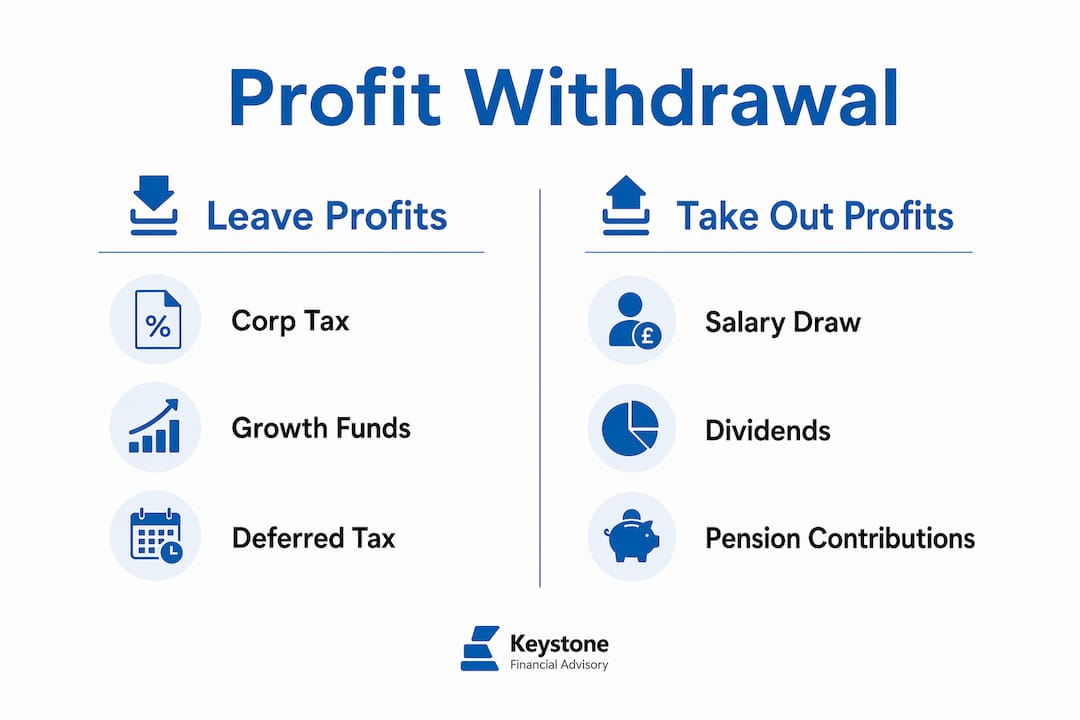
The most tax-efficient answer for most UK limited company directors in 2026 is: do both, deliberately. A salary set at the personal allowance level, topped up with dividends to fill your basic rate band, with employer pension contributions absorbing any surplus, often provides a better outcome than any single-method approach. But the right split depends on your profit level, personal income, and what you plan to do with the business long term.
The core trade-off at a glance:
Leaving profits in the company:
Defers personal tax until you choose to withdraw
Funds reinvestment or builds a cash reserve
Attracts corporation tax at 19%–25% before any distribution
Can complicate a future sale if retained cash inflates the balance sheet artificially
Exposes funds to future legislative changes on dividend or capital gains tax
Taking profits out:
Gives you personal control over the cash
Triggers income tax and potentially National Insurance
From april 2026, dividend tax rates rise to 10.75% (basic), 35.75% (higher), and 39.35% (additional)
Pension contributions remain the most tax-efficient extraction route, with no National Insurance and full corporation tax relief
2026 tax rates at a glance: Corporation tax about 19% on lower profits and higher rates on larger profits. Dividend tax from april 2026: the basic rate rises to 10.75%, higher rate to 35.75%, and additional rate stays at 39.35%. Employer NIC applies above a lowered threshold at increased rates.
Should you leave profits in your company? Benefits and real risks
Retaining profits inside your limited company is not simply a way to delay tax. It can be a deliberate financial strategy, but it carries genuine risks alongside the advantages.
The case for keeping profits in:
Deferred personal tax. Profits sitting in the company are subject only to corporation tax (19%–25%), not income tax. You choose when to extract, and at what rate.
Funding growth. Reinvesting company profits into equipment, staff, or marketing avoids the cost of external borrowing.
Resilience. A cash buffer inside the company protects against a bad trading quarter without you needing to inject personal funds.
Company valuation. Retained earnings can increase the book value of your business, which matters if you plan to sell.
The risks directors often underestimate:
Legislative exposure. Tax rules change. Profits sitting in the company today may face higher extraction costs tomorrow, as the 2026 dividend rate increase demonstrates.
Idle cash. HMRC may challenge a company holding excessive cash with no commercial purpose, particularly if it affects Business Asset Disposal Relief eligibility on a sale.
Companies House obligations. Retained profits appear on your annual accounts, which are publicly filed at Companies House. Large reserves attract scrutiny from lenders, HMRC, and potential acquirers alike.
Distributable profits rule. Dividends must be paid from post-tax distributable profits only. If your retained earnings are eroded by prior losses, you cannot simply declare a dividend against current-year profits without checking the cumulative position.
The corporation tax rates matter here. Company profits face tax at 19% on the first £50,000, 25% above £250,000, with marginal relief between those bands. Every pound retained has already had corporation tax deducted, so the “deferral” benefit is real but not cost-free.

How salary and dividends work together for tax-efficient withdrawal
The salary-plus-dividends combination remains the foundation of most directors’ profit distribution strategies, but the 2026 changes shift the maths.
Setting the right salary
A salary matching the personal allowance threshold, meaning no income tax on that amount. It also earns qualifying years towards the State Pension. Most directors benefit from this level precisely because it avoids income tax while building entitlement. If your company qualifies for the Employment Allowance (most do, except sole-director companies with no other employees), employer National Insurance on this salary drops to zero.
Employer NIC rose to 15% from april 2025, with the secondary threshold lowered to £5,000. For a sole director without Employment Allowance, employer NIC applies on the salary above the threshold, incurring notable costs. The corporation tax saving on that salary usually outweighs this cost, so the £12,570 baseline still holds for most.
Dividend tax rates for 2026/27
Income band | Total income threshold | Dividend tax rate |
Basic rate | Up to £50,000 | 10.75% |
Higher rate | £50,001 to £125,140 | 35.75% |
Additional rate | Above £125,140 | 39.35% |
Dividend allowance | First £500 | — |
These rates reflect the 2-percentage-point increase legislated in the Finance Act 2026, effective from the 2026/27 tax year.
Key points on dividends:
No National Insurance applies, which is their primary advantage over salary above the personal allowance
Dividends are paid from post-tax profits, so corporation tax has already been deducted
The £500 dividend allowance is modest; planning around it matters less than managing which tax band your dividends fall into
Pushing dividends above £100,000 total income triggers the personal allowance taper, creating an effective 60% tax rate on income in that band
Pro Tip: If your total income is approaching £100,000, use employer pension contributions to bring your adjusted net income below that threshold before taking additional dividends. The tax saving is substantial.
For a practical breakdown of how much to withdraw tax-efficiently at different profit levels, the calculation depends on whether you have other income sources and whether a spouse or partner holds shares.
Why pension contributions are often the best use of company profits
Employer pension contributions are the extraction method most directors underuse, and the tax case for them is compelling.
When your company contributes directly to your pension:
The contribution is a deductible business expense, reducing corporation tax at 19%–25%
No employer or employee National Insurance applies
No income tax is payable in the year of contribution
The money grows free of tax within the pension wrapper
At retirement, 25% can be taken as a tax-free lump sum
Employer contributions are not limited by your salary level. The company can contribute up to the annual allowance of £60,000 and deduct the full amount from corporation tax, provided the contribution satisfies the “wholly and exclusively” test for business expenses. HMRC requires that contributions are commercially justifiable relative to your role, but working directors contributing up to the annual allowance are rarely challenged.
The personal pension trap directors miss: Dividend income does not count as relevant UK earnings for personal pension tax relief. A director taking £12,570 salary and £60,000 in dividends can only claim personal tax relief on contributions up to £12,570. Employer contributions bypass this restriction entirely.
Annual allowance: £60,000 total from all sources (employer, personal, and any other scheme). Directors with adjusted income above £260,000 face a tapered allowance, potentially as low as £10,000. Unused allowance from the previous three years can be carried forward.
Pension contribution advantages:
Corporation tax relief at the company’s marginal rate
No National Insurance from either party
Avoids the 60% effective tax trap above £100,000 income
Contributions can be timed to match profitable years
Tax-free growth until retirement
Contributions must meet the wholly and exclusively test. For most working directors, this is straightforward, but very large contributions relative to salary warrant a brief commercial justification on file.
Other ways to extract money from your limited company
Beyond salary, dividends, and pensions, several other methods are worth understanding, each with specific conditions and risks.

Director’s loans
You can borrow money from your company via a director’s loan account. If the account is in credit (the company owes you money from funds you previously lent it), withdrawals are tax-free. If the account becomes overdrawn, the rules are strict: loans not repaid within nine months of the company’s accounting year-end trigger a 33.75% corporation tax charge under section 455 of the Corporation Tax Act 2010. This charge is refundable if the loan is later repaid, but the cash flow impact is real.
Benefits-in-kind
Company-provided benefits such as private health insurance or a company car are taxable on the director as employment income, with Class 1A National Insurance at 15% payable by the company. Electric vehicles attract a low benefit-in-kind rate (currently 2%), making them one of the more tax-efficient perks available. Whether a benefit-in-kind beats a cash dividend depends on the specific benefit and your marginal tax rate.
Expense reimbursements
Genuine business expenses reimbursed by the company are tax-free. Mileage at the approved rate of 45p per mile for the first 10,000 miles is a common example. The boundary between business and personal expenses matters here; for guidance on what qualifies, see personal expenses via your company.
Shares and income splitting
Issuing shares to a spouse or family member who pays a lower rate of tax can multiply the available personal allowances and dividend allowances. Each shareholder gets their own £500 dividend allowance and personal allowance. HMRC requires genuine commercial involvement; alphabet share structures make the mechanics straightforward, but the arrangement must be defensible.
Members’ Voluntary Liquidation on wind-up
When closing a solvent company, a Members’ Voluntary Liquidation allows retained reserves to be treated as a capital distribution rather than income. MVL reserves can be taxed at capital gains tax rates of 20%, or 14% with Business Asset Disposal Relief if conditions are met. For directors with accumulated profits, this often produces a significantly lower effective rate than extracting the same funds as dividends over several years.
Common mistakes that cost directors money (and how to avoid them)
Most profit extraction errors are avoidable with basic planning. These are the ones that come up repeatedly.
Overdrawn director’s loan accounts. Taking money from the company informally, without declaring a salary or dividend, creates an overdrawn loan. The 33.75% section 455 charge applies if not cleared within nine months of year-end.
Paying dividends without sufficient distributable profits. A dividend declared when the company lacks adequate retained earnings is treated as an illegal distribution. HMRC may reclassify it as a loan, triggering the section 455 charge.
Ignoring the employer NIC rise. With employer NIC now at 15% from a £5,000 threshold, setting a salary above £12,570 without Employment Allowance cover becomes expensive quickly.
Falling into the 60% tax trap. Income between £100,000 and £125,140 loses the personal allowance at £1 for every £2 earned, creating an effective 60% marginal rate. Employer pension contributions are the standard fix.
Not reviewing retained profits before a sale. Excessive cash in the company at the point of sale can disqualify Business Asset Disposal Relief, pushing the capital gains tax rate up from 14% to 20%.
Practical warning: Always prepare interim accounts before declaring a dividend. A dividend paid without documented distributable profits is not just a tax risk; it is a legal one under the Companies Act 2006. Your accountant should confirm the position before any distribution is made.
For tax-efficient strategies that go beyond the basics, reviewing your extraction plan annually against current rates is the single most reliable way to avoid overpaying.
How the 2026 dividend tax changes affect your planning
The Finance Act 2026 increased the dividend ordinary rate from 8.75% to 10.75% and the upper rate from 33.75% to 35.75%, effective from the 2026/27 tax year. The additional rate remains at 39.35%.
New dividend rates from april 2026: Basic rate 10.75%, higher rate 35.75%, additional rate 39.35%. The 2-percentage-point increase applies across all dividend taxpayers outside ISA and pension wrappers.
This changes the relative attractiveness of dividends versus pension contributions for directors in the higher rate band. A director extracting £30,000 of higher-rate dividends now pays £10,725 in dividend tax rather than £10,125, a difference of £600 on that tranche alone. Across a full year of higher-rate extraction, the cumulative cost adds up.
The government’s stated rationale, as set out in HMRC guidance, is narrowing the gap between tax on employment income and tax on income from assets. That direction of travel suggests further increases are possible, which strengthens the case for pension contributions as a long-term extraction preference.
Corporation tax rates are unchanged for 2026/27: 19% up to £50,000 profit, 25% above £250,000. The interaction matters because dividends are paid from post-corporation-tax profits. A higher-rate taxpayer extracting dividends from a company paying 25% corporation tax faces a combined effective rate that makes pension contributions look considerably more attractive by comparison.
Reviewing your extraction strategy at the start of each tax year, rather than leaving it to the self-assessment deadline, gives you the most flexibility to adjust salary, pension contributions, and dividend levels before the position is locked in.
Key takeaways
The most tax-efficient approach for UK limited company directors in 2026 combines a £12,570 salary, employer pension contributions to absorb higher-rate exposure, and dividends to fill the basic rate band at 10.75%.
Point | Details |
Salary baseline | Set salary at £12,570 to use the personal allowance and earn State Pension qualifying years. |
Dividend tax rise | From april 2026, basic rate dividends are taxed at 10.75% and higher rate at 35.75%. |
Pension priority | Employer contributions reduce corporation tax, carry no National Insurance, and bypass the personal earnings limit. |
Avoid the 60% trap | Keep total income below £100,000 or use pension contributions to reduce adjusted net income below that threshold. |
MVL on wind-up | Members’ Voluntary Liquidation can treat reserves as capital, taxed at 14%–20% CGT rather than dividend rates. |
FAQ
What is the most tax-efficient way to take money from a limited company?
For most directors in 2026, the optimal approach is a £12,570 salary, employer pension contributions before crossing into the higher rate band, then dividends at the basic rate of 10.75%. This combination minimises National Insurance and income tax while maximising corporation tax deductions.
Should you leave money in your business account?
Leaving profits in the company defers personal tax and funds growth, but idle cash with no commercial purpose can affect Business Asset Disposal Relief eligibility on a sale. A working cash reserve makes sense; large uninvested surpluses generally do not.
What should you do with limited company profits?
The standard approach is salary at personal allowance, pension contributions to absorb any income above £100,000, then dividends to fill the basic rate band. Any remaining surplus can be retained for reinvestment or extracted via a Members’ Voluntary Liquidation on wind-up.
What is the 70/30 rule in business?
Cash management guidelines often suggest splitting profits between operations, growth, tax, and owner drawings, but no formal fixed percentages exist. The right split for a UK limited company depends on your corporation tax rate, personal income needs, and pension planning.
How do the 2026 dividend tax changes affect my extraction strategy?
The Finance Act 2026 raised the basic dividend rate to 10.75% and the higher rate to 35.75% from april 2026. Directors previously relying heavily on higher-rate dividends should model whether redirecting some of that extraction into employer pension contributions produces a better net outcome.
KeystoneFA works with UK limited company directors on exactly these decisions, from setting the right salary and dividend split to structuring pension contributions and planning for a future sale. If you want a clear picture of what your profits actually cost you under 2026 rules, speak to the team for tailored advice.
[
](www.keystonefa.co.uk)
Recommended