Audit Trail: Prove Your Numbers for UK Accounting and Compliance

An audit trail is a tamper-evident, chronological record that links every business event to who did it, when and why. It exists to answer one question when something goes wrong or an auditor comes asking: can you prove it? A properly kept trail supports accuracy in financial statements, fraud detection and regulatory compliance, and this article covers exactly what it should contain, what UK law demands, and how to build one that actually holds up.
TL;DR:
An effective audit trail must include timestamps, user IDs, action types, affected records, before-and-after values, source document references, and device or IP addresses.
Tamper-evidence relies on append-only storage and hashing to detect alterations, with both system logs and human notes contributing to the record.
UK law mandates companies keep adequate and accessible accounting records for three to six years, depending on company type, to comply legally.
Building a reliable trail requires consistent field capture, synchronized clocks, centralized logs, secure storage, source linking, and regular integrity testing.
Common audit trail weaknesses include editable entries without evidence, missing document links, retention gaps, and unreadable formats, which can be identified with quick, end-to-end reconstructions.
Table of Contents
What does an audit trail include?
A usable audit trail captures a consistent set of fields for every recorded action, not just a note that something happened. Miss one of these and reconstruction becomes guesswork.
Timestamp, synchronised across systems so events line up in the right order
User ID identifying exactly who performed the action, not a shared login
Action type, such as create, edit, approve, delete or export
Affected record, naming the invoice, ledger entry, patient file or transaction touched
Before and after values, showing precisely what changed
Source document reference, linking back to the invoice, contract or receipt that triggered the entry
Device or IP address, where relevant to security investigations
Tamper-evidence matters as much as content. Reliable systems make records append-only or write-once, often backed by hashing so any alteration is detectable rather than invisible. And both machine-generated logs (system timestamps, access records) and human-entered notes (approval comments, exception explanations) belong in the trail. Systems tell you what happened; people tell you why it was allowed.
Audit trail vs audit log vs paper trail: what’s the difference?
These three terms get used interchangeably, and that confusion causes real problems at audit time.
Audit log: a system-level record of technical events, such as logins or configuration changes, usually confined to one platform
Audit trail: the end-to-end chain connecting a business event to its final outcome, often stitched together from several logs plus documents
Paper trail: the everyday physical or digital documents (invoices, signed contracts, receipts) that support a transaction
A single sales transaction might show up as a login event in the IT log, an invoice PDF in the paper trail, and a full ledger-to-bank-reconciliation chain in the audit trail. Auditors care about the trail because isolated logs, however detailed, cannot prove a transaction was legitimate from start to finish.
Why do audit trails matter for accuracy and fraud control?
Audit trails exist because trust in numbers has to be verifiable, not assumed. They underpin the accuracy and reliability of financial statements, support efficient audits, and help detect or deter fraud and unauthorised activity.
Beyond compliance, they solve everyday operational problems. When a figure looks wrong, a good trail lets you trace it back to the exact entry, person and moment it changed, instead of interviewing half the finance team. Disputes with suppliers or customers get resolved faster when you can show the precise sequence of approvals and adjustments. And because every correction leaves a visible mark rather than quietly overwriting history, staff who might otherwise fudge a number know the record will outlast the temptation.

What are some real examples of an audit trail?
Seeing the concept applied to familiar systems makes the definition concrete.
Accounting: an invoice is raised, linked to a purchase order, paid via bank transfer, and posted to the ledger. A complete trail shows the invoice number, approver, payment reference and the exact ledger line it created, so any auditor can walk that chain unaided.
IT and security: a staff member logs in, their access privileges are elevated, and a system configuration is changed. The log records the user ID, timestamp, old and new permission levels, and the device used, flagging exactly who could have caused a downstream error or breach.
Regulated sectors: in healthcare, accessing a patient record triggers an entry noting who viewed it, when, and for what stated purpose, typically retained far longer than commercial records because of sector-specific rules.
What does UK law require for keeping audit records?
Companies operating in the UK are not just following good practice when they maintain audit trails; they are meeting a legal duty. The Companies Act 2006, section 386, requires every company to keep adequate accounting records sufficient to explain its transactions and disclose its financial position at any time, including day-to-day entries of money received and spent, records of assets and liabilities, and stock statements where relevant.
Retention periods are set out just as clearly:
Private companies must preserve accounting records for a period of years from the date they are made
Public companies must preserve them for a longer period from the date they are made
These figures come directly from section 388 of the Companies Act 2006, which also specifies that records must be kept somewhere accessible for inspection by officers of the company. Falling short isn’t a paperwork technicality: directors can face fines or, in serious cases, disqualification. If you’re unsure whether your current records meet that “adequate” threshold, KeystoneFA’s statutory accounts preparation guide walks through what should actually be in the file.
How do you build a tamper-evident audit trail that holds up?
Building a trail that survives scrutiny is less about buying software and more about disciplined habits, though the right tools help enormously.
Capture the right fields from the start. Timestamp, user ID, action, and before/after values should be non-negotiable defaults, not optional extras someone forgot to switch on.
Synchronise clocks across systems. A trail where timestamps drift between platforms is nearly impossible to reconstruct in the right order.
Centralise and normalise logs. Pulling records from five disconnected tools into one reviewable format is what turns scattered data into an actual trail.
Secure storage with append-only design and hashing. Security controls around accounting software should make historical entries genuinely unchangeable, not just discouraged from editing.
Separate duties. The person who raises a payment should not be the same person who approves and reconciles it.
Link every transaction to its source document. A ledger entry with no invoice behind it is a red flag, not a shortcut.
Automate retention and archival. Manual reminders to keep records for three or six years fail; scheduled archiving doesn’t.
Test integrity regularly. Pick a handful of transactions and try to trace them end to end, exactly as an auditor would.
Pro Tip: Run your own mini-audit twice a year: pick five random transactions and try to reconstruct each one from source document to ledger entry without asking a colleague for help. If you can’t, your system has a gap worth fixing before an actual auditor finds it.
KeystoneFA’s audit readiness check service and independent guidance on audit preparation checklists both use a version of that same reconstruction exercise as their starting test.
What pitfalls do auditors most often find?
The same few weaknesses appear repeatedly, and most are cheap to fix once spotted.
Editable historical entries with no before/after evidence, meaning a figure can change with nothing showing it happened
Missing links to source documents, forcing reliance on staff memory to explain a transaction
Retention gaps, where records were deleted or overwritten before the legal minimum expired
Unreadable proprietary formats that need discontinued software to open, creating compliance risk when records can’t be produced on demand
Quick checks catch most of these: reconstruct a handful of sample transactions end to end, audit who actually has edit permissions on financial records, and verify that stored files can still be opened and match their original hash. Fifteen minutes running these three checks tells you more than a year of assuming everything’s fine.
How do advisers actually apply these checks for clients?
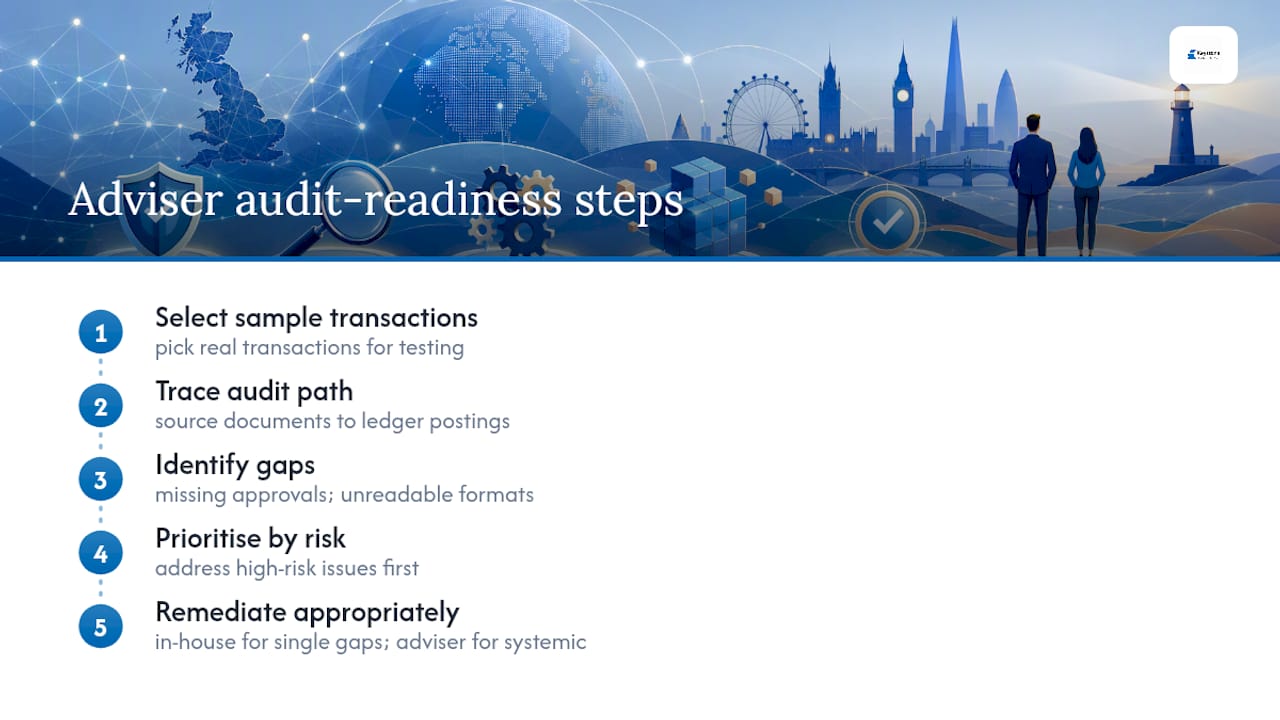
A proper audit-readiness engagement starts by picking a sample of real transactions and tracing them the way an auditor would: source document through to ledger posting. That single exercise usually surfaces the gaps fastest, whether it’s a missing approval trail or a format nobody can open anymore.
KeystoneFA’s own work on audit-readiness reflects that approach, prioritising fixes by risk rather than ticking boxes. Small businesses with one obvious gap, say, no before/after logging on invoice edits, can often patch it in-house. Bringing in an adviser earns its cost when the gaps are systemic: no separation of duties, no centralised logging, or retention practices that clearly fall short of the Companies Act minimums.
— Shoaib
Get your records audit-ready before an auditor asks
KeystoneFA runs audit-readiness checks that go beyond a general compliance review: a working reconstruction of your actual transactions, source document to ledger, flagging exactly where your trail breaks down before a real auditor finds the gap for you.
[

](www.keystonefa.co.uk)
A short engagement typically produces a clear report, a prioritised list of fixes ranked by risk, and a concrete next step, whether that’s tightening access controls, backfilling missing source-document links, or restructuring how corrections get recorded. It sits alongside KeystoneFA’s day-to-day bookkeeping, Companies House and HMRC compliance support, so the fixes stick rather than drifting back within a quarter. If your current records would struggle to survive the reconstruction test above, request an audit-readiness review with Keystone Financial Advisory and find out exactly where you stand.
Primary sources and further reading
For the legal text itself, see section 386 and section 388 of the Companies Act 2006, plus KeystoneFA’s recordkeeping guidance for small businesses.
This article is general information, not a substitute for advice from a qualified financial advisor. Consult a qualified financial professional about your own circumstances before acting on anything here.
Sources
FAQ
What is the purpose of an audit trail?
An audit trail exists to prove that financial statements are accurate, to make audits faster and cheaper to run, and to detect or deter fraud and unauthorised activity through a tamper-evident record of events.
What is an example of an audit trail?
A common example is an invoice raised, approved, paid and posted to the ledger, with each step timestamped and linked back to the original invoice number so the whole chain can be traced without asking anyone to recall what happened.
What does an audit trail show?
It shows who took an action, what the action was, when it happened, and what changed as a result, essentially a record of activity on a system that reveals who altered a document and when.
Is an audit trail compulsory?
For UK companies, maintaining adequate accounting records is a legal duty under the Companies Act 2006, with private companies required to preserve records for three years and public companies for six, though the exact form the trail takes isn’t dictated by law.
Recommended