How long must UK businesses keep records? The 6-year rule explained

Keep most business and tax records for 6 years from the end of the company financial year they relate to. That single rule covers invoices, VAT records, accounting books, and most contracts, and it’s the baseline HMRC and the Companies Act both build from.
Some categories break that pattern. Payroll records generally need only 3 years, statutory registers under the Companies Act must survive for as long as the company exists, and COSHH exposure records can require 40 years. For UK business record retention, HMRC, the Companies Act 2006, and the Information Commissioner’s Office (ICO) are the three authorities whose rules actually govern what you keep and for how long.
Do this today:
Pull out payroll, VAT, and statutory register files and check they’re stored separately from general accounting records.
Flag anything involving health and safety exposure, capital assets, or open HMRC enquiries. These often need far longer than 6 years.
Confirm you can still open and read digital files from 6 years ago. Software becomes obsolete faster than retention obligations expire.
Key Takeaways
Most UK business records need 6 years’ retention, but payroll, statutory registers, and health and safety records follow different rules entirely, and getting the start date wrong is the most common compliance mistake.
Point | Details |
Default is 6 years | Accounting records, VAT documents, and most invoices follow the standard 6-year rule from issue or period end. |
Payroll is shorter | PAYE records need only 3 years, but National Minimum Wage and pension records need 6. |
Some records never expire | Statutory registers and board minutes must be kept for as long as the company exists. |
Start dates vary by document | Invoices count from issue date, balance sheets from preparation date, ledgers from the last entry. |
Late filing extends the window | An open HMRC enquiry or late return pushes the effective retention period past 6 years. |
Table of Contents
Record retention rules UK businesses actually need to follow
Every UK limited company has to keep “adequate accounting records” under the Companies Act 2006, and in practice, tax law pushes that obligation to a 6-year window for most businesses regardless of company type. The table below sets out the periods that come up most often.
Document type | Minimum retention period | Starts from |
Accounting records (general) | 6 years | End of company financial year |
VAT records and VAT account | 6 years | End of the VAT period |
Sales invoices and purchase invoices | 6 years | Date of issue |
Payroll and PAYE records | 3 years | End of the tax year |
Statutory registers (members, directors, minutes) | Life of the company | Company incorporation |
Contracts (simple) | 6 years | Contract completion or last action |
RIDDOR accident reports | 3 years | Date of incident |
COSHH exposure records | Up to 40 years | Date of exposure |
Private companies have a statutory minimum of 3 years for accounting records under section 388 of the Companies Act, while public companies must keep them for 6 years. That’s the legal floor. In reality, HMRC’s tax rules mean almost every business, private or public, ends up working to the 6-year mark anyway, because that’s the window HMRC can go back and query.
A few things sit outside the table and catch people out:
Statutory registers never expire while the company exists. Minutes, resolutions, and the register of members need to be preserved indefinitely, not for a fixed number of years.
Businesses often keep records longer than required, particularly where a document supports a Capital Gains Tax calculation on an asset bought decades earlier, or where a contract dispute is a live possibility.
Penalties for poor record keeping aren’t fixed at a single figure. HMRC can charge penalties for failing to keep or preserve adequate records, and the risk multiplies if inadequate records also lead to an inaccurate tax return.
The safest working assumption for a small business or startup is this: treat 6 years as the default, then check whether the specific document type belongs on the exceptions list before you shred anything.
How the retention clock actually starts
The confusing part of business document retention laws isn’t the length of the period. It’s working out when that period begins, because it’s different for almost every document type. HMRC’s internal manual CH15200 sets out three separate starting points that catch out even experienced bookkeepers.
Invoices and receipts run from the date of issue. A sales invoice dated 14 March 2020 reaches its 6-year mark on 14 March 2026, not at the end of the financial year it fell within.
Balance sheets and year-end accounts run from the date they were prepared, not the date of the transactions they summarise.
Bound books and ledgers (or their digital equivalent) run from the date of the last entry made in them, which means a ledger you kept adding to across several years doesn’t start its countdown until you stop using it.
That variance matters because a single accounting record might have several dates attached to it. Get it wrong and you either destroy something HMRC could still ask for, or hoard paperwork well past when it’s actually needed.
Two events extend the clock further than the standard 6 years. If you filed a tax return late, HMRC’s enquiry window shifts accordingly, and if HMRC opens an enquiry into a specific year, records for that year need to survive until the enquiry closes, however long that takes. Electronic records are treated exactly the same as paper for these purposes, so a scanned invoice carries the same retention obligation as the original.
Software availability is worth a separate mention. If old accounting software becomes unsupported, the record itself doesn’t stop counting towards your retention obligation just because you can no longer open the file.
Payroll, statutory registers and the retention rules everyone forgets
Some of the longest and shortest retention periods in UK company record storage sit right next to each other, which is exactly why they cause confusion.
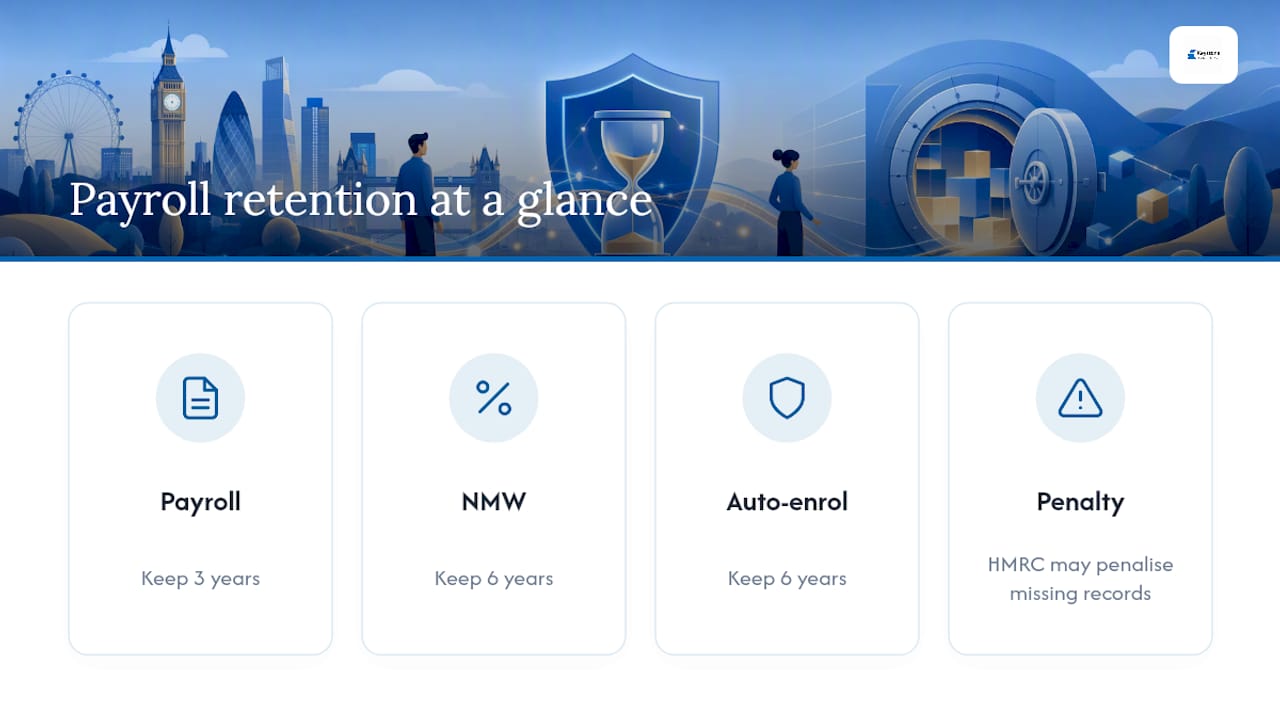
Payroll and PAYE records generally need 3 years from the end of the tax year they relate to, a shorter window than general accounting records. But not every payroll-related document follows that rule. National Minimum Wage records and auto-enrolment pension records both need 6 years, and HMRC can issue penalties where employers can’t produce adequate payroll records on request.
Statutory registers and board minutes don’t fit a fixed number of years at all. The register of members, register of directors, and minutes of general meetings and board meetings need to be preserved for as long as the company exists, since they form the ongoing legal record of who owns and controls the business.
Health and safety records carry two very different obligations. RIDDOR reports of workplace accidents need at least 3 years’ retention, while COSHH records documenting employee exposure to hazardous substances can require up to 40 years, reflecting how long some occupational illnesses take to surface.
Capital assets and Capital Gains Tax evidence are the quiet exception most businesses miss. If you bought a commercial property or a significant asset 15 years ago and still own it, you need the purchase records now, not just for 6 years after the purchase, because you’ll need them to calculate the gain whenever you eventually sell.
Pro Tip: Build a separate “long retention” folder for statutory registers, COSHH records, and capital asset purchase documents. Mixing them into your standard 6-year filing system is how they end up shredded by mistake.
Building a record retention policy that actually works
A written policy turns these scattered rules into something your team can follow without checking legislation every time. Four elements make it functional rather than decorative.
Define scope. List every document category your business generates: accounting records, VAT and payroll, HR files, contracts, statutory registers, health and safety records. Vague scope is the most common reason retention policies fail in practice.
Build a retention schedule. Assign each category its statutory minimum, then add a business-justified extension where a legal claim, ongoing contract, or capital asset makes it sensible to keep records longer.
Assign ownership. One person or role should be responsible for each category, including deciding when something is destroyed and logging that decision.
Set format and disposal rules. Digital records should be exported to a stable, non-proprietary format such as PDF/A if the software that created them risks going obsolete before the retention period ends. Disposal, whether shredding paper or deleting files, needs a documented rationale, partly because the ICO expects personal data to be held no longer than necessary, and having a rationale on file protects you if that decision is ever questioned.
Start this week with a simple audit: list your document types, map each to its statutory period from the table above, and set a review date twelve months out. Our guide to why keeping business records matters walks through the same mapping process in more depth if you want a fuller worked example.
Pro Tip: Keep an index of where every record category lives, especially if you use more than one system. A retention policy is only as good as your ability to actually find the record when HMRC asks for it.
Why this guidance holds up, and how KeystoneFA fits in
Everything above traces back to primary sources: the Companies Act 2006, HMRC’s own internal manuals, and VAT notice 700/21, not secondhand summaries of what those documents supposedly say.
KeystoneFA works with UK founders and small business owners on exactly this kind of compliance groundwork, alongside day-to-day bookkeeping, VAT filing, and year-end reporting. That combination means retention policy isn’t an abstract exercise. It’s tied directly to how your statutory accounts get prepared each year.
Where clients most often need support:
Drafting a retention schedule that matches their specific document types, not a generic template
Untangling old accounting software before records become unreadable
Preparing for an HMRC enquiry where the clock on retention has effectively been extended
If you’d rather have someone build the policy and check your compliance than do it yourself, KeystoneFA’s accounting services cover exactly this ground alongside your regular bookkeeping and tax work.
Primary sources and official references
The gap between statutory minimums and sensible practice
The conventional advice on record retention treats 6 years as a ceiling. That’s backwards. It’s a floor, and one that only covers you against a routine HMRC check, not against a contract dispute five years after a project closed or a capital gains calculation on an asset you bought before some of your current staff were born.
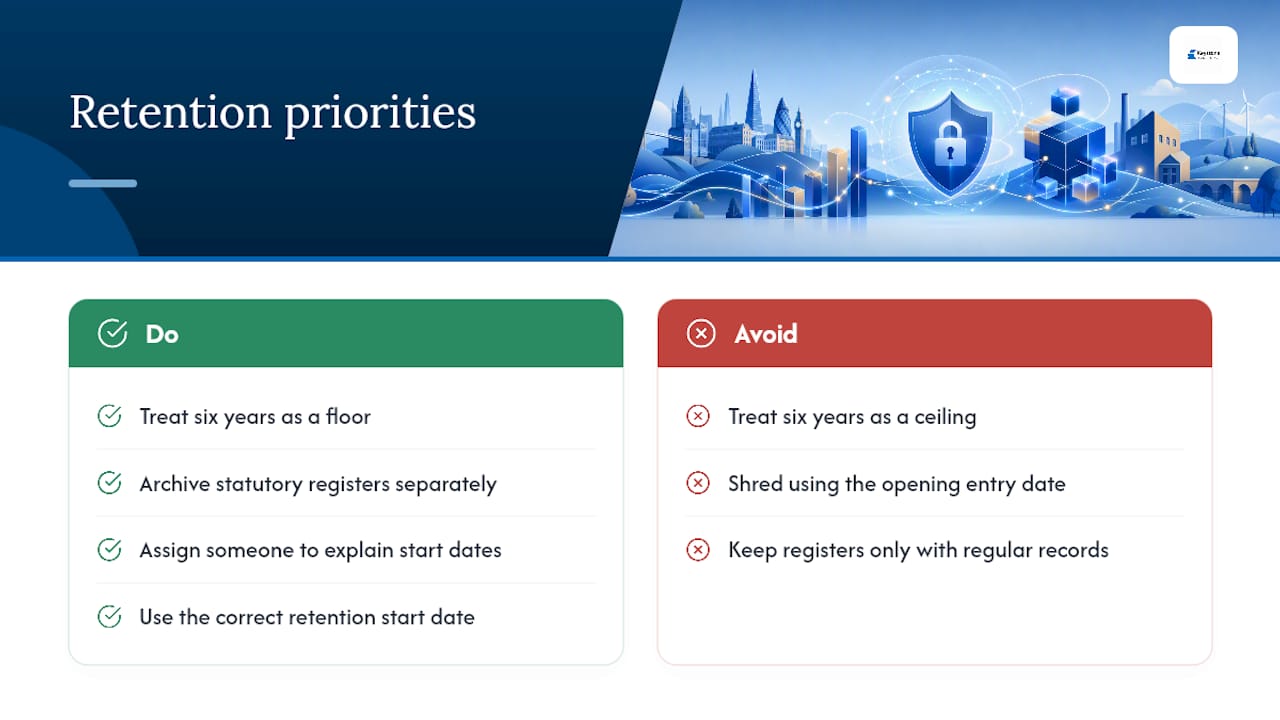
What gets underestimated is how often the starting point of a retention period causes more damage than the length. A business that shreds ledgers based on the wrong date, say, treating the opening entry as the trigger rather than the last one, can lose records it was legally required to keep. That’s a bigger practical risk than most owners realise, because it usually only surfaces during an enquiry, when it’s too late to fix.
Prioritise two things before anything else: get your statutory registers into a permanent, separate archive, and make sure someone in your business can actually explain when each retention clock starts. The rest, the schedules, the disposal logs, the software formats, follows naturally once those two are solid.
— Shoaib
This article is general information, not a substitute for advice from a qualified financial advisor. Consult a qualified financial professional about your own circumstances before acting on anything here.
Sources
FAQ
What is the 6-year retention rule for UK businesses?
Most business and tax records, including invoices, VAT documents, and general accounting records, must be kept for 6 years from the end of the relevant financial year or VAT period.
What records need to be kept for 6 years?
VAT records, sales and purchase invoices, general accounting books, and most business contracts all fall under the 6-year rule, with the clock starting from issue date, period end, or last entry depending on the document.
Do I need to keep 7 years of bank statements?
There’s no statutory 7-year rule in UK law for bank statements specifically; the operative period for most supporting financial records is 6 years, matching HMRC’s standard retention window.
How long should payroll records be kept?
Standard PAYE and payroll records need at least 3 years from the end of the tax year, though National Minimum Wage and auto-enrolment pension records require 6 years.
What happens if business records are lost or destroyed?
HMRC expects you to make a documented attempt to recreate lost records and notify your tax office promptly; simply reporting the loss without trying to reconstruct the records is unlikely to avoid penalties.
Recommended