Register PAYE in 5 steps and avoid penalties for UK directors

You must register as an employer with HMRC before you pay anyone, including yourself as a sole director, and you cannot register more than two months before that first payday. A common recommended timing is a few weeks ahead, which allows HMRC enough time to post your employer reference before you need it. Miss the deadline and you risk penalties; register too early and HMRC will simply reject it.
TL;DR:
Employers must register with HMRC within two months of paying their first employee or director to avoid penalties and ensure timely PAYE setup.
Registering too early results in HMRC rejection, while delay risks missing payroll deadlines and incurring late penalties.
The registration process involves preparing specific documents, choosing a payroll method, and waiting 5 to 10 working days for references, making timing crucial.
Missing the postal delivery of PAYE references is manageable by running payroll, storing submissions, and submitting late with a reasonable excuse.
Engaging professional payroll services can reduce errors related to classification, timing, and compliance, especially for first-time employers.
Table of Contents
Who must register for PAYE: eligibility and common scenarios
Most companies assume PAYE only kicks in once they hire staff. That’s wrong far more often than people expect.
You need to register if any of the following applies:
You pay any employee above the National Insurance lower earnings limit, even part-time
You employ a director who takes a salary, however small
A worker already has another job, meaning tax codes need coordinating
You provide expenses or benefits in kind, such as a company car or health cover
You use subcontractors under the Construction Industry Scheme
The sole director scenario catches out more founders than any other. Plenty of new company owners believe that because they’re the only person on the payroll, PAYE somehow doesn’t apply. It does. HMRC treats a director’s salary the same as any employee’s wage. If you’re unsure whether a particular working relationship counts as employment, check the employment status guidance before assuming either way. Misclassifying a genuine employee as self-employed is one of the costliest and most common errors new employers make.
What to gather before you start: documents HMRC expects
Get these ready before you open the registration form, and the process takes minutes rather than days:
Your company’s Unique Taxpayer Reference (UTR) and Companies House registration number
Your registered office or correspondence address, plus a working contact phone number and email
Your planned first payday and how often you’ll pay (weekly, fortnightly, monthly)
Names and National Insurance numbers for employees or directors, where you already have them
A decision on your payroll route: HMRC’s free Basic PAYE Tools, commercial software, or an accountant
That last point matters more than it looks. Your choice here determines how easily you submit reports later, and switching mid tax year is a hassle worth avoiding.
Step-by-step: register as an employer with HMRC
Once you know your first payday, work backwards from it.
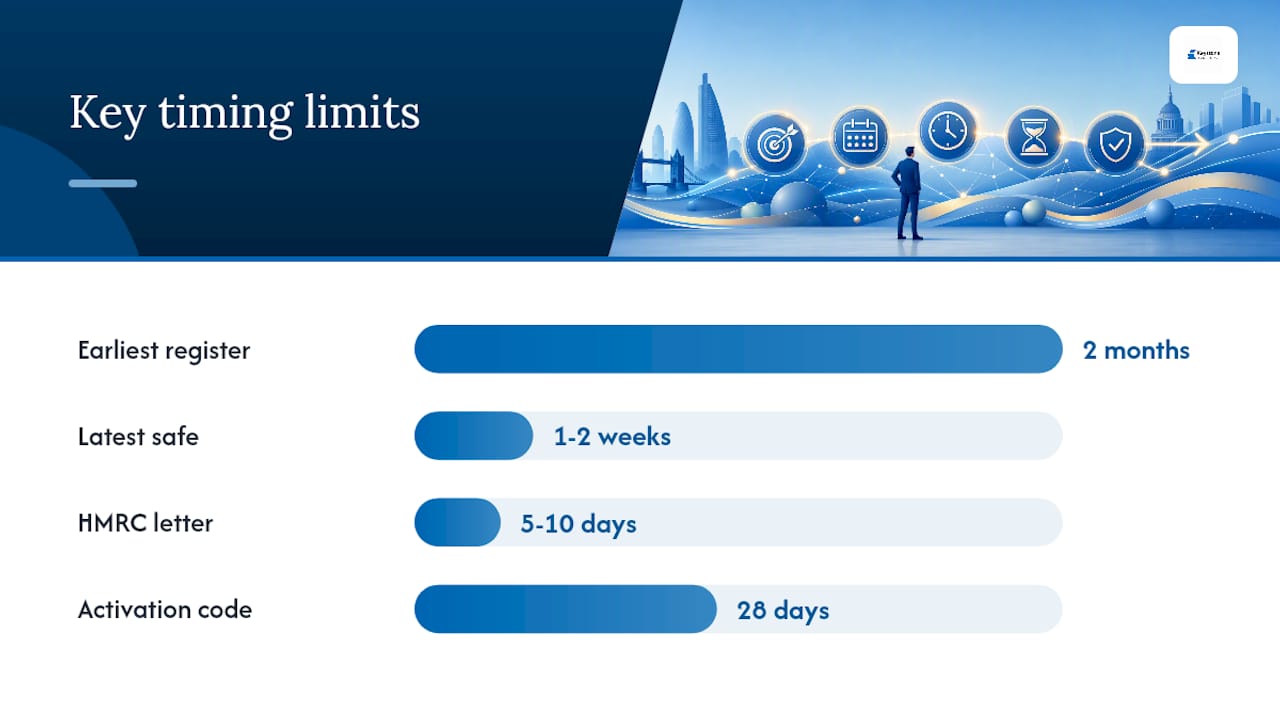
Confirm your timing. You cannot register more than two months before you start paying people, but leaving it any later than a week or two before payday cuts things fine.
Sign in to your Government Gateway or business tax account. If you don’t have one, you’ll create it as part of the process.
Complete the “register as an employer” service on GOV.UK. You’ll enter your company details, UTR, and first payday.
Wait for HMRC to post your employer PAYE reference and Accounts Office reference. This typically takes 5 to 10 working days, sometimes longer around busy periods.
Activate PAYE Online. HMRC sends an activation code separately, and it expires after 28 days, so don’t let it sit in a drawer.
If your company UTR hasn’t arrived yet, or the post is running late, you can still contact HMRC directly rather than waiting indefinitely. In the meantime, run payroll as normal, store the Full Payment Submission data, and send it once your reference lands.
Pro Tip: Set your first payday for the middle of a month rather than right at month end. It gives you a buffer if HMRC’s reference letter is delayed, and it avoids the scramble that happens when a payment deadline and a registration delay collide in the same week.
After registration: your PAYE reference and what to do if the letter is late
Your employer PAYE reference (format like 123/AB45678) identifies your scheme, while your Accounts Office reference is what you quote when you actually pay HMRC. Keep both somewhere permanent, because you’ll use them on every FPS, every payslip, and every P60 or P45 you issue.
PAYE Online activation follows a separate track from the reference itself:
HMRC posts an activation code once you’ve enrolled for the online service
You have 28 days to activate it before the code expires and you have to request a new one
If the reference letter hasn’t arrived by your first payday, don’t delay payroll. Run it anyway, store the FPS data, and submit it as a late submission once your reference comes through
HMRC’s guidance allows you to select a “late reporting reason” when you eventually file, so this isn’t treated as an unexplained gap
Running payroll and reporting: RTI, FPS, tax codes and options
Real Time Information (RTI) means most employers must send a Full Payment Submission for every pay period, on or before payday, not weeks afterwards. An FPS reports each employee’s pay, tax, and National Insurance deductions for that period.
New starter without a P45? You’ll need the starter checklist instead.
Ask every new employee to complete a starter checklist if they can’t provide a P45
Use tax code 0T on a Week 1 or Month 1 basis where the checklist doesn’t give you enough information, as HMRC’s new employee guidance sets out
Update the tax code once HMRC issues a proper one, usually after your first FPS goes in
On software: Basic PAYE Tools is free and fine for a handful of employees, commercial payroll software suits growing teams who want automation and integration with accounting systems, and handing the whole thing to an accountant removes the admin entirely.
Pro Tip: Don’t guess a tax code. An incorrect 0T deduction on someone’s first payslip is one of the fastest ways to get a frustrated email from a new hire in their first week.
Payments, deadlines and penalties: paying HMRC on time
Pay HMRC by the 22nd of the month following the tax month when paying electronically, or by quarterly deadlines if eligible. Some smaller employers qualify to pay quarterly instead, which helps cash flow if your average monthly PAYE and National Insurance bill is under the relevant threshold.
Pay via Direct Debit through PAYE Online, or by BACS or CHAPS, always quoting your Accounts Office reference
HMRC charges late payment penalties on amounts not paid in full and on time
Late reporting can trigger separate penalties from late payment, so the two risks stack
You have a set window to pay or appeal a penalty notice; demonstrating a reasonable excuse can sometimes reduce or cancel the charge.
Statistic Callout: HMRC’s own guidance confirms penalties apply specifically when PAYE amounts aren’t paid in full and on time, with a structured 30-day window to respond to any penalty notice, whether you’re paying or appealing.
Getting your corporation tax payment deadlines organised alongside PAYE dates saves you from juggling two separate HMRC calendars in your head.
Common mistakes and when to bring in professional help
The same handful of errors show up again and again with new employers.
Assuming a contractor is self-employed without checking HMRC’s status guidance, then discovering a liability months later
Registering too early or too late, missing the two-month ceiling or the payday deadline entirely
Missing the posted PAYE reference letter because nobody’s checking the registered office mail
Choosing payroll software that doesn’t talk to HMRC’s systems properly, causing submission errors
If you’ve already slipped up, the fix usually isn’t complicated. Store your FPS data and submit it late with the correct reason code. Contact HMRC proactively if you need a scheme start date backdated; practitioners report that demonstrating a reasonable excuse can sometimes mitigate penalties. The businesses that get burned worse are usually the ones who go quiet rather than the ones who call HMRC and explain what happened.
Pro Tip: If you’ve missed a deadline, don’t wait for HMRC to chase you. A phone call explaining a genuine reasonable excuse, made before the penalty notice lands, carries more weight than an appeal filed afterwards.
Persistent late payment doesn’t just risk PAYE penalties either. It tends to be a symptom of wider cash flow strain that quietly damages small businesses long before anyone notices the pattern.
Why the timing rule catches out more founders than the paperwork does
Most guides on PAYE registration focus heavily on the form itself, as if the hard part is filling in boxes correctly. It isn’t. The genuinely difficult part is timing, and specifically the gap between deciding to hire and actually having a working PAYE reference in hand.
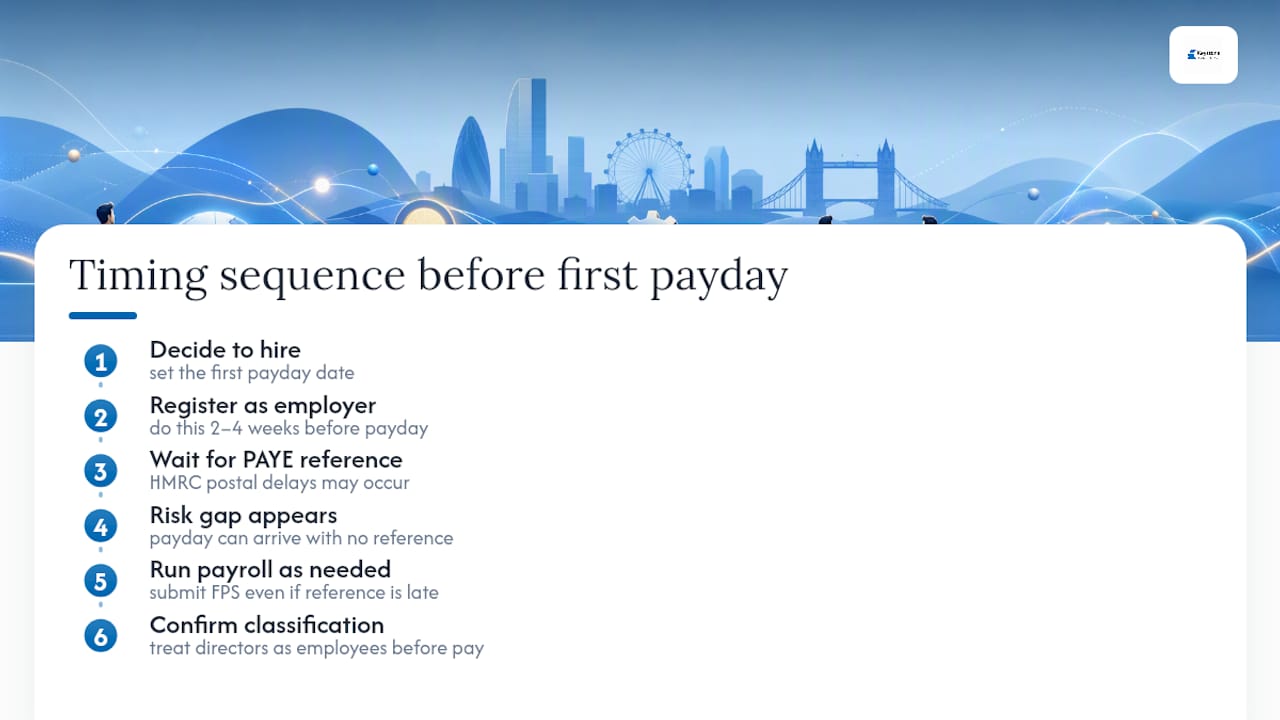
Founders consistently underestimate how long HMRC’s postal process takes, then panic when a payday arrives with no reference number. The fix isn’t complicated: work backwards from your first payday, register within that 2 to 4 week window, and accept that running payroll before the reference arrives is completely normal and fully supported by HMRC’s own process. Storing an FPS and submitting it late isn’t a workaround. It’s the documented route.
The other blind spot is classification. Directors assume paying themselves is somehow different from paying an employee. It isn’t, and HMRC doesn’t treat it as an exception. If there’s one thing worth prioritising above the mechanics of the registration form, it’s getting that judgement call right before the first payment goes out, not after.
— Shoaib
Get PAYE registration and payroll off your desk entirely
Consider engaging a professional team to handle PAYE registration, payroll runs, and RTI submissions while you focus on running the business.
[

](www.keystonefa.co.uk)
Many founders seek professional help to avoid risks of misclassification or timing errors in PAYE registration, ensuring registration, ongoing FPS submissions, payment scheduling, and monitoring for penalty triggers are properly handled. It’s also worth pairing payroll setup with proper self assessment planning for directors, since the two often interact more than new founders expect. If your business correspondence still runs through a personal inbox, sorting a proper business email address before your PAYE letters start arriving is a small step that avoids missed HMRC post.
If you’re about to make your first hire or pay yourself a salary for the first time, get in touch with KeystoneFA for a quick onboarding call and let someone else own the deadline.
FAQ
What is PAYE registration in the UK?
PAYE registration is how a business tells HMRC that it will start paying employees or directors, resulting in an employer PAYE reference and an Accounts Office reference used for all future payroll reporting and payments.
How do I register for a PAYE number?
You register as an employer online through GOV.UK using your Government Gateway details, company UTR, and planned first payday; HMRC then posts your reference within roughly 5 to 10 working days.
When should I register for PAYE?
Register no earlier than two months before your first payday and no later than the payday itself, with most practitioners recommending 2 to 4 weeks ahead to allow for postal delivery of your reference.
How much does it cost to register for PAYE?
Registering as an employer with HMRC is free; costs only arise from the payroll software or accountant you choose to run submissions and payments, such as through KeystoneFA’s managed payroll service.
Recommended