10 legitimate business expenses directors forget to claim

TL;DR:
Many UK company directors overlook legitimate deductions such as pre-trading expenses, home working costs, and professional subscriptions. Claiming these allowances correctly can reduce their company’s tax liability and prevent overpayment. Proper documentation and understanding of rules like ‘wholly and exclusively’ are essential to avoid HMRC penalties.
Legitimate business expenses are costs incurred wholly and exclusively for business purposes that reduce your company’s Corporation Tax liability. UK company directors routinely leave money on the table by missing valid deductions, from pre-trading costs to home working contributions. The 10 legitimate business expenses many directors forget to claim are not obscure loopholes. They are standard allowances that HMRC permits, and overlooking them means paying more tax than you legally owe. This guide covers each one clearly, with the compliance rules you need to claim them correctly in 2026.
What expenses do company directors commonly miss claiming?
Directors miss these ten deductions more than any others. Each one is fully allowable under UK tax law when claimed correctly.

1. Pre-trading expenses Costs incurred up to seven years before your company began trading are claimable, provided they would have been allowable had the company existed at the time. Market research fees, legal costs, and equipment purchases all qualify. Most directors assume the clock starts on incorporation. It does not.
2. Home working contributions Directors working from home can claim a contribution towards household running costs. HMRC permits either a flat rate or an actual costs calculation. Both are legitimate; the right choice depends on your usage pattern and record-keeping preference.
3. Professional subscriptions and training Membership fees for bodies such as the ICAEW, CIMA, or ACCA are fully deductible when the subscription is relevant to your role. Job-related training courses qualify too. Personal development courses with no direct link to your current trade do not.
4. Business insurance premiums Insurance premiums and professional fees are fully allowable and carry clear documentation, yet directors frequently forget to include them. Professional indemnity insurance, public liability cover, and directors and officers insurance all qualify.
5. Mobile phone contracts The contract must be in the company’s name, not yours personally. Reimbursing a personal mobile bill risks triggering PAYE and National Insurance obligations. One contract, one company name, one clean deduction.
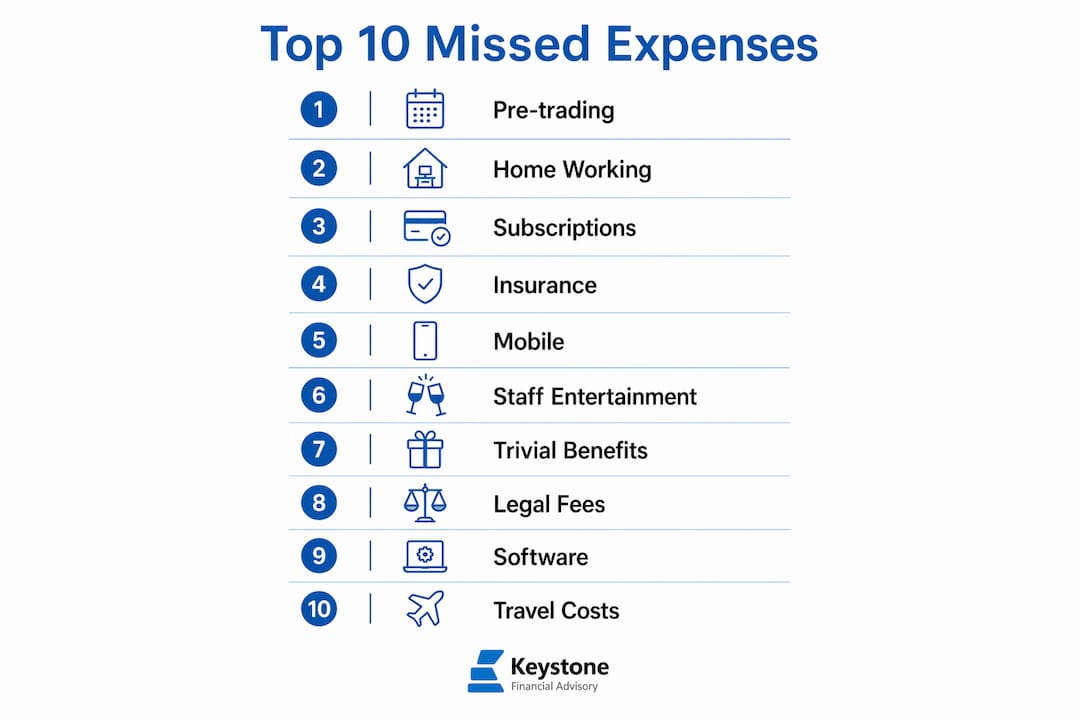
6. Staff entertainment vs client entertainment Staff entertainment is tax deductible within specific limits; client entertainment is not deductible for Corporation Tax purposes. Misclassifying a client dinner as a staff event is one of the most common triggers for HMRC enquiries.
7. Trivial benefits Gifts to employees costing £50 or less per item, with no cash equivalent and no contractual obligation, qualify as trivial benefits and are exempt from tax and National Insurance. Directors of close companies can receive up to £300 per tax year in trivial benefits.
8. Legal and professional fees Accountancy fees, company secretarial costs, and legal advice related to business contracts are all deductible. Fees for acquiring capital assets or settling personal disputes are not.
9. Software subscriptions and business broadband Office supplies, software subscriptions, and business travel costs are among the most commonly allowable expenses, yet broadband and SaaS tools such as Xero, QuickBooks, or Microsoft 365 are regularly omitted from claims. If the subscription serves the business, it belongs in your accounts.
10. Vehicle and travel costs Parking fees, road tolls, and mileage on business journeys are all claimable. HMRC’s approved mileage rate for the first 10,000 business miles in a personal vehicle is 55p per mile. Many directors claim the fuel but forget the parking receipt sitting in their coat pocket.
Pro Tip: Keep a dedicated folder, physical or digital, for every receipt and invoice the moment you receive it. Reconstructing records at year end costs time and risks disallowance.
How does the ‘wholly and exclusively’ rule affect claims?
The ‘wholly and exclusively’ rule is the single most important principle in UK business expense law. Expenses with any significant personal element are ineligible, and this is the most common reason HMRC disallows claims.
The rule means the expenditure must have been incurred solely for business purposes. A broadband contract used entirely for work qualifies. The same contract used for personal streaming does not, unless you can apportion the costs with clear evidence. Apportionment is permitted in some cases, but it requires documented evidence of the split.
HMRC audits focus heavily on expenses that blur personal and business use. Mobile phones, home office costs, and travel are the three areas that attract the most scrutiny. If your company reimburses a personal expense rather than paying a company contract directly, HMRC may treat the reimbursement as a taxable benefit, triggering PAYE and National Insurance charges on top of any disallowed deduction.
The consequences of incorrect claims extend beyond a single disallowed expense. HMRC can open a full enquiry into your accounts, apply penalties, and charge interest on underpaid tax. The safest protection is documentation: contracts in the company name, invoices addressed to the company, and a clear business purpose recorded at the time of purchase.
“The ‘wholly and exclusively’ rule is not a grey area. It is a bright line. Directors who treat it as flexible tend to find out the hard way that HMRC does not agree.”
Pro Tip: If you are unsure whether an expense qualifies, ask your accountant before you claim it, not after HMRC writes to you.
Flat rate vs actual costs: which home working method saves more?
Directors working from home face a genuine choice between two HMRC-approved methods. The right one depends on your circumstances.
Method | How it works | Record-keeping | Best suited to |
Flat rate | Fixed weekly amount per number of hours worked at home | No receipts required | Directors with modest home costs |
Actual costs | Proportionate share of utility bills, council tax, and broadband | Detailed bills and usage logs required | Directors with high household running costs |
The flat rate method is simpler and requires no receipts, making it the lower-risk option for directors who lack detailed household records. The actual costs method can produce a larger deduction, but it requires you to calculate the business-use proportion of each bill and retain supporting evidence. For most directors in 2026, the flat rate is the pragmatic starting point. If your home office costs are genuinely high, an accountant can model both methods and confirm which produces the better outcome before you file.
How to organise expense claims and avoid HMRC scrutiny
Good record-keeping is not optional. HMRC requires receipts and expense records to be kept for six years from the end of the relevant accounting period. That is the minimum. Losing a receipt does not make the expense disappear from your accounts; it makes it indefensible if challenged.
Open a dedicated business bank account and pay all company expenses from it. Mixing personal and business transactions is the fastest route to a messy set of accounts and a sceptical HMRC inspector.
Use accounting software such as Xero or QuickBooks to log expenses in real time. Both platforms allow you to photograph receipts on your phone and attach them directly to transactions.
Review your expense categories quarterly, not just at year end. Errors compound over twelve months and become harder to correct.
Never claim client entertainment as a business expense. It is not deductible for Corporation Tax, regardless of how the invoice is worded.
Work with a professional adviser for complex claims, particularly around vehicles, property, or international travel. The cost of advice is itself a deductible expense.
Pro Tip: Label every receipt with the business purpose at the time of purchase. “Lunch with client re: contract renewal” is a defensible record. “Lunch” is not.
Key takeaways
Directors who claim all allowable expenses reduce their Corporation Tax liability without taking any risk, provided every claim meets the ‘wholly and exclusively’ rule and is supported by clear documentation.
Point | Details |
Pre-trading costs are claimable | Expenses incurred up to seven years before trading began can be claimed if they would have been allowable at the time. |
Mobile contracts must be in the company name | Personal mobile reimbursements risk triggering PAYE and National Insurance; company contracts avoid this entirely. |
Staff and client entertainment are treated differently | Staff entertainment is deductible within limits; client entertainment is never deductible for Corporation Tax. |
Flat rate home working is simpler | The flat rate requires no receipts and suits most directors; actual costs suit those with high, well-documented household expenses. |
Records must be kept for six years | HMRC requires all expense receipts and records to be retained for six years from the end of the accounting period. |
What I see directors get wrong every year
The pattern I observe most often is not recklessness. It is passivity. Directors assume their accountant will catch everything at year end, so they do not engage with their expenses throughout the year. By the time the accounts are being prepared, receipts are missing, contracts are in the wrong name, and the pre-trading costs from three years ago have been forgotten entirely.
The second pattern is conflating “I spent it on the business” with “it qualifies as a deductible expense.” Those two things are not the same. A working lunch with a prospective client feels like a business cost. Under UK tax law, it is not deductible for Corporation Tax. Directors who understand this distinction before they spend the money make better decisions and cleaner claims.
The third pattern is avoiding the actual costs method for home working because it feels complicated. For directors running a genuine home office with high utility bills, the actual costs method can produce a meaningfully larger deduction. The types of accounting services available to directors include exactly this kind of calculation. It takes one conversation with an adviser to know whether it is worth pursuing.
My honest recommendation: review your expense categories now, not in march when your accountant is under pressure. The directors who maximise their legitimate claims are the ones who treat expense management as an ongoing discipline, not an annual scramble.
— Shoaib
How KeystoneFA helps directors claim every legitimate expense
KeystoneFA works with UK company directors to identify overlooked deductions and build compliant, well-documented expense claims. The team brings direct experience from top firms in the UK and the Middle East, and applies that depth to the practical realities of running a limited company.
[
Whether you need a one-off review of your current expense categories or ongoing support with tax consultation, KeystoneFA provides the kind of personalised advice that larger firms rarely offer. Directors who work with KeystoneFA consistently find expenses they had not previously claimed, from pre-trading costs to software subscriptions. You can book a consultation directly through the KeystoneFA platform and get a clear picture of where your claims stand before your next filing deadline.
FAQ
What counts as a legitimate business expense for UK directors?
A legitimate business expense is a cost incurred wholly and exclusively for business purposes that reduces your company’s Corporation Tax liability. Common examples include office equipment, travel costs, professional fees, and staff benefits.
Can I claim expenses from before my company started trading?
Yes. Pre-trading costs up to seven years before your company began trading are claimable, provided they would have been allowable had the company existed at the time.
Is client entertainment tax deductible?
Client entertainment is not deductible for Corporation Tax purposes. Only staff entertainment qualifies, and only within specific HMRC limits.
Do I need receipts for home working expenses?
The flat rate method requires no receipts. The actual costs method requires detailed bills and evidence of the business-use proportion of each household expense.
How long must I keep expense records?
HMRC requires expense records and receipts to be kept for six years from the end of the relevant accounting period.
Recommended