Electric company cars: still the best-value benefit in 2026/27

TL;DR:
Electric company cars offer low benefit-in-kind tax rates and full salary sacrifice relief in the UK for 2026/27. Key models like Tesla Model 3, BMW i4, and Kia EV3 balance low P11D values, good range, and lease affordability, making them attractive options. Choosing the right model, specification, and lease term can significantly reduce employee tax costs while benefiting employers through NIC savings.
Yes, electric company cars remain one of the best-value employee benefits available to UK businesses in 2026/27, and the numbers make that case decisively. The zero-emission benefit-in-kind (BIK) rate is low for the current tax year and is planned to rise gradually over the next few years. A higher-rate taxpayer driving an electric company car with a typical list price pays significantly less in BIK tax compared to petrol equivalents. A petrol equivalent at a substantially higher BIK rate would cost several times more in BIK tax. That gap is the whole story.
Crucially, EV salary sacrifice is completely unaffected by the pension salary-sacrifice cap changes. Schemes continue to deliver full Income Tax and National Insurance relief on the sacrificed salary. For mid-to-high earners, this makes EV salary sacrifice one of the few remaining ways to sacrifice a meaningful slice of pay with full tax and NIC benefit intact.
What decision-makers should do right now:
Run a BIK cost model using current P11D values for two or three shortlisted models before the 2026/27 year closes.
Check pension salary-sacrifice interactions with your payroll team: EV schemes are unaffected, but pension contributions may need a notional pay arrangement to protect pensionable salary.
Consider a 24–48 month lease window to lock in rates while BIK remains at its lowest point on the published roadmap.
Review whether your current company car policy covers PHEVs, and model the 2028 tax position before renewing any PHEV leases.
Table of Contents
Which electric company cars give the best low-BIK value in 2026/27?
Model-by-model breakdown: what employers and drivers need to know
How is company car BIK tax calculated, and what does it cost in 2026/27?
Salary sacrifice versus employer-provided company car: which saves more?
PHEVs versus pure EVs: why the tax outlook matters from 2028
What do electric company cars actually cost over their whole life?
How to set up an EV company car scheme: a practical checklist
Is it worth offering electric company cars in 2026/27? The verdict
How KeystoneFA can help you model and implement your EV scheme
Which electric company cars give the best low-BIK value in 2026/27?
The five models below represent the strongest all-round options for UK fleets right now, balancing low P11D, real-world range, and lease availability. All are pure EVs, so all qualify for the 4% BIK rate confirmed by HMRC for 2026/27.
BIK tax examples below use the formula: P11D value × 4% × marginal tax rate ÷ 12 = monthly BIK cost. Basic-rate taxpayer = 20%; higher-rate = 40%.
Model | List price (approx.) | Monthly BIK for a basic-rate taxpayer | Monthly BIK for a higher-rate taxpayer | Real-world range | Best for |
Tesla Model 3 | £42,990 | £28.66 | £57.32 | 280–310 miles | Executive travel, high-mileage |
BMW i4 | £54,900 | £36.60 | £73.20 | 280–310 miles | Senior/client-facing roles |
Volkswagen ID.3 | £35,995 | £24.00 | £47.99 | 180–200 miles | General fleet, commuters |
Kia EV3 | £35,995 | £24.00 | £47.99 | 280–310 miles | Cost-sensitive, city/mixed roles |
Renault 5 E‑Tech | £22,990 | £24.00 | £47.99 | 180–200 miles | Urban, lower-mileage staff |
Monthly BIK figures are illustrative, calculated at 4% BIK and rounded. Actual figures depend on exact P11D (including options) and individual tax code.
A few quick notes on the table:
The Renault 5 E‑Tech entry-trim P11D is the lowest of the five, making it the cheapest BIK option in cash terms, though its range limits it to urban and shorter commuter roles.
The BMW i4 carries the highest P11D and therefore the highest monthly BIK cost, but for client-facing senior staff the premium positioning often justifies the difference.
All five are widely available on fleet lease terms, which matters for payroll and salary-sacrifice administration.
No PHEVs appear here. Their BIK treatment from 2028 onwards makes them a riskier long-term choice; that is covered in detail in the PHEV section below.
Model-by-model breakdown: what employers and drivers need to know
Tesla Model 3
The Model 3 is the default choice for high-mileage executives, and for good reason. Real-world range of 280–310 miles on a single charge, combined with access to Tesla’s Supercharger network, means drivers rarely face range anxiety on long motorway runs. Fleet residuals are strong, which keeps lease rates competitive.

Pros: best-in-class charging network access; strong real-world range; well-established fleet residuals. Cons: higher P11D than mid-range options increases monthly BIK cost; some drivers find the minimalist interior polarising on client visits. Employer takeaway: the go-to for sales teams and executives who cover significant mileage and need reliable rapid charging away from base.
Kia EV3
The EV3 is the value proposition of this shortlist. Its modest P11D keeps BIK costs low, and Kia’s seven-year warranty adds confidence for fleet managers worried about residual risk. Lease pricing is competitive, and the specification at mid-trim is genuinely practical rather than stripped-out.
Pros: lowest-risk residuals for a newer model; competitive lease rates; seven-year manufacturer warranty. Cons: less established fleet track record than VW or BMW; brand image may not suit senior roles. Employer takeaway: strong choice for cost-sensitive schemes where keeping the monthly BIK figure small is the primary objective.
Volkswagen ID.3
The ID.3 sits in the middle of this list on almost every dimension: price, range, and brand recognition. That balance is its strength. Fleet managers at larger organisations tend to favour it because VW’s fleet infrastructure, service network, and residual value history are all well understood.
Pros: established fleet marque with predictable residuals; practical hatchback form factor suits most roles; solid real-world range. Cons: interior quality has attracted criticism; software updates have been patchy on earlier builds. Employer takeaway: the safe, fleet-manager-friendly choice for general-purpose roles where predictability matters more than excitement.
BMW i4
The i4 is the premium option on this list, and it earns that position. For businesses where the company car is part of the employer brand, or where senior staff expect a certain level of vehicle, the i4 delivers without forcing a move to a petrol or diesel car with a punishing BIK rate.

Pros: executive presence and performance; strong brand recognition for client-facing roles; genuine long-range capability. Cons: highest P11D of the five, which translates directly into the highest monthly BIK cost; premium lease rates. Employer takeaway: justified for senior and client-facing roles, but model the P11D carefully and consider whether a lower-spec trim reduces cost without harming the image objective.
Renault 5 E‑Tech
The Renault 5 E‑Tech is the most interesting entry on this list precisely because it is so easy to underestimate. Its entry-level P11D produces the lowest monthly BIK figure of any model here, and for urban staff or lower-mileage roles the 180–200 mile real-world range is more than sufficient.
Pros: lowest P11D and monthly BIK cost; compact and easy to park in cities; retro styling generates genuine enthusiasm. Cons: range limits its usefulness for motorway-heavy roles; smaller boot than the ID.3 or EV3. Employer takeaway: ideal for urban-based staff or as a second-car option in a mixed fleet where range is not the primary requirement.
Pro Tip: Specification choices have a direct BIK impact. Opting for a mid-trim rather than a fully loaded variant can reduce P11D by £2,000–£5,000 on most models, cutting the employee’s monthly BIK cost by £1–£3 at basic rate and £2–£7 at higher rate. Always model the P11D of the exact trim before finalising a lease.
How these models were selected and compared
The shortlist was built around criteria that matter to UK employers and employees making real fleet decisions, not manufacturer marketing claims.
Selection criteria:
BIK percentage and P11D sensitivity: all five qualify for the 4% zero-emission BIK rate; P11D range was assessed across trim levels to identify where specification choices materially affect employee tax cost.
Real-world range: WLTP figures were discounted by approximately 15–20% to reflect typical mixed driving conditions, motorway speeds, and UK winter temperatures.
Total cost of ownership signals: lease pricing availability, residual value track record, maintenance cost profile, and charging infrastructure compatibility.
Professional image: relevant for client-facing and senior roles; assessed against typical fleet and executive car expectations in the UK market.
Fleet leasing availability: all five models are available through mainstream UK fleet leasing channels on standard 24–48 month terms.
What was excluded and why:
Niche or low-volume EVs with limited fleet leasing availability were excluded, even where BIK rates are equally favourable. PHEVs were excluded from the main shortlist given the 2028 tax-rate risk. Luxury EVs above £70,000 list price were excluded because the P11D exposure outweighs the BIK rate advantage for most employees.
Data assumptions:
Lease length assumed at 36 months for illustrative purposes. P11D values are based on manufacturer list prices at standard mid-trim specification, excluding optional extras. Range figures reflect real-world estimates rather than WLTP maximums.
Pro Tip: When comparing models for your fleet, always request the exact P11D figure from the leasing company before signing. The P11D includes delivery charges and any factory-fitted options, and even a £1,000 difference in P11D changes the employee’s annual BIK liability.
How is company car BIK tax calculated, and what does it cost in 2026/27?
Benefit-in-kind tax on a company car is calculated using a straightforward formula, though the inputs matter enormously. HMRC bases the charge on the car’s P11D value and an appropriate percentage determined by CO2 emissions. For zero-emission cars, that percentage is 4% for 2026/27.
The formula:
P11D value × BIK% × marginal income tax rate = annual BIK tax Divide by 12 for the monthly equivalent.
The 2026/27 to 2029/30 rate roadmap
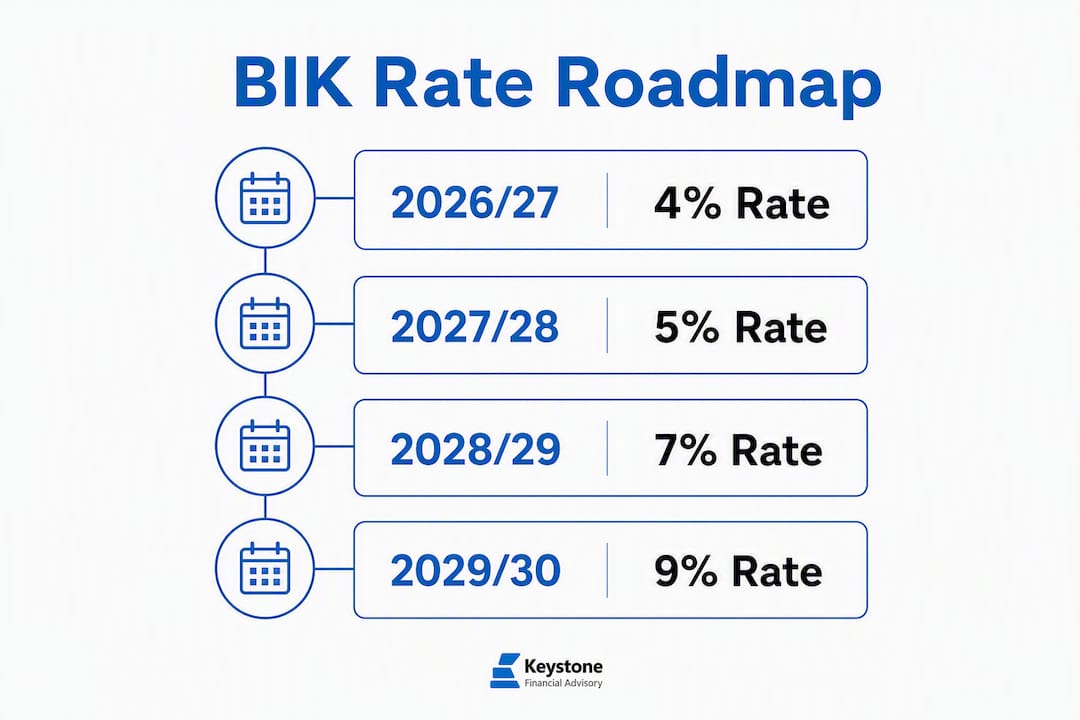
The government has published rates through 2029/30, which is the single most important factor for fleet planning:
Tax year | Zero-emission BIK rate |
2026/27 | 4% |
2027/28 | 5% |
2028/29 | 7% |
2029/30 | 9% |
That roadmap certainty is what has restored fleet confidence and made 24–48 month lease commitments viable again. Businesses signing leases now are locking in the lowest rates on the published schedule.
Worked examples for employees
Example 1: Volkswagen ID.3, P11D £35,995
Basic-rate taxpayer (20%): £35,995 × 4% × 20% = £287.96/year = £24.00/month
Higher-rate taxpayer (40%): £35,995 × 4% × 40% = £575.92/year = £47.99/month
Example 2: Tesla Model 3, P11D £42,990
Basic-rate taxpayer: £42,990 × 4% × 20% = £343.92/year = £28.66/month
Higher-rate taxpayer: £42,990 × 4% × 40% = £687.84/year = £57.32/month
Example 3: BMW i4, P11D £54,900
Basic-rate taxpayer: £54,900 × 4% × 20% = £439.20/year = £36.60/month
Higher-rate taxpayer: £54,900 × 4% × 40% = £878.40/year = £73.20/month
For context, a higher-rate taxpayer in a £45,000 EV at 4% BIK pays roughly £720 per year. A petrol car at a 30% BIK rate on the same list price would cost £5,400 per year in BIK tax for the same taxpayer. That is a difference of £4,680 annually, or £390 per month.
Employer Class 1A NIC
Employers pay Class 1A National Insurance at 15% on the taxable benefit of company cars. For a VW ID.3 at P11D £35,995 with a 4% BIK rate, the taxable benefit is £1,439.80 per year. The employer’s Class 1A NIC on that is £215.97 per year. For a petrol equivalent at 30% BIK on the same list price, the taxable benefit would be £10,798.50 and the employer’s Class 1A NIC would be £1,619.78. Switching one employee from a petrol car to an equivalent EV saves the employer over £1,400 per year in NIC alone.
Salary sacrifice versus employer-provided company car: which saves more?
There are two main routes to providing an electric company car. Understanding the difference in cash terms is what separates a good scheme from a great one.
Employer-provided company car: the employer leases or purchases the car and makes it available to the employee. The employee pays BIK tax on the taxable benefit. Their gross salary is unchanged.
Salary sacrifice: the employee agrees to reduce their gross salary by the lease cost. In return, the employer provides the car as a non-cash benefit. The employee pays BIK tax on the car but saves Income Tax and employee National Insurance on the sacrificed amount.
Why salary sacrifice wins for most employees
Under salary sacrifice, the employee gives up gross pay equal to the lease cost, so they avoid Income Tax and NIC on that amount. They still pay BIK tax, but at 4% that is a fraction of what they saved. Higher-rate taxpayers typically save 30–40% versus a personal lease; basic-rate taxpayers save around 20–25%.
Worked example: VW ID.3, monthly lease cost £450
Salary sacrifice, basic-rate taxpayer:
Gross salary reduction: £450/month
Income Tax saving (20%): £90
Employee NIC saving (8%): £36
BIK tax payable: £24/month
Net monthly cost: £450 − £90 − £36 + £24 = £348/month
Personal lease, same taxpayer:
Monthly lease cost from net pay: £450 (no tax relief)
Net monthly cost: £450/month
The salary-sacrifice route saves this employee £102 per month, or £1,224 per year, on the same car.
Higher-rate taxpayer on the same arrangement:
Income Tax saving (40%): £180
Employee NIC saving (2%): £9
BIK tax payable: £47.99/month
Net monthly cost: £450 − £180 − £9 + £47.99 = £308.99/month
Saving: £141.01/month, or £1,692.12/year.
The pension salary-sacrifice cap: what it means for EV schemes
The pension salary-sacrifice cap changes do not apply to EV schemes. EV salary sacrifice retains full Income Tax and NIC relief on the sacrificed salary, making it one of the few remaining ways for mid-to-high earners to sacrifice a meaningful amount of pay with full tax benefit. This is a material advantage that many employees and employers have not yet fully registered.
Operational considerations
Pension contributions: — salary sacrifice reduces the gross salary base used for workplace pension calculations unless the employer implements a notional pay arrangement. This must be an explicit decision, not an oversight.
National Minimum Wage floor: — salary sacrifice cannot reduce cash earnings below the National Minimum Wage. GOV.UK guidance requires employers to cap sacrifice accordingly.
Pro Tip: Model pension contributions before finalising a salary-sacrifice arrangement. If the employee’s pension is calculated on post-sacrifice salary, they could lose pension contributions worth more than the EV tax saving. A notional pay arrangement preserves the pension base and is straightforward to implement with most payroll software.
PHEVs versus pure EVs: why the tax outlook matters from 2028
Plug-in hybrid electric vehicles (PHEVs) are not the same as pure EVs for company car tax purposes, and the gap is about to widen.
Currently, PHEVs with a meaningful electric-only range attract lower BIK rates than petrol or diesel cars, which is why many fleets adopted them as a transitional option. The problem is what happens from 2028 onwards.
The 2028 risk for PHEVs:
From 2028/29, the government’s published roadmap raises zero-emission BIK rates to 7%, then 9% in 2029/30. PHEVs, however, are subject to separate CO2-based percentage bands that are already higher than the zero-emission rate and are set to rise further. PHEVs with lower electric-only ranges face BIK rates that could reach 15–20% or higher depending on their CO2 emissions, compared to 7–9% for pure EVs over the same period.
When a PHEV might still make sense:
Drivers with very long rural routes where public rapid charging is genuinely impractical.
Staff without home charging who need the petrol range as a genuine fallback.
Short-term leases ending before 2028 where the current BIK advantage is locked in.
For any lease extending into 2028/29 or beyond, a pure EV is the safer tax choice. The BIK rate certainty that the government has provided for zero-emission cars does not extend to PHEVs in the same way, and the risk of a materially higher tax bill in year three of a four-year lease is real.
BIK rate comparison: EV vs PHEV trajectory
Tax year | Zero-emission EV | Typical PHEV (CO2-dependent) |
2026/27 | 4% | 8–14% (varies by CO2/range) |
2027/28 | 5% | Higher |
2028/29 | 7% | Higher still |
2029/30 | 9% | Potentially 15–20%+ |
PHEV rates are indicative and depend on the specific model’s CO2 emissions and electric-only range. Check the HMRC appropriate percentage tables for the exact figure.
What do electric company cars actually cost over their whole life?
BIK tax is the headline figure, but the total cost picture for employers and employees includes several other components that are worth modelling before committing to a scheme.
Cost categories to budget for
Lease or purchase cost: most UK businesses lease rather than purchase. Typical 36-month fleet lease rates for the five models on this shortlist vary widely depending on model and trim. Purchasing outright qualifies for 100% First Year Allowance on qualifying new zero-emission cars, providing immediate corporation tax relief.
Insurance: broadly comparable to petrol equivalents at fleet rates, though repair costs for EVs can be higher due to battery and sensor complexity.
Maintenance: EVs have significantly fewer moving parts than internal combustion engines. No oil changes, fewer brake replacements (regenerative braking reduces wear), and generally lower servicing costs over a 36-month lease.
Electricity: home charging at typical domestic rates costs roughly £3–£6 per 100 miles depending on the tariff. Workplace charging is often provided free to employees, which is a tax-free benefit when the employer installs the charger at the workplace.
Workplace charging infrastructure: a standard 7kW workplace charger costs roughly £500–£1,000 installed per point, before any available grant funding. The government’s Workplace Charging Scheme provides a contribution towards installation costs for eligible businesses.
Residual values: EVs have faced residual value pressure in recent years, though the models on this shortlist (particularly Tesla and VW) have more stable residuals than some newer entrants.
Illustrative whole-life monthly cost comparison
Model | Monthly lease (est.) | Monthly electricity (est.) | Monthly maintenance (est.) | Monthly BIK for a higher-rate taxpayer | Approx. total monthly cost |
Tesla Model 3 | — | — | £30 | £57.32 | — |
BMW i4 | — | — | £30 | £73.20 | — |
Volkswagen ID.3 | — | £45 | £25 | £47.99 | — |
Kia EV3 | £310 | £45 | £25 | £47.99 | — |
Renault 5 E‑Tech | — | £35 | £20 | £47.99 | — |
Figures are illustrative estimates for a higher-rate taxpayer under employer provision (not salary sacrifice). Lease rates vary by term, mileage allowance, and supplier. Electricity costs assume home or workplace charging at approximately £0.25/kWh.
For a detailed breakdown of what your company can reclaim on EV charging costs, the rules on employer contributions and workplace charger installation are worth reviewing before finalising your scheme.
Charging practicality
Home charging is the most cost-effective option and suits the majority of company car drivers. Workplace charging removes range anxiety for staff without home charging access. Public rapid charging is the most expensive route and should be treated as a fallback rather than a primary plan. Schemes that include a home charger contribution or installation as part of the package materially improve driver satisfaction and reduce the likelihood of employees opting out.
Pro Tip: When negotiating a lease, ask whether the package includes a home charger installation allowance. Some fleet providers bundle this in; others charge separately. Charger installation costs spread over the lease term add a modest monthly amount to the total cost of the scheme.
How to set up an EV company car scheme: a practical checklist
Setting up a scheme properly takes four to eight weeks from first decision to first payroll change. The steps below are what a finance director or HR lead should work through.
Step-by-step implementation
Define the policy scope. Decide which employees are eligible, what vehicle categories are permitted, and whether the scheme is employer-provided, salary sacrifice, or both. Set a P11D cap if you want to control BIK exposure.
Model the tax position. Run BIK calculations for your target employee groups at both basic and higher rates. Model the employer’s Class 1A NIC position before and after. Check the company car versus personal car tax implications if you have a mixed fleet.
Check pension interactions. Confirm with your payroll provider whether salary sacrifice will reduce pensionable pay. Decide whether to implement notional pay. This step must happen before any contracts are amended.
Select a scheme provider or leasing company. Request quotes for your shortlisted models on 24, 36, and 48-month terms. Ask specifically about leaver insurance, early termination charges, mileage allowances, maintenance inclusions, and VAT treatment on the lease.
Amend employment contracts. Salary sacrifice requires a formal written amendment. The amendment must specify the sacrifice amount, the benefit provided, and the conditions under which it can be varied or ended.
Configure payroll. Update payroll software to reflect the salary reduction and the P11D value for Class 1A NIC reporting. Set a reminder for the P11D submission deadline (6 July following the end of the tax year).
Communicate to employees. Provide a clear summary of the net monthly cost, the BIK tax they will pay, and the process for ordering. Include a worked example at their tax rate.
Arrange charging infrastructure. Confirm workplace charger provision and decide whether to offer a home charger contribution. Check eligibility for the Workplace Charging Scheme grant.
Go live and monitor. Process the first payroll change, confirm P11D values with the leasing company, and set a review date for the scheme at the 12-month mark.
Compliance checklist for payroll and pensions teams
Salary sacrifice contract amendments signed before the first deduction.
Payroll configured to report the correct P11D value for Class 1A NIC.
Pension contribution basis confirmed (post-sacrifice or notional pay).
National Minimum Wage check completed for all participating employees.
Leaver insurance confirmed with scheme provider.
P11D reporting calendar set for 6 July.
Pro Tip: Run the implementation timeline backwards from your target go-live payroll date. Payroll configuration changes typically need to be in place five to ten working days before the pay run. Contract amendments and employee communications need to precede that. A four-week runway from decision to first payroll change is realistic; six weeks is comfortable.
Is it worth offering electric company cars in 2026/27? The verdict
For employers: yes. The combination of low Class 1A NIC on EV benefits, the salary-sacrifice NIC saving on sacrificed pay, and the 100% First Year Allowance for outright purchases makes EVs materially cheaper to provide than petrol or diesel equivalents. The published BIK roadmap through 2029/30 removes the uncertainty that previously deterred multi-year commitments.
For employees: yes, particularly for higher-rate taxpayers. A higher-rate taxpayer in an electric company car at a low BIK rate pays significantly less tax compared to a petrol equivalent. The salary-sacrifice route enhances this saving, making the net monthly cost often lower than a personal lease, even excluding fuel savings.
The benefit is strongest when:
The employee is a higher-rate taxpayer (40%).
The employer can offer workplace or home charging support.
The role involves client-facing or executive travel where a quality vehicle matters.
The business can commit to a 24–48 month lease to capture the lowest BIK rates on the roadmap.
The employee currently drives a petrol or diesel company car at 25–37% BIK.
The tax contrast is stark. A pure electric company car at a low BIK rate costs substantially less in tax than a petrol car with a much higher BIK rate. For a higher-rate taxpayer, that difference in personal tax is significant, excluding employer-side NIC savings.
Key takeaways
Electric company cars remain one of the most tax-efficient employee benefits available to UK businesses in 2026/27, with a 4% BIK rate and full salary-sacrifice relief that no pension cap change can touch.
Point | Details |
4% BIK rate now, 9% by 2029/30 | Lock in a lease for a term that secures current low BIK rates according to the published roadmap. |
Salary sacrifice is unaffected by pension cap changes | EV schemes retain full Income Tax and NIC relief; model this before pension salary-sacrifice changes alter your benefits strategy. |
PHEV leases carry 2028 tax risk | Any PHEV lease extending into 2028/29 faces a materially higher BIK rate; prefer pure EVs for new agreements. |
P11D specification choices cut employee tax | Choosing a mid-trim over a fully loaded variant can reduce the monthly BIK cost noticeably for a higher-rate taxpayer. |
KeystoneFA can model and implement your scheme | KeystoneFA provides BIK modelling, payroll coordination, and company car policy drafting for UK founders and small businesses. |
Why this matters more than most advisers admit
The conventional wisdom on company car benefits tends to focus on the headline BIK rate and stop there. What gets underplayed is the compounding effect of getting the structure right from the start.
The salary-sacrifice route is not just a tax efficiency. For a small business competing with larger employers for talent, it is a way to offer a genuinely attractive benefit without increasing the cash payroll. A well-structured EV scheme can deliver a net monthly saving to the employee while costing the employer less in NIC than a cash equivalent. That is a rare combination in the current employment market.
What I see most often with director clients is a missed opportunity at the specification stage. The employer agrees a scheme in principle, the employee picks the fully loaded trim, and nobody models the P11D until the P11D form arrives. A £3,000 difference in list price between trim levels translates to a £24 per year difference in BIK tax at basic rate. That sounds trivial. Multiply it across ten employees over three years and it is not.
The pension interaction is the other area where small businesses consistently get caught out. Salary sacrifice reduces pensionable pay unless notional pay is in place. For an employee close to a pension contribution threshold, that reduction can cost them more in lost pension than they save in Income Tax. The fix is straightforward, but it requires the payroll and pensions question to be asked before the contract is signed, not after.
The published roadmap to 2029/30 is genuinely useful. It means a business signing a 36-month lease today knows exactly what the BIK rate will be for the full term. That kind of certainty is rare in tax policy and it is worth acting on.
How KeystoneFA can help you model and implement your EV scheme
For UK founders and small businesses, getting the numbers right before committing to a company car scheme is the difference between a benefit that pays for itself and one that creates unexpected payroll and pension complications.
[
](www.keystonefa.co.uk)
KeystoneFA works with director clients to model BIK costs across employee tax bands, structure salary-sacrifice arrangements that protect pension contributions, draft company car policies, and coordinate with payroll providers ahead of go-live. The firm also advises on the purchase versus lease decision, including the 100% First Year Allowance position for outright purchases and the VAT treatment of lease payments.
If you are reviewing your benefits package for 2026/27 or planning a new EV scheme, book a discovery call with KeystoneFA to get a bespoke cost model for your specific employee mix and vehicle shortlist. The conversation takes under an hour and typically identifies savings that more than cover the cost of the advice.
Useful sources and further reading
Official guidance
Salary sacrifice for employers, GOV.UK — HMRC’s authoritative guidance on setting up salary sacrifice arrangements, including the National Minimum Wage cap requirement.
Taxation of company cars: appropriate percentages 2025–2028, GOV.UK — the official HMRC publication confirming BIK rates for 2025/26 through 2027/28.
Company car tax rates 2028 to 2030, GOV.UK — confirms the 7% and 9% rates for 2028/29 and 2029/30.
Appropriate percentage for company car benefits (480: Appendix 2), GOV.UK — the full CO2 and electric range percentage tables used to calculate BIK.
Industry analysis
Benefit-in-kind company car and van tax guide, Fleet News — foundational explainer on how BIK is calculated using P11D and CO2 bands.
KeystoneFA resources
Electric cars through a UK limited company: still worth it? — KeystoneFA’s analysis of the limited company EV decision, covering BIK, salary sacrifice, and the purchase versus lease question.
Company car vs personal car: UK limited company guide — tax and accounting comparison of company provision versus personal use with mileage claims.
EV charging costs: what UK limited companies can claim — practical guide to reclaimable charging costs and employer contributions.
FAQ
What is the BIK rate for electric company cars in 2026/27?
The zero-emission BIK rate is 4% for 2026/27, confirmed by HMRC. It rises to 5% in 2027/28, 7% in 2028/29, and 9% in 2029/30.
Are electric cars still 100% tax deductible for businesses?
Businesses purchasing a qualifying new zero-emission car outright can claim 100% First Year Allowance, giving immediate corporation tax relief on the full purchase price. Leased vehicles are treated differently; lease payments are generally deductible as a business expense, subject to the usual rules.
Is it worth having an electric company car in 2026/27?
For most employees, particularly higher-rate taxpayers, yes. A higher-rate taxpayer in a £45,000 electric company car pays roughly £720 in BIK tax per year. The equivalent petrol car at 30% BIK on the same list price would cost around £5,400 per year. Under salary sacrifice, the net monthly cost falls further still.
Does the pension salary-sacrifice cap affect EV schemes?
No. EV salary sacrifice is completely unaffected by the pension salary-sacrifice cap changes. EV schemes continue to deliver full Income Tax and National Insurance relief on the sacrificed salary, making them one of the most tax-efficient benefits still available to mid-to-high earners.
Are electric cars losing value faster than petrol cars?
Residual values for EVs have faced pressure across the market, though established fleet models such as the Tesla Model 3 and Volkswagen ID.3 have shown more stable residuals than newer or lower-volume entrants. For company car purposes, residual value affects lease pricing rather than BIK tax, so the impact is on the monthly lease cost rather than the employee’s tax bill.
Recommended