Company car vs mileage claims: which saves more tax?

TL;DR:
Mileage claims at or below the HMRC-approved rates are fully tax- and NIC-free for limited company owners. Company cars are taxed as a benefit in kind, with costs rising significantly for higher-emission vehicles, especially petrol and diesel. The 2026 rate increase to 55p per mile makes mileage claiming more advantageous for most drivers than choosing a company car.
For UK limited company owners, the choice between a company car and mileage claims is one of the most consequential vehicle tax decisions you will make. Mileage claims paid at or below HMRC’s Approved Mileage Allowance Payment (AMAP) rates are fully exempt from income tax and National Insurance, while company cars attract Benefit-in-Kind (BIK) tax based on the vehicle’s P11D value and CO2 emissions. The right answer depends on your annual mileage, the car’s emissions band, and your personal tax rate. The 2026 AMAP rate increase and new BIK bands for electric vehicles have shifted the numbers considerably.
How does HMRC tax company cars versus mileage claims?
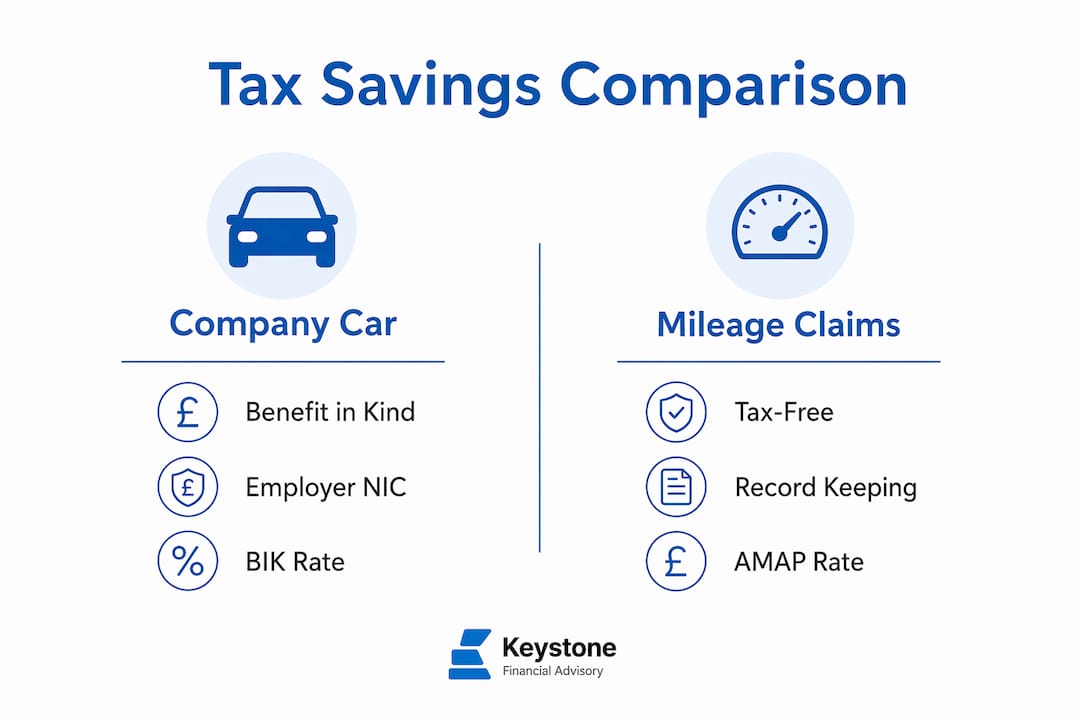
Company cars are taxed as a Benefit in Kind. HMRC calculates the taxable value by multiplying the car’s P11D list price by the relevant BIK percentage, which is determined by CO2 emissions. The employee then pays income tax on that taxable value at their marginal rate.

The employer carries a separate cost. Employers pay Class 1A NIC at 15% on the BIK value, reported by 6 July each year via a P11D form, with payment due by 22 July if paid electronically. That employer NIC is an ongoing overhead that many business owners underestimate when comparing vehicle options.
Mileage claims work differently. Reimbursements at or below AMAP rates are exempt from both income tax and National Insurance for qualifying business travel. There is no P11D to file, no BIK calculation, and no employer Class 1A NIC liability. The administrative burden is significantly lower.
Key mechanics to understand:
BIK taxable value = P11D value × BIK percentage × employee’s income tax rate
Employer Class 1A NIC = 15% of the BIK value, paid annually
AMAP mileage claims = tax-free and NIC-free up to the approved rate per mile
Excess mileage payments above AMAP must be reported on the employee’s P11D as a taxable benefit
What impact do vehicle type and emissions have on company car tax?
Emissions band is the single biggest variable in company car tax. For 2026/27, fully electric cars attract a 4% BIK rate on the P11D value. Petrol and diesel vehicles can reach up to 37%, depending on CO2 output. That gap is enormous in practice.
Consider a concrete example. A £40,000 electric vehicle at 4% BIK creates a taxable benefit of £1,600 per year. A basic-rate taxpayer pays £320 in income tax on that. A comparable petrol car at 30% BIK on the same list price creates a £12,000 taxable benefit, costing a basic-rate taxpayer £2,400 in income tax annually. The employer also pays 15% Class 1A NIC on each figure, adding £240 or £1,800 respectively to the business cost.
Higher BIK percentages on older petrol or high-emission vehicles significantly increase employee tax costs compared to mileage claims, especially for higher-rate taxpayers. A 40% taxpayer driving a high-emission company car can pay thousands more in tax each year than a colleague using their own car and claiming mileage.
Other factors that affect the final BIK figure include:
Capital contributions: a one-off employee contribution of up to £5,000 reduces the P11D value used in the calculation
Private fuel benefit: if the employer pays for private fuel, a separate fuel benefit charge applies, often making this an expensive perk
Payrolling benefits: employers can payroll BIK instead of filing P11D forms, which changes the timing of tax collection but not the liability
Pro Tip: If you are considering a company car, an electric vehicle at 4% BIK is the most tax-efficient choice in 2026/27. The difference against a petrol equivalent can exceed £2,000 per year in employee tax alone.
How does the 2026 AMAP rate increase affect mileage tax savings?
The AMAP rate increased from 45p to 55p per mile for the first 10,000 business miles from 6 April 2026. This is the first change since 2011. The rate for miles above 10,000 remains at 25p per mile.
This change has three direct consequences for limited company owners:
Update your expense policy immediately. Payroll and expense systems must reflect the new 55p rate. Paying the old 45p rate means employees are being underpaid relative to HMRC’s approved threshold.
Claim Mileage Allowance Relief if underpaid. If your employer pays below AMAP, you can claim Mileage Allowance Relief directly from HMRC by keeping accurate mileage records with dates, destinations, and business purposes.
Do not exceed the approved rate without reporting it. Paying above 55p per mile creates a taxable benefit in kind. The excess must be reported on the employee’s P11D, triggering income tax and potentially employer NIC.
At 55p per mile, a director driving 10,000 business miles per year receives £5,500 tax-free. That is a meaningful sum with zero BIK liability and no employer Class 1A NIC. For many limited company owners driving moderate annual mileage, this outcome is better than any company car arrangement.
Keeping records is non-negotiable. AMAP replaces detailed vehicle cost calculations, but HMRC still expects a mileage log with dates and journey purposes for verification. A simple spreadsheet or mileage tracking app satisfies this requirement.
Company car or mileage claim: which saves more for limited company owners?
The answer depends on three variables: annual mileage, the car’s BIK percentage, and the employee’s tax band. Mileage claims paid at approved rates avoid company car BIK entirely, making them the default winner for lower-mileage drivers using higher-emission vehicles.
Scenario | Company car | Mileage claim |
Low mileage, high-emission petrol car | High BIK tax + employer NIC | Tax-free up to 55p per mile |
High mileage, electric vehicle | Low 4% BIK, employer covers all running costs | 25p per mile above 10,000 miles |
Higher-rate taxpayer, mid-range petrol car | Significant personal tax liability | No BIK, full tax-free reimbursement |
Director with own car, moderate mileage | Not applicable | Most tax-efficient option |
Employer Class 1A NIC on company cars adds a significant ongoing cost that must always be factored into any comparison. Mileage claims paid at approved rates avoid this charge entirely, making them cheaper for the business as well as the individual.
The company car becomes competitive when the BIK rate is very low, such as with a fully electric vehicle, and when the employer is covering substantial running costs that would otherwise fall on the employee. At 4% BIK on a £40,000 EV, the annual employee tax cost is just £320 for a basic-rate taxpayer. That can be worth accepting in exchange for a fully funded vehicle.
Pro Tip: Compare your total annual BIK tax plus employer Class 1A NIC against the tax-free mileage reimbursement you would receive at 55p per mile. That single calculation will tell you which option costs less.
Key takeaways
For most UK limited company owners driving moderate mileage in petrol or diesel vehicles, mileage claims at the 2026 AMAP rate of 55p per mile deliver better net tax savings than a company car.
Point | Details |
AMAP rate increased in 2026 | The rate rose from 45p to 55p per mile for the first 10,000 miles from 6 April 2026. |
Mileage claims avoid BIK entirely | Reimbursements at or below AMAP are tax-free and NIC-free for both employee and employer. |
Electric vehicles reduce BIK significantly | A 4% BIK rate on EVs makes company cars far more competitive than petrol equivalents. |
Employer NIC adds to company car cost | Employers pay 15% Class 1A NIC on BIK value, increasing the true cost of a company car. |
Records are required for mileage claims | A mileage log with dates and journey purposes is required for HMRC compliance and MAR claims. |
My view after years of working with limited company directors
The question I hear most often is whether a company car is a perk worth having. My honest answer is: it depends almost entirely on the car’s emissions and how many miles you actually drive for business.
Most directors I work with overestimate the tax benefit of a company car and underestimate the BIK liability. A mid-range petrol car at 25–30% BIK on a £35,000 list price creates a taxable benefit of £8,750 to £10,500 per year. A higher-rate taxpayer pays £3,500 to £4,200 in income tax on that alone, before the employer’s Class 1A NIC is even considered. Mileage claims at 55p per mile on 10,000 miles deliver £5,500 tax-free with no P11D, no NIC, and no annual reporting headache.
The one scenario where a company car genuinely wins is a fully electric vehicle with a low list price. At 4% BIK, the numbers are hard to argue with. But for most petrol or diesel vehicles, mileage claims are the cleaner, cheaper option.
The risk I see most often is directors not updating their expense policies after HMRC changes rates. The 2026 AMAP increase caught many businesses still paying 45p per mile. That means employees were either underpaid or the business was missing a legitimate tax-free reimbursement opportunity. Review your vehicle expense policy annually, not just when something goes wrong.
If your circumstances are complex, particularly if you are considering an EV, have multiple directors, or have high annual mileage, get professional advice before committing to either route. The numbers are specific to your situation.
— Shoaib
How KeystoneFA can help with your vehicle tax strategy
Choosing between a company car and mileage claims is not a one-size-fits-all decision. The 2026 AMAP changes and updated BIK bands for electric vehicles have made the calculation more nuanced than ever for UK limited company owners.
[
KeystoneFA works with founders and limited company directors to model the real tax cost of each option based on your specific mileage, vehicle, and tax position. From P11D reporting to proactive tax planning, the team handles the detail so you do not have to. If you want a clear answer tailored to your business, book a consultation and get the numbers in front of you before your next tax year begins.
FAQ
Are mileage claims always more tax-efficient than a company car?
Mileage claims at or below the AMAP rate are tax-free and NIC-free, making them more efficient for most petrol and diesel vehicle scenarios. A fully electric company car at 4% BIK can be competitive for high-mileage drivers.
What is the AMAP rate for 2026?
The AMAP rate is 55p per mile for the first 10,000 business miles, increased from 45p on 6 april 2026. Miles above 10,000 are reimbursed at 25p per mile.
What happens if my employer pays above the AMAP rate?
Any mileage reimbursement above the approved rate is treated as a taxable benefit in kind and must be reported on the employee’s P11D form, triggering income tax and potentially employer NIC.
What is Mileage Allowance Relief?
Mileage Allowance Relief (MAR) is a tax relief available to employees whose employer pays below the AMAP rate. You claim it directly from HMRC by keeping a mileage log with dates and journey purposes.
How is company car BIK tax calculated?
BIK tax is calculated by multiplying the car’s P11D list price by the relevant BIK percentage (based on CO2 emissions), then multiplying by the employee’s income tax rate. The employer also pays 15% Class 1A NIC on the BIK value.
Recommended