Cash basis vs accruals: which suits UK landlords and sole traders?

TL;DR:
Starting from 2024/25, HMRC automatically applies the cash basis to most UK unincorporated businesses, simplifying bookkeeping for straightforward finances.
However, businesses with significant debtors, creditors, or complex property portfolios should consider electing accruals for better financial accuracy and lender compatibility.
For most UK sole traders and individual landlords, cash basis is the right default from 2024/25 onwards. HMRC made it the automatic starting point for unincorporated businesses that tax year, removing the old turnover thresholds entirely. Stick with it if your finances are straightforward. Elect accruals instead if you have significant debtors or creditors, plan to seek finance, or run a property portfolio complex enough to need proper management accounts.
One more thing before you read on: cash basis and Making Tax Digital are not the same thing. MTD is about how you keep records digitally; it says nothing about which accounting method you use. That confusion trips up a surprising number of people, and this article clears it up.
Table of Contents
What do cash basis and accruals actually mean?
Cash basis records income when money lands in your account and expenses when you pay them. That is it. If a tenant pays January’s rent in February, it falls into February’s figures.
Accruals basis (also called traditional accounting) records income when it is earned and expenses when they are incurred, regardless of when cash moves. Under traditional accounting, a December invoice sits in December’s accounts even if the client pays in March.
The timing difference matters enormously for tax. Consider two parallel examples:
Rent received late — A tenant owes £1,200 for March but pays it on 5 April (the first day of the new tax year). Under cash basis, that £1,200 falls into the new year’s income. Under accruals, it belongs to the year it was earned — March — and is taxable a year earlier.
Neither method is wrong. They simply produce different taxable profit figures in different years, which is why choosing deliberately matters.
On management accounts and bank feeds: cash basis aligns naturally with a bank feed, because every transaction in the feed is a cash event. Accruals requires you to go beyond the feed and capture invoices raised, bills received, prepayments, and accrued income. HMRC’s HS222 helpsheet sets out how taxable profits are calculated under traditional accounting, including the treatment of capital allowances, which behave differently under each basis.
Who can use the cash basis in the UK, and who cannot?
From the 2024/25 tax year, cash basis became the default for unincorporated businesses. The previous turnover thresholds for joining and leaving the cash basis were removed. If you are a sole trader or an individual landlord and you do nothing, you are on cash basis.
GOV.UK sets out clearly who cannot use it:
Limited companies
Limited liability partnerships (LLPs)
Partnerships that include a corporate partner
Businesses that have elected to use accruals for a previous year and have not formally switched back
For landlords, the position is slightly more layered. Property income is treated separately from trading income, and the HMRC Property Income Manual at PIM1090 is the authoritative reference for property-specific cash-basis rules. If you own multiple properties, each property business is assessed together, but the cash-basis election covers the whole property business, not individual properties.
If you run both a sole-trader business and a rental portfolio, the two income streams are assessed separately. You could theoretically use cash basis for one and accruals for the other, though in practice most advisers recommend keeping both on the same basis to reduce complexity.
Pro Tip: If you jointly own a rental property with a spouse or partner, both of you must use the same accounting basis for that property business. Confirm this before filing.
Pros and cons: when does each basis suit you?
The table below maps the two methods across the dimensions that actually drive the decision.
Dimension | Cash basis | Accruals basis |
Best for | Simple sole traders, individual landlords with few tenants | Growing businesses, landlords with agents, anyone seeking finance |
Income/expense timing | Recognised when cash moves | Recognised when earned or incurred |
Bookkeeping complexity | Lower — bank feed often sufficient | Higher — invoices, prepayments, accruals all tracked |
Capital expenditure | Deducted as paid (with some restrictions); no capital allowances computation needed for most items | Capital allowances claimed via Annual Investment Allowance or writing-down allowances |
Property-specific rules | Deposits, agent timing, and finance-cost restrictions apply | Full accruals treatment; deposits recognised when liability ends |
MTD implications | Bank feed maps closely to records required | Requires additional records beyond the feed |
Suitability for loans/investors | Weaker — no formal GAAP framework | Stronger — aligns with UK GAAP and lender expectations |
A few practical use-case matchers:
Use cash basis if — you have no significant unpaid invoices at year end, your expenses are paid promptly, and you have no plans to approach a bank for a mortgage or business loan in the near term.
Use accruals if — you regularly have outstanding rent arrears, you use a letting agent (agent-timing rules make accruals cleaner), you want to claim capital allowances on plant or equipment, or you are building a portfolio that a lender will scrutinise.
The lending point deserves emphasis. ICAS notes there is no formal GAAP framework for cash-basis accounts, which means a lender or investor reviewing your accounts may find them harder to interpret. Accruals accounts, prepared under UK GAAP, give a clearer picture of financial position and are what most mortgage underwriters expect to see. If you are planning to remortgage or expand your portfolio in the next two or three years, that alone can tip the decision.
Landlord-specific rules and common pitfalls under cash basis
Landlords face a set of property-specific rules that do not apply to most sole traders, and several of them catch people out.
Tenant deposits
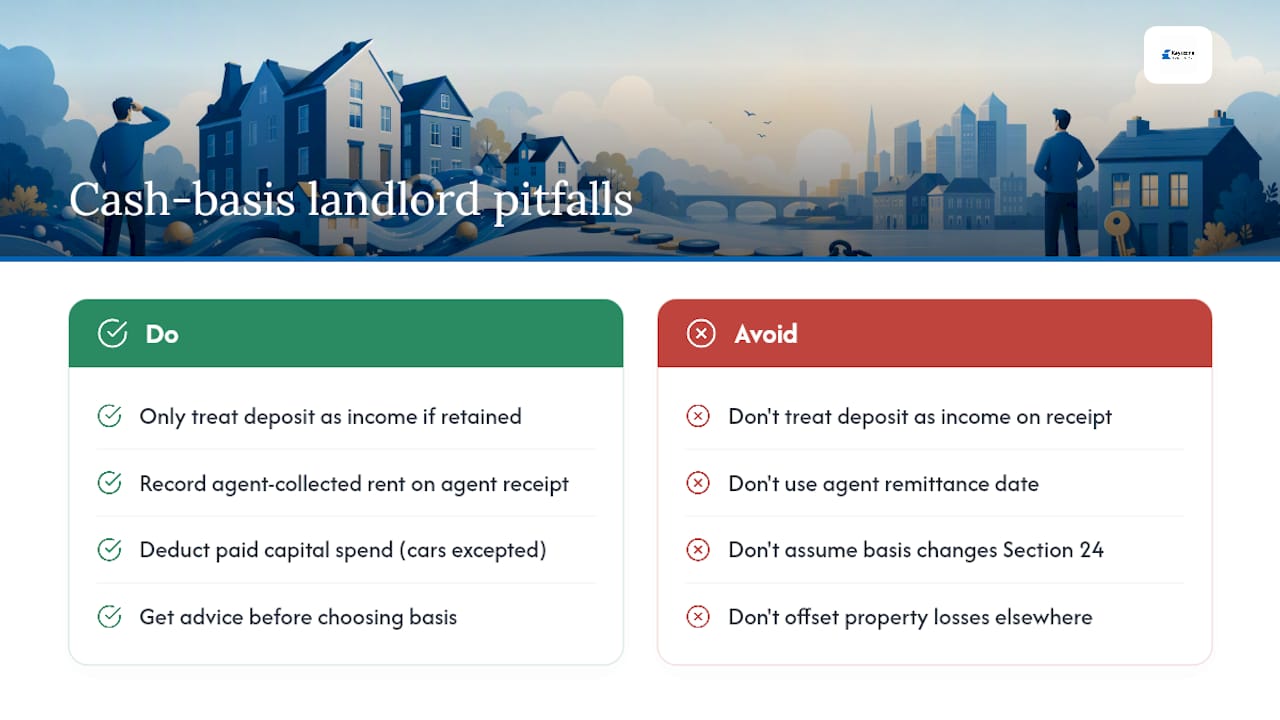
A deposit held in a tenancy deposit scheme is not taxable income when received. It becomes taxable only if you retain it at the end of the tenancy, at which point it is treated as a receipt in the year you keep it. Under cash basis, that is the year the money actually stays with you. Getting this wrong and declaring the deposit as income on receipt is one of the most common landlord errors.
Agent-collected rent
If a letting agent collects rent on your behalf, income is recognised under cash basis when the agent receives the funds, not when the agent pays you. A tenant who pays the agent on 28 March has generated March income for you, even if the agent’s remittance arrives in your bank on 5 April. This timing distinction is set out in HMRC’s property income guidance and is a frequent source of year-end confusion.
Mortgage interest and Section 24
The Section 24 finance-cost restriction means individual landlords can no longer deduct mortgage interest directly from rental income. Instead, you receive a basic-rate tax credit (currently 20%) on finance costs. This applies under both cash basis and accruals, so switching basis does not change your Section 24 position. For more on reducing your overall tax exposure as a landlord, the KeystoneFA guide to landlord tax planning covers the full picture.
Capital expenditure
Under cash basis, most capital expenditure is deducted when paid rather than through capital allowances. The exception is cars, which must still go through the capital allowances system. Under accruals, you claim Annual Investment Allowance or writing-down allowances via the standard capital allowances computation.
Under cash basis, a landlord who spends £8,000 replacing a boiler in March gets the full deduction in that tax year — no capital allowances computation required. Under accruals, the same spend goes through the capital allowances system, and the timing of relief depends on the allowance claimed. For most landlords with one or two properties, the cash-basis treatment is simpler and equally effective.
Loss relief quirks
Cash-basis losses from a property business can only be carried forward against future property income from the same business. They cannot be set against other income. Accruals losses follow the same rule for property, but the interaction with other reliefs can differ. If you are running at a loss, take advice before choosing your basis.
How to switch between cash and accruals, and what adjustments to expect
Switching basis is not complicated, but the transitional adjustments are where mistakes happen. PIM1096 sets out the rules for property businesses entering the cash basis, and the principle is the same for sole traders: you must adjust to avoid counting income or expenses twice, or missing them entirely.
Why adjustments are needed
Suppose you were on accruals and switch to cash basis. At the point of switching, you may have accrued income (rent earned but not yet received) and prepaid expenses (insurance paid in advance). Under accruals, those were already in your accounts. Under cash basis, they would be counted again when the cash moves. The transitional adjustment removes the double-count.
Worked example: moving from accruals to cash basis
At 5 April (year end), you have:
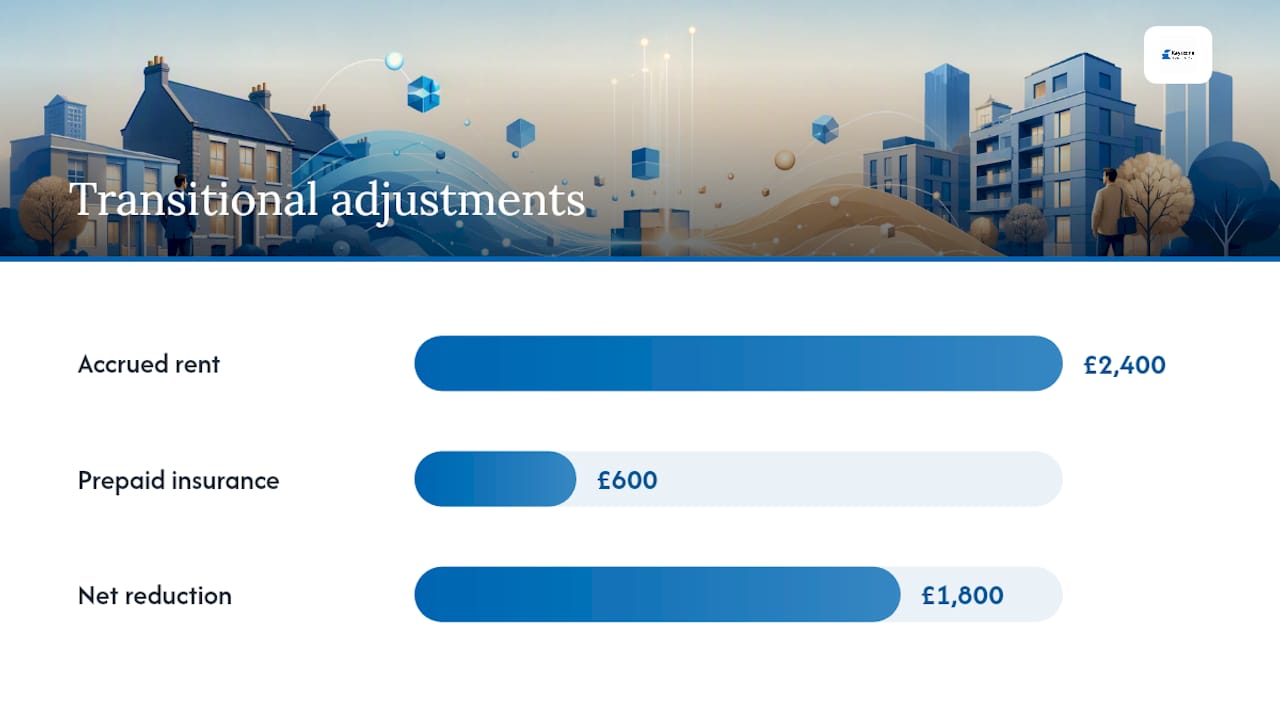
£2,400 of rent accrued but not yet received
£600 of prepaid insurance already expensed under accruals
On entering cash basis, you make a negative adjustment of £2,400 (to remove the accrued income already taxed) and a positive adjustment of £600 (to add back the prepaid expense already deducted). Net effect: a £1,800 reduction in the first year’s cash-basis profit, which reduces your tax bill in that transition year.
Step-by-step process
List all debtors (income earned but unpaid) and creditors (expenses incurred but unpaid) at the last day of your final accruals year.
List all prepayments (expenses paid in advance) and accrued income at the same date.
Calculate the net transitional adjustment and include it on your Self Assessment return for the first cash-basis year.
Note on the return that you are electing cash basis (or, if moving the other way, electing accruals).
Retain the workings in your records in case HMRC queries the adjustment.
Pro Tip: If your debtors or prepayments are large relative to your annual profit, the transitional adjustment can produce an unusually low or high tax bill in the switch year. Model it before you file, or ask an adviser to run the numbers.
How to decide: a practical checklist
Work through these questions before you file or before you speak to an accountant.
Do you regularly have unpaid invoices or rent arrears at year end? If yes, accruals will give a more accurate picture and may avoid a tax spike when large payments arrive.
Do you have significant prepaid expenses? Insurance, service charges, and annual subscriptions paid in advance are common. Under accruals, these are matched to the period they cover.
Are you planning to apply for a mortgage or business loan in the next two years? Lenders typically want accruals-based accounts.
Do you use a letting agent? Agent-timing rules under cash basis add complexity; accruals can be cleaner.
Do you have significant capital expenditure planned? Under accruals, capital allowances can produce better-timed relief in some cases.
Are you approaching MTD? Confirm your software handles your chosen basis correctly before your first quarterly submission.
Questions to raise with an accountant:
What is my transitional-adjustment exposure if I switch now?
Does my current software support the basis I want to use under MTD?
Do I need management accounts for any purpose beyond tax (lending, investor reporting)?
How does my property income interact with my trading income under each basis?
At KeystoneFA, the typical recommendation is to use accruals once a landlord has more than two or three properties, uses an agent, or has plans to refinance. For a sole trader with straightforward income and no significant debtors, cash basis is almost always the cleaner choice. If you are unsure whether you need to file a Self Assessment return at all, the KeystoneFA self-assessment guide covers the basics.
Key takeaways
Cash basis is the right default for most UK sole traders and individual landlords from 2024/25, but accruals is the stronger choice once complexity, lending needs, or portfolio scale tip the balance.
Point | Details |
Cash basis is now the default | From 2024/25, HMRC applies cash basis automatically to unincorporated businesses; no action needed to opt in. |
Elect accruals for complexity | Use accruals if you have significant debtors, use a letting agent, plan to seek finance, or have more than two or three properties. |
MTD does not dictate your basis | Both bases are permitted under MTD; your digital records must simply match whichever basis you use. |
Transitional adjustments matter | Switching basis triggers adjustments for accrued income and prepayments; model the tax impact before filing. |
KeystoneFA can review your position | KeystoneFA offers basis reviews, transitional-adjustment support, and MTD setup for landlords and sole traders. |
When should you actually call an accountant?
The cash-basis default is genuinely useful for keeping things simple. But there are situations where doing nothing, or choosing the wrong basis, costs more than an adviser’s fee.
The clearest signal is a change in scale. A landlord who goes from one property to four in a single year, or a sole trader who takes on a large contract with staged payments, will find that the timing effects of cash basis start to matter in ways they did not before. Large prepayments, significant arrears, or a planned remortgage are all moments where the basis choice has a direct cash consequence.
Switching basis is another trigger. The transitional adjustments are mechanical, but getting them wrong produces a tax error that HMRC may not spot for years, and the correction is rarely straightforward. Bring your last set of accounts, a list of outstanding debtors and creditors at year end, and any prepayments to the meeting. That is the information an adviser needs to run the numbers quickly.
KeystoneFA: accounting support built around your situation
Choosing the right accounting basis is one decision. Implementing it correctly, keeping records that satisfy HMRC and MTD, and making sure the basis still fits as your circumstances change — that is an ongoing process.
[
](www.keystonefa.co.uk)
KeystoneFA works with UK landlords and sole traders who want that process handled properly, without the overhead of a large firm. The team offers basis reviews (including transitional-adjustment modelling), MTD setup and quarterly submission support, and outsourced bookkeeping for landlords who want clean records without managing them personally. Engagements are structured around what you actually need: a one-off review, an ongoing monthly package, or specialist support at a specific trigger point such as a portfolio expansion or a remortgage.
If you are unsure which basis you are currently on, or whether it still suits you, the starting point is a short conversation. Get in touch with KeystoneFA to book a basis review and find out exactly where you stand.
Useful sources and HMRC references
For readers who want the primary authority rather than a summary:
Cash basis changes from the 2024/25 tax year | ACCA Global
PIM1090 — Cash basis for landlords - HMRC internal manual - GOV.UK
Framework for preparing accounts on a cash basis for income tax purposes — ICAS
HS222: How to calculate your taxable profits (2024) — GOV.UK
Making Tax Digital for Income Tax — GOV.UK
FAQ
Can sole traders use the accruals basis?
Yes. Sole traders can elect to use accruals by indicating this on their Self Assessment return; LITRG’s guidance on traditional accounting explains the election process. From 2024/25, cash basis is the default, so you must actively elect accruals if you want it.
Is cash basis or accruals better for a sole trader?
Cash basis suits most sole traders with straightforward income and no significant unpaid invoices at year end. Accruals is better if you have large debtors or creditors, plan to seek finance, or need management accounts that align with UK GAAP.
What is the best accounting method for rental property?
Cash basis works well for landlords with one or two properties and direct rent collection. Accruals tends to be the stronger choice once you use a letting agent, have rent arrears, or plan to remortgage, because it gives a cleaner picture of income earned and is what lenders expect to see.
Do landlords use traditional accounting or cash basis by default?
From the 2024/25 tax year, HMRC made cash basis the default for unincorporated property businesses, including individual landlords. You must actively elect accruals if you want traditional accounting.
Does MTD for Income Tax require you to use cash basis?
No. MTD is a digital-records requirement, not an accounting-basis mandate. Both cash basis and accruals are permitted under MTD, provided your digital records match the basis you have chosen.
This article provides general information about UK tax and accounting rules and is not a substitute for professional advice. Tax rules can change and individual circumstances vary; confirm your position with HMRC or a qualified adviser before making decisions.
Recommended