Audit readiness checks: your practical preparation checklist

An audit readiness check is a structured pre-audit review that tests whether your controls, records, and evidence can withstand an auditor’s scrutiny before fieldwork begins. It is not a formality. It is the difference between a three-week audit and a nine-week one.
The single most important action you can take right now is this: assemble your prepared-by-client (PBC) list and name one person to own it. Practitioner guidance from the ICAEW treats the PBC list as the actual project plan for the audit, not paperwork that sits alongside it. Everything else, including whether you even need a statutory audit under the Companies Act 2006, flows from getting that list right early.
Before you do anything else, get these in place:
Nominate a single point of contact who owns every PBC response.
Pull last year’s PBC list (if you have one) and update it for this year’s scope.
Confirm whether you actually qualify for audit exemption this year, since the thresholds changed in April 2025.
Book a kickoff call with your auditor before fieldwork dates are fixed, not after.
Key Takeaways
Audit readiness comes down to one discipline: treat the PBC list as the project plan, assign a single owner, and prioritise evidence by materiality and risk.
Point | Details |
Define readiness early | An audit readiness check tests whether your controls and evidence would survive auditor scrutiny before fieldwork starts. |
Appoint one owner | A single point of contact chasing the PBC list resolves confusion faster than a shared team responsibility. |
Map evidence to entries | Label every PBC document with its reference number and the trial balance line it supports. |
Start early for first audits | First-time audits need extra time to test opening balances that were never previously audited. |
Fix pitfalls fast | Triage late PBC items daily and reconstruct missing approvals through email or system trails rather than backdating. |
Work with KeystoneFA | KeystoneFA builds PBC trackers, runs gap analyses, and liaises directly with auditors for founders who need extra capacity. |
Table of Contents
What should an audit readiness checklist actually cover?
Most delays trace back to one thing: the finance team didn’t know exactly what “ready” looked like until the auditor told them, mid-fieldwork, that something was missing. A proper checklist removes that guesswork by mapping every PBC request to a specific document, owner, and accounting entry before the auditor ever asks.
Start with the core document groups every auditor will request, regardless of sector:
Bank and cash: twelve months of bank statements, bank reconciliations for each month end, and confirmation of any restricted or pledged cash.
Trial balance and general ledger: a final trial balance tied to the statutory accounts, plus the detailed ledger behind any material line item.
Revenue evidence: signed contracts, invoices, delivery or completion evidence, and a reconciliation between billed revenue and recognised revenue.
Expenses and accruals: supplier invoices, expense approvals, and the accrual workings showing how period-end estimates were calculated.
Payroll: payroll registers, HMRC submissions (RTI), pension contribution schedules, and evidence of director or related-party remuneration.
Fixed assets: an asset register with additions, disposals, and depreciation workings that reconcile to the balance sheet.
Tax: corporation tax computations, VAT returns for the period, and correspondence with HMRC on any open queries.
Related parties: a list of related-party transactions and balances, with supporting agreements or board minutes approving them.
For each of these, auditors are not just checking that a number exists. They want to see that it was reviewed by someone with the authority to approve it, at the time it happened, not reconstructed afterwards. A reconciliation prepared six months late, with no sign-off trail, tells an auditor something about your controls even if the numbers tie out.
PBC mapping is where most teams lose time. Rather than dumping files into a shared folder, label each document with the exact PBC reference number the auditor gave you, and note which trial balance line or disclosure it supports. A file called “Bank Rec March” is far less useful than one called “PBC 4.2 Bank Reconciliation March 2026 to TB line 1200”.

Pro Tip: Work through your PBC list in order of materiality and risk, not alphabetical order. Auditors sample the largest and riskiest balances first, so getting revenue and payroll evidence ready before, say, prepayments, keeps fieldwork moving instead of stalling on day one.
Who owns each part of the readiness check?
Confusion over ownership is the second biggest cause of slow audits, right behind late PBC responses. Someone needs the authority to chase colleagues, escalate blockers, and answer for the whole list, not just their own patch.
Audit project manager / single point of contact: usually the finance director or head of finance, this person owns the PBC tracker, chases outstanding items, and is the auditor’s main contact throughout fieldwork.
Finance team: owns reconciliations, ledger evidence, tax workings, and payroll data, since these sit inside the accounting system they run day to day.
Operations, HR, and legal: own evidence finance doesn’t hold directly, contracts, employment records, litigation status, and board minutes.
External advisor: brought in when the internal team lacks audit experience or bandwidth; expect a scoped engagement covering PBC preparation, mock reviews, and liaison with the auditor rather than the audit itself.
A firm like KeystoneFA typically steps in either to run the readiness check independently or to sit alongside your finance lead as extra capacity during a first audit.
How should you structure the PBC folder and evidence?
Auditors move fastest through readiness checks when the folder structure mirrors their PBC list exactly, section by section, rather than making them hunt through a generic company drive.
A structure that works well in practice: top-level folders numbered to match each PBC section (1. Cash, 2. Revenue, 3. Payroll, and so on), with subfolders inside for supporting evidence and a single index file listing what’s been provided against what’s outstanding. Naming conventions matter more than they get credit for. A consistent format, PBC reference, document type, and period, means nobody has to open five files to find the right one.
What counts as sufficient evidence varies by item, but three things recur across almost every PBC request:
Signed approval: a reconciliation or journal entry needs evidence someone with appropriate authority reviewed it, not just that it exists.
Contemporaneous records: documentation created at the time of the transaction carries more weight than something reconstructed after the fact.
Tie-out to the ledger: every supporting schedule should reconcile to the trial balance figure it’s meant to support, with the variance explained if it doesn’t.
Version control gets overlooked until it causes a problem. If a reconciliation gets updated after the auditor has already reviewed a draft, both versions can end up in the file, creating confusion about which one is final. Use a shared platform with file locking or clear version tags, and keep an audit trail of who changed what and when, particularly for spreadsheet-based workings that don’t have this built in the way accounting software does.
Pro Tip: Give your auditor read-only access to a live shared folder rather than emailing batches of documents. It cuts the “did you get my email” back-and-forth that eats days off every audit timeline.
When should you start, and how does the audit phase into stages?
Timing is where founders most often underestimate what’s needed. A recurring audit for a business with clean records can often be readiness-checked in two to three weeks. A first-time audit needs considerably longer, because auditors have to test opening balances that were never audited before, which the ICAEW flags as additional work unique to first audits.
A realistic phasing plan looks like this:
Six to eight weeks out (first audit) or two to three weeks out (recurring): review accounting policies, confirm scope with the auditor, and finalise your PBC list against last year’s requests.
Three to four weeks out: complete reconciliations, close out related-party disclosures, and resolve any known gaps in evidence before the auditor arrives.
Kickoff and fieldwork: hold a planning meeting to agree communication channels and escalation points, then run fieldwork with your single point of contact triaging queries daily.
Reporting: respond quickly to draft findings and outstanding queries, since delays here often cost more time than the fieldwork itself.
First-time audits carry one extra burden: founders need to pull together documentation for opening balances, sometimes going back further than the current financial year, so starting that search early avoids a scramble in week two.
Where do audit delays actually come from, and how do you fix them?
Most overruns have the same three or four root causes, and none of them are exotic.
Late PBC responses: the single biggest driver of slippage; fix it by triaging outstanding items daily and escalating anything untouched after 48 hours.
Missing approvals: when a sign-off can’t be found, reconstruct it through the original approver’s email trail or system log rather than backdating a fresh signature.
Spreadsheet-only processes: workings with no audit trail invite more questions; add a simple change log or move critical reconciliations into your accounting system where changes are tracked automatically.
Repeated queries on the same item: usually a sign the first answer was incomplete; give auditors the full context and supporting detail the first time, not just the number they asked for.
Grant Thornton’s readiness checklist makes a point worth repeating: agreeing communication channels and response times with your auditor before fieldwork starts prevents most of these frictions from ever becoming a problem.
Pro Tip: If an approval genuinely can’t be reconstructed, tell the auditor early and explain the compensating control you’re offering instead. Silence looks far worse than an honest gap.
How do you keep audit readiness in place all year?
Treating readiness as a once-a-year sprint is exactly why it feels painful every time. Businesses that stop dreading their audit tend to build small habits into the calendar rather than compressing a year of catch-up into a few weeks before fieldwork.
Run reconciliations monthly as part of close, not as a pre-audit exercise.
Refresh key policies (revenue recognition, capitalisation thresholds) at least once a year, even if nothing has changed.
Assign a named control owner to each major balance sheet area, so nobody has to work out who’s responsible when the auditor asks a follow-up.
Run a mock PBC request once or twice a year, picking a handful of items at random and timing how quickly the team can produce them.
Founders should also see readiness as more than compliance. Treating it as a signal of financial discipline matters to investors during due diligence just as much as it matters to an auditor, and it’s a habit worth building into how you manage compliance year-round.
How does KeystoneFA approach an audit readiness check?
When KeystoneFA runs a readiness check for a client, the process starts the same way every time: build or refresh the PBC list, assign a single point of contact, and triage items by materiality before touching anything else. One recurring pattern with first-time audit clients is that opening balance evidence takes longer to assemble than anyone expects, so that work starts in week one, not week four.
A workable template looks like this:
PBC folder layout: numbered top-level folders matching the auditor’s PBC sections, each with an index file tracking status.
Sample timeline: six to eight weeks for a first audit, two to three weeks for a recurring one, phased into planning, fieldwork, and reporting.
Checklist structure: document group, owner, deadline, and status, reviewed weekly by the single point of contact.
The businesses that find audits painless aren’t the ones with perfect records. They’re the ones who know exactly where every piece of evidence lives before the auditor asks for it.
Outsourcing makes sense when the internal team lacks recent audit experience or simply doesn’t have spare capacity during close. A readiness check service should deliver a completed PBC tracker, a gap analysis against your evidence, and direct liaison with your auditor, not just a generic checklist.
Primary sources for audit exemption and readiness guidance
Companies Act 2006: statutory audit requirement and shareholder rights.
Gov: current exemption thresholds.
ICAEW helpsheets: practitioner guidance on audit scope.
Grant Thornton checklist: practical readiness steps for lean teams.
Always confirm exemption eligibility with your auditor, since scope interpretation can vary by circumstance.
Why the PBC list matters more than any checklist template
Most advice on audit readiness focuses on documents: get your bank recs done, tidy the fixed asset register, chase the missing invoices. That’s not wrong, but it misses the actual lever that determines whether an audit runs to eight weeks or fourteen. It’s coordination, not completeness.
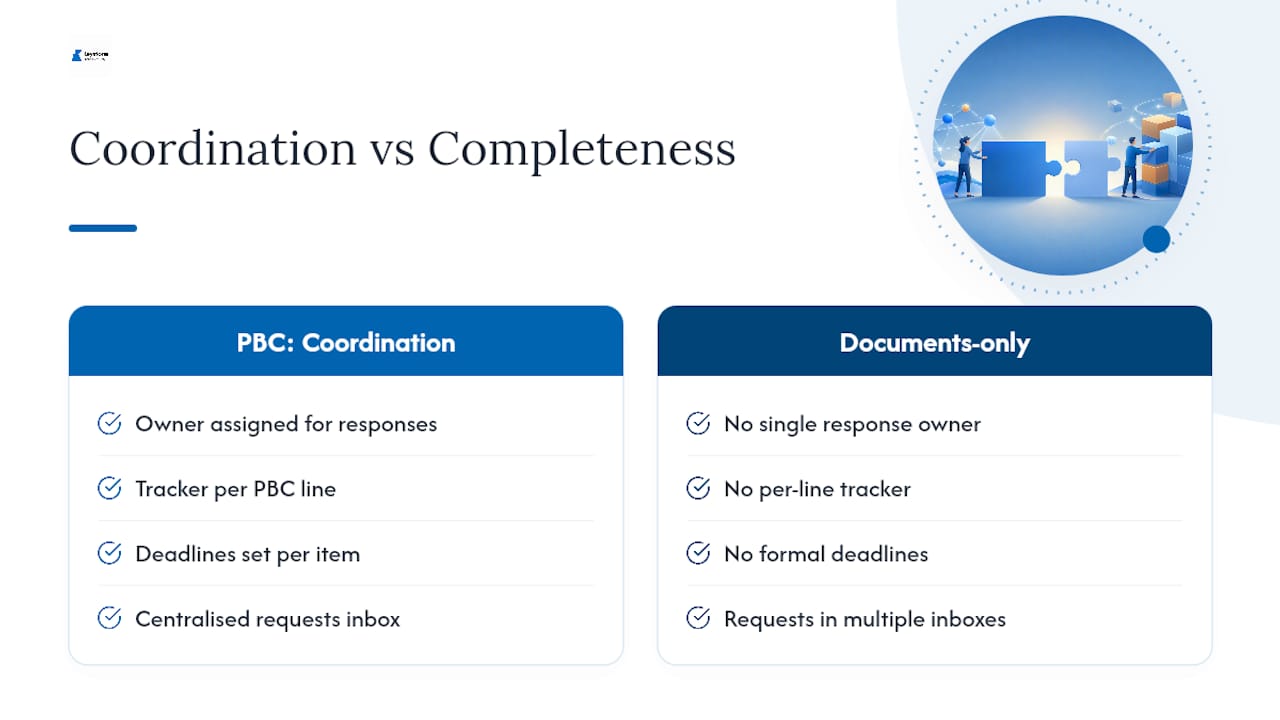
I’ve seen finance teams walk into fieldwork with genuinely strong records and still lose weeks, because nobody owned the response process. Requests sat in three different inboxes. Nobody knew which items were answered and which were half-answered. The PBC list, treated properly, solves that problem before it starts, because it turns a compliance obligation into a project with a tracker, an owner, and a deadline for every line.
The conventional advice undersells first-time audits badly. Founders are told to “get organised” without being warned that opening balance testing alone can add weeks nobody budgeted for. If you’re heading into your first statutory audit, start that specific piece of work before anything else on the checklist.
Prioritise ownership over perfection. A team with an average-tidy PBC list and a clear single point of contact will consistently outpace a team with pristine records and no coordination.
— Shoaib
Get your audit readiness check done properly, with KeystoneFA
If you’ve read this far, you already know the checklist isn’t really the hard part, keeping every workstream moving at once without dropping something is. KeystoneFA runs audit readiness checks for founders and finance leads who don’t have a spare finance hire to dedicate to PBC chasing for six weeks straight. Instead of a generic template, you get a team that has actually built PBC trackers, run gap analyses, and sat opposite auditors for clients going through exactly this.
[

](www.keystonefa.co.uk)
That matters most for first-time audits, where opening balance testing catches founders out every year, and for lean teams where the finance lead is already stretched across bookkeeping, payroll, and tax deadlines. KeystoneFA works alongside your existing team or takes the readiness check on end to end, then stays as the point of contact with your auditor through fieldwork and reporting. If your audit is on the horizon, get in touch through KeystoneFA’s site to scope a readiness check before your kickoff date is fixed.
Sources
FAQ
What is audit readiness?
Audit readiness is the state of having your financial records, controls, and supporting evidence organised and verified so that an audit can proceed without delays or repeated queries.
What is a pre-audit checklist?
A pre-audit checklist is a structured list of documents and reconciliations, mapped to an auditor’s PBC requests, that a finance team works through before fieldwork begins.
What are the 5 C’s of audit findings?
Definitions vary across firms, but a commonly used version covers condition, criteria, cause, consequence, and corrective action for describing an audit finding. Confirm the specific framework your auditor uses, since terminology differs between firms.
How do you ensure audit readiness?
Appoint a single point of contact to own the PBC list, prioritise evidence by materiality, and agree communication timelines with your auditor before fieldwork starts. Firms like KeystoneFA typically run this as a standalone readiness check ahead of the audit itself.
Recommended