Founder's compliance survival guide for UK startups

This week, do three things before anything else: open a dedicated business bank account if you haven’t already, register your company with HMRC for corporation tax within three months of incorporation, and file any overdue confirmation statement with Companies House. These three actions remove the most immediate risks to you as a director and to any future fundraising conversation.
Separate bank account (owner: founder, today): mixing personal and company funds is the single fastest way to lose limited liability protection and create a nightmare during due diligence. Open a business account this week, even a free one. Read more on the personal expenses pitfall before your next payment run.
HMRC corporation tax registration (owner: founder or accountant, within three months of incorporation): HMRC must be notified within three months of starting to trade. Miss this and penalties begin accruing silently. Go directly to GOV.UK and register online; it takes under 30 minutes.
Confirmation statement (owner: founder or Companies House agent, annually): this is not the same as your annual accounts. It confirms your registered details are current. The filing fee is £34 online. A missed confirmation statement can lead to compulsory strike-off, which ends the company.
These three steps also signal to investors and lenders that the company is properly constituted. Integrating compliance into daily operations rather than treating it as one-off admin materially reduces director liability and the cost of retrospective fixes during due diligence.
Pro Tip: Set a single recurring monthly calendar event called “Compliance check” for the last Friday of each month. Use it to review what is due in the next 45 days. One 20-minute slot prevents most deadline surprises.
Key takeaways
UK founders who treat compliance as an operational layer rather than an annual task reduce director liability, survive due diligence, and spend less fixing errors than founders who defer.
Point | Details |
Three actions this week | Separate bank account, HMRC corporation tax registration, and confirmation statement filing remove the biggest immediate risks. |
MTD from April 2026 | Sole traders and landlords earning above £50,000 must submit quarterly digital updates via HMRC-recognised software. |
Companies House software mandate | From April 2028, all UK companies must file annual accounts in iXBRL format using commercial software; select compatible software now. |
Governance documents first | A founders’ agreement and shareholders’ agreement with vesting provisions prevent equity disputes that derail companies and block investment. |
KeystoneFA handles the stack | KeystoneFA covers bookkeeping, payroll, VAT, corporation tax, Companies House filings, and MTD updates for UK founders from day one. |
Table of Contents
What must every UK founder finish in the first 90 days?
The table below maps the foundational tasks, who owns each one, and the timing blockers that catch founders off guard.
Task | Owner | Deadline / trigger | Blocker to watch |
Incorporate via Companies House | Founder | Before trading | Authentication code arrives by post (allow 5 days) |
Register for corporation tax | Founder / accountant | Within 3 months of trading | Requires UTR from HMRC |
Set up PAYE scheme | Founder / payroll provider | Before first payroll run | Must be live before any salary or director’s pay |
Check VAT registration threshold | Founder / accountant | Ongoing; register if turnover exceeds £90,000 | Voluntary registration possible earlier for credibility |
Open business bank account | Founder | Week 1 | Some banks require 2–4 weeks for approval |
Draft founders’ agreement | Founder + solicitor | Before any equity split decision | Delays here create disputes that are expensive to unwind |
Assign IP to the company | Founder + solicitor | At or shortly after incorporation | Pre-incorporation IP stays personally owned without assignment |
Register with ICO (data protection) | Founder | Before collecting any personal data | Annual fee applies; most companies pay £40–£115 |
Choose MTD-compatible accounting software | Founder / finance lead | Before first quarterly update | Software must be HMRC-recognised; check the MTD eligibility tool |
File first confirmation statement | Founder / agent | Within 14 days | Easy to miss; set a calendar alert immediately |
For pre-revenue companies, the accounting for pre-revenue startups guide walks through the bookkeeping baseline you need before any of the above deadlines hit.
A staged approach works best. Incorporation and tax registrations are week-one tasks. Governance documents and software selection can follow in weeks two to eight, but should not slip past the 90-day mark. A staged legal roadmap prevents both over-spend on legal fees early and under-protection when the first investor or employee arrives.
Which deadlines should you put in your calendar right now?
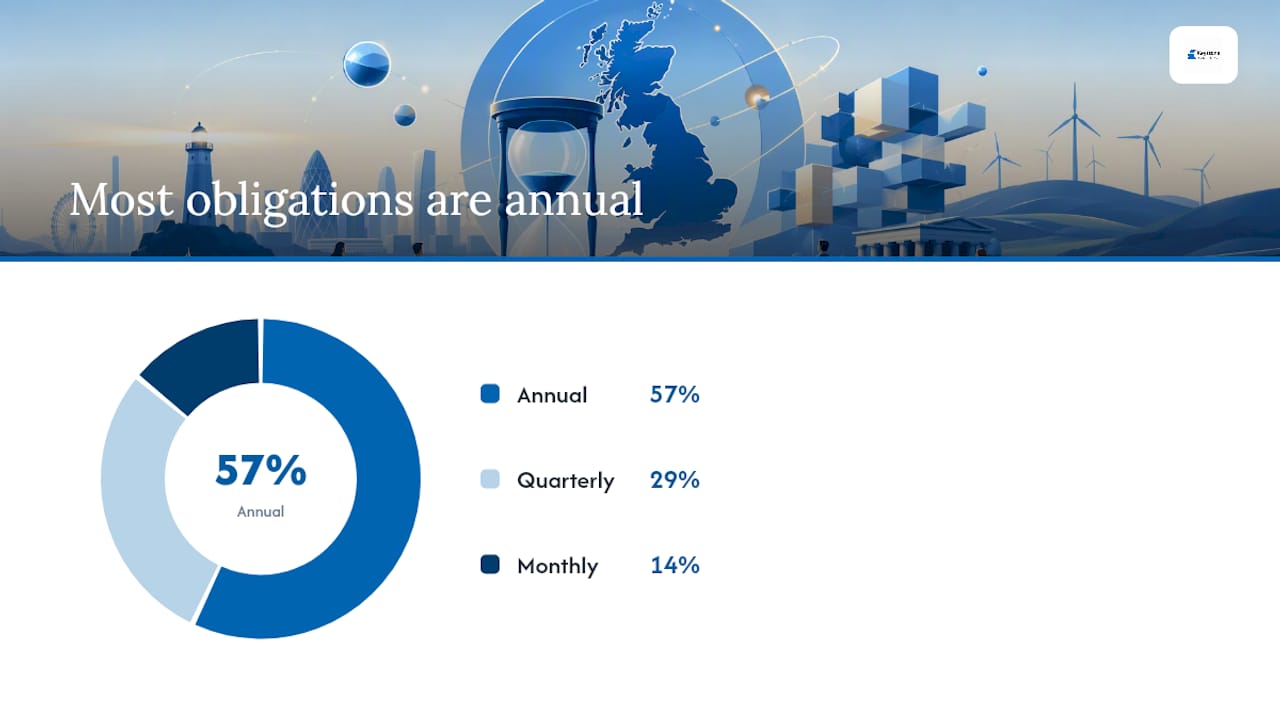
Missing a filing deadline rarely feels catastrophic in the moment. The penalty arrives weeks later, and by then the founder has moved on to the next fire. The table below maps the recurring obligations by frequency, the penalty shape, and the cashflow impact.
Obligation | Frequency | Key date | Penalty if missed | Cashflow note |
MTD quarterly update (Income Tax) | Quarterly | 5 Aug, 5 Nov, 5 Feb, 5 May | Late filing penalties under new MTD penalty regime | Plan for tax payment; quarterly visibility helps cashflow |
VAT return and payment | Quarterly (standard scheme) | One month + 7 days after quarter end | Surcharge / penalty points system | VAT collected is not your money; keep it in a separate pot |
PAYE / RTI submission | Monthly (or each pay run) | 19th of following month (22nd electronic) | £100 per month per employee group | Payroll must be run before submission |
Corporation tax payment | Annually | 9 months after year end | Interest from day one of late payment | Budget from month one; do not spend the reserve |
Annual accounts (Companies House) | Annually | 9 months after accounting reference date | £150 to £1,500 for late filing | From April 2028, iXBRL software filing mandatory |
Confirmation statement | Annually | Within 14 days | Compulsory strike-off risk | £34 online filing fee |
Corporation tax return (CT600) | Annually | 12 months after year end | Initial penalties escalating with continued delay | Separate from payment deadline above |
ICO registration renewal | Annually | Anniversary of registration | Up to £4,000 fine for non-registration | £40–£115 fee depending on company size |
Making Tax Digital for Income Tax shifts the reporting rhythm from annual to quarterly for qualifying sole traders and landlords. From 6 April 2026, those with qualifying income above £50,000 must submit quarterly digital updates via HMRC-recognised software. HMRC urged over 864,000 sole traders and landlords to sign up and choose compatible software before the April 2026 deadline.
On the Companies House side, all UK companies will need to file annual accounts using commercial software in iXBRL format from April 2028, and small companies will be required to file profit and loss accounts. Web and paper filing options will close. That gives you roughly two years to select software that handles iXBRL output — but founders who leave it to 2027 will face a scramble. The Companies House software-only changes are explained in detail on the KeystoneFA blog.
Calendar reminder template: Create an event titled “VAT return due [quarter]” set 35 days before each quarter end. For corporation tax, set two alerts: one at month six (to start preparing) and one at month eight (to pay). For MTD quarterly updates, set alerts on the 1st of the month the update is due.
Which legal documents stop founders being derailed?
Governance documents are the most deferred item on every early-stage founder’s list, and the most expensive to fix retrospectively. Legal experts consistently highlight that delaying a shareholders’ agreement is one of the most common survival mistakes, because it leaves equity splits and exit mechanics unresolved until a dispute forces the issue.
Think of the founders’ agreement and shareholders’ agreement as the operating system for the company. Without them, every difficult conversation about who owns what, who can be bought out, and on what terms has to be negotiated under pressure, usually at the worst possible moment.
Founders’ agreement: Covers equity split, roles, decision-making, and what happens if a founder leaves. Draft this before you incorporate or within the first two weeks. The cost of not having one is a potential court dispute over equity.
Shareholders’ agreement: More formal than the founders’ agreement; governs share transfers, drag-along and tag-along rights, and investor protections. Becomes critical at the first funding round. Investors will ask for it during due diligence.
Articles of association: The default Companies House model articles are a starting point, but most funded companies need bespoke articles that align with their shareholders’ agreement. Review these before any investment.
IP assignment agreement: Any IP created before incorporation, or by a founder personally, stays personally owned without a written assignment to the company. This is a due diligence red flag. Sign IP assignments at or immediately after incorporation.
Employment contracts: Required from day one for any employee. A contract that omits restrictive covenants or IP ownership clauses creates risk when an employee leaves.
Contractor agreements: Misclassifying an employee as a contractor (IR35) is an HMRC compliance risk. A written contractor agreement is not sufficient on its own; the working arrangements must also reflect contractor status.
Pro Tip: Build vesting into the founders’ agreement from day one. A standard four-year vest with a one-year cliff means a co-founder who leaves in month eight takes no equity. Without vesting, a departing founder retains their full share, which can block future investment and leave the remaining founders holding a company they can’t control.
What is the minimum toolstack to automate compliance?
The goal is not to buy every piece of software on the market. It is to remove the manual steps that cause deadlines to slip and records to become unreliable. A lean toolstack of four or five well-integrated tools handles the vast majority of recurring compliance work.
Recommended tool types, in implementation order:
MTD-compatible accounting software (e.g. Xero, QuickBooks, FreeAgent): This is the foundation. It must be HMRC-recognised for MTD submissions and capable of producing iXBRL output for Companies House from April 2028. Industry guidance is clear that selecting software ahead of the Companies House software mandate is a near-term priority, not a 2027 problem. Connect your bank account via open banking on day one.
Payroll software (e.g. Xero Payroll, Sage Payroll, BrightPay): Must support Real Time Information (RTI) submissions to HMRC. If you have even one employee or pay yourself a salary as a director, you need this running before the first pay date.
Expense and spend management (e.g. Pleo, Soldo, Expensify): Removes the receipt-chasing that makes monthly bookkeeping painful. Issue company cards with spending limits rather than reimbursing personal cards.
Document storage and e-signature (e.g. Google Drive or SharePoint for storage, DocuSign or Adobe Sign for contracts): All signed contracts, board minutes, and Companies House correspondence should live in one place with version control.
Password manager and access control (e.g. 1Password, Bitwarden): HMRC and Companies House accounts hold sensitive credentials. A shared password manager with role-based access prevents the “only the founder knows the login” problem that delays filings.
Quick checklist for software selection:
Is it on HMRC’s list of MTD-compatible software?
Does it produce iXBRL output (required for Companies House from April 2028)?
Does it integrate with your bank via open banking?
Can your accountant access it directly without you as an intermediary?
Does it support multi-user access with audit trails?
If you are outsourcing compliance tasks, virtual assistant integration best practices covers how to embed external resource into these workflows without losing control of sensitive data.
What do founders need to know about UK GDPR and the ICO?
Data protection is the compliance area founders most often treat as a future problem. It isn’t. The moment you collect an email address, run a contact form, or use analytics on your website, UK GDPR applies.
Practical data processing checklist:
Privacy policy: Must be published on your website before you collect any personal data. It must state what data you collect, why, how long you keep it, and who you share it with. The ICO provides a free privacy notice generator as a starting point.
Cookie notice: If your website uses any non-essential cookies (analytics, advertising), you need a cookie banner that obtains consent before those cookies fire. Pre-ticked boxes do not count as consent.
ICO registration: Most organisations that process personal data must register with the ICO and pay an annual data protection fee. The fee is £40 for micro-organisations and £115 for small companies. Failure to register carries a fine of up to £4,000.
Data processing records: Keep a Record of Processing Activities (ROPA). This is a simple internal document listing what personal data you hold, why, and for how long. It is required under UK GDPR Article 30 and is the first thing the ICO asks for in an investigation.
Marketing emails: You need explicit consent or a legitimate interest basis for marketing emails. Buying email lists and mailing them without consent is an enforcement risk.
Contractor and employee data: Employment contracts should include a data protection clause explaining how employee data is used. This is often missing from template contracts.
For product teams specifically: if your product processes personal data on behalf of customers, you are likely a data processor. Your customer contracts need a Data Processing Agreement (DPA). This is a due diligence requirement for any B2B sale to a larger company.
How do you prioritise compliance when you have no time?
The honest answer is that you cannot do everything at once, and trying to will cause you to do nothing well. A simple triage matrix helps: map each compliance item by the severity of the consequence if ignored against the effort required to fix it.

Quadrant | Consequence | Effort | Action |
Do now | High (director liability, strike-off, HMRC penalty) | Low to medium | Companies House filings, HMRC registrations, separate bank account |
Delegate | High | High | Governance documents, MTD setup, payroll — hire an accountant or solicitor |
Schedule | Low to medium | Low | ICO renewal, contract templates, expense policy |
Defer | Low | High | Advanced tax planning, ESG reporting, audit readiness |
Outsourcing checklist — what to hire out:
Monthly bookkeeping and bank reconciliation (hire out from month one)
Payroll and RTI submissions (hire out before first pay run)
VAT returns (hire out once VAT-registered)
Annual accounts and corporation tax return (hire out; this requires professional judgement)
Companies House filings (hire out; agents must now meet authorised agent requirements including identity verification records kept for seven years)
What to keep in-house: cash flow monitoring, expense approval, and the relationship with your accountant. You must understand your numbers even if you don’t prepare them.
Emergency steps if a deadline slips:
File late rather than not at all. HMRC and Companies House both apply lower penalties for late filing than for non-filing.
Contact HMRC or Companies House proactively. In some cases, a reasonable excuse can reduce or cancel a penalty.
Gather the relevant documents immediately (bank statements, invoices, payroll records) so your accountant can reconstruct the position quickly.
Do not ignore penalty notices. They escalate automatically.
For founders building governance and reporting frameworks with an eye on future ESG obligations, ESG compliance obligations for 2026 sets out the evolving reporting environment worth tracking now.
When should you hire an accountant, and how does KeystoneFA onboard you?
Four events should trigger the decision to bring in professional help, and waiting until after all four have happened is usually too late.
Fundraising: Investors will ask for clean accounts, a cap table, and evidence of tax compliance. Preparing these retrospectively is expensive and slow.
First hire: PAYE, RTI, and employment law create an immediate compliance obligation that most founders are not equipped to manage alone.
Revenue inflection: Once monthly revenue becomes material, the cost of an error (a missed VAT registration, a miscalculated corporation tax liability) exceeds the cost of an accountant many times over.
Falling behind on deadlines: If you have missed a filing or are unsure whether you are compliant, this is the clearest signal. The cost of catching up without help is almost always higher than the cost of prevention.
Onboarding checklist to hand to your accountant:
Certificate of incorporation and memorandum and articles
Companies House authentication code
HMRC online account login (or authorise your accountant as agent)
Last filed accounts and corporation tax return (if any)
Bank statements for the current and prior year
Payroll records and employee contracts
VAT registration certificate (if registered)
List of outstanding deadlines and any penalty notices received
Access to your accounting software
What KeystoneFA handles once onboarded:
Monthly bookkeeping and bank reconciliation
Payroll processing and RTI submissions
VAT return preparation and filing
Annual accounts preparation and Companies House filing
Corporation tax return (CT600) and HMRC liaison
Confirmation statement filing
MTD quarterly update submissions
Proactive alerts for upcoming deadlines
The types of accounting services for founders page explains how these services are structured and what each engagement covers.
Pro Tip: When handing over to an accountant, write a one-page “state of the company” note covering what has been filed, what hasn’t, and any known errors. This saves hours of discovery time and means your accountant can focus on fixing problems rather than finding them.
A founder-friendly view on living with compliance rules
The founders who cope best with compliance are not the ones who know the most rules. They are the ones who accept early that they cannot know all of them, and build a system to catch what matters before it becomes a crisis.
The instinct to defer governance documents, skip the ICO registration, or file the confirmation statement a month late is understandable when you are building a product and managing a team. But the compounding effect of small deferrals is what creates the existential compliance risk, not any single missed deadline. The founders I see struggle most are those who treat compliance as something to get through rather than something to get right once and then maintain cheaply. Get the foundations right in the first 90 days, automate the recurring obligations, and delegate the technical work to people who do it every day. That is not a compliance burden. That is just good operations.
KeystoneFA takes compliance off your plate so you can build
Founders who reach the first funding round with clean books, filed accounts, and a working payroll system close faster and on better terms than those who don’t. KeystoneFA works with UK founders from day one, handling the recurring obligations that eat time and create risk when they slip.
[
](www.keystonefa.co.uk)
KeystoneFA’s founder-focused accounting service covers the full compliance stack: monthly bookkeeping, payroll and RTI, VAT returns, annual accounts, corporation tax, Companies House filings, and MTD quarterly updates. You get a named adviser who knows your company, not a ticket queue.
Company formation and HMRC registration: set up correctly from the start
Monthly bookkeeping and close: clean records every month, not a year-end scramble
Payroll and RTI: processed on time, every pay run
VAT and corporation tax: filed and paid with no surprises
MTD quarterly updates: handled via HMRC-recognised software
Companies House filings: confirmation statements, annual accounts, and iXBRL-ready from April 2028
To get started, visit Keystone Financial Advisory and book an initial call. Onboarding takes one week from the point you share the documents listed above.
Sources
This article is general information, not a substitute for advice from a qualified financial advisor. Consult a qualified financial professional about your own circumstances before acting on anything here.
FAQ
What are the biggest compliance risks for early-stage UK founders?
Missing HMRC registration deadlines, failing to file confirmation statements, and not having a shareholders’ agreement in place are the three most common risks. Each can result in penalties, compulsory strike-off, or an equity dispute that blocks investment.
Does Making Tax Digital apply to limited companies?
MTD for Income Tax applies to sole traders and landlords above the qualifying income threshold, not to limited companies directly. Limited companies have separate corporation tax obligations, though they will be subject to the Companies House iXBRL software filing mandate from April 2028.
When should a startup founder hire an accountant?
The clearest triggers are a fundraising round, the first employee hire, crossing the VAT threshold, or falling behind on any HMRC or Companies House deadline. KeystoneFA recommends engaging an accountant before the first payroll run rather than after the first penalty notice.
Why do so many startups fail on operational grounds?
Analyses of startup failure point to product/market mismatch combined with weak operational disciplines, including poor bookkeeping, missed deadlines, and absent governance documents, as compounding causes. A clean compliance foundation does not guarantee success, but its absence creates avoidable existential risk.
What is a confirmation statement and why does it matter?
A confirmation statement is an annual filing with Companies House confirming that your registered company details are accurate. Missing it can lead to compulsory strike-off, which dissolves the company. The online filing fee is £34.
Recommended