Why your margins keep shrinking: a UK founder's 2026 playbook

Your margins are being squeezed by three forces hitting simultaneously: input costs rising faster than your prices, payroll tax changes that added real money to every salary line, and cashflow timing that turns a profitable month on paper into an overdraft in practice. The triple squeeze of input inflation, the National Living Wage rising in April 2026 to a new rate, and frozen employer NIC thresholds is not a temporary blip. It is the operating environment for 2026.
Three things to do this week:
Run a contribution-margin check on your top five products or services. Calculate price minus variable cost for each. Any line below 30% contribution margin needs a decision: raise the price, cut the cost, or drop it.
Start a 13-week rolling cash forecast. Map every receipt and payment for the next quarter. You will almost certainly find a gap you did not know existed.
Check your Employment Allowance eligibility. The allowance rose to £10,500 for 2026/27. If your payroll software has not applied it, you are overpaying employer NIC right now.
Key takeaways
UK founders in 2026 face a triple squeeze of input inflation, payroll tax changes, and cashflow timing gaps that together erode gross margin faster than any single factor alone.
Point | Details |
Triple squeeze is the core problem | Input inflation, NLW at £12.71, and frozen NIC thresholds are compressing margins simultaneously. |
13-week forecast is the highest-impact action | A rolling cashflow forecast surfaces gaps weeks before they become crises. |
Contribution margin reveals the truth | Any service or product line below 25% contribution margin needs a price rise, cost cut, or removal. |
Employment Allowance is worth £10,500 | Check your payroll software claimed it for 2026/27 before your next payroll run. |
KeystoneFA provides the forecasting and margin reporting | Monthly bookkeeping, payroll review, and cashflow forecasting from KeystoneFA give founders the numbers to act on. |
Table of Contents
How does a 13-week rolling forecast stop cashflow from eroding your margin?
When does borrowing help, and when does it make margins worse?
How do you monitor changing tax policies before they hit your margin?
How do customer retention and revenue diversification protect margins?
How do you model margin scenarios to anticipate future risks?
How does a 13-week rolling forecast stop cashflow from eroding your margin?
An annual budget tells you where you planned to be. A 13-week rolling forecast tells you where you actually are and what is coming. When margins are tight, that distinction is the difference between acting early and acting too late.
Build it in four steps:
List every expected receipt by week: customer invoices due, retainer payments, any grants or tax credits.
List every committed outgoing: payroll, rent, supplier invoices, VAT, PAYE, loan repayments.
Calculate the weekly closing cash balance. Any week that goes negative is a decision point, not a surprise.
Roll it forward every week. Replace actuals, extend the horizon, and update assumptions.
Operational controls that feed the forecast:
Pull your accounts-receivable ageing report weekly. Any invoice over 30 days gets a call, not an email.
Set credit limits for new customers before you start work, not after the invoice is overdue.
Use staged invoicing on projects over £5,000: 30–50% upfront, balance on delivery.
Offer a 2% early-payment discount on invoices over £10,000 if cashflow is tight. The cost is far less than an overdraft.
Where should you cut costs, and where should you not?
Start with the highest-impact lines. Payroll is typically 40–60% of operating costs for service businesses. That does not mean cutting headcount first; it means checking that every payroll relief is claimed.
Employer NIC changes in 2026 increased the real cost of employment significantly, but the expanded Employment Allowance (£10,500 for 2026/27) offsets a material portion for many small employers. Check that your payroll software applied both the NLW rate and the allowance correctly. Many have not.
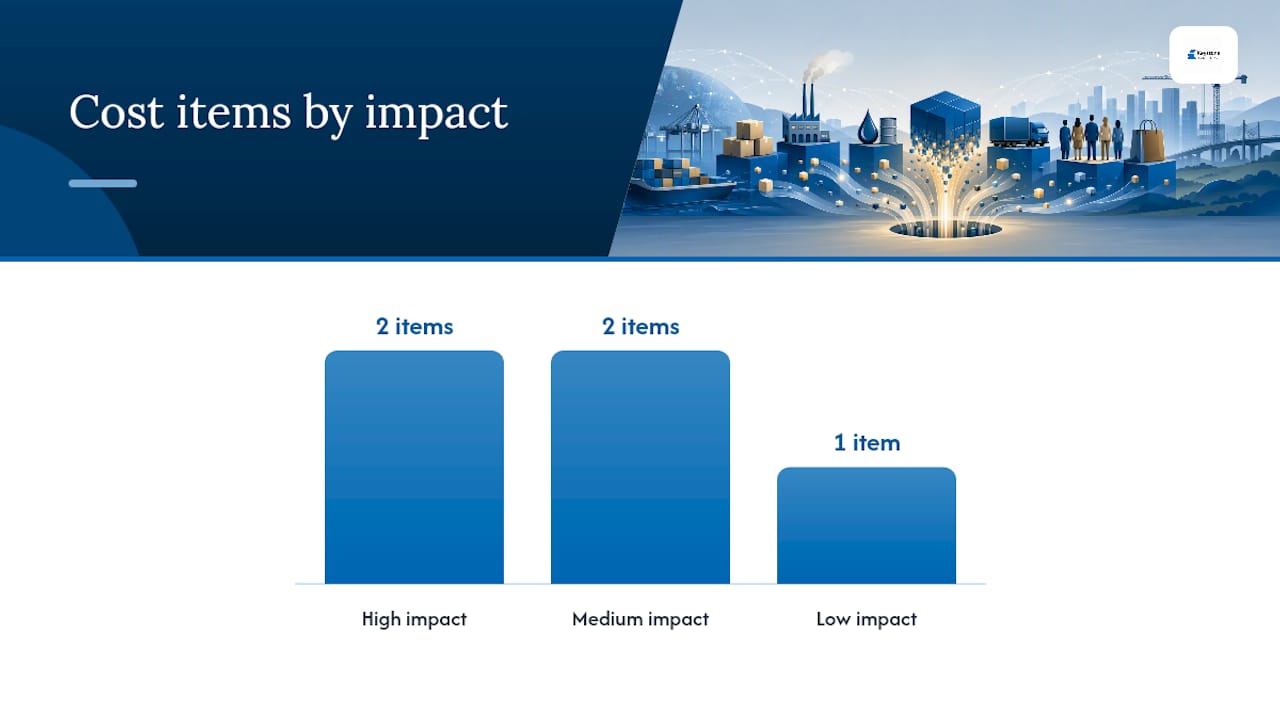
Cost item | Impact | Action |
Employer NIC / Employment Allowance | High | Verify allowance claimed; check NLW applied correctly |
Supplier contracts (annual renewals) | High | Renegotiate; benchmark against alternatives |
SaaS subscriptions | Medium | Audit quarterly; cancel unused seats |
Professional services retainers | Medium | Scope-check; move to project basis if underused |
Bank charges and payment fees | Low | Switch provider or negotiate; quick win |
Do not cut sales, marketing, or delivery capacity that directly generates revenue. Cutting those to protect short-term margin is how businesses shrink their way to closure.
When does borrowing help, and when does it make margins worse?
Finance is a timing tool, not a margin fix. If your underlying contribution margin is healthy but you have a 60-day gap between paying suppliers and collecting from customers, invoice finance or an overdraft bridges that gap at a cost that is lower than the alternative (turning away work or missing supplier discounts).
If your contribution margin is below 20% and you are borrowing to cover operating losses, finance is amplifying the problem. Fix the margin first.
Finance type | Best use | Risk to margin |
Overdraft | Short-term timing gaps | Interest erodes margin if used persistently |
Invoice finance | Bridging debtor gaps | Fees reduce effective margin; check the rate |
Asset finance | Equipment with clear ROI | Fixed cost; manageable if asset earns its keep |
Term loan | Planned investment with payback model | Debt service reduces cashflow headroom |
High-cost lenders | Avoid for operating costs | APRs can exceed 40%; destroys margin rapidly |
The GOV.UK evidence annex notes that UK SMEs have lower borrowing rates and loan success rates than most G7 peers. The British Business Bank exists partly to address this gap; its Start Up Loans and growth finance programmes are worth checking before approaching a high-street bank.
Your 30/90/365-day action plan
30 days:
Complete the contribution-margin table for your top five lines.
Build your first 13-week rolling cash forecast.
Confirm Employment Allowance is claimed for 2026/27.
Verify NLW and NIC changes are applied correctly in payroll.
Renegotiate one supplier contract — start with your largest non-payroll cost.
90 days:
Implement tiered pricing for any line below 30% contribution margin.
Automate invoicing and set up a weekly credit-control cadence.
Audit your subscription stack; cancel anything not used in the last 60 days.
Model two margin scenarios: costs rise a further 5%, and costs hold flat. Know your break-even in both.
Review your year-end tax planning actions to protect net margin.
365 days:
Revisit your product and service mix using updated contribution-margin data.
If growth is strategic, model whether equity or asset finance improves margin more than retained earnings alone.
Embed monthly margin reporting into your management accounts. Gross margin, contribution margin by line, and debtor days should be on every board agenda.
How do Brexit and UK-specific factors affect your costs?
Post-Brexit customs friction adds cost and delay to any supply chain that crosses the UK/EU border. Import duties, additional documentation, and longer lead times have pushed some UK SMEs to hold more stock (tying up working capital) or switch to domestic suppliers (often at higher unit cost). Neither option is free.
Regulatory divergence is also a factor. UK product standards, labelling requirements, and employment law have begun to diverge from EU equivalents, which adds compliance cost for businesses selling into both markets. The GOV.UK evidence annex documents how taxation and regulatory burden rank among the top obstacles SMEs report. Monitoring the new PM’s tax direction is worth doing as further threshold changes remain possible.
How do you monitor changing tax policies before they hit your margin?
Tax policy in the UK has moved quickly. Frozen thresholds, the NIC secondary threshold reduction, and the Corporation Tax rate increase have all landed within a short window. The pattern suggests more changes are likely.
Practical monitoring steps:
Subscribe to HMRC’s email updates for employers and VAT-registered businesses.
Check the HMRC compliance activity landscape annually; penalties for errors are rising.
Review your company structure periodically. The sole trader versus limited company decision has a direct margin impact given current NIC rates.
Build a tax-event calendar: VAT quarters, PAYE deadlines, Corporation Tax payment dates. Late payment interest compounds quickly.
How do customer retention and revenue diversification protect margins?
Acquiring a new customer costs more than retaining an existing one. When margins are tight, churn is a margin problem, not just a revenue problem: you spend acquisition cost to replace revenue you already had.
Retention tactics with a direct margin benefit:
Annual contract reviews where you present value delivered, not just invoice history. Customers who see ROI renew at higher rates and accept price increases more readily.
Introduce a recurring revenue element (retainer, subscription, maintenance contract) to any service currently sold on a project basis. Predictable revenue makes forecasting accurate and reduces the cost of sales.
Diversify by customer concentration: if one client represents more than 25% of revenue, their departure is a solvency event. Add clients in adjacent sectors or geographies to spread risk.
How do you model margin scenarios to anticipate future risks?
Scenario modelling does not require a finance team. It requires three assumptions and a spreadsheet.
Build three cases: a base case (costs hold, prices hold), a stress case (costs rise 8%, one major client reduces spend by 20%), and an upside case (prices rise 5%, costs hold). For each, calculate gross margin, contribution margin, and monthly cash position at week 13.
The stress case tells you your floor. If the floor is negative, you have a structural problem that needs addressing now, not when the stress case becomes reality. British Business Bank guidance specifically recommends scenario planning as a core tool for SMEs navigating inflation. Run the model quarterly and update assumptions when a major cost or revenue variable changes.
The accountant’s view
Most of the founders I speak with know their revenue number cold. Ask them their contribution margin on their top three services and you get silence. That gap is where margin erosion hides. The businesses that come through a cost squeeze intact are not necessarily the ones with the lowest costs. They are the ones who knew their numbers early enough to make deliberate choices rather than reactive ones.
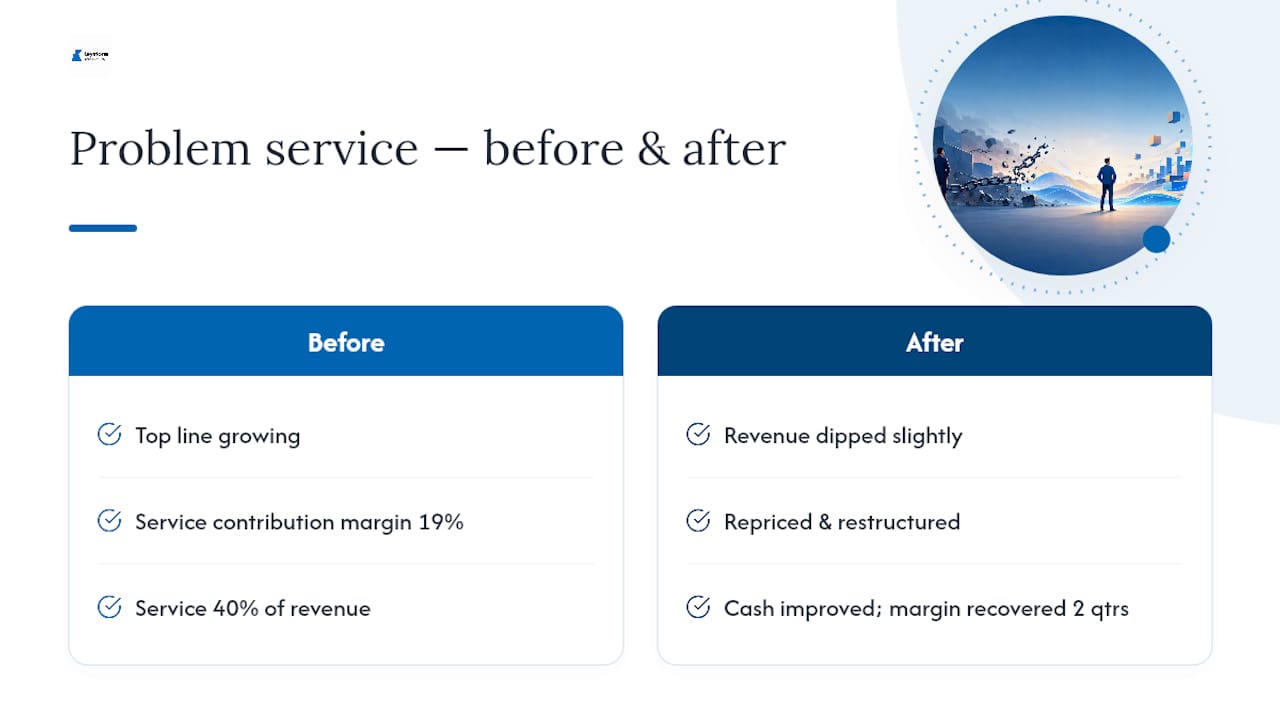
One client came to us with a growing top line and a shrinking bank balance. The issue was a single service line priced at a 19% contribution margin that had grown to represent 40% of revenue. We repriced it, restructured the delivery model, and within two quarters the overall margin had recovered. The revenue dipped slightly. The cash position improved materially.
Proactive accounting is not about filing returns on time. It is about having the right numbers in front of you before the decision becomes urgent.
How KeystoneFA helps you stop margin erosion
If the 13-week forecast, contribution-margin table, and payroll check in this article feel like things you should have but do not, that is exactly the gap KeystoneFA fills for UK founders and startups.
[

](www.keystonefa.co.uk)
KeystoneFA’s monthly accounting packages include real-time bookkeeping, margin reporting, and payroll management with an Employment Allowance check built in. For founders who need a sharper picture fast, a fixed-price margin review covers your top five lines, your cashflow position, and your payroll reliefs in a single engagement. No long-term commitment required to start.
Book a short discovery call with the KeystoneFA team to discuss a forecasting subscription or a one-off margin review. The conversation takes 20 minutes and costs nothing.
Useful sources
UK inflation 2026 — the real cost for small businesses (Elite Business Journal)
Seven business tips for dealing with high inflation (British Business Bank)
How UK small businesses can protect themselves against rising costs in 2026 (Easy Finance Tips)
Rising costs in 2026: UK small business guide (UK Business Buddy)
FAQ
Why are UK business costs rising so fast in 2026?
The main drivers are elevated energy prices, the National Living Wage increase to £12.71 per hour from April 2026, and frozen employer NIC thresholds that push more of each salary into the taxable band. Supply-chain friction from post-Brexit customs adds further cost for businesses with cross-border suppliers.
What is contribution margin and why does it matter?
Contribution margin is selling price minus variable cost. It shows how much each sale actually contributes to covering your fixed costs and profit. Any line with a contribution margin below 25% is likely destroying value once fixed costs are allocated.
How does a 13-week rolling cashflow forecast help?
It maps every receipt and payment for the next quarter, revealing cash gaps weeks before they become crises. Unlike an annual budget, it updates weekly with actuals, so decisions are based on current reality rather than a plan made months ago.
What is Employment Allowance and how much is it worth?
Employment Allowance lets eligible employers reduce their employer NIC bill. For 2026/27 it rose to £10,500. Check that your payroll software has applied it; many small employers are still overpaying.
When should a founder seek outside finance?
Use finance to bridge a timing gap when your contribution margin is healthy but customer payment terms create a cashflow mismatch. Avoid borrowing to cover operating losses from a structurally weak margin. Fix the margin first, then consider finance for growth.
Recommended