What makes financial records investor-ready for a raise?

Investor-ready financial records means your management accounts reconcile cleanly to your statutory accounts, every compliance filing is current, and a populated data room is ready for a stranger to open cold. Investors need three documents on day one: a profit and loss statement, a balance sheet, and a cash flow statement, backed by a clean cap table. If you do nothing else this week, reconcile your management accounts to your last statutory filing. That single exercise surfaces most of the errors that later cause a valuation retrade.
Reconciled P&L, balance sheet and cash flow statement
Cap table matching Companies House filings exactly
Current HMRC filings (CT600, VAT, PAYE/RTI)
A data room that an investor can navigate without asking you questions
Pro Tip: Founders who pre-prepare for diligence close deals faster and face fewer valuation retrades, because the surprises that usually surface mid-diligence get fixed before anyone else sees the numbers.
Key Takeaways
Investor-ready financial records combine reconciled statutory and management accounts, a clean cap table, and current compliance filings, presented in a structured data room.
Point | Details |
Reconcile before you pitch | Match management accounts to statutory filings first; this surfaces most diligence problems early. |
Build the eight-folder data room | Structure documents into corporate, financial, tax, legal, HR, commercial, technical and insurance folders. |
Test your model under stress | Run scenario and sensitivity tests before sharing forecasts, since untested models are a common deal killer. |
Confirm SEIS/EIS status early | Check advance assurance and qualifying conditions in month one of preparation, not during outreach. |
Get specialist support fast | KeystoneFA offers starter engagements covering cap table clean-up, management accounts and SEIS/EIS support in two to four weeks. |
Table of Contents
Data room checklist: the folders and documents investors expect
Telling a credible financial story: metrics, assumptions and sensitivity
Which compliance filings must be current before you fundraise?
Common red flags that delay deals and how fast you can fix them
Keystone’s approach: from messy books to a data room investors trust
What does due diligence actually test beyond the obvious red flags?
How should you prepare records differently for angels versus VCs versus private equity?
How do you present financial records in an investor meeting?
What documents and metrics do investors actually check?
Investors don’t read your accounts for accuracy alone. They read them to test whether your story holds up under scrutiny. Three statements do the heavy lifting.
Profit and loss shows whether the business model produces margin, not just revenue.
Balance sheet reveals what you owe, what you own, and whether working capital is under control.
Cash flow statement tells investors how many months you have left before you need this round to land.
Alongside the statements, most investors want management accounts reconciled to statutory accounts, with variances explained rather than glossed over. Keeping FRS 102/105 classifications consistent year on year cuts the number of queries that come back during quality-of-earnings review.
On metrics, expect questions on burn rate, runway, ARR or MRR if you’re subscription-based, CAC against LTV, and gross margin trend over at least four quarters. A single month of strong ARR growth means little without the trend line behind it.

How much history do you need? Investors typically ask for two to three years of accounts where available, plus year-to-date management accounts. If your company is younger than that, say so plainly and lean on monthly management accounts from incorporation. A short history handled transparently reads far better than one padded with vague explanations.
Data room checklist: the folders and documents investors expect
A data room is not a dumping ground for every PDF you’ve ever generated. It’s a structured proof file, and structure is what separates a two-week diligence process from a two-month one.
Series A diligence frameworks typically expect eight top-level folders:
Corporate — certificate of incorporation, articles, board minutes, shareholder resolutions
Financial — statutory accounts, management accounts, budgets, bank statements
Tax — CT600 filings, VAT returns, R&D tax credit evidence where claimed
Legal — customer and supplier contracts, IP assignment agreements, leases
HR — employment contracts, payroll records, option agreements
Commercial — pipeline data, key customer concentration, pricing history
Technical — architecture documentation, security certifications where relevant
Insurance — policies covering professional indemnity, employers’ liability, cyber
Cap table documentation deserves special attention. Present it on a fully diluted basis, meaning every convertible loan note, SAFE, and unexercised option pool sits alongside issued shares, not tucked into a footnote. A canonical cap table reconciled to Companies House filings and option registers shortens legal diligence more than almost any other single fix.
File naming and version control matter more than founders expect. Use a consistent convention (2026_Q1_ManagementAccounts_v2), retire old versions rather than leaving five drafts floating in a folder, and reconcile every summary document back to its source ledger before upload.
Pro Tip: Ask whoever prepared your management accounts to walk through the data room once, cold, as if they were an investor’s analyst. They will find the gaps faster than you will.
Telling a credible financial story: metrics, assumptions and sensitivity
Numbers without narrative confuse investors. Narrative without numbers worries them. The fix is aligning both before the first meeting.
Lead with two or three headline metrics that match your investment thesis. A marketplace business leads with take rate and GMV growth, not headcount efficiency.
Document every assumption behind your forecast — churn rate, sales cycle length, hiring pace — in a visible assumptions tab, not buried in formulas.
Build sensitivity scenarios showing what happens to runway if churn doubles or a key contract slips a quarter.
Present runway, ARR or MRR, and unit economics first, because British Business Bank’s investor-readiness guidance treats alignment between story, financials and governance as the core test investors apply.
The most common failure isn’t a bad number. Alignment between the story, the financials and the governance evidence is what investors actually screen for, and a mismatch here is a primary cause of delays and retrades.
Pro Tip: Before every investor meeting, ask someone outside the finance function to read the deck against the model. If they spot a contradiction, an investor will spot it faster.
Building a financial model that survives investor scrutiny
A model that only shows a P&L is not a model an investor trusts. Expect them to want an integrated set: profit and loss, cash flow, and balance sheet, all linked so a change in one assumption ripples correctly through the other two.
Before sharing anything, run it through a basic testing checklist:
Scenario test the model at 50% of forecast revenue and confirm runway still calculates correctly
Build a sensitivity table for your two or three highest-risk assumptions (churn, CAC, contract timing)
Check that billing mix (annual versus monthly) flows through to cash correctly, not just to revenue
Confirm formulas don’t break when a row is inserted or a year rolls over
Common model mistakes that recur across UK fundraises include a missing cash flow tab, an untested billing mix, and no scenario testing at all. Founders who skip these checks often find an investor’s analyst finds the bug first, which does nothing for credibility.
UK-specific items to model explicitly: Corporation Tax at the applicable rate for your profit band, PAYE and employer National Insurance contributions, and R&D tax credits if you’re claiming them, since the cash timing of an R&D credit can materially change your runway calculation.
Add a short “how to read this model” note on the first tab. State your reporting periods, currency, and the one or two assumptions most likely to move the outcome. Testing models under adverse scenarios signals more to a serious investor than a beautifully formatted summary tab ever will.
Which compliance filings must be current before you fundraise?
Compliance gaps are among the fastest ways to stall a term sheet, and most of them are entirely avoidable with a few weeks’ notice.
Confirm your Companies House filings are current, including confirmation statements and the last set of statutory accounts, since a late filing shows up the moment anyone runs a company search.
Check HMRC filings are up to date: CT600 corporation tax returns, VAT returns if registered, and PAYE/RTI submissions if you employ staff. Keep the acknowledgement receipts as evidence.
If you plan to use SEIS or EIS to attract investors, confirm your advance assurance status. Gov sets a £250,000 lifetime SEIS limit alongside qualifying trade, gross asset, and employee conditions that must hold for three years after the shares are issued.
Prioritise remediation by materiality: a missing confirmation statement is a quick fix, but a company that no longer meets SEIS gross asset limits is a structural problem that needs advice before you approach investors.
Advance assurance failures are more common than founders assume. One practitioner estimate puts the failure rate at around 19%, usually because the qualifying conditions were checked too late, after the round was already being marketed.
Get advance assurance sorted before outreach starts, not during it.
Common red flags that delay deals and how fast you can fix them
Certain problems appear in almost every diligence process, and most are fixable inside a fortnight if you start early.
Cap table errors (unrecorded option grants, unreconciled share transfers) — fix in one to two weeks with a full Companies House reconciliation; escalate to a specialist if convertible instruments are involved.
Unreconciled management accounts against statutory filings — usually a two to four week fix, longer if several years have drifted.
Revenue recognition inconsistencies (recognising annual contracts as cash received rather than earned) — needs an accountant’s input immediately, since this often affects more than one year of accounts.
Undisclosed liabilities (unpaid PAYE, informal loans from directors) — disclose immediately rather than waiting for an investor to find them; concealment does far more damage to trust than the liability itself.
Cap table and revenue recognition issues carry the biggest valuation risk, because they change the numbers an investor is actually pricing. Filing gaps and naming inconsistencies are procedural and rarely move the price, but they do slow everything down.
Pro Tip: If a fix touches historic revenue recognition or share issuance, get an accountant involved before you touch the model yourself. Correcting it wrong is worse than leaving it flagged.
Keystone’s approach: from messy books to a data room investors trust
KeystoneFA works specifically with founders preparing for a raise, not just year-end compliance.
Cap table clean-up and reconciliation against Companies House records
Management accounts set-up that reconciles cleanly to statutory filings
Financial model remediation and sensitivity testing before investor sharing
SEIS/EIS advance assurance support and ongoing compliance checks
A typical starter engagement runs two to four weeks depending on how far the books have drifted, and includes a full audit readiness check alongside the remediation work.
Pro Tip: Book the readiness check before you set a fundraising date, not after. It’s far cheaper to fix a cap table error in week one than in the middle of term sheet negotiations.
What does due diligence actually test beyond the obvious red flags?
Formal diligence checks numbers, but experienced investors run a parallel process that founders rarely prepare for: soft diligence. This covers how the team behaves under pressure, not just what the spreadsheet says.
An investor’s analyst will time how long it takes you to answer a data request. A same-day response to a straightforward query builds confidence; a week of silence on a simple ask raises more concern than almost any single accounting error. They’ll also watch whether your explanations for variances stay consistent across separate conversations with different team members. If your co-founder gives a different reason for a margin dip than you did, that inconsistency gets noted even if both explanations are individually plausible.
Reference calls with existing customers and past employees form part of soft diligence too, and they’re testing whether the culture matches the pitch, not just whether revenue is real. A founder who oversells team stability while key hires are quietly job-hunting will usually get caught here, not in the numbers.
Series A diligence formally takes four to eight weeks, but a clean data room and a team that responds fast and consistently often compress that considerably. The instinct to over-explain or bury a bad number in a footnote is exactly what experienced investors are trained to spot, so the safer move is always to flag a problem yourself before diligence surfaces it.
How should you prepare records differently for angels versus VCs versus private equity?
Not every investor reads your numbers the same way, and preparing one generic pack for all of them wastes effort.
Angel investors often move fast and informally. They’ll want to see a clean P&L, a realistic runway calculation, and evidence you understand your own numbers when questioned directly. Heavy formal data rooms can feel disproportionate at this stage. A tidy set of management accounts and a one-page cap table summary usually covers it.
Venture capital investors expect the fuller data room: reconciled statutory and management accounts, a fully diluted cap table, sensitivity-tested forecasts, and SEIS/EIS documentation if that’s part of the raise. They also scrutinise unit economics harder than angels typically do, particularly CAC against LTV and cohort retention trends over time.
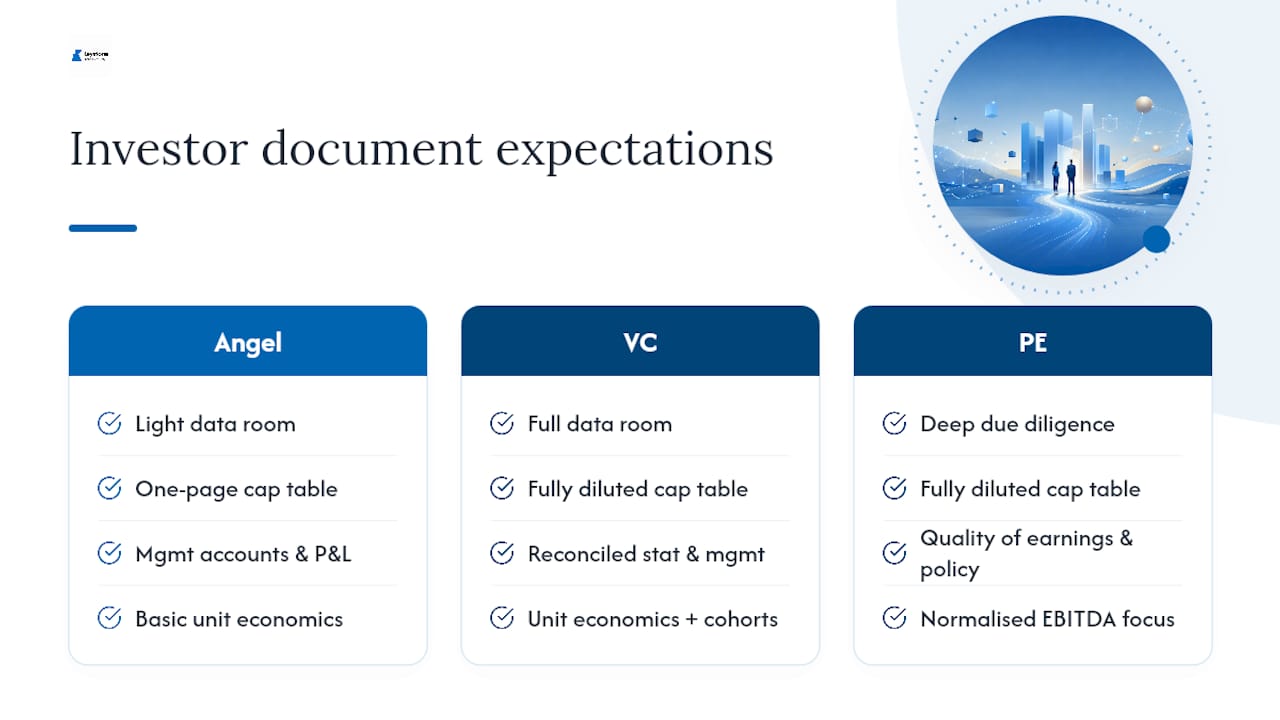
Private equity investors, more common at later stages or for profitable businesses seeking growth capital, dig deeper into quality of earnings. Expect detailed scrutiny of revenue recognition policy, working capital trends across multiple years, and normalised EBITDA adjustments that strip out one-off costs. They’ll also want longer historical trading records than most VCs ask for, often three to five years where the business has traded that long.
The practical takeaway: build your core data room once to the VC standard, then trim or expand it depending on who’s actually reading it. Over-preparing for an angel wastes your time; under-preparing for private equity costs you weeks in follow-up requests.
How do you present financial records in an investor meeting?
The document is not the presentation. Investors have usually skimmed your numbers before the meeting starts, so the room is where you demonstrate you understand them, not where you read them aloud.
Open with the two or three metrics that matter most to your specific business model, not a slide-by-slide tour of the P&L. If you’re a subscription business, that’s ARR growth and net revenue retention. If you’re transactional, that’s gross margin and contribution per unit. Investors form an early impression from whether you lead with the right numbers for your model, and a mismatch here signals you haven’t internalised your own thesis.
When questioned on a variance, answer with the number and the cause in the same breath. “Gross margin dipped two points in Q3 because we onboarded a large enterprise customer at a discounted rate to prove the use case” is a complete answer. A vague “we had some one-off costs” is not, and experienced investors will ask a follow-up until they get specifics.
Bring someone from your finance function into the room, even for early rounds. A founder who defers every financial question to “I’d have to check” repeatedly looks less prepared than one who has a colleague fielding the detail live.
Finally, never present a number in the meeting that contradicts what’s in the data room. If a live figure has moved since the model was shared, say so upfront and explain why, rather than letting an investor’s analyst find the discrepancy later.
What ongoing habits keep financial records investor-ready?
Investor readiness isn’t a sprint before a raise. It’s a habit that, done consistently, means there’s no scramble when an opportunity appears.
Close your management accounts monthly, not quarterly, and reconcile them to your bank and payroll records as part of that close, not as an afterthought. Keep your cap table updated the day any option is granted or share is issued, rather than batching updates once a year, because a stale cap table is one of the most common sources of last-minute diligence delay.

Review your KPI trends every month against the same definitions you’d use with an investor, so burn rate, runway, and gross margin are numbers you already know cold rather than figures you calculate for the first time when someone asks. File your CT600, VAT returns, and PAYE/RTI submissions on schedule and keep the confirmation receipts somewhere accessible, not buried in an inbox.
Treat your data room as a living folder rather than a one-time build. Add signed contracts, updated cap table extracts, and fresh management accounts as they’re generated, so there’s never a scramble to backfill six months of documents the week before a term sheet.
Where founders get investor readiness wrong
Most guidance on this topic treats investor readiness as a paperwork exercise: tick the boxes, fill the folders, done. That undersells what’s actually being tested. Investors aren’t grading your filing system. They’re using the state of your records as a proxy for how you’ll run the company with their money in it.
The conventional advice overweights polish and underweights honesty. A beautifully formatted deck with an unreconciled cap table behind it fails faster than a plain spreadsheet with numbers that hold up when questioned. If there’s one judgement this research supports clearly, it’s that alignment between the story and the underlying records matters more than presentation quality, and most founders spend their prep time on the wrong one.
Where I’d push back hardest on standard checklists: they treat SEIS/EIS advance assurance as a box to tick near the end. Given how often advance assurance applications fail on qualifying conditions checked too late, it deserves attention in month one of prep, not week one of outreach.
Prioritise in this order: reconcile the cap table first, get advance assurance confirmed second, and only then move on to polishing the pitch deck. Everything else is secondary to those three.
How Keystone can help you get investor-ready
Everything in this guide, reconciling management accounts, cleaning up a cap table, stress-testing a model, confirming SEIS/EIS status, is exactly the work KeystoneFA does day to day for founders preparing to raise. The advantage of bringing in a specialist rather than tackling it solo is speed: a team that’s reconciled dozens of cap tables against Companies House filings spots the errors in hours that might otherwise take a founder days to find working alone, without paying for enterprise-grade audit fees you don’t need at this stage.
A typical starter engagement covers bookkeeping clean-up, cap table reconciliation, management accounts set-up, and a first-pass model review, usually completed within two to four weeks depending on how far the records have drifted from statutory filings.
If a raise is on your horizon this year, get in touch through the KeystoneFA site for a starter readiness review before you set a fundraising date.
Sources
FAQ
What are the five basic financial reports investors want to see?
The core set is the profit and loss statement, balance sheet, cash flow statement, statement of changes in equity, and notes to the accounts, though most early-stage investors focus heavily on the first three.
What are five examples of financial records to keep organised?
Bank statements, sales invoices, purchase invoices, payroll records, and your cap table are the five most commonly requested during any investor review.
What’s the best way to organise financial records for a raise?
Structure them into a data room with separate folders for corporate, financial, tax, legal, HR, commercial, technical and insurance documents, and reconcile every summary figure to its source ledger before sharing.
What’s the best system for keeping financial records investor-ready?
A monthly close process, reviewed against the same KPI definitions you’d present to an investor, kept in cloud accounting software with a live cap table, is the most reliable approach; firms like KeystoneFA build this as an ongoing service rather than a one-off exercise.
How far back do investors expect financial history to go?
Most investors ask for two to three years of accounts where the business has traded that long, plus current year-to-date management accounts reconciled to your last statutory filing.
Recommended