Account reconciliation explained for UK small businesses

Account reconciliation is the process of comparing your internal financial records against external statements, such as bank statements or supplier invoices, to confirm the balances agree and every transaction is accounted for. Sage defines it as comparing two sets of financial records to ensure they match, covering types from bank and general ledger through to balance sheet reconciliations.
For a UK small business, getting this right is not optional:
HMRC compliance: Accurate, reconciled records underpin your VAT returns and corporation tax filings. Errors that slip through unreconciled books can trigger HMRC enquiries and penalties.
Management account accuracy: The bank ledger is the foundation for every downstream report. Skip reconciliation and your profit figures, cash position, and forecasts all inherit the same error.
Fraud detection: Reconciling regularly is one of the few controls that catches duplicate payments, fictitious transactions, and unauthorised withdrawals before they compound.
Modern UK accounting software automates around 80% of transaction matching, but the remaining 20% still needs human eyes. KeystoneFA works with founders and small businesses across the UK to make that process reliable, repeatable, and audit-ready.
Key takeaways
Account reconciliation is the control that keeps every downstream report, VAT return, and management account grounded in reality; skip it and errors compound silently until they become expensive.
Point | Details |
Core definition | Reconciliation compares internal records to external statements to confirm every transaction is accurate and complete. |
Recommended cadence | Review bank feeds weekly; complete a full bank reconciliation monthly; reconcile balance sheet accounts quarterly and at year-end. |
Automation limit | UK accounting software automates around 80% of matching; the remaining 20% needs manual review and is where critical errors hide. |
The golden rule | Always investigate discrepancies rather than overriding them; forcing a balance masks errors that corrupt downstream reports. |
KeystoneFA | KeystoneFA manages the full monthly reconciliation cycle for UK founders and small businesses, keeping records HMRC-compliant and audit-ready. |
Table of Contents
What types of account reconciliation does a UK business need?
Most small businesses encounter five main types. Knowing which one you are doing, and how often, saves a lot of confusion.
Bank reconciliation: Matches your accounting software’s bank ledger to the actual bank statement. The classic example is an unpresented cheque: you recorded the payment, but the bank has not yet cleared it, so the balances differ by exactly that amount. Typically done monthly, or weekly for high-volume accounts.
General ledger reconciliation: Checks every GL account balance against its supporting documentation, such as invoices, contracts, or sub-ledgers. Sage notes this is essential before publishing financial statements or setting a budget. Usually performed at month-end and always at year-end.
Balance sheet reconciliation: Confirms that every line on the balance sheet, from fixed assets to accruals, is supported by evidence. A common catch here is a prepayment that was posted once but never released monthly. Quarterly or year-end work for most small businesses.
Accounts receivable (AR) reconciliation: Agrees the total of your aged debtor list to the AR control account in the GL. A mismatch often means a payment was posted to the wrong customer or a credit note was never applied. Monthly for businesses with active invoicing.
Accounts payable (AP) reconciliation: Matches your supplier ledger to AP control accounts and, ideally, to supplier statements. Duplicate invoices and missed credit notes are the usual culprits. Monthly, or at minimum before each VAT quarter.
How to reconcile an account: a step-by-step process
The short version: gather your documents, import the bank feed, run auto-matching, investigate anything unmatched, post the necessary journals, then lock the period. Here is each step in practice.
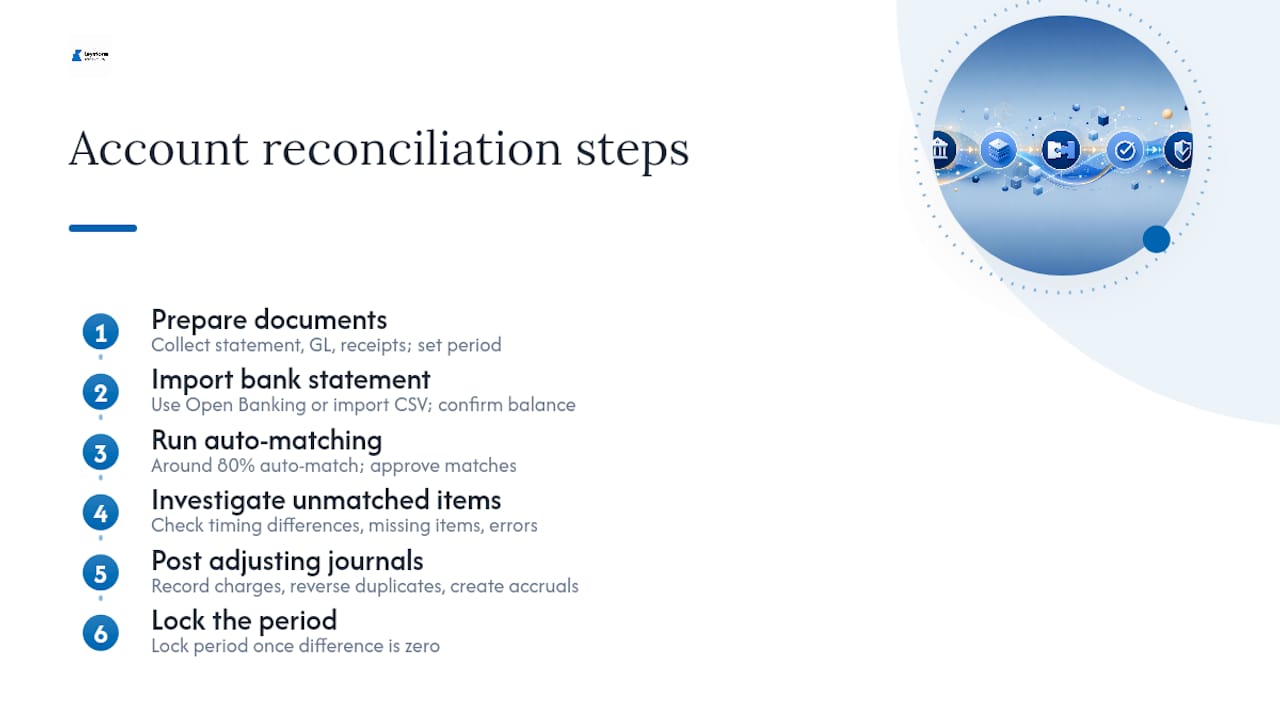
1. Prepare your documents Collect the bank statement (or connect your live bank feed), the relevant GL printout, and any supporting documents such as receipts, invoices, or remittance advices. Set the period clearly before you start.
2. Import the bank statement or activate the bank feed Most UK accounting packages pull transactions directly via Open Banking. If you are working from a downloaded CSV, import it into the reconciliation screen and confirm the opening balance matches last period’s closing balance.
3. Run auto-matching Let the software match transactions automatically. As ReAI notes for UK accounting software, around 80% of items will match without intervention. Approve the suggested matches you are confident in.
4. Investigate unmatched items This is where the real work happens. For each unmatched item, ask: Is it a timing difference (unpresented cheque, deposit in transit)? A missing transaction (bank charge not yet posted)? Or a genuine error? Stripe frames this stage as catching timing lags, duplicates, and errors before they affect reporting.

5. Post adjusting journals Once you know the cause, post the correction: record the bank charge, reverse the duplicate, or create an accrual for a missing invoice. Never adjust the bank statement figure; always correct the ledger.
6. Lock the period When the difference is zero, lock the period in your software so no one can post back-dated entries that reopen the break. BankReconciler.app describes this lock as the internal control that proves your books are accurate for HMRC.
Sample bank reconciliation table
Pro Tip: Never force a reconciliation to balance by overriding or deleting unmatched items. If the difference is not zero after all known adjustments, there is an error somewhere. Forcing masks the problem and corrupts every report that draws on that ledger.
What causes reconciliation mismatches, and how do you fix them?
Investopedia identifies timing differences, bank fees, duplicate postings, and missing transactions as the most common sources of breaks. Here is a practical cause and fix for each scenario a UK small business is likely to meet.
Timing differences (unpresented cheques, deposits in transit)Cause: You recorded the transaction; the bank has not yet processed it. Fix: Leave it on the outstanding items list. It will clear in the next statement period. No journal needed.
Bank charges and interest not postedCause: The bank deducted a fee that was never entered in your ledger. Fix: Post a bank charge journal: debit bank charges expense, credit bank account. Xero notes bank charges are one of the most frequent causes of balance differences.
Duplicate entriesCause: The same invoice or payment was entered twice, either manually or via an import. Fix: Identify the duplicate, reverse one entry with a credit journal, and confirm the net effect is zero.
Unrecorded receiptsCause: A customer paid directly into your bank account but no sales receipt was posted. Fix: Post the receipt against the correct customer invoice or to a suspense account if you cannot immediately identify the payer.
Foreign-exchange (FX) revaluation differencesCause: You hold a euro or dollar account. The exchange rate at the transaction date differs from the month-end closing rate. Fix: Reconcile in the source currency first, then post a month-end revaluation journal using the closing rate. This isolates FX movements and keeps the reconciliation clean.
Potential fraud or unauthorised transactionsCause: A payment appears on the bank statement that no one in the business recognises. Fix: Do not post it to a suspense account and move on. Escalate immediately: contact your bank, review authorisation records, and document the investigation. This is precisely the scenario that regular reconciliation is designed to surface.
How often should you reconcile, and why does timing matter for HMRC?
Cadence matters as much as method. A reconciliation done once a year is better than none, but it is far less useful than one done monthly, and monthly is far less useful than weekly for a busy current account.
Weekly: Review your bank feed, approve auto-matched items, and flag anything unusual. Takes 15–30 minutes when done regularly.
Monthly: Full bank reconciliation, AR and AP control account checks, and a review of any suspense account balances. This is the minimum recommended cadence for any trading business.
Quarterly: Balance sheet reconciliation timed to coincide with your VAT quarter. Reconciling before you submit a VAT return means the figures in the return match the figures in your books.
Year-end: Full GL reconciliation across every account, signed off before the accounts are prepared and filed at Companies House.
The HMRC dimension is direct. Under HMRC’s record-keeping rules, businesses must keep accurate records for at least six years. A reconciliation that is months out of date when an inspector calls is not just embarrassing; it is evidence of inadequate record-keeping, which can extend the scope of an enquiry. Reconciling monthly and locking periods creates a clear, dated audit trail that demonstrates your records were maintained in real time.
For VAT specifically, the figures on your return must agree to your VAT account in the ledger. If they do not, HMRC can assess the difference plus interest and a penalty. A quarterly balance sheet reconciliation, timed before each VAT submission, is the simplest way to catch mismatches before they become assessments.
Pro Tip: Set a recurring calendar reminder for the fifth working day of each month: bank reconciliation due. Doing it at the same time every month means the prior period is still fresh and the bank statement is available.
Which tools make reconciliation easier for UK businesses?
The right software does not eliminate the need for judgement, but it removes the mechanical grind. Here are the features worth looking for, with notes on what the main UK-relevant platforms typically offer.
Bank feeds via Open Banking: Transactions pull directly from your bank into the software, removing manual CSV imports and the transcription errors that come with them. Both Sage and Xero support Open Banking feeds for most UK high-street banks.
Auto-matching rules: You can set rules so that, for example, a monthly payment of exactly £85.00 to a named payee is always matched to a specific expense code. Over time, rules handle a growing proportion of routine transactions automatically.
Bulk journal posting: For period-end adjustments, the ability to post multiple lines in a single journal, with a clear description and reference, speeds up the investigation and posting stage considerably.
Audit trail: Every match, unmatch, and journal should be logged with a timestamp and user name. This is not a nice feature; it is what an HMRC inspector or auditor will ask to see.
FX revaluation: If you hold foreign-currency accounts, look for software that runs an automatic month-end revaluation and posts the gain or loss to a dedicated FX account.
Receipt capture: Apps such as Sage’s AutoEntry or Xero’s Hubdoc let you photograph receipts and match them to bank transactions, closing the evidence gap for small purchases.
Automation typically handles the bulk of straightforward matching, but the remaining exceptions often contain the most critical errors. A successful process combines rules with targeted manual review. Treat the unmatched queue as the most important part of your reconciliation screen, not an afterthought.
For context on why bank feeds matter beyond bookkeeping, the banking and finance sector has driven much of the Open Banking infrastructure that makes real-time feeds possible for small businesses today.
A monthly reconciliation checklist for UK small businesses
Use this checklist each month-end. Tick every item before you lock the period.
Preparation
Confirm the opening balance matches last month’s closing reconciled balance.
Download or connect the bank statement for the full period.
Print or export the GL bank account listing for the same dates.
Matching
Run auto-match and approve confirmed matches.
Review the unmatched queue; do not approve anything you cannot explain.
Check the suspense account balance; it should be zero or clearly documented.
Investigation and posting
Post journals for bank charges, interest, and any unrecorded transactions.
Reverse any confirmed duplicates.
Post FX revaluation if applicable.
Sign-off and archive
Confirm the difference is zero.
Lock the period in the software.
Save the reconciliation report, bank statement, and supporting journals in a named folder (e.g. Reconciliations/2026/March).
Record the approver’s name and date.
HMRC retention: Keep all reconciliation records, bank statements, and supporting journals for a minimum of six years from the end of the accounting period to which they relate. This is a statutory requirement, not a suggestion.
Monthly reconciliation template
Pro Tip: Store reconciliation files in a cloud folder your accountant can access. If HMRC opens an enquiry, your adviser can pull the evidence immediately rather than spending billable time hunting for it.
What are the real risks of skipping reconciliation?
Poor reconciliation is not just an admin problem. The consequences are financial and regulatory.
Inaccurate management accounts: Directors make pricing, hiring, and investment decisions based on management accounts. If those accounts carry unreconciled errors, the decisions built on them are built on fiction.
VAT misstatements: An unrecorded bank receipt or a duplicate purchase invoice can overstate or understate your VAT liability. HMRC can assess the difference, add interest, and apply a penalty, all of which are avoidable.
HMRC enquiries: Reconciliation gaps are visible to an inspector reviewing your records. Unexplained differences, missing periods, or a suspense account with a large uncleared balance are red flags that extend the scope of any investigation. Reconciliation is central to audit efforts because it verifies balances and provides evidence trails.
Cash surprises: A business that does not reconcile monthly may discover, weeks after the fact, that a large customer payment was never received or that a supplier was paid twice. By then, the cash has already been spent or the supplier relationship is complicated.
Fraud going undetected: Unauthorised payments, fictitious suppliers, and inflated expense claims are far easier to hide in books that are never reconciled. Regular reconciliation is one of the most cost-effective fraud controls available to a small business. See our guide on UK audit readiness for a fuller picture of what auditors look for.
An accountant’s perspective on making reconciliation stick
Most small-business owners I speak with know they should reconcile monthly. The gap is not knowledge; it is habit. The businesses that do it consistently are the ones that have made it a fixed, non-negotiable calendar event, not something that happens when there is time.
The single most important rule: investigate discrepancies, never override them. A £12 difference that you force to zero today might be a duplicated direct debit that costs you £12 every month for the next two years. Or it might be nothing. You will only know if you look.
Who should sign off matters too. The person posting transactions should not be the same person approving the reconciliation. Even in a two-person business, that separation, however informal, is a meaningful control. If you are a sole founder doing everything yourself, consider having your accountant review the reconciliation monthly. It takes them minutes and it closes the loop.
Escalate anything you cannot explain within 48 hours. The longer an unresolved break sits, the harder it is to trace.
KeystoneFA handles reconciliation so you do not have to
Reconciliation done properly takes time, discipline, and accounting knowledge. For founders and small-business owners already stretched across sales, operations, and compliance, it is often the first thing that slips.
[

](www.keystonefa.co.uk)
KeystoneFA’s bookkeeping and accounts preparation service covers the full monthly reconciliation cycle: bank, AR, AP, and balance sheet accounts, reconciled, adjusted, and locked each period. Your records stay HMRC-compliant, your management accounts reflect reality, and your VAT returns are filed from figures you can stand behind. Every reconciliation is documented with a clear evidence trail, so if HMRC calls, the answer is already filed.
Book a free initial call with the KeystoneFA team to see how a managed monthly reconciliation fits your business.
Sources
This article is general information, not a substitute for advice from a qualified financial advisor. Consult a qualified financial professional about your own circumstances before acting on anything here.
FAQ
What is accounts reconciliation in simple terms?
Account reconciliation is the process of comparing your business’s internal records, such as your accounting software’s ledger, against external documents like bank statements, to confirm every transaction matches and the balances agree.
How often should a small UK business reconcile its accounts?
Most small businesses should complete a full bank reconciliation monthly and review bank feeds weekly. Balance sheet accounts are typically reconciled quarterly, timed before each VAT return submission.
What causes a reconciliation to not balance?
The most common causes are timing differences such as unpresented cheques, unposted bank charges, duplicate entries, and unrecorded receipts. Fraud or unauthorised transactions are rarer but also surface through reconciliation.
Does accounting software do reconciliation automatically?
Those unmatched exceptions are often where the most significant errors sit.
How long must I keep reconciliation records for HMRC?
HMRC requires businesses to retain accounting records, including bank statements and reconciliation evidence, for at least six years from the end of the accounting period they relate to.
Recommended