How to get a straight answer out of HMRC

Ask for written confirmation, include your exact reference numbers, and check the Gov before you call. That combination works because it creates an auditable trail and forces a recorded response rather than a verbal one you cannot later prove.
Here is what to do right now:
State your question as a closed question (“Will my payment on account be reduced to £X?”) not an open one (“What do I owe?”).
Read out or paste your UTR, NI number, and the HMRC letter reference at the start of every contact.
Ask the adviser for their name and a case or call reference number before you hang up or close the chat.
Follow up in writing the same day, summarising what was said and asking HMRC to confirm in writing.
Log the date, time, channel, and adviser name in a simple note or spreadsheet.
The reason this works is straightforward. HMRC advisers handle enormous volumes of contact. A caller who arrives with precise references, a clear question, and a request for written confirmation signals that they will hold HMRC to the answer. That changes the dynamic.
Key takeaways
Getting a straight answer from HMRC consistently requires the right channel, precise references, a closed question, and a written confirmation request every time.
Point | Details |
Prepare your references | Have your UTR, NI number, and the specific HMRC letter reference ready before every contact. |
Choose the right channel | Use webchat for a written record; phone for urgent matters; post for formal correspondence. |
Ask for written confirmation | End every call or chat by requesting a case reference and written confirmation of the outcome. |
Use the GOV.UK status tool | Check the reply-times tool weekly before chasing; the 15/40 working-day targets are your escalation benchmark. |
KeystoneFA as your buffer | KeystoneFA acts as an authorised agent, handling HMRC contact on your behalf so founders avoid queues and get written outcomes. |
Table of Contents
Which HMRC contact channels should you use, and when?
HMRC offers five main ways to get in touch. Choosing the wrong one for your query type is the single biggest cause of wasted time.
Digital assistant. HMRC’s digital assistant handles simple, factual queries around the clock. It can answer questions about payment deadlines, account balances, and basic registration steps. For anything nuanced, type “I’d like to speak to an adviser” early in the flow to transfer to webchat. Do not spend ten minutes answering its prompts if your question has any complexity at all.
Webchat. Faster than the phone for many routine queries and gives you a written transcript you can save. Availability varies by tax type. For Self Assessment, the digital assistant and webchat transfer option is the starting point. Webchat suits account queries, simple clarifications, and situations where you want a record of the exchange.

Phone helplines. The Self Assessment helpline is 0300 200 3310. Phone is best for urgent matters, situations where you need to negotiate a deadline, or where the digital assistant cannot resolve the issue. The trade-off is wait times. HMRC’s monthly performance reports publish adviser attempt handling rates, and the figures reflect the reality that call volumes are very high. Calling at 8:00 AM on a Tuesday or Wednesday typically means shorter queues than a Monday or Friday afternoon.
Online forms and iForms. Useful for submitting documents or making a formal request where you need a paper trail. Slower than phone or webchat but creates a timestamped submission record.
Post. Slowest channel but sometimes the only option for complex correspondence, appeals, or situations where you need a formal written reply. Always send by tracked post and keep a copy.
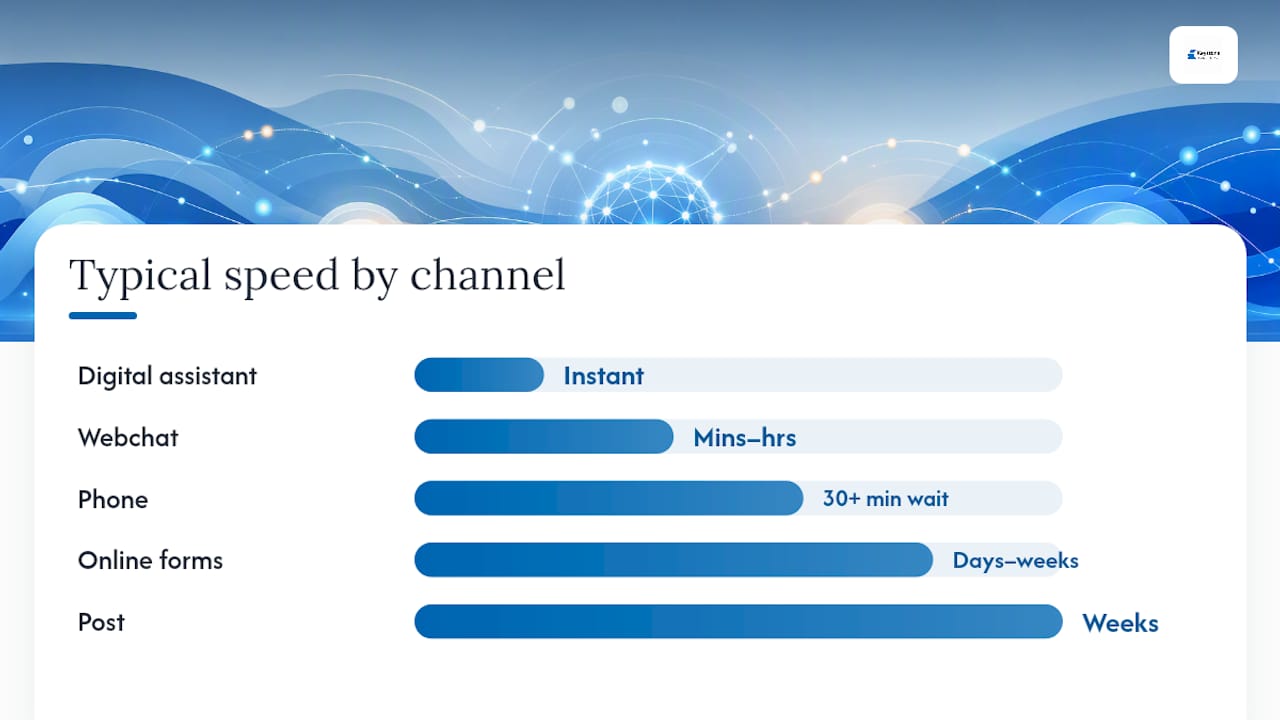
Channel | Best for | Written record? | Typical speed |
Digital assistant | Simple factual queries | No | Instant |
Webchat | Routine clarifications | Yes (save transcript) | Minutes to hours |
Phone | Urgent or complex matters | No (log it yourself) | Variable; often 30+ min wait |
Online forms | Document submission, formal requests | Yes | Days to weeks |
Post | Appeals, complex correspondence | Yes | Weeks |
Pro Tip: Save your webchat transcript immediately at the end of the session. HMRC does not send it to you automatically, and it is your only record of what was agreed.
What to have ready before you contact HMRC
Preparation is the single biggest variable you control. Arriving without the right references means the adviser cannot locate your file, and the call ends without a useful answer.
Reference numbers to have to hand:
Unique Taxpayer Reference (UTR): 10 digits, found on any HMRC letter, your Personal Tax Account, or your Self Assessment return. HMRC cannot discuss your Self Assessment without it.
National Insurance number: two letters, six digits, one letter (e.g. QQ 12 34 56 A). Found on your payslip, P60, or Personal Tax Account.
PAYE reference / Accounts Office reference: on your P60 or employer registration letter. Format: three digits, slash, then letters and numbers (e.g. 123/AB456).
VAT registration number: nine digits, on your VAT certificate and invoices.
Company Registration Number (CRN): eight digits, on your Companies House certificate of incorporation.
The specific HMRC letter reference: printed at the top right of any HMRC letter. Always quote this when replying to a specific notice.
Identity and authorisation:
HMRC will ask security questions before disclosing any account information. If you are calling on behalf of a client or a third party, you need to be registered as an authorised agent or hold a valid Power of Attorney for HMRC purposes. Without that authorisation, HMRC will not discuss the account, regardless of how well you know the details.
Pro Tip: Draft a one-page summary before you call or open a webchat: your name, UTR, the specific question in one sentence, the relevant dates, and the outcome you are requesting. Paste it into webchat at the start or read it out in the first 30 seconds. Advisers locate files faster and give cleaner answers when the query is precise from the outset.
How long does HMRC take to reply, and where can you check?
HMRC’s internal guidance sets targets to acknowledge correspondence within a couple of weeks and provide a full reply within a few weeks, with some flexibility during busy periods. The enquiry manual EM1580 documents this approach and notes that flexibility applies during peak periods or for complex cases. In practice, that means a letter sent in January may take longer than one sent in June.
The most practical tool available is the GOV.UK ‘Check when you can expect a reply from HMRC’ page, updated weekly. It lists expected reply times by correspondence type. Check it before you call to chase a reply. If the tool shows your category is within the normal window, a chasing call will not speed anything up and adds to the queue for everyone else.
HMRC’s published performance data shows correspondence clearance rates within both the 15 and 40 working-day targets, alongside call and webchat handling volumes. These figures are worth knowing because they give you a realistic baseline and something concrete to cite if you need to escalate.
What to do while you wait:
Note the date you sent the correspondence and count 15 working days forward.
Check the GOV.UK reply-times tool weekly rather than calling.
If 40 working days pass with no substantive reply, you have grounds to escalate formally.
If the matter is time-sensitive, state that explicitly in your original letter and ask for an interim acknowledgement.
Tactics that actually get HMRC to give you a straight answer
The framing of your question matters more than most people realise. Open questions (“Can you explain my tax position?”) invite long, hedged answers. Closed questions force a concrete response.

Ask closed questions. “Is my Self Assessment return for 2023/24 showing as received?” gets a yes or no. “What is the status of my repayment claim submitted on 14 March?” gets a date or a status. “Will you confirm in writing that no further action is required?” gets either a yes or a reason why not.
Request written confirmation every time. At the end of any call or webchat, say: “Can you confirm that in writing, please?” If the adviser says they cannot, ask for the case reference number and their name so you can follow up by post.
That phrasing works because it is polite, specific, and signals that you are tracking the interaction. Advisers who know a record exists tend to be more precise.
Log everything. Date, time, channel, adviser name or reference, what was asked, what was said. A simple note in your phone is enough. If the matter escalates, this log is your evidence.
Follow up in writing the same day. Send a brief letter or email summarising the call: “Further to our telephone conversation today at 10:30 AM, I understand that [X]. Please confirm this is correct.” This creates a written record even when HMRC did not provide one directly.
Pro Tip: If you get a vague answer, ask: “What specifically do I need to do next, and by what date?” That question is hard to answer vaguely.
When and how to escalate if you are not getting anywhere
Escalation should follow a clear sequence. Jumping straight to a formal complaint before trying the earlier steps often slows things down rather than speeding them up.
Escalation order:
Ask to speak to a manager during the same call or webchat. State that you have not received a clear answer and would like a second opinion.
Make a formal complaint via HMRC’s complaints process. Submit it in writing, include a timeline of contacts, copies of correspondence, the question you asked, and every reference number you have.
Request a tCCM or CCRT if you are a mid-sized business. HMRC’s mid-sized business help page explains how to request a temporary Customer Compliance Manager or the Customer Compliance Resolution Team when standard channels have failed.
Contact your MP or the Adjudicator’s Office if HMRC’s own complaints process does not resolve the matter.
What to include in any escalation:
A chronological timeline of every contact attempt (date, channel, reference number, outcome).
Copies of all written correspondence.
The specific question you asked and the answer (or non-answer) you received.
The relief or outcome you are seeking, stated clearly.
That structure keeps the complaint factual and makes it harder to dismiss. Vague complaints get vague responses.
What to do immediately if you receive an HMRC enquiry or notice
An HMRC enquiry letter is not a verdict. It is a request for information, and how you respond in the first few days shapes the entire process.
Do:
Read the letter carefully and note the response deadline.
Gather the documents relevant to the period or issue mentioned.
Ask for more time if you need it. HMRC’s internal guidance allows flexibility during busy periods; request an extension explicitly and in writing.
Get specialist advice if the matter is complex, involves significant sums, or relates to a tax area you are unfamiliar with.
Do not:
Admit fault or make concessions in your initial reply.
Ignore the letter or miss the deadline without requesting an extension.
Send original documents (send certified copies).
Discuss the matter with HMRC before you have gathered the relevant records.
Pro Tip: Create a one-page evidence pack: a brief timeline of the relevant transactions or events, the documents that support each point, and the question HMRC has asked. Give this to your adviser or use it to structure your own reply. It keeps the response focused and factual.
How a professional adviser helps you get straight answers from HMRC
The practical value of an adviser is not just technical knowledge. It is time and leverage. An authorised agent can contact HMRC on your behalf, bypassing the security questions that slow down founder calls, and can obtain written confirmations that carry more weight than a verbal assurance.
A typical engagement works like this:
Engage the adviser and provide authority (a signed 64-8 form or equivalent online authorisation).
Prepare the documents together: references, correspondence history, the specific question.
The adviser contacts HMRC by the most appropriate channel, with a precise written query.
Outcomes are logged and confirmed in writing, with copies to the client.
Next steps are actioned promptly, whether that means filing a document, making a payment, or escalating.
For founders dealing with HMRC’s increasing compliance activity, that process removes the phone queue entirely. The adviser handles the back-and-forth; you receive a summary of what was agreed and what to do next.
What an adviser handles that founders typically cannot:
Registering as an authorised agent so HMRC will discuss the account freely.
Drafting precise, closed-question correspondence that forces a written reply.
Chasing responses within the 15/40 working-day framework without burning founder time.
Escalating to tCCM or CCRT for mid-sized business issues.
Representing the client in formal enquiries without the client needing to be present.
If you want to understand the broader context of HMRC’s current compliance focus, the KeystoneFA insights blog covers recent developments in plain language.
Why founders should stop wrestling with HMRC phone queues
There is a particular kind of frustration that comes from spending 45 minutes on hold, finally reaching an adviser, and then receiving an answer so hedged it tells you nothing. Founders describe it regularly. It is not incompetence on either side. It is a volume problem: HMRC handles millions of contacts annually, and the system is not designed to give nuanced, case-specific answers quickly over the phone.
The practical response is delegation. An authorised agent communicates with HMRC in writing, on your behalf, with precise references and a clear question. HMRC responds to the agent. You receive the answer. Your confidential information is handled through HMRC’s formal agent authorisation process, which means security checks are completed once, properly, rather than repeated every time you call.
At KeystoneFA, that is precisely how we work with founders. We handle HMRC correspondence so you do not have to, and we keep a written record of every exchange.
Stop spending your mornings on hold: KeystoneFA handles HMRC for you
[
](www.keystonefa.co.uk)
Founders who engage KeystoneFA as their authorised agent hand off the entire HMRC communication process. No more 45-minute hold times, no more vague verbal answers you cannot prove, no more uncertainty about whether your question was actually answered. KeystoneFA prepares precise written queries, logs every response, and escalates when HMRC misses its own targets. The service covers everything from day-to-day VAT and Self Assessment queries through to formal enquiries and compliance reviews, all delivered by a team with direct experience of UK and international tax practice.
If you are a founder or SME owner who has hit a wall with HMRC, talk to KeystoneFA about taking over your HMRC correspondence. The first conversation costs you nothing; the alternative is another hour on hold.
This article is general information, not a substitute for advice from a qualified financial advisor. Consult a qualified financial professional about your own circumstances before acting on anything here.
Sources
These are the GOV.UK pages worth saving before you next need to contact HMRC.
FAQ
What is the quickest way to speak to someone at HMRC?
Start the HMRC digital assistant and type “I’d like to speak to an adviser” early in the flow to transfer to webchat. For urgent matters, call the relevant helpline directly — the Self Assessment helpline is 0300 200 3310 — at 8:00 AM on a Tuesday or Wednesday for shorter wait times.
Why is it so difficult to get a clear answer from HMRC?
HMRC handles millions of calls and correspondence items annually, which creates backlogs and means phone advisers often give hedged answers to avoid committing to case-specific positions. Asking closed questions and requesting written confirmation pushes past that tendency.
How do you get HMRC to actually respond to correspondence?
Send correspondence by tracked post, quote your UTR and the specific letter reference, state your question as a single closed question, and ask for a written reply. Check the GOV.UK reply-times tool after 15 working days; if 40 working days pass with no substantive reply, you have grounds to raise a formal complaint.
How long does HMRC typically take to answer the phone?
Wait times vary significantly by helpline and time of day. HMRC’s published performance data shows adviser attempt handling rates, but does not give a single average wait time. Calling early in the morning mid-week reduces wait times; using webchat or the digital assistant avoids the queue entirely for routine queries.
Recommended