MTD for Income Tax: first quarterly submission due 7 August 2026

If you are self-employed or a landlord earning above the income threshold, your first Making Tax Digital (MTD) for Income Tax quarterly update is due soon in 2026. Miss it, and you are already behind on one of the biggest shifts to UK tax administration in a generation. Here is what you need to know before that date arrives.
Key facts at a glance:
The first quarterly update covers the first quarter of the 2026/27 tax year, with a submission deadline in early August 2026
Quarterly updates are summaries of your business income and expenses, categorised by type, not full tax returns
You must submit using HMRC-compatible software; paper or manual filing is not permitted
The obligation applies to UK sole traders and landlords whose combined gross income from self-employment and property exceeded the threshold set for the 2024/25 tax year
Quarterly updates do not trigger a tax payment; your Self Assessment payment deadlines remain unchanged
A soft-landing period applies to late quarterly updates in 2026/27, but this does not excuse missed filings entirely
Table of Contents
What are quarterly updates under MTD for Income Tax?
Quarterly updates are not tax returns, and they are not tax payments. That distinction matters more than it might seem, because a significant number of taxpayers assume otherwise.
A quarterly update is a categorical summary of income and expenses prepared through your MTD-compatible software and sent directly to HMRC. The data you submit covers totals across categories such as turnover, other income, cost of goods sold, travel, rent, and professional fees. You do not attach individual receipts or invoices.

The purpose is to give HMRC an ongoing estimate of your tax liability across the year, rather than a single snapshot in January. For you, that means fewer year-end surprises and a clearer picture of what you owe as the months progress.
What quarterly updates include:
Gross turnover from self-employment or property
Other business income
Cost of goods sold
Travel and subsistence costs
Rent and premises costs
Professional fees and subscriptions
What they do not include:
Individual receipts or invoices
Tax payment instructions
Final adjustments or reliefs (those come with the end-of-year return)
Your actual tax payment deadlines follow the traditional Self Assessment schedule, with the 2026/27 tax return due by 31 January 2028.
Who needs to send MTD quarterly updates?
The £50,000 income threshold is based on your combined gross income from self-employment and property before expenses and tax. If that figure exceeded £50,000 in the 2024/25 tax year, you are in scope from 6 April 2026.
HMRC will write to those it identifies as mandated based on previous tax returns, but do not wait for a letter before acting. If your Self Assessment return indicates you meet the income criteria, you need to register and prepare now.
Who is in scope from April 2026:
Sole traders with gross self-employment income above the applicable threshold
UK landlords with gross property income above the applicable threshold
Individuals with combined self-employment and property income above the applicable threshold
Each separate business and each property income source requires its own quarterly update. A sole trader running two businesses, for example, submits two sets of quarterly updates. UK property income is treated as a single source, but foreign property income is counted separately.
Those below the income threshold are not currently required to submit, though this threshold will reduce in following years. Landlords specifically should review the 2026 tax planning options available to them before the first submission date.
How do you submit your MTD quarterly updates?
Submission happens entirely through your MTD-compatible software. There is no HMRC portal where you manually type figures. Your software connects to HMRC’s systems and transmits the summary data on your behalf.
Step-by-step process:
Maintain digital records from 6 April 2026 using your chosen compatible software, categorising every transaction as it occurs
Categorise income and expenses by the required types (turnover, travel, professional fees, and so on) throughout the quarter
Connect your software to HMRC by authorising it through your Government Gateway or MTD account, if you have not already done so during sign-up
Compile the quarterly summary within your software once the quarter ends on 5 July 2026
Submit the update through the software interface; the submission window opens from 6 July 2026, giving you just over a month before the 7 August deadline
Taxpayers on a calendar year basis have a slightly earlier window, with submissions possible from 20 June 2026, though the 7 August deadline applies regardless.
Correcting errors: If you spot a mistake after submitting, you can correct it in a subsequent quarterly update. The software itself performs validation checks before submission, flagging obvious categorisation errors. That said, initial accuracy is crucial because corrections carry forward into later periods and can complicate your end-of-year position.
Most MTD-compatible software is available as both desktop and mobile applications, so you can review and submit from wherever you work.
MTD for Income Tax: key dates and deadlines for 2026/27
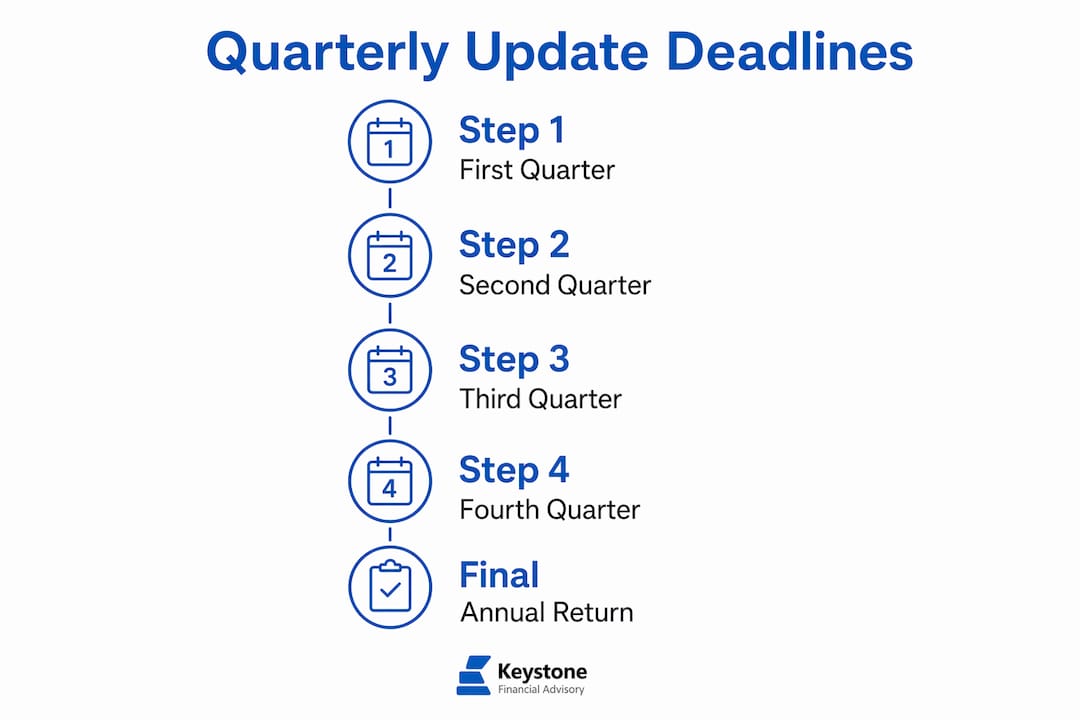
The four quarterly deadlines run from August 2026 through to May 2027, with the final tax return due in January 2028. HMRC’s official timeline sets these out clearly.
Quarterly update | Period covered | Earliest submission | Deadline |
First | First quarter of the 2026/27 tax year | Early July 2026 | Early August 2026 |
Second | 6 July 2026 to 5 October 2026 | 6 October 2026 | 7 November 2026 |
Third | 6 October 2026 to 5 January 2027 | 6 January 2027 | 7 February 2027 |
Fourth | 6 January 2027 to 5 April 2027 | 6 April 2027 | 7 May 2027 |
End-of-year return | Full 2026/27 tax year | After 5 April 2027 | 31 January 2028 |
A soft-landing period applies to late quarterly updates in 2026/27, meaning HMRC will not issue immediate penalties for late submissions during this first year. However, this leniency does not extend to the end-of-year tax return due 31 January 2028, and it does not mean you can skip updates altogether. The requirement to submit remains, and HMRC’s position is that the soft landing is a transitional concession, not a permanent exemption.
How do you sign up for Making Tax Digital for Income Tax?
Registration must be completed before your first quarterly update deadline. Leaving it until July 2026 is cutting it too fine, particularly if you encounter software compatibility issues or delays in HMRC processing.
Check your eligibility by reviewing your 2024/25 Self Assessment return. If combined gross income from self-employment and property exceeded £50,000, you are mandated from 6 April 2026
Choose compatible software from HMRC’s approved list. Options range from accounting platforms to dedicated MTD apps; select one that suits your record-keeping habits and business complexity
Register for MTD for Income Tax through HMRC’s online services, using your Government Gateway credentials
Authorise your software to connect to your HMRC account; this is done within the software itself and usually takes a few minutes
Verify your digital records are set up correctly within the software, with the right income sources and categories configured
Test the connection before the submission window opens to confirm data flows correctly between your records and HMRC
If you use an accountant or tax agent, they can register and manage submissions on your behalf, provided they are authorised through HMRC’s agent services. KeystoneFA handles this process for clients, covering registration, software setup, and ongoing submission management.
How to keep your records ready for each quarterly submission
The single biggest source of stress around quarterly updates is not the submission itself. It is arriving at quarter-end with three months of unreconciled transactions and no clear categorisation. Maintaining clean, categorised records monthly is what separates a smooth submission from a frantic one.
Practical record-keeping habits:
Reconcile your bank account within your MTD software at least once a month, not once a quarter
Categorise every transaction at the point of entry, using the MTD categories consistently (turnover, travel, professional fees, and so on)
Use bank feeds where your software supports them; automatic transaction imports reduce manual entry errors significantly
Keep digital copies of receipts linked to transactions, even though you do not submit them with quarterly updates
Review your software’s running tax estimate monthly to track your expected liability and plan cash flow accordingly
Consistent categorisation matters more than most people realise. If you categorise the same type of expense differently across quarters, your end-of-year return becomes harder to reconcile and your tax estimate less reliable.
Pro Tip: Use your software’s real-time tax liability estimate as a cash flow tool. If the figure is climbing faster than expected mid-year, you have time to review expenses, consider year-end tax planning, or set aside funds before January 2028. Quarterly updates give you that visibility; use it.
Key takeaways
The first MTD for Income Tax quarterly update is due 7 August 2026, and sole traders and landlords over the £50,000 threshold must submit via compatible software or face compliance risk, even during the soft-landing period.
Point | Details |
First submission deadline | The first quarterly update covers 6 April to 5 July 2026 and must be submitted by 7 August 2026. |
Who must comply | Sole traders and landlords whose combined gross income exceeded £50,000 in the 2024/25 tax year. |
Updates are not tax payments | Quarterly updates are income and expense summaries only; tax payments follow existing Self Assessment deadlines. |
Monthly record-keeping | Reconciling and categorising transactions monthly prevents errors and reduces quarter-end pressure. |
KeystoneFA support | KeystoneFA manages MTD registration, software setup, and quarterly submissions for self-employed clients and landlords. |
The soft-landing period in 2026/27 provides temporary relief from penalties for late submissions, but it does not remove the obligation to submit all quarterly updates and the end-of-year return. HMRC expects all mandated taxpayers to comply fully. That is a meaningful distinction. A taxpayer who submits all four updates late but does not submit them is in a different position from one who skips updates entirely and hopes the soft landing covers them.
The more important point is this: the habits you build in 2026/27 determine how manageable MTD feels in every subsequent year. Sole traders and landlords who treat the first year as a trial run and catch up at year-end will find the process genuinely difficult. Those who set up their software properly, connect bank feeds, and reconcile monthly will barely notice the quarterly deadlines. The administrative burden of MTD is almost entirely front-loaded in the setup phase. Once the system is running, the quarterly submission itself takes minutes, not hours.
The audit readiness principles that apply to business compliance more broadly apply here too: clean records, consistent categorisation, and no last-minute scrambles.
KeystoneFA: MTD compliance support for sole traders and landlords
For self-employed individuals and landlords navigating MTD for the first time, the compliance burden is real, particularly when you are running a business at the same time. KeystoneFA offers a practical alternative to managing it alone.
[

](www.keystonefa.co.uk)
KeystoneFA’s team works specifically with sole traders and landlords over the £50,000 threshold, handling everything from MTD registration and software selection to monthly bookkeeping and quarterly submission management. The approach combines modern digital tools with hands-on professional oversight, so your records stay accurate throughout the year rather than being corrected in a rush before each deadline. Unlike larger firms where you are passed between teams, KeystoneFA provides direct access to experienced professionals who understand the specifics of your income sources.
If you want your first quarterly update submitted correctly and on time, get in touch with KeystoneFA to discuss how they can support your MTD compliance from April 2026 onwards.
FAQ
What is the first deadline for MTD for Income Tax?
The first quarterly update must be submitted by 7 August 2026, covering income and expenses from 6 April 2026 to 5 July 2026. The submission window opens from 6 July 2026.
What is the income threshold for MTD in 2026?
The threshold for the 2026/27 tax year is £50,000 in combined gross income from self-employment and property, based on your 2024/25 tax return figures.
Do you pay tax quarterly with MTD?
No. Quarterly updates are summaries of income and expenses sent to HMRC; they do not trigger a tax payment. Tax payments continue to follow the existing Self Assessment deadlines, with the 2026/27 bill due by 31 January 2028.
How do you submit an MTD quarterly update?
You submit through your chosen MTD-compatible software, which connects directly to HMRC. Compile your categorised income and expense totals within the software, then send the summary digitally. No manual portal entry or paper filing is permitted.
What happens if you miss a quarterly update deadline?
A soft-landing period applies in 2026/27, meaning HMRC will not issue automatic penalties for late quarterly updates during this first year. However, the obligation to submit still stands, and the leniency does not extend to the end-of-year tax return due 31 January 2028.
Recommended