How much can I take out of my limited company tax efficiently?

TL;DR:
The most tax-efficient way for directors to withdraw money combines salary, dividends, and pension contributions carefully tailored to their profit and allowance thresholds.
Most directors make mistakes by ignoring profit rules, pension benefits, and proper documentation, risking penalties and lost savings.
The most tax-efficient way to withdraw money from your limited company combines salary, dividends, pension contributions, and allowable expenses. Each method carries different tax implications, and the right mix depends on your profit levels, personal income, and eligibility for reliefs like Employment Allowance. This guide covers the 2026/27 thresholds, the key rules for each withdrawal method, and the common mistakes that cost directors money every year.
What is the optimal salary to pay yourself for tax efficiency in 2026?
The tax-efficient salary limit for most directors sits at either £12,570 or around £6,500, depending on Employment Allowance eligibility. Getting this wrong costs you money from the very first payroll run.
Here is how the key thresholds work:
The Lower Earnings Limit (LEL) sits at £6,708. A salary at or above this level accrues state pension entitlement without triggering significant National Insurance costs.
Employer NI is charged at 15% on salaries above £5,000 in 2026/27. That makes salary planning critical for any director without Employment Allowance.
Employment Allowance (EA) is worth £10,500 and offsets employer National Insurance for eligible companies. Where EA applies, a salary of £12,570 is often optimal because it uses the full personal allowance and reduces Corporation Tax.
Where EA does not apply, a salary of around £6,500 avoids the employer NIC cost above the £5,000 threshold while still accruing state pension.
Salary is deductible against Corporation Tax at 19–25%, so paying yourself reduces the company’s taxable profit directly.
The rising employer NIC rate and reduced threshold make EA eligibility a decisive factor in salary planning for 2026 and beyond. Single-director companies with no other employees are typically ineligible for EA, which shifts the optimal salary downward.
Pro Tip: If you have a student loan or other income-related deductions, the £12,570 salary level may trigger repayments that outweigh the Corporation Tax saving. Tailor your salary to your full personal picture, not just the headline threshold.

How much can you withdraw as dividends and what are the tax implications?
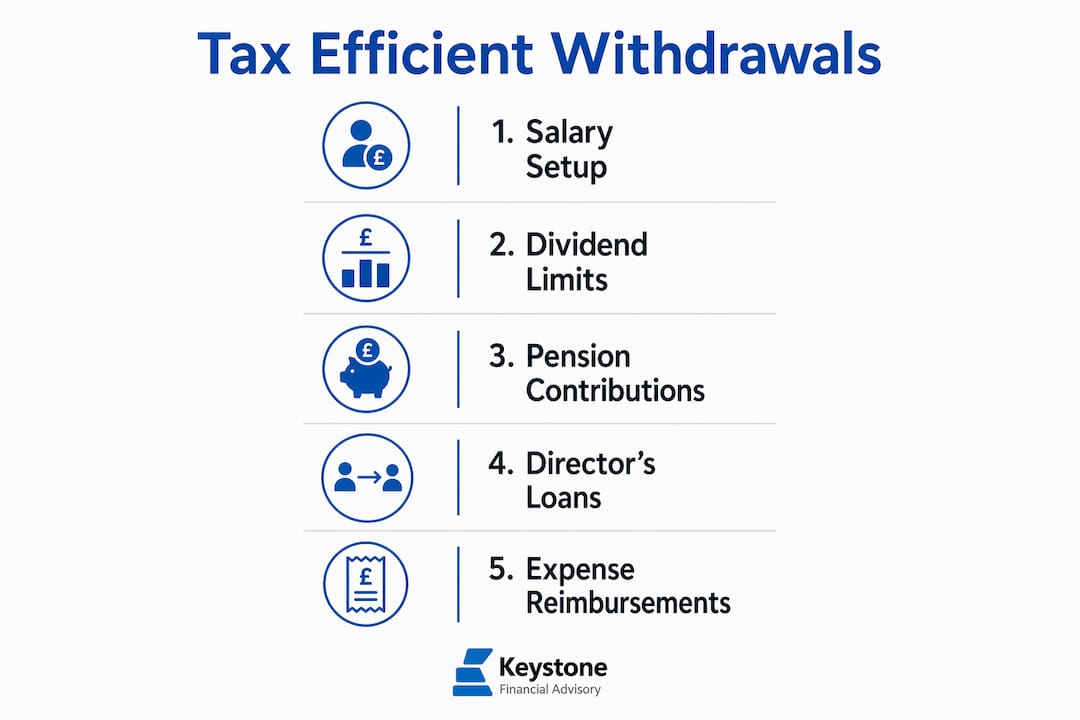
Dividends are the most common method of limited company drawdown, but they come with rules that many directors overlook. Dividends must come from distributable profits after Corporation Tax. Taking dividends without sufficient retained profits creates an illegal distribution that may require repayment and trigger HMRC penalties.
The key dividend tax rates for 2025/26 are:
£500 dividend allowance: tax-free for all shareholders.
Basic rate: 8.75% on dividends within the basic-rate band (up to £37,700 above the personal allowance).
Higher rate: 33.75% on dividends above the basic-rate band.
Additional rate: 39.35% on dividends above £125,140.
A director taking a £12,570 salary and filling the basic-rate band with dividends pays an effective rate of around 10.75% on those dividends. That is significantly lower than the 33.75% higher-rate dividend charge, which makes staying within the basic-rate band the core objective of most limited company salary structures.
Pro Tip: Always pass a formal board resolution and record dividend minutes before paying. Undocumented payments are treated as salary by HMRC, triggering National Insurance on the full amount.
Stat to know: Higher-rate dividends are taxed at 33.75% after the dividend allowance. Pension contributions, by contrast, attract no National Insurance and reduce Corporation Tax. For larger withdrawals, pensions outperform dividends at the higher rate.
What role do employer pension contributions play in tax-efficient fund withdrawal?
Employer pension contributions are the most underused tool in limited company tax planning. They provide triple tax relief: deductible from Corporation Tax, free from employer and employee National Insurance, and invested with tax-free growth inside the pension.
The practical benefits are:
Contributions up to the £60,000 annual allowance are tax-free, subject to earnings.
No employer or employee NIC applies, unlike salary.
Pension growth is tax-free, compounding the long-term benefit beyond immediate cash access.
Contributions reduce adjusted net income, which can preserve your personal allowance and avoid the 60% marginal rate that applies between £100,000 and £125,140.
For a higher-rate taxpayer, the choice between a dividend and a pension contribution is straightforward. A dividend above the basic-rate band costs 33.75% in personal tax. A pension contribution costs nothing in NIC and saves up to 25% in Corporation Tax. The pension wins on every measure except immediate liquidity.
Pro Tip: Use pension contributions to bring your adjusted net income below £100,000 before the tax year ends. Every £2 you contribute above that threshold restores £1 of personal allowance, effectively saving tax at 60%.
How can director’s loans and expense reimbursements be used tax-efficiently?
Director’s loans and business expense reimbursements give directors flexible access to company funds outside the salary and dividend structure. Both carry specific rules that must be followed precisely.
Method | Tax treatment | Key risk |
Director’s loan (repaid within 9 months) | No personal tax if repaid on time | Must be formally recorded in loan account |
Director’s loan (overdrawn after 9 months) | Section 455 tax at 33.75% applies | Refundable only after full repayment |
Business expense reimbursement | Tax-free if wholly for business | Requires clear documentation |
Mileage allowance (first 10,000 miles) | 55p per mile, tax-free | Must be business travel only |
Reimbursement of wholly business-related expenses is a frequently underutilised, tax-free way to extract cash from your company. Expenses qualify only if they are “wholly, exclusively and necessarily” for business purposes and are properly documented.
Many directors underutilise legitimate business expenses due to poor record-keeping. A well-maintained expenses log, supported by receipts and a clear business purpose, protects you in any HMRC review.
Pro Tip: Keep a dedicated director’s loan account in your bookkeeping software and reconcile it monthly. Untracked withdrawals are the most common trigger for unexpected Section 455 charges. For more on managing this correctly, see KeystoneFA’s guide to statutory accounts preparation.
How do profit levels and personal income affect your maximum tax-free withdrawal?
The interaction between company profits and your total personal income determines how much you can withdraw before hitting costly tax thresholds. Getting this wrong can push you into a 60% effective marginal rate without realising it.
The critical thresholds to plan around are:
£12,570: Personal allowance. Income below this is tax-free.
£50,270: Top of the basic-rate band. Dividends and salary above this are taxed at higher rates.
£100,000: Adjusted net income above this triggers gradual withdrawal of the personal allowance.
£125,140: Personal allowance fully withdrawn. Every £2 over £100,000 removes £1 of personal allowance, creating a 60% effective rate on income in that range.
Corporation Tax rates also affect how much profit remains for withdrawal. The small profits rate is 19% on profits up to £50,000. The main rate is 25% on profits above £250,000. Marginal relief applies between those figures.
Spousal shareholdings offer a powerful planning tool. Using spousal shareholdings, couples can double their tax-free allowances and dividend bands, potentially withdrawing large sums at under 12% effective tax rate. Two personal allowances plus two dividend allowances plus two basic-rate bands create significant headroom.
Pro Tip: Time dividend declarations carefully within each tax year. Unused personal allowances and dividend bands do not carry forward. A dividend declared in April rather than March can shift income into a new tax year and preserve allowances.
Key takeaways
The most tax-efficient withdrawal strategy for a UK limited company combines a salary set at the right NIC threshold, dividends within the basic-rate band, and employer pension contributions to manage adjusted net income.
Point | Details |
Set salary by EA eligibility | Pay £12,570 if Employment Allowance applies; around £6,500 if it does not. |
Keep dividends in the basic-rate band | Dividends up to £37,700 above the personal allowance are taxed at 8.75%, not 33.75%. |
Use employer pension contributions | Pension contributions save Corporation Tax and carry no NIC, outperforming higher-rate dividends. |
Document everything | Illegal dividends and undocumented loans trigger HMRC penalties and repayment demands. |
Plan around the £100,000 threshold | Adjusted net income above £100,000 creates a 60% effective marginal rate through personal allowance withdrawal. |
Why most directors leave money on the table
Most directors I work with make the same three mistakes. They take dividends without checking distributable profits, they ignore employer pension contributions entirely, and they treat the director’s loan account as a personal current account with no records.
The dividend mistake is the most dangerous. Treating company funds as personal money without following legal and accounting rules leads to costly tax penalties and compliance issues. An illegal dividend is not just a paperwork problem. It is a debt owed back to the company, and HMRC will find it.
The pension oversight is the most expensive. A director withdrawing £20,000 above the basic-rate band as a dividend pays 33.75% on that sum. The same £20,000 paid as an employer pension contribution saves Corporation Tax and costs nothing in NIC. The difference over a decade is significant.
The loan account problem is the most avoidable. Section 455 tax at 33.75% on an overdrawn loan is refundable, but only after repayment. In the meantime, it is a cash flow hit that most directors did not see coming.
The directors who extract funds most efficiently treat it as part of their broader financial plan, not an afterthought at year end. They review their salary, dividend, and pension mix before the tax year closes, not after.
— Shoaib
How KeystoneFA helps directors withdraw funds tax efficiently
Tax-efficient fund extraction is not a one-size-fits-all calculation. It depends on your profit level, personal income, Employment Allowance eligibility, pension position, and whether your spouse holds shares.
[
KeystoneFA works with limited company directors to build a withdrawal strategy that fits their specific numbers. From Corporation Tax optimisation to salary and dividend structuring, the team provides personalised advice grounded in current HMRC rules. Directors who work with KeystoneFA avoid the common pitfalls that generate unexpected tax bills and compliance issues. You can book a consultation online to get bespoke advice on your withdrawal strategy before the next tax year begins.
FAQ
What is the most tax-efficient salary for a limited company director in 2026?
A salary of £12,570 is optimal where Employment Allowance applies. Without EA eligibility, a salary of around £6,500 avoids employer NIC above the £5,000 threshold while still accruing state pension.
Can I take dividends if my company has not made a profit?
No. Dividends must be paid from distributable profits after Corporation Tax. Paying dividends without sufficient retained profits creates an illegal distribution that may require repayment and trigger HMRC penalties.
How much can I contribute to a pension from my limited company?
Employer pension contributions up to £60,000 per year are tax-free, subject to earnings. These contributions are deductible for Corporation Tax and carry no employer or employee National Insurance.
What happens if I do not repay a director’s loan within 9 months?
Section 455 tax at 33.75% applies to any director’s loan overdrawn and unpaid 9 months after the accounting period ends. The tax is refundable once the loan is repaid, but it creates an immediate cash liability.
Does my spouse’s shareholding affect how much I can withdraw tax-efficiently?
Yes. Spousal shareholdings allow couples to use two personal allowances and two dividend bands, significantly increasing the amount that can be withdrawn at lower effective tax rates.
Recommended