£6M Cap and £120M Asset Limit: 2026 EMI Options Scheme For Founders

An EMI options scheme lets UK companies grant employees share options with income tax and National Insurance relief, provided the company and the option meet strict statutory tests. The 2026 reforms widen who qualifies, raising the gross assets limit, employee headcount, and company‑wide option cap, but the tax advantages still hinge on correct valuation and timely HMRC notification. Get either wrong and a “tax‑free” option turns into an income tax bill.
TL;DR:
Meeting strict deadlines for HMRC registration, valuation agreement, and grant notifications is crucial to preserve EMI tax advantages and avoid unexpected income tax liabilities.
Setting the exercise price at or above market value and obtaining a formal valuation agreement ensures gains are taxed as capital rather than employment income.
Changes in company circumstances, such as a change of control or loss of independence, can disqualify options and convert future gains into taxable income if not exercised within 90 days.
The recent rise in thresholds allows larger companies and those with more employees to qualify again for EMI schemes, especially if they previously lost eligibility.
Proper planning around shareholding rights, vesting, and exercise timing can influence the tax treatment and exit strategy benefits for employees.
Table of Contents
What is an EMI options scheme and how does it work?
Enterprise Management Incentives (EMI) are a UK tax‑advantaged share option scheme created under Schedule 5 of ITEPA 2003. A qualifying EMI option gives an employee the right, but not the obligation, to buy shares at a fixed price later, usually on exit or after a vesting period, without triggering income tax or National Insurance at grant.
The mechanics are fairly simple once you strip away the legal wrapping. A company sets an exercise price (ideally matching current market value), attaches vesting conditions, and defines an exercise window. Most founders use one of these structures:
Exit‑only vesting: options only become exercisable on a sale or listing, keeping cap tables clean until there’s an actual liquidity event.
Time‑based vesting: options vest in tranches (often over three to four years), rewarding retention regardless of exit timing.
Performance vesting: exercise depends on hitting revenue, profit, or other agreed milestones.
Shares are typically issued fresh rather than transferred from existing holders, which avoids diluting the cap table before it needs to happen. The scheme itself has to be registered with HMRC before any grant is notified, a step many founders leave too late.
Who qualifies for EMI, and what changed in April 2026?
Eligibility works on two levels: the company has to qualify, and each employee has to qualify. Get the company test wrong and every option granted under the scheme loses its tax advantages, not just one employee’s.
Company‑level tests require:
A qualifying trade, carried out mostly in the UK, that isn’t on HMRC’s excluded activities list (property development, banking, and legal services, among others).
Independence: the company can’t be a subsidiary of, or under the control of, another company.
A UK permanent establishment.
Numeric limits have moved substantially. From 6 April 2026, the gross assets limit rises to £120 million and the employee headcount threshold increases to fewer than 500 full‑time equivalents. The company‑wide cap on unexercised EMI options rises from £3 million to £6 million, and the maximum exercise period extends from 10 to 15 years. The £250,000 per‑employee limit on unexercised options over any three‑year period stays in place.
Employee‑level tests are simpler but easy to overlook:
Working time: the employee must work at least 25 hours a week, or if fewer, at least 75% of their total working time, for the company.
The 30% rule: no employee (with associates) can hold a “material interest” of 30% or more of the ordinary share capital.
Scale‑ups that outgrew EMI under the old thresholds should revisit eligibility now. The larger employee headcount and asset limits mean a business that lost access two years ago may qualify again.
What tax do you pay on EMI options at grant, exercise, and sale?
No income tax or National Insurance applies at grant for a qualifying EMI option. That’s the entire point of the scheme, and it’s where most explanations stop, which is unhelpful, because the real tax exposure sits at exercise and sale.
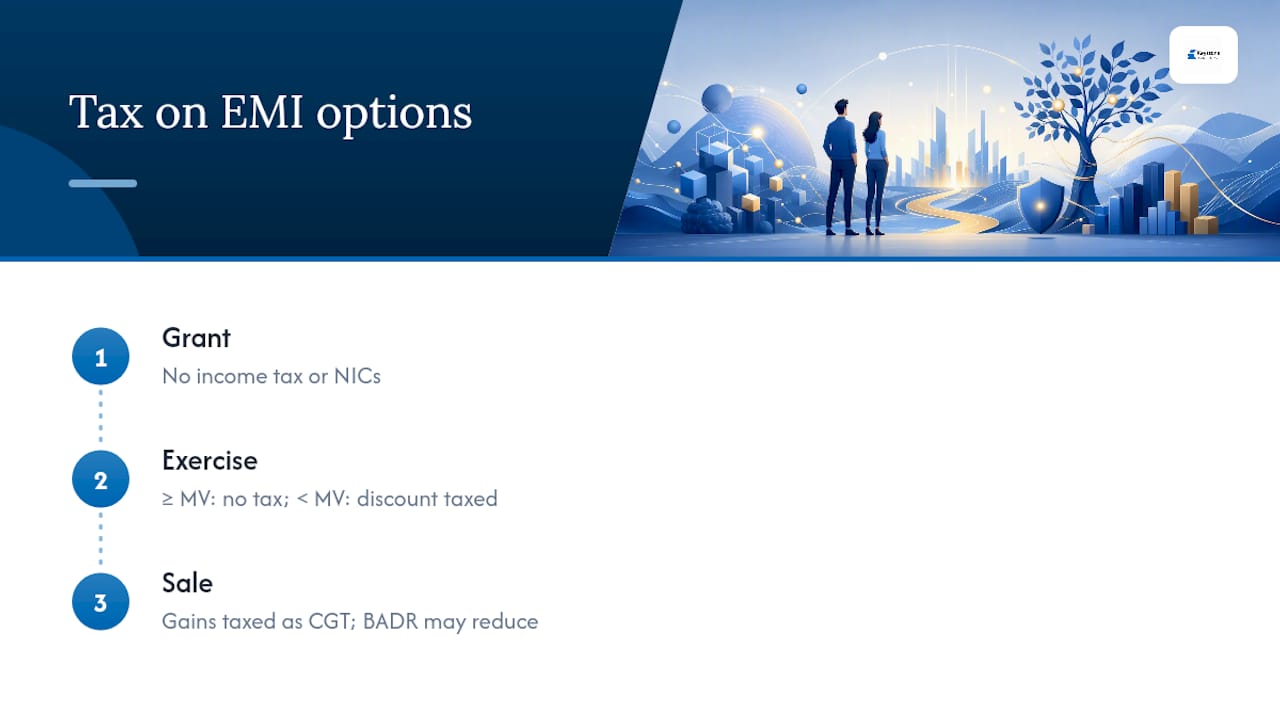
At exercise, the outcome depends entirely on the exercise price set at grant. If the exercise price was at or above the market value agreed with HMRC at that point, there’s usually no income tax or NICs due when the option is exercised, even if the shares have grown enormously in value. This is the scheme’s headline benefit.
Pro Tip: If the exercise price is set below market value at grant, the discount itself is treated as employment income and taxed through PAYE at exercise. This catches out founders who price options cheaply to make them more attractive, not realising they’ve created a tax charge instead of removing one, according to Pinsent Masons’ analysis of EMI mechanics.
At sale, gains above the exercise price are usually subject to Capital Gains Tax rather than income tax, which is the second major benefit. Where the employee has held the option (or shares) for at least two years and meets the other qualifying conditions, Business Asset Disposal Relief can reduce the CGT rate further on qualifying gains.
The single biggest risk factor across all three stages is valuation uncertainty. Agreeing market value with HMRC in advance, rather than guessing, removes the ambiguity that turns a well‑designed scheme into a dispute.
How do you register and administer an EMI scheme with HMRC?
Administration is where good EMI schemes fall apart in practice. The legal design might be sound, but a missed deadline or a botched valuation submission can unwind the tax treatment for every option‑holder.
Register the scheme. Before notifying any grant, register the EMI scheme through HMRC’s Employment Related Securities (ERS) service and obtain a scheme reference number.
Agree valuation. Submit form VAL231 to request an HMRC valuation, or agree an advance valuation agreement, before setting the exercise price. This fixes market value for grant purposes and removes most of the discount‑pricing risk described above.
Notify each grant on time. For options granted on or after 6 April 2024, notification must reach HMRC by 6 July following the end of the tax year of grant. Options granted before that date carried a stricter 92‑day notification window.
File the annual ERS return. Every year the scheme is live, submit a return, even if no options were granted that year, using HMRC’s EMI40 template and guidance notes for adjusted, replaced, or lapsed options.
For companies granting to more than 30 employees, HMRC expects a downloadable template submission rather than the online form used for smaller batches. Trustee‑held grants and bulk grants across multiple entities both need separate scheme registrations if the entities aren’t consolidated under one PAYE reference.
What are the disqualifying events that can void EMI tax benefits?
A disqualifying event doesn’t retrospectively cancel an option outright, but it starts a 90‑day clock. Exercise within that window and the tax advantages built up to that point are usually preserved; miss it, and any gain accrued after the disqualifying event is treated as income rather than capital.
Common triggers include:
Change of control: the company is acquired, or a new parent company takes control, without the option terms anticipating it.
Loss of independence: the company becomes a subsidiary of another business, failing the independence test retroactively.
Ceasing the qualifying trade: the business pivots into an excluded activity, or simply stops trading.
Working‑time failures: an employee drops below the required weekly or proportional working time threshold, often after moving to part‑time or taking extended leave.
Conflicting option grants: granting an employee a second option that breaches the individual cap on option holdings.
Beyond these statutory triggers, the most frequent pitfalls are self‑inflicted: notifying a grant late, drafting vesting language ambiguously enough that HMRC or a future buyer disputes when the option actually “vested,” or allowing options to become transferable when the scheme rules require them to lapse on transfer. None of these are exotic problems. They’re administrative slips that a proper checklist catches before they happen.
A practical checklist for designing and operating an EMI scheme
Founders who get EMI right tend to follow the same sequence, roughly in this order:
Confirm eligibility for both the company and the intended option‑holders against the current thresholds.
Design the plan: decide on exit‑only, time‑based, or performance vesting, and set the pool size relative to the £6 million company‑wide cap.
Agree valuation with HMRC via VAL231 before fixing the exercise price.
Get board approval for the scheme rules and the specific grants.
Open the grant window and issue option agreements to each employee.
Notify HMRC through the ERS service within the applicable deadline.
Build payroll and exercise processes so exercise‑time tax (where discounted pricing applies) flows through PAYE correctly.
Drafting priorities worth spending real time on: the exercise window length (especially now it can stretch to 15 years), leaver provisions distinguishing good leavers from bad leavers, and clear performance metrics if vesting isn’t purely time‑based. Communicate the rules to option‑holders in plain language, not just the legal agreement, because most disputes stem from misunderstood vesting terms rather than bad faith.
Bring in a tax adviser and solicitor before the grant window opens, not after. A payroll provider should be looped in early too, since discounted‑price exercises and disqualifying‑event exercises both need correct PAYE treatment the moment they happen.
What does an EMI scheme look like in practice?
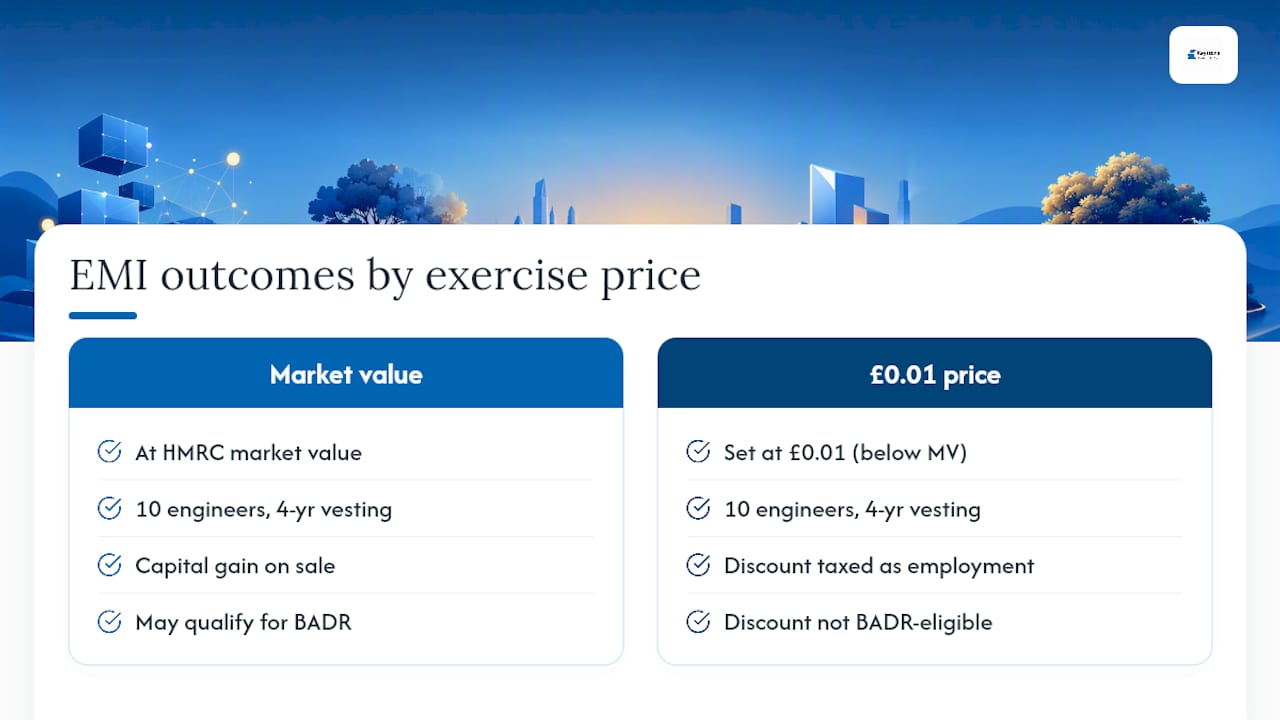
Take a software company with 40 employees and gross assets of £8 million. It comfortably clears every 2026 eligibility test, and grants EMI options to its first ten engineering hires with a four‑year time‑based vesting schedule and an exercise price set at the HMRC‑agreed market value on the grant date.
Three years later, the company is acquired. Because the exercise price matched market value at grant, the engineers exercise their options and sell into the acquisition on the same day, with the entire gain taxed as a capital gain rather than income. Several qualify for Business Asset Disposal Relief because they’ve held their options for over two years and meet the other conditions, cutting their effective tax rate on the gain substantially.
Compare that with a company that priced its options at a nominal £0.01 per share to make them “attractive,” well below the agreed market value at grant. When those options are exercised, the discount between £0.01 and the true market value at grant is taxed as employment income through PAYE, not treated as a capital gain. The company also has to run this through payroll at the point of exercise, an administrative burden it hadn’t planned for.
The difference between these two outcomes isn’t the scheme design. It’s a single number: whether the exercise price was set at or below market value. It illustrates why an HMRC valuation agreement isn’t a bureaucratic extra step, it’s the mechanism that decides which of these two outcomes an employee gets.
How do employees exercise EMI options and report the tax?
Exercise itself is usually a short administrative process: the employee submits a notice of exercise to the company, pays the exercise price (often via a cashless exercise funded from sale proceeds on exit), and the company issues or transfers the shares.
Tax reporting depends on how the option was priced. If the exercise price matched market value at grant, there’s typically nothing extra to report through PAYE at that point, and any eventual gain on sale is reported through the employee’s Self Assessment return under Capital Gains Tax, using the shares’ base cost (the exercise price paid) against the eventual sale proceeds.
If the option carried a discount against market value at grant, the company must run the discount through PAYE at exercise, deducting income tax and National Insurance as if it were salary. The employee then still reports any further gain between exercise and eventual sale as a capital gain on their Self Assessment return.
Employees who benefit from Business Asset Disposal Relief need to claim it explicitly on their tax return, it isn’t applied automatically. Given the two‑year holding requirement runs from the option grant date in most EMI cases, not the exercise date, getting the timeline recorded correctly from day one avoids scrambling for evidence years later.
What happens after you exercise: shareholding and exit planning
Exercising an EMI option converts a paper right into an actual shareholding, and that changes the employee’s position in ways worth planning for before it happens, not after.
Shareholders typically get information rights and, depending on the class of shares issued, voting rights alongside existing investors and founders. Company articles or a separate shareholders’ agreement usually govern how minority shareholdings behave on a future sale, including drag‑along provisions that force smaller shareholders to sell alongside a majority decision, and tag‑along rights that let them join a sale on the same terms.
Founders should decide before the first exercise whether option‑derived shares carry full voting rights or a more limited class, and document it clearly in the option agreement rather than leaving it to be negotiated at exit. Employees exercising close to an anticipated sale should also think about the practical mechanics: many EMI exercises happen on the same day as completion, funded directly from sale proceeds, which avoids the employee having to find cash upfront to buy shares they’re about to sell anyway.
Keystone Financial Advisory’s view on getting EMI right
Most EMI problems we see aren’t legal drafting failures, they’re timing and valuation failures. A founder grants options, gets busy, and the HMRC notification slips past the deadline, or the exercise price never gets formally agreed with HMRC and sits as a guess.
KeystoneFA works with founders and finance teams on the practical side of EMI: eligibility reviews against the current thresholds, liaising with HMRC on valuation, and keeping the ERS notification and annual return calendar on track alongside payroll integration. If your business is weighing up whether the 2026 changes reopen EMI as an option, that’s worth checking properly rather than assuming.
— Shoaib
Get help implementing an EMI scheme correctly
Founders comparing EMI against other retention tools usually reach the same conclusion: the tax advantages are real, but the administrative margin for error is thin, and one missed HMRC notification undoes a scheme designed to reward the people who built the business. We work specifically with UK founders and growing businesses, combining digital bookkeeping tools with hands‑on tax planning, so eligibility checks, valuation liaison, and ERS filings sit alongside the rest of your compliance calendar rather than as a separate fire drill each year.
[

](www.keystonefa.co.uk)
If you’re weighing up an EMI scheme against the new 2026 thresholds, or you’ve already granted options and need the annual return handled properly, KeystoneFA’s team can review your eligibility and valuation position before your next grant window opens. For related year‑end planning, KeystoneFA’s guide on tax planning actions before year‑end covers the deadlines that often coincide with EMI notification windows. Get in touch to book a review of where your business stands.
This article is general information, not a substitute for advice from a qualified financial advisor. Consult a qualified financial professional about your own circumstances before acting on anything here.
Sources
FAQ
What is the EMI scheme in the UK?
Enterprise Management Incentives are a UK tax‑advantaged share option scheme that lets qualifying companies grant employees options to buy shares, usually without income tax or National Insurance due at grant or exercise, provided the option and company meet the statutory tests under Schedule 5 ITEPA 2003.
What are the disadvantages of an EMI scheme?
The main disadvantages are administrative: strict notification deadlines, the risk of a discounted exercise price triggering an unexpected income tax charge, and the fact that disqualifying events like a change of control can convert future gains from capital to income if options aren’t exercised within 90 days.
What are the disqualifying events for EMI options?
Common disqualifying events include a change of control, the company losing its independence, ceasing to carry on a qualifying trade, an employee’s working time falling below the required threshold, or an employee being granted options that breach the £250,000 individual cap.
Recommended