UK Directors: Stop Misdating Trading Start for Corporation Tax

Most UK limited companies must register for Corporation Tax within the period HMRC requires after becoming active. There’s no separate application fee and no waiting for HMRC to chase you. The immediate next step is simple: check whether your Unique Taxpayer Reference (UTR) has arrived by post, then log in to your HMRC business tax account to add Corporation Tax and start the enrolment.
TL;DR:
Companies must register for Corporation Tax within three months of becoming active, defined by the first sale, invoice, or business activity, not incorporation date.
Registration relies on proper collection of documents like the company’s UTR, CRN, trading start date, and intended accounting period, with delays caused by lost mail or incorrect trading dates.
Setting up an organisation Government Gateway account and entering the correct trading start date are crucial; errors here can misalign your entire tax schedule.
Missing the registration deadline triggers penalties that increase the longer you delay, so immediate registration is critical even if the deadline has passed.
Handling registration properly from the start, ideally with professional help, prevents common mistakes that lead to late filings, incorrect accounting periods, and costly penalties.
Table of Contents
When does the three-month corporation tax registration deadline start?
The clock starts from the beginning of your accounting period, or the date your company becomes “active”, whichever HMRC deems the trigger. HMRC’s guidance on trading and non-trading status sets the registration window at three months from that start date, not from the date you incorporated at Companies House.
That distinction catches out a lot of new directors. Incorporation and trading are two separate events, and HMRC only cares about the second one for this deadline.
You count as “active” the moment any of the following happens:
You make your first sale or issue your first invoice
You start advertising or marketing your services
You hire staff or take on a contractor
You rent premises or buy stock for the business
You receive any form of business income
A company incorporated in January that doesn’t trade until June has until September to register, not April. Get that trading start date wrong, though, and you risk misaligning your entire accounting period, which creates headaches for every filing that follows.
Who actually has to register for corporation tax?
UK limited companies must register, full stop, once they start trading. So must overseas companies operating through a UK branch or permanent establishment, and unincorporated associations (clubs, societies, some community groups) once they become active in the same sense.
There’s a genuine exception worth noting:
Dormant companies with no significant accounting transactions don’t need to register immediately
Group subsidiaries that haven’t started operating yet follow the same “active” test as standalone companies
Non-UK incorporated but UK-resident companies follow a separate registration route, covered further down
If your company is sitting dormant while you plan a launch, you can notify HMRC of dormancy rather than registering for Corporation Tax straight away.
What documents and details do you need before registering?
Gather everything first and the actual registration takes minutes rather than days. HMRC and Companies House both feed into the process, so you need details from each.
Your company’s 10-digit UTR — this typically lands by post within around 15 working days of incorporation, often alongside a CT41G form
Your Company Registration Number (CRN) from Companies House
The registered office address currently on file
Your SIC code (Standard Industrial Classification), which describes what the company does
Your accounting reference date (ARD), set automatically by Companies House unless you’ve changed it
The exact trading start date
Your intended accounting period end date
Once you enrol, HMRC posts an activation code separately, so allow some additional time before you can use the online service in full.
Pro Tip: Don’t throw away post addressed to the company in its first few weeks. The UTR letter and the activation code both arrive by standard mail to the registered office, and they look unremarkable enough to end up in a drawer unopened.
How do you register for corporation tax step by step?
Registering online is the route almost every company should take, and it starts with getting the account type right.
Set up an organisation Government Gateway account, not a personal one. Directors sometimes register using their personal Gateway login from a previous PAYE or Self Assessment account, which creates confusion later when an accountant needs access.
Enrol for Corporation Tax inside your HMRC business tax account. You’ll be asked for the company’s UTR, the trading start date, and your intended accounting period end date.
Wait for the activation code, which HMRC posts to your registered office after enrolment.
Enter the activation code online to unlock full access to the Corporation Tax service, including the ability to file returns and view your account.
If you don’t yet have a UTR, don’t try to skip ahead. Registering with Companies House usually triggers HMRC to issue one automatically, but if it hasn’t arrived and your three-month window is closing, contact HMRC directly rather than guessing at the number.
A few situations call for a different route:
No online access or unusual company structure: you can register by post to HMRC’s Corporation Tax Services team, though it takes considerably longer.
Want someone else to manage HMRC correspondence and registration on your behalf: a formal power of attorney arrangement for tax matters lets a nominated agent deal directly with HMRC.
Registering via an accountant or agent: they can act on your behalf once authorised, which many directors find removes the guesswork entirely.
What happens after you register for corporation tax?
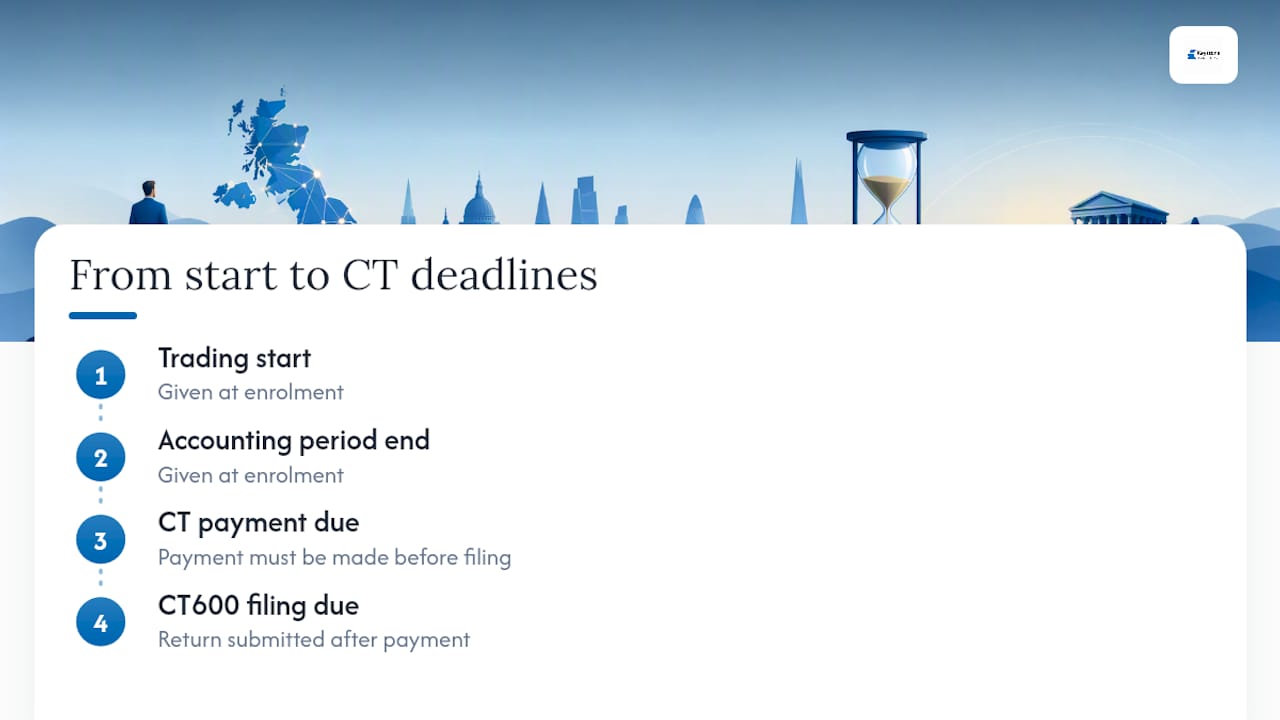
Registration is the start of an ongoing relationship with HMRC, not a one-off task. Two deadlines now govern your company’s year, and Register for Corporation Tax on GOV.UK confirms both flow directly from the trading start date and accounting period end date you gave at enrolment.
Notice that the payment deadline lands before the filing deadline. That surprises a lot of first-time directors, who assume you file first and pay afterwards. In practice, you’re expected to calculate and pay what’s owed months before the full CT600 return is technically due, then submit the paperwork afterwards.
A return is normally required even when there’s nothing to pay, and Corporation Tax obligations sit alongside separate PAYE, VAT, and Companies House filing duties if they apply to your business.
Do dormant companies and associations need to register?
HMRC treats “dormant” narrowly. According to HMRC’s guidance on trading and non-trading status, a company only qualifies as dormant when it has had no significant accounting transactions, not simply low activity. Paying a small annual fee to Companies House or holding a bank account open can be enough to tip a company into “active” territory in HMRC’s eyes.
If you’re genuinely dormant, notify HMRC formally rather than staying silent
Unincorporated associations (clubs, societies, some voluntary groups) follow a separate registration process once they start generating taxable income
Non-UK incorporated companies resident in the UK for tax purposes register through a distinct HMRC route rather than the standard company registration path
In a takeover or group restructuring, each entity’s “active” status is assessed separately. Don’t assume a dormant subsidiary stays dormant once it starts trading under new ownership
What penalties apply if you miss the registration deadline?
Missing the three-month window triggers what HMRC calls a “failure to notify” penalty, calculated with reference to how late you were and how much tax was ultimately due. It isn’t usually catastrophic for a business with no tax liability yet, but it compounds the longer you leave it.
Register now, even if you’re already past the deadline. Waiting makes it worse, not better.
Note your actual trading start date accurately when you do register. Understating it to look less late is not a fix.
Contact HMRC directly if your situation involves an unusual accounting period or a company that’s changed structure recently.
Speak to an accountant if you’re dealing with group companies, a delayed UTR, or multiple missed deadlines at once.
Pro Tip: If HMRC hasn’t contacted you about a missed registration, don’t take the silence as permission. Automated systems flag “failure to notify” cases later than you’d expect, often once a return is overdue rather than at the three-month mark itself.
What Keystone sees go wrong with corporation tax registration
Working with founders through their first year, a few patterns repeat constantly. Directors register using a personal Government Gateway account instead of an organisation one, then can’t hand access to an accountant without a separate mess to untangle. Others let post pile up at a registered office that’s actually a residential address or a formation agent’s mailbox, missing the UTR letter entirely.
Before registering, confirm your registered office is somewhere you actually check, track the UTR letter’s expected arrival date, and resist the urge to reuse an old personal login. Professional accountants typically step in either to handle the enrolment directly or to fix a first-year accounting period that’s drifted out of sync with actual trading dates, which is a far more common problem than most directors expect.
Why the standard advice on registration timing misses the point
Most guidance on this topic treats the three-month rule as the whole story: register within the window, tick the box, move on. That’s technically correct and practically incomplete. The real risk isn’t missing the deadline by a few weeks. It’s getting the trading start date wrong at the point of registration, which then misaligns your accounting period, your first CT600, and every subsequent filing for years.
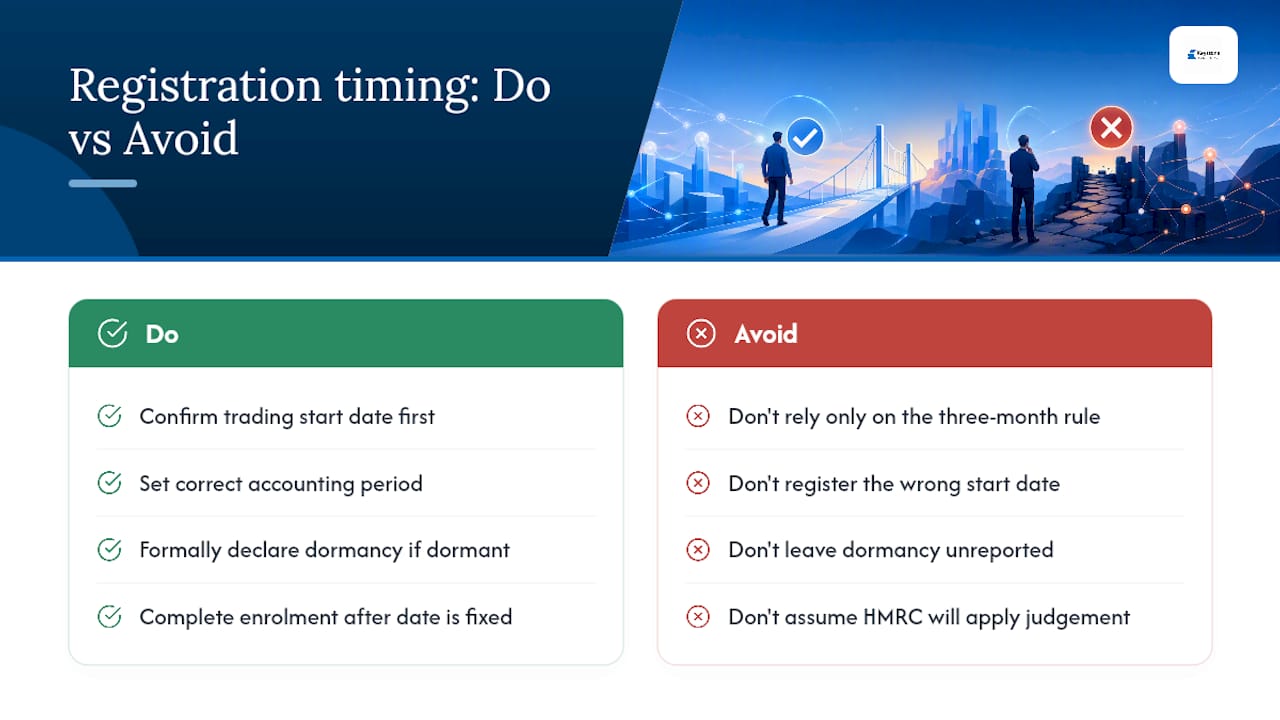
HMRC’s own dormancy test compounds this. Plenty of directors assume dormant means “not much happening” rather than “no significant transactions at all”, and end up registered as active when they didn’t need to be, or worse, treated as active by HMRC’s automated systems without realising it.
If there’s one priority above the rest, it’s this: settle the trading start date properly before you touch the enrolment form, and if you’re dormant, say so formally rather than staying quiet and hoping HMRC agrees. Silence isn’t a strategy with a tax authority that runs on automated triggers rather than judgement calls.
— Shoaib
Get help registering for corporation tax and staying compliant
Handling registration yourself is entirely possible, but the margin for error sits exactly where it hurts most: the trading start date and accounting period end date that determine every deadline afterwards. Specialist accountants can set these up correctly from day one, so your first CT600 and payment deadline line up with reality rather than a guess made under time pressure.
[

](www.keystonefa.co.uk)
Some firms handle company setup, HMRC business tax account enrolment, CT600 preparation, and ongoing tax planning as one connected service rather than a series of disconnected tasks. That matters most in year one, when a wrong trading date or a missed activation code can cascade into late filings you didn’t see coming. Beyond registration, the team also works on reducing your Corporation Tax bill legally once your first period is behind you.
If you’d rather have someone confirm your registration is correct, or handle it from scratch, book a consultation with KeystoneFA and get your Corporation Tax obligations set up properly the first time.
FAQ
Does my limited company have to pay Corporation Tax?
Yes, if it’s trading and generating taxable profits. Even a company with modest income owes Corporation Tax once its accounting period ends, and a return is required whether or not tax is actually due.
Do all UK companies have to register with Companies House?
Yes, every UK limited company must register with Companies House to legally exist, and this is separate from, but connected to, registering for Corporation Tax with HMRC afterwards.
What information does HMRC need to register a company for Corporation Tax?
You need the company’s UTR, Companies House registration number, registered office address, trading start date, and intended accounting period end date, as GOV.UK’s registration guidance confirms.
How long does it take to get a UTR after incorporation?
A UTR typically arrives by post within around 15 working days of incorporation, sent automatically once Companies House notifies HMRC of the new company.
What happens if I register for Corporation Tax late?
You risk a “failure to notify” penalty from HMRC, with the size depending on how late the registration was and how much tax was ultimately owed. Registering as soon as you realise, rather than waiting, limits the damage.
Recommended