Car and food claims for self-employed UK dentists

TL;DR:
HMRC allows car, travel, and food claims for self-employed dentists only when expenses are wholly and exclusively for trade purposes, with commuting and private meals disallowed. Dentists must keep detailed, contemporaneous records to support claims, especially when travel involves multiple sites or variable locations. The choice between mileage and actual costs impacts future claims, and proper documentation is essential for HMRC compliance.
HMRC permits car, travel, and food claims for self-employed dentists only when the expense is wholly and exclusively for the trade. Ordinary commuting is disallowed. Subsistence is deductible only in narrow circumstances. Dentists face particular scrutiny because of high earnings and mixed income streams, so getting this right from the outset matters more than in most trades.
The three categories dentists most commonly ask about:
Business journeys between sites — travel between two practice locations or to a patient’s home can be allowable; travel from home to your regular practice is not.
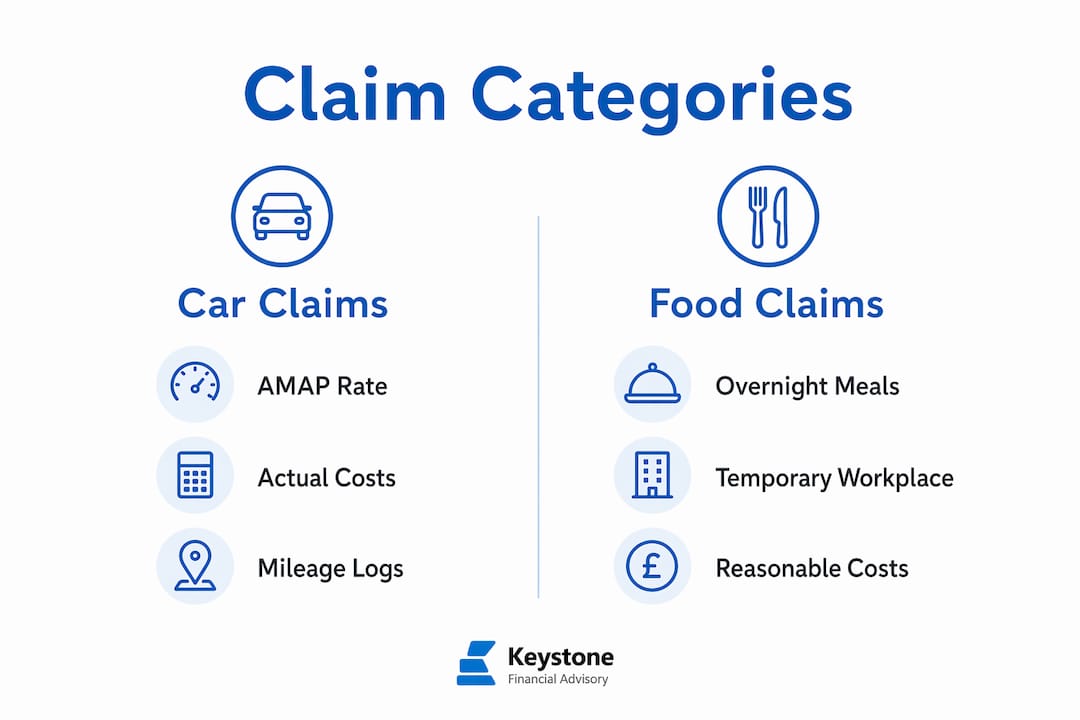
Mileage vs actual vehicle costs — you can use HMRC’s Approved Mileage Allowance Payments (AMAP) flat rates or claim actual costs, but you must pick one method per vehicle and stick with it.
Subsistence and food — allowable only on overnight business trips or when travelling to a genuine temporary workplace; everyday meals are a private expense.
The governing rule: HMRC’s ‘wholly and exclusively’ test means any personal element in a journey or meal can make the entire cost disallowable. Dentists with multiple practice contracts and high turnover are a known audit focus. Contemporaneous records are not optional — they are your only defence.
KeystoneFA works with self-employed dentists on exactly these questions: identifying which journeys qualify, choosing the right vehicle-cost method, and building the record-keeping habits that hold up under scrutiny.
Table of Contents
What does ‘wholly and exclusively’ actually mean for dentists?
The statutory test comes from S34(1)(a) of the Income Tax (Trading and Other Income) Act 2005: an expense is deductible only if it is incurred wholly and exclusively for the purposes of the trade. HMRC’s internal manual at BIM37007 makes clear that any duality of purpose — even a minor personal element — is fatal to the deduction.
HMRC’s position: “The sole question is whether the expenditure in question was ‘exclusively’ laid out for business purposes.” Duality of purpose is not a grey area — it disallows the whole cost unless the business element can be cleanly separated.
Four definitions dentists misapply most often:
Ordinary commuting — travel between home and your regular, predictable place of work. For most dentists, that means the practice where you hold regular sessions. HMRC’s guidance at BIM37605 is unambiguous: this is a private cost, even if you carry instruments in the car.
Business journey — travel between two places of work, or to a site that is not your regular base. Driving from Practice A to Practice B mid-day is a business journey.
Temporary workplace — a site you attend for a limited period or purpose, not on a regular and predictable basis. A locum session at an unfamiliar practice can qualify; a regular Thursday slot at the same surgery usually does not.
Itinerant work — trades where the home genuinely serves as a base and work locations are unpredictable. BIM37620 gives the travelling sales representative as the classic example. A dentist who performs domiciliary visits across an unpredictable range of patient addresses can argue a similar pattern, but only if the locations genuinely vary and are not predictable in advance.
One misconception worth addressing directly: doing admin at home does not make your home the base of operations. HMRC and case law are consistent that keeping records at home does not shift the place of work. Your surgery is your place of work; the journey there is commuting.
Pro Tip: For every business journey, note the date, start point, destination, purpose, and mileage at the time of travel — not weeks later. A contemporaneous log is far more credible to an HMRC inspector than a reconstructed spreadsheet.
AMAP or actual costs: which vehicle method suits you?
Self-employed dentists have two ways to claim vehicle costs, and the choice has lasting consequences.

Method | What it covers | Key constraint |
Simplified mileage (AMAP) | Flat rate per business mile; covers fuel, wear, insurance, depreciation | Once used for a vehicle, you cannot switch to actual costs for that vehicle |
Actual costs | Fuel, insurance, servicing, MOT, repairs, parking, capital allowances on purchase price | Must apportion personal vs business use; more admin, potentially higher claim |
AMAP rates from 6 April 2026 (tax year 2026–2027):
Cars and vans: 55p per mile for the first 10,000 business miles; 25p per mile thereafter.
Motorcycles: 24p per mile.
Bicycles: 20p per mile.
The rate for cars and vans increased from 45p to 55p per mile from 6 April 2026, applied retrospectively from that date.
The lock-in rule matters: once you use simplified mileage rates for a vehicle, section 38ZA of the Capital Allowances Act 2001 prevents that vehicle from qualifying for capital allowances. Run the numbers before you commit. A high-mileage dentist covering 15,000 business miles a year will often find AMAP simpler and competitive; a dentist who drives relatively little but owns an expensive car may do better claiming actual costs and capital allowances.
When actual costs make sense:
You drive fewer business miles but have high fixed costs (finance, insurance).
The vehicle is used almost entirely for business, making apportionment straightforward.
You are considering a van or electric vehicle where capital allowances are favourable.
Where a trip mixes business and personal use, HMRC will allow the identifiable business share if it is clearly evidenced. That means a written record of the business purpose, not a rough estimate at year end.
Dentists weighing whether to hold a vehicle personally or through a company structure should read the company car vs mileage claims comparison before deciding.
How to make a compliant mileage claim
Choose your method before the first business journey of the tax year for each vehicle. Once you use AMAP for a vehicle, that method applies for the life of that vehicle in your business.
Record every business journey at the time — date, start point (address or postcode), destination, purpose, and miles driven.
Calculate your claim — multiply business miles by the applicable AMAP rate, or total your actual receipted costs and apply the business-use percentage.
Retain supporting evidence — fuel receipts, insurance documents, and service records if claiming actual costs; the mileage log itself if using AMAP.
Keep records for at least five years after the 31 January Self Assessment filing deadline for the relevant tax year.
Minimum mileage log fields:
Date of journey
Start point and destination (postcodes or named sites)
Purpose of journey (e.g. “locum session, Dental Practice X”)
Odometer reading start and end, or total miles
Cumulative business miles for the year (to track the 10,000-mile threshold)
Pro Tip: Apps such as MileIQ or TripLog record GPS-verified journeys automatically and export HMRC-compatible logs. HMRC accepts digital records; the key requirement is that the log is contemporaneous and complete, not that it is on paper.
When can self-employed dentists claim food and subsistence?
HMRC’s default position is that everyday meals are a private expense. Food is something you would buy regardless of work, so it fails the ‘wholly and exclusively’ test. The exceptions are narrow.
Allowable subsistence situations:
An overnight business trip that genuinely requires you to stay away from home — reasonable hotel and meal costs qualify under BIM47705.
Travel to a genuine temporary workplace where the journey is itself allowable.
Itinerant work patterns where the home is the base and travel is unpredictable.
Scenario | Claimable? | Reason |
Overnight CPD conference, hotel and dinner | Yes | Overnight stay necessitated by business travel |
Lunch bought near your regular practice | No | Ordinary living cost; private expense |
Meal during a day trip to a temporary locum site | Borderline — see note | Allowable only if the journey itself qualifies as a temporary workplace trip |
Coffee on the commute to your main surgery | No | Commuting cost; disallowed |
The “borderline” row deserves a word. HMRC’s guidance at BIM47705 permits subsistence where travel to a temporary workplace is itself allowable, but a single-day trip without an overnight stay sits in contested territory. The safer position is to claim only where there is a clear overnight element or the itinerant pattern is well-documented.
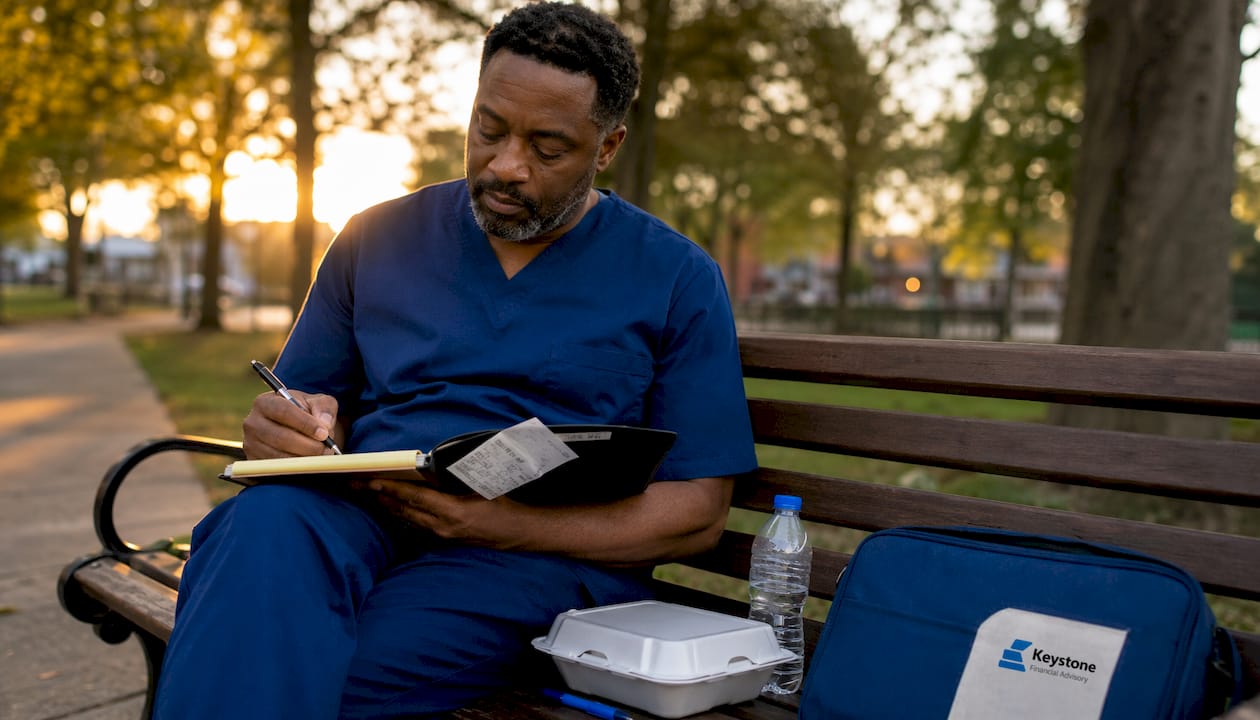
Many guides overstate what is claimable here. HMRC allows reasonable overnight costs when travel requires being away from home, but not subsistence at your base of operations even if a contract requires you to be present. The distinction is whether the meal arises from the business travel or simply from being alive and needing to eat.
For dentists operating through a limited company, the rules differ — see the meals and subsistence guide for the company-structure equivalent.
Common pitfalls and HMRC audit triggers
Multiple predictable sessions at fixed practices are the single most common audit trigger for self-employed healthcare professionals. HMRC does not treat a dentist with regular Thursday and Friday slots at two different surgeries as itinerant — those are predictable attendances, and the journeys from home are commuting.
Red flags that attract HMRC attention:
Claiming home-to-practice travel as a business journey.
Mileage totals that appear inconsistent with the practice locations or working pattern.
Subsistence claims for meals on non-overnight trips.
No receipts or contemporaneous notes to support claims.
Apportionment percentages that look implausibly high for business use.
If HMRC opens an enquiry, a defensible file should contain:
A complete mileage log covering the period in question.
Copies of practice contracts or locum agreements showing the sites and dates.
Rota evidence or appointment records confirming attendance at temporary sites.
Receipts for any subsistence claimed, with the business purpose noted.
A clear written explanation of how any apportionment was calculated.
Where a trip genuinely combines business and personal elements — driving to a conference that includes a weekend away, for example — apportion the cost and document the basis. HMRC will usually accept the business share if it is clearly identified and evidenced. What they will not accept is a claim for the full cost of a trip that was partly a holiday.
Worked examples for common dental working patterns
Example 1: dentist with one main practice and occasional locum sessions
Dr A works four days a week at her regular practice in Leeds. On occasional Saturdays she takes locum sessions at various practices across Yorkshire, booked through an agency with no fixed location.
Travel from home to Leeds practice: not claimable — ordinary commuting to a regular, predictable place of work.
Travel from home to Saturday locum sites: potentially claimable — the locations are unpredictable and vary each time, which supports an itinerant argument for those specific journeys.
Travel between the Leeds practice and a locum site on the same day: claimable — a business journey between two places of work.
At the current Amended Mileage Allowance Payment (AMAP) rate, 200 business miles of locum travel in a month produces a deduction calculated by multiplying the miles by the applicable flat rate. Over a full year of occasional locum work, this amounts to a meaningful tax deduction.
Example 2: dentist performing domiciliary visits
Dr B has no fixed surgery. He visits elderly and housebound patients at their homes across a wide area, with appointments allocated by a care coordinator. His home is his administrative base.
Travel from home to patient addresses: likely claimable — the pattern is genuinely itinerant; locations are unpredictable and vary daily.
He should keep a GPS-verified mileage log for every visit, noting the patient address (or postcode) and appointment reference.
Meals during the working day: not claimable unless an overnight stay is involved.
Printable checklist — what to retain for each claim type:
[ ] Mileage log with date, start, destination, purpose, and miles for every journey
[ ] Practice contracts or locum agency agreements confirming site and dates
[ ] Rota or appointment records for temporary workplace visits
[ ] Fuel receipts and vehicle running-cost receipts (if claiming actual costs)
[ ] Hotel and meal receipts for overnight trips, with business purpose noted
[ ] Written apportionment calculation for any mixed-use trips or vehicles
[ ] Bank or credit card statements as corroborating evidence
Pro Tip: Review your mileage log monthly rather than annually. Errors and gaps are far easier to correct when the journeys are recent. A five-minute monthly check saves hours of reconstruction before a Self Assessment deadline.
Key takeaways
HMRC allows car and food claims for self-employed dentists only where the expense is wholly and exclusively for the trade, ordinary commuting is always disallowed, and subsistence is deductible only on overnight trips or genuine temporary workplace travel.
Point | Details |
‘Wholly and exclusively’ governs everything | Any personal element in a journey or meal can disallow the entire cost; apportion where you can separate the business share. |
AMAP rates from April 2026 | Cars and vans: 55p per mile for the first 10,000 business miles; 25p per mile thereafter. |
Lock-in on vehicle method | Once you use simplified mileage rates for a vehicle, you cannot switch to actual costs for that vehicle. |
Subsistence is narrowly allowable | Food is deductible only on overnight business trips or travel to a genuine temporary workplace — not on ordinary working days. |
KeystoneFA for complex cases | KeystoneFA helps self-employed dentists with expense reviews, mileage log set-up, apportionment advice, and Self Assessment support. |
An adviser’s note on what we see in practice
The dentists who run into trouble with HMRC are rarely the ones trying to cheat the system. They are usually the ones who assumed that working across two or three practices automatically made them itinerant, or who claimed every meal bought near a surgery as a business cost because they were “working that day.”
The itinerant argument is genuinely available to some dentists — domiciliary practitioners, locums with no fixed base, and those whose work locations are genuinely unpredictable. But it requires evidence, not just assertion. HMRC will look at your contracts, your rotas, and your mileage log. If the pattern shows you attending the same two practices on the same days each week, the itinerant argument will not hold.
What actually protects a dentist in an enquiry is a contemporaneous mileage log, clear contracts that show the nature of each engagement, and a consistent, documented apportionment method. Those three things, kept properly, make a disputed claim defensible. Without them, even a legitimate claim becomes hard to sustain.
The tax savings from missed dentist reliefs are real, but only when the underlying records support them. Getting the record-keeping right from the start of a tax year costs almost nothing; fixing it retrospectively under enquiry is expensive and stressful.
How KeystoneFA helps dentists with HMRC-compliant expense claims
Self-employed dentists with mixed income streams, multiple practice contracts, or domiciliary work need more than a generic tax return. The difference between a defensible claim and an expensive HMRC enquiry often comes down to how the records were kept and whether the right method was chosen at the start of the year.
[
](www.keystonefa.co.uk)
KeystoneFA provides expense reviews that identify which journeys and costs qualify under the ‘wholly and exclusively’ test, mileage log set-up tailored to your working pattern, apportionment calculations for mixed-use vehicles and trips, and full Self Assessment preparation and filing. For dentists facing an HMRC enquiry, the team can compile the case file and handle correspondence directly.
The starting point is a short tax review call. Book yours with KeystoneFA to get a clear picture of what you can legitimately claim and what records you need to keep.
Useful HMRC sources and further reading
The rules in this article draw directly from HMRC’s internal manuals and GOV.UK guidance. Check these pages for the latest rates and any policy changes:
BIM37007 — ‘Wholly and exclusively’: overview — the statutory test; check for any updated case law commentary.
BIM37605 — Home-to-work travel — commuting rules and the duality of purpose principle.
BIM37620 — Travel to and between sites — itinerant trades and the temporary workplace test.
BIM47705 — Subsistence and accommodation — when overnight costs and meals are allowable.
GOV.UK simplified expenses — vehicles — AMAP flat rates, the lock-in rule, and the simplified expenses checker.
GOV.UK mileage and fuel rates — current AMAP rates; check here each April for any rate changes.
LITRG — Self-employed travel and accommodation expenses — scenario-based guidance and audit risk commentary from the Low Incomes Tax Reform Group.
The governing test remains ‘wholly and exclusively’. Advisory fuel rates and AMAP rates can change at each Budget; always verify the current figures on GOV.UK before filing.
This article is general information, not professional tax advice. Confirm the current rules with HMRC or a qualified adviser for your specific circumstances.
FAQ
Can self-employed dentists claim food as a business expense?
Only in narrow circumstances. HMRC treats everyday meals as a private cost; food is deductible only when an overnight business trip makes it necessary, or when travel to a genuine temporary workplace is itself allowable.
What is the HMRC mileage allowance for self-employed dentists in 2026?
For cars and vans, the AMAP rate from 6 April 2026 is 55p per mile for the first 10,000 business miles in the tax year, and 25p per mile for each mile above that threshold.
Does working at multiple practices make a dentist’s travel tax-deductible?
Not automatically. HMRC looks at whether attendance is regular and predictable. Regular sessions at fixed practices on set days are treated as commuting; genuinely unpredictable locum work across varying sites is more likely to qualify as business travel.
What vehicles are 100% tax-deductible in the UK?
No vehicle is automatically fully deductible. Capital allowances apply only to the business-use proportion of a vehicle’s cost; a vehicle used exclusively for business can attract full allowances, but mixed personal and business use requires apportionment. Electric vehicles and vans may attract enhanced allowances — check the current capital allowances guidance on GOV.UK.
Recommended