How much tax can a £100K dentist save in the UK?

TL;DR:
Dentists earning around £100,000 face a high effective tax rate due to the personal allowance taper. Proper planning with pension contributions and allowable expenses can help avoid excess taxation and recover thousands annually. Starting financial strategies before year-end and preparing for digital reporting can optimize tax outcomes.
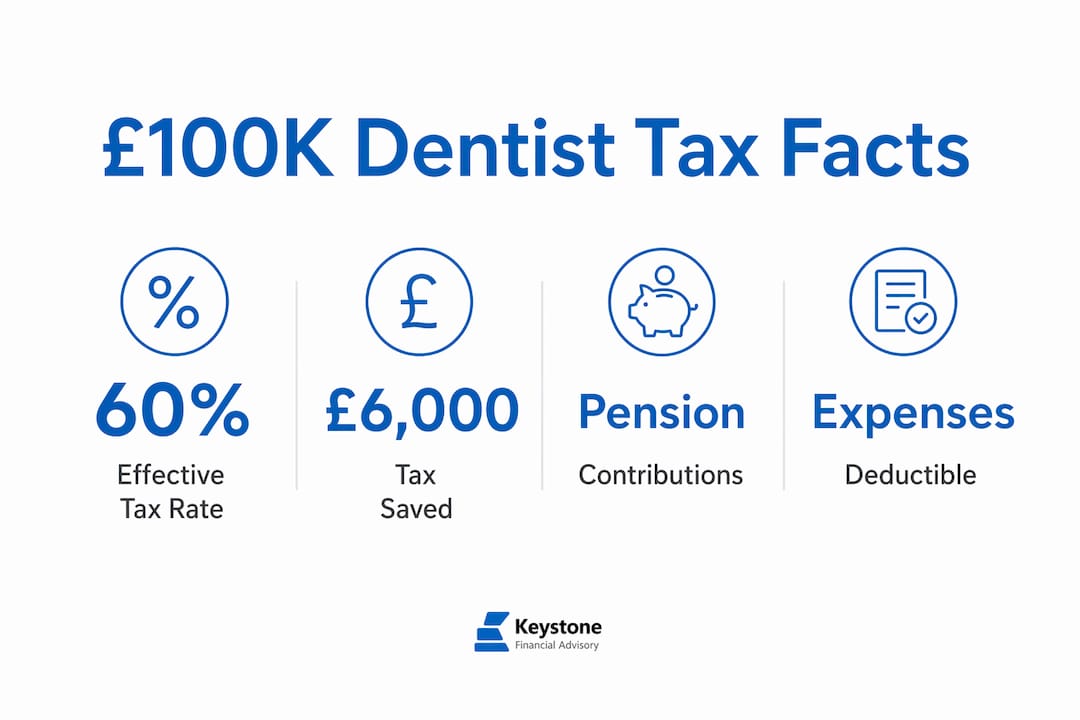
A dentist earning £100,000 in the UK faces one of the most punishing tax traps in the entire HMRC system. The personal allowance taper, which begins at £100,000 adjusted net income, creates an effective 60% marginal tax rate on every pound earned between £100,000 and £125,140. That single fact changes everything about how you should plan your finances. With the right combination of pension contributions, allowable expenses, and income timing, a dentist at this threshold can realistically recover thousands of pounds each year.
What is the £100,000 tax trap and how does it affect your tax bill?
The £100,000 tax trap is the informal name for the personal allowance taper. For the 2026/27 tax year, HMRC withdraws £1 of your personal allowance for every £2 your adjusted net income exceeds £100,000. The allowance disappears entirely at £125,140.
The maths is brutal. You pay 40% Income Tax on the extra income, and you simultaneously lose tax relief worth 20% on the allowance withdrawn. Combined, that produces a 60% effective marginal rate on £25,140 of earnings. No other income band in the UK tax system hits this hard outside of the additional rate threshold.
The ripple effects go beyond your tax return. Dentists with income in this band may also lose access to childcare hours and Childcare Choices top-ups, which adds further financial pressure for families. The table below illustrates how the taper bites at different income levels.
Adjusted net income | Personal allowance remaining | Effective marginal rate |
£100,000 | £12,570 (full) | 40% |
£110,000 | £7,570 | 60% |
£120,000 | £2,570 | 60% |
£125,140 | £0 | 60% |
£130,000 | £0 | 40% |
Pro Tip: Your adjusted net income is not the same as your gross income. Pension contributions and Gift Aid donations reduce it directly. That distinction is where your tax saving begins.
How do pension contributions and Gift Aid reduce your tax as a dentist?
Pension planning is the single most effective tool for dentists earning near £100,000. Every pound you contribute to a registered pension scheme reduces your adjusted net income pound for pound. Contribute £10,000 and your adjusted net income falls by £10,000, potentially restoring part or all of your personal allowance.
The tax relief compounds quickly. A dentist with £110,000 adjusted net income who contributes £10,000 to a pension drops back to £100,000. That move alone recovers £5,000 of personal allowance and eliminates the 60% rate on that slice of income. The annual allowance for pension contributions sits at £60,000 for most dentists, though it tapers for very high earners.
Gift Aid charitable donations work the same way. HMRC grosses up your donation and treats the full amount as a reduction to your adjusted net income. A £4,000 cash donation becomes a £5,000 reduction in adjusted net income after grossing up.
Common mistakes dentists make with pension and donation planning:
Waiting until january to make pension contributions instead of spreading them across the tax year
Forgetting that employer pension contributions through a limited company do not count toward the personal annual allowance limit
Missing the Gift Aid declaration, which invalidates the tax relief entirely
Underestimating carry-forward rules that allow unused allowance from the previous three tax years
Pro Tip: If you are close to £100,000 but not certain of your final income, make a pension contribution before 5 April. You can always adjust the amount once your accountant confirms your year-end position.
Which business expenses and capital allowances can dentists claim?
Allowable expenses reduce your taxable profit directly. For dentists, the wholly and exclusively rule governs every claim. An expense must be incurred solely for business purposes. HMRC scrutinises dental expense claims closely, and mixed-use items such as personal clothing are routinely disallowed.
Expenses dentists can legitimately claim include:
General Dental Council (GDC) registration fees
Professional indemnity insurance premiums
Dental defence organisation memberships
Continuing professional development (CPD) courses and materials
Laboratory fees and clinical consumables
Practice software subscriptions and accountancy fees
Business mileage at HMRC approved rates
The Annual Investment Allowance (AIA) offers a particularly powerful route for capital spending. For 2026/27, the AIA permits a 100% deduction on qualifying plant and machinery up to £1,000,000 in the year of purchase. Dental chairs, digital scanners, X-ray equipment, and autoclave units all qualify. Claiming the AIA immediately rather than spreading depreciation over several years produces a significant cash flow benefit.
Expense type | Tax treatment | Notes |
GDC fees | Fully deductible | Revenue expense |
Indemnity insurance | Fully deductible | Revenue expense |
Dental chair | 100% via AIA | Capital allowance |
Digital scanner | 100% via AIA | Capital allowance |
Personal clothing | Disallowed | Fails wholly and exclusively test |
Home office (partial) | Proportionate claim | Requires calculation |
You can find a broader list of HMRC-approved expenses that apply to limited company dentists, many of which are overlooked at self-assessment time.
What income extraction strategies work best for dentists earning £100K?
The structure of your practice determines which strategies are available to you. Limited company dentists have more flexibility than sole traders. They can mix salary, dividends, and employer pension contributions to manage adjusted net income with precision.
A typical approach for a limited company dentist involves setting salary at the National Insurance secondary threshold, taking dividends up to the basic rate band, and directing remaining profits into a pension. This keeps adjusted net income below £100,000 while extracting value tax-efficiently. The sole trader versus limited company decision carries real financial weight at this income level.
Timing is equally critical. Financial advisers stress that dentists should plan the timing of dividends, expense claims, and equipment purchases to manage taxable income within efficient limits each tax year. Buying a digital scanner in march rather than April, for example, can shift a large capital allowance claim into the current tax year.
From 6 April 2026, Making Tax Digital for Income Tax applies to self-employed dentists earning over £50,000. Quarterly digital submissions replace the annual self-assessment return. Dentists who have not yet adopted compatible bookkeeping software face compliance risk and potential penalties.
Best practices for managing tax liability throughout the year:
Set aside a fixed percentage of income each month for tax payments on account
Review your adjusted net income position at the midpoint of the tax year, not just in January
Use salary sacrifice schemes for benefits such as electric vehicles to reduce gross pay
Keep digital records of all expenses from the start of the tax year, not retrospectively
Key takeaways
A dentist earning £100,000 in the UK can save thousands annually by reducing adjusted net income through pension contributions, claiming all allowable expenses, and timing income extraction to stay below the personal allowance taper threshold.
Point | Details |
The 60% tax trap | Income between £100,000 and £125,140 carries an effective 60% marginal rate due to personal allowance withdrawal. |
Pension contributions | Every pound contributed to a pension reduces adjusted net income and can restore your personal allowance. |
Annual Investment Allowance | Qualifying equipment up to £1,000,000 qualifies for 100% deduction in the year of purchase. |
Income timing | Timing dividends and equipment purchases within the tax year controls which band your income falls into. |
MTD compliance | From April 2026, self-employed dentists over £50,000 must file quarterly digital reports with HMRC. |
The £100K threshold: what I have seen dentists get wrong
The dentists I work with who earn around £100,000 almost always underestimate how much the personal allowance taper costs them. They see a gross income figure and assume the tax bill is simply 40%. The reality is that a dentist earning £115,000 with no planning in place pays an effective rate far higher than a colleague earning £130,000 who has structured their affairs properly. That is a genuinely counterintuitive outcome.
The most common mistake I see is treating pension contributions as a retirement decision rather than a tax decision. At this income level, a £15,000 pension contribution does not just save you 40% tax relief. It can restore your entire personal allowance, eliminate the 60% rate, and recover childcare benefits simultaneously. The compounded saving is often £9,000 or more from a single action.
The second mistake is leaving expense claims until self-assessment season. Dentists who track GDC fees, indemnity costs, CPD, and equipment purchases throughout the year claim more and claim correctly. Those who reconstruct records in January miss items and make errors that attract HMRC attention.
Making Tax Digital changes the game from April 2026. Quarterly reporting means your tax position is visible in near real time. That is actually an opportunity. Dentists who engage with their numbers quarterly can course-correct before the year ends, not after.
— Shoaib
How KeystoneFA helps dentists manage tax around the £100K mark
Dentists earning around £100,000 need more than a standard accountant. They need someone who understands the personal allowance taper, the Annual Investment Allowance, and the shift to Making Tax Digital as a connected set of decisions, not separate tasks.
[
KeystoneFA works with dental professionals to build tax plans that account for pension timing, expense structuring, and income extraction in one joined-up approach. The team has experience across both sole trader and limited company dental practices, and provides personalised tax consultation rather than off-the-shelf advice. If you want to understand exactly where your tax liability sits and what you can do about it before the tax year ends, you can book a consultation directly online. KeystoneFA’s broader accounting and tax services are built for professionals who want clarity, not complexity.
FAQ
What is the effective tax rate for a dentist earning £100K in the UK?
A dentist earning between £100,000 and £125,140 faces an effective marginal tax rate of 60% on that income band due to the personal allowance taper. Above £125,140, the rate returns to 45% for additional rate taxpayers.
How much can pension contributions save a dentist earning £100K?
A pension contribution that reduces adjusted net income from £110,000 to £100,000 can save up to £6,000 in tax by restoring personal allowance and eliminating the 60% rate on that £10,000 slice.
What expenses can a dentist claim to reduce their tax bill?
Dentists can claim GDC registration fees, professional indemnity insurance, CPD costs, laboratory fees, and qualifying equipment under the Annual Investment Allowance, provided each expense meets HMRC’s wholly and exclusively rule.
Does operating through a limited company help dentists avoid the £100K trap?
A limited company gives dentists more control over the timing and mix of salary, dividends, and pension contributions, which makes it easier to keep adjusted net income below the £100,000 threshold.
What is Making Tax Digital and when does it affect dentists?
Making Tax Digital for Income Tax Self Assessment applies to self-employed dentists earning over £50,000 from 6 April 2026, requiring quarterly digital submissions to HMRC instead of a single annual return.
Recommended