Should dentists incorporate a UK limited company?

TL;DR:
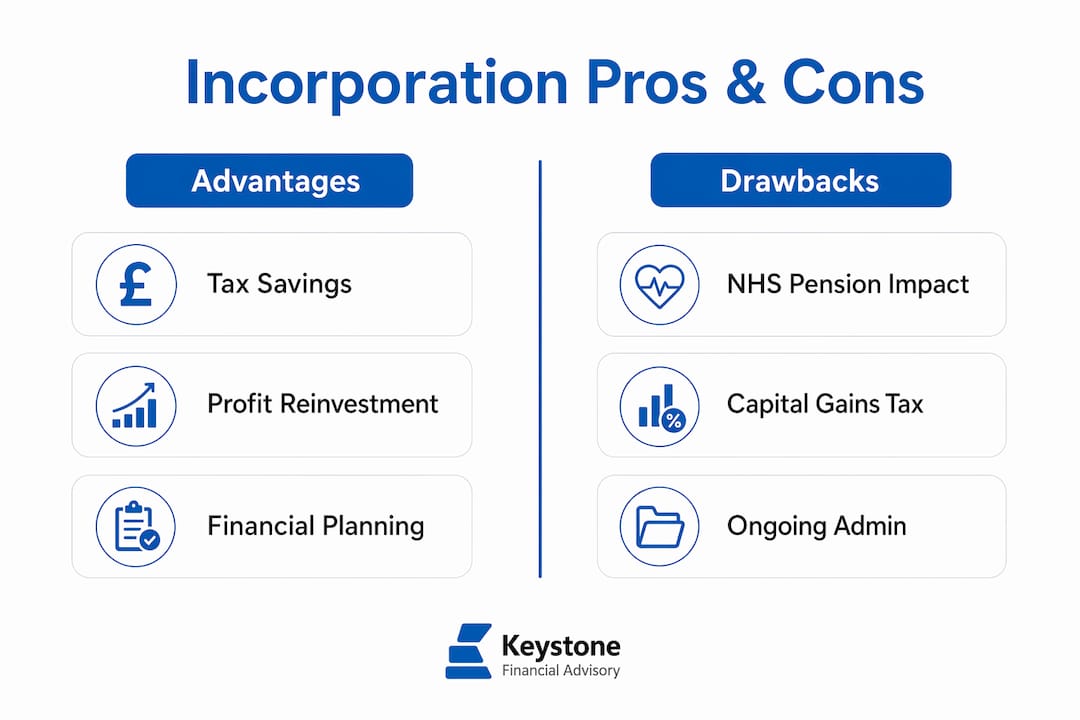
Incorporating a UK dental practice offers tax benefits, especially for profits above the higher rate threshold.
However, it also risks disqualifying dentists from NHS pension schemes and complicates NHS contract transfers.
Incorporation as a UK limited company is defined as the process of registering a dental practice as a separate legal entity under the Companies Act 2006, distinct from the dentist as an individual. For dentists earning above the £50,270 higher rate income tax threshold, this structure delivers meaningful tax advantages by allowing profit extraction through a combination of salary and dividends. The decision is not purely a tax calculation. NHS pension rights, contract obligations, and administrative costs all shape whether incorporation is the right move for your practice.
Should dentists incorporate a UK limited company for tax savings?
The core tax case for incorporation rests on one comparison. Corporation tax starts at 19%, while higher rate income tax sits at 40%. For a dentist drawing significant profits as a sole trader, that gap represents a substantial annual overpayment to HMRC.
A limited company allows you to extract profits via salary and dividends, which is more tax-efficient than drawing everything as personal income. You pay yourself a low salary, typically set around the National Insurance threshold, and take the remainder as dividends taxed at lower rates. This approach legally reduces both income tax and National Insurance contributions.
The key benefits of this structure include:
Lower effective tax rate on profits above £50,270 compared to sole trader rates
Dividend allowance reducing tax on distributions from the company
Employer National Insurance savings when salary is kept at the optimal level
Deductible business expenses reducing the corporation tax base before profits are calculated
Sole trader dentists earning over £50,000 must also comply with HMRC’s Making Tax Digital rules from april 2026, requiring digital record-keeping and quarterly submissions. A limited company operates under a different filing regime, which many dentists find more structured once the initial setup is complete.
Pro Tip: Plan your salary and dividend withdrawals at the start of each tax year, not at year end. Reactive extraction often results in unnecessary tax charges that advance planning would have avoided.
What are the NHS pension and contract implications?
This is where incorporation becomes genuinely complicated, and where many dentists make costly mistakes.
Incorporating NHS income within a limited company can disqualify you from contributing to the NHS pension scheme. The NHS pension is a defined benefit scheme, meaning it pays a guaranteed income in retirement based on your career earnings. Losing access to it is not a minor inconvenience. For many dentists, the long-term value of NHS pension rights exceeds the short-term tax savings achieved through incorporation.
The contract risk is equally serious. NHS dental contracts are held by individuals, not companies. Transferring a contract to a limited company requires re-registration with NHS England, which can trigger an efficiency review and potentially reduce your Units of Dental Activity rates. That reduction in UDA rates could cost more annually than the tax saving you were hoping to achieve.
Before incorporating, ask yourself these questions:
Do you rely on NHS income as a significant portion of your earnings?
Are you actively building NHS pension entitlement you cannot afford to lose?
Have you confirmed with NHS England whether your contract is transferable without penalty?
Is your practice predominantly private, making NHS restrictions less relevant?
Pro Tip: Dentists with a mixed NHS and private income should model the pension loss in pounds, not percentages. A specialist dental accountant can run this calculation before you commit to any structure change.
What are the legal and administrative obligations after incorporating?
Incorporation is not a one-time action. It creates ongoing legal and financial obligations that cost time and money to maintain.
Corporation tax returns, annual accounts, and director responsibilities all become mandatory once you incorporate. Failure to file on time carries penalties from Companies House and HMRC, and persistent non-compliance can affect your professional registration. The administrative burden is genuinely higher than operating as a sole trader.
The steps involved in ongoing compliance include:
Prepare annual statutory accounts in the format required by Companies House
File a corporation tax return with HMRC within nine months of your year end
Submit a confirmation statement to Companies House each year
Maintain a payroll for director salary, including Real Time Information submissions to HMRC
Keep board minutes and company records as required under the Companies Act 2006
One area that catches dentists off guard is goodwill. Transferring goodwill when incorporating can trigger an immediate Capital Gains Tax liability if not managed with advance planning. A practice built over years carries significant goodwill value, and HMRC will expect that value to be recognised at the point of transfer. Specialist advice before incorporation is not optional here. It is the difference between a planned tax position and an unexpected bill.
How does incorporation support long-term growth and financial planning?
Beyond the immediate tax position, incorporation creates structural advantages that support practice growth and eventual exit.
Retained profits taxed at corporation tax rates can be reinvested into the business without first passing through personal income tax. This means a dentist who wants to fund new equipment, acquire a second site, or bring in an associate can do so using pre-personal-tax money. That is a material advantage over a sole trader structure, where every pound reinvested has already been taxed at up to 45%.
The table below summarises how incorporation supports different growth objectives:
Growth objective | How incorporation helps |
Equipment investment | Retained profits fund purchases at lower effective tax cost |
Practice acquisition | Company structure simplifies borrowing and asset ownership |
Bringing in associates | Partners or associates can hold shares or be employed within the company |
Practice sale or exit | Shares in a company may qualify for Business Asset Disposal Relief |
Pension planning | Employer pension contributions reduce corporation tax and avoid National Insurance |
The ability to integrate pension planning with company structure is particularly valuable. Employer contributions made by the company reduce the corporation tax bill and do not attract National Insurance. This makes pension funding through a limited company more efficient than personal contributions made from post-tax income.
Key takeaways
Incorporation delivers real tax advantages for UK dentists, but the NHS pension and contract risks mean it is not the right structure for every practice.
Point | Details |
Tax efficiency threshold | Incorporation becomes most beneficial when profits exceed the £50,270 higher rate band. |
NHS pension risk | Incorporating NHS income can disqualify you from the NHS pension scheme, often worth more than the tax saved. |
Contract transfer risk | NHS contracts require re-registration with NHS England, which may reduce UDA rates. |
Goodwill and Capital Gains Tax | Transferring practice goodwill on incorporation triggers a Capital Gains Tax event requiring advance planning. |
Long-term growth | Retained profits taxed at corporation tax rates fund reinvestment more efficiently than sole trader income. |
My honest view on dental incorporation
I have worked with dentists at various stages of their careers, and the pattern I see most often is this: a dentist hears about the tax savings from incorporation, gets excited, and then proceeds without fully accounting for what they stand to lose.
The tax case for incorporation is real and well-established. But it is only half the picture. The NHS pension is one of the most valuable benefits in any profession. Walking away from it to save tax in the short term is a trade-off that deserves serious modelling, not a quick decision.
My advice is to treat incorporation as a business restructuring decision, not a tax hack. Consider your retirement timeline, your NHS income dependency, your appetite for administrative complexity, and your growth ambitions. When all of those factors point in the same direction, incorporation is a genuinely powerful move. When they conflict, a more measured approach, such as private practice growth before any structural change, often serves dentists better.
— Shoaib
How KeystoneFA supports dentists considering incorporation
KeystoneFA works with dental professionals across the UK who are weighing up their business structure options. The team brings direct experience in dental sector accounting, covering corporation tax planning, NHS pension analysis, goodwill valuation, and Companies House compliance.
[
Whether you are a sole trader exploring incorporation for the first time or a practice owner planning an exit, KeystoneFA provides the tailored advice that generic accountants cannot. The team models your specific income mix, pension position, and growth goals before recommending any structural change. Book a tax consultation with KeystoneFA to get a clear picture of what incorporation would actually mean for your practice, in numbers, not generalities.
FAQ
Is a limited company always better for dentists?
A limited company is not always the better structure. Dentists with significant NHS income risk losing pension rights and facing contract transfer complications that can outweigh the tax savings.
What tax rate does a dental limited company pay?
A dental limited company pays corporation tax starting at 19% on profits, compared to the 40% higher rate income tax that applies to sole traders above the £50,270 threshold.
Can I transfer my NHS contract to a limited company?
NHS contracts are held by individuals and are not automatically transferable. Re-registration with NHS England is required and may trigger a contract review that reduces UDA rates.
What is the Capital Gains Tax risk when incorporating?
Transferring practice goodwill to a limited company creates a Capital Gains Tax liability at the point of transfer. Advance planning with a specialist accountant is necessary to manage this charge.
How do I register a dental company in the UK?
You register a dental limited company through Companies House, then notify HMRC for corporation tax, set up payroll, and separately address any NHS England re-registration requirements for existing contracts.
Recommended