Multi-currency bookkeeping for startups: what to do now

Record every foreign transaction in its original currency, then post the GBP equivalent using the exchange rate on the transaction date. Keep separate ledgers per currency, and revalue outstanding foreign balances at each reporting date. That single habit stops most of the compliance and reporting problems founders run into.
Three things to sort today:
Confirm your functional currency. UK limited companies report in GBP, full stop.
Pick one exchange-rate source and write it down. ECB reference rates are a recognised option under HMRC’s VAT rules.
Segregate your ledgers. One bank account, one ledger, per currency, so FX movement never hides inside ordinary trading figures.
These aren’t preferences. FRS 102 Section 30 sets the translation rules, HMRC governs VAT conversion consistency, and getting either wrong tends to surface at the worst possible moment: due diligence or year-end audit.
Key Takeaways
Compliant multi-currency bookkeeping depends on posting original currency plus GBP equivalents at the transaction date, then revaluing foreign balances at each reporting date.
Point | Details |
Post dual amounts always | Record the original currency figure and its GBP equivalent at the transaction date, every time. |
Pick one rate source | Use a consistent method, such as ECB reference rates, and never switch mid-period without documenting why. |
Separate currency ledgers | Keep each currency in its own bank account and ledger to make reconciliation and revaluation straightforward. |
Revalue at reporting date | Retranslate outstanding foreign balances at year-end under FRS 102 Section 30 and disclose the resulting FX movement. |
Get managed support when complexity grows | KeystoneFA combines automated capture with accountant review to keep multi-currency accounts audit-ready. |
Table of Contents
What multi-currency bookkeeping actually requires day to day
Five components make up a compliant system, and skipping any one of them tends to cause reconciliation headaches within a quarter.
Original-currency posting. Every invoice or receipt is logged in the currency it was actually issued in, not converted on entry.
Dual-amount recording. The system holds both the original figure and its GBP equivalent at the transaction date, with the rate used stored alongside it.
Currency-specific bank and ledger accounts. Keeping a US dollar account separate from a euro account, each mapped to its own ledger, is what makes reconciliation possible at all.
FX gain and loss accounts. Realised and unrealised movements need their own home in the chart of accounts, not a spot inside general expenses.
A written accounting policy. One paragraph stating your rate source and conversion method, kept on file for whoever prepares your accounts or answers an HMRC query.
Roles matter here too. The founder owns the policy decision (which rate source, which conversion date). A bookkeeper or finance system handles the daily postings and reconciliations. When unrealised FX movements start affecting reported profit meaningfully, or when a funding round brings in multi-currency investor terms, that’s the point to bring in an adviser rather than muddle through.
Pro Tip: Tag every foreign transaction with the exchange rate used at the moment you post it, not the rate you look up later. Reconstructing historic rates during a year-end scramble is where most multi-currency errors are born.

What are the legal and tax rules you can’t ignore?
UK limited companies must prepare statutory accounts in GBP. That’s not a formatting choice, it’s a requirement under FRS 102 Section 30, which also sets out how foreign-currency transactions get translated: at the exchange rate ruling on the transaction date, with monetary balance-sheet items revalued at the closing rate on the reporting date.
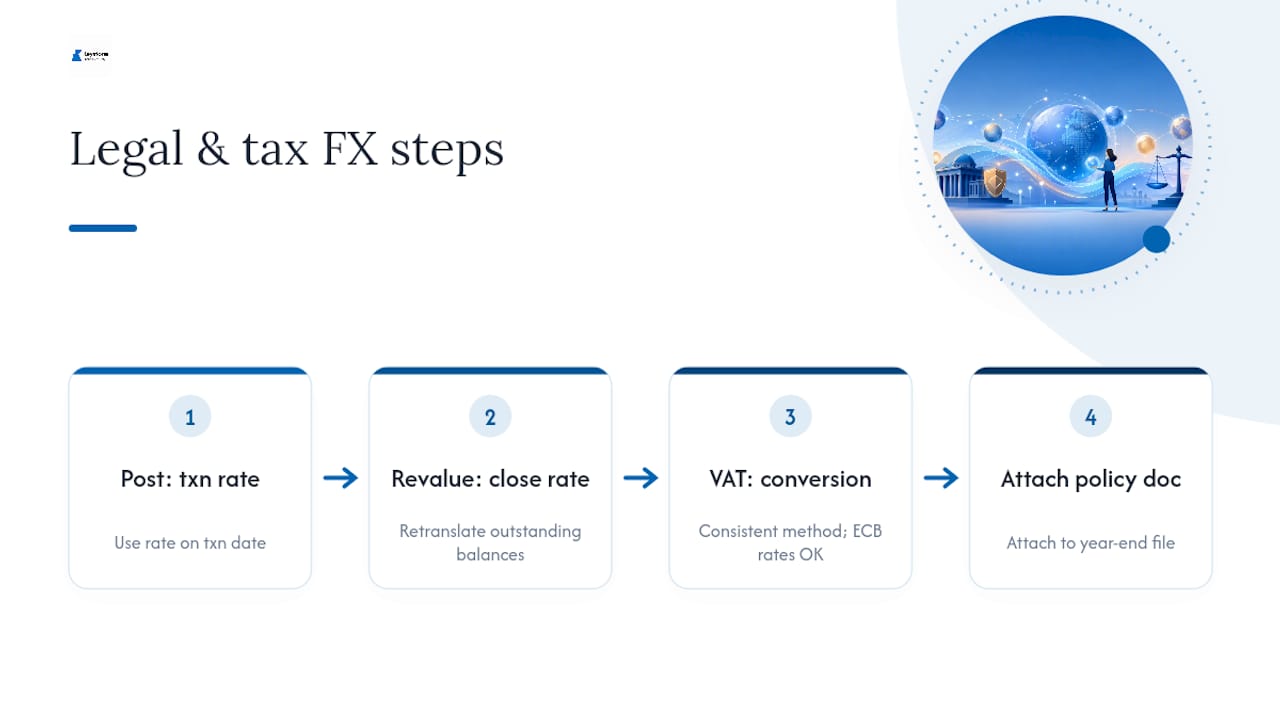
VAT has its own conversion logic. HMRC requires a consistent method for turning foreign-currency invoices into GBP figures on your VAT return, and it accepts recognised sources such as the ECB’s daily reference rates, published at 14:15 CET. The rule that trips people up isn’t the rate itself, it’s consistency: switching your conversion method partway through a VAT period, without formal approval, is one of the most common triggers for an HMRC review.
Balance-sheet revaluation is the part founders forget entirely. At each reporting date, you retranslate outstanding foreign monetary balances (unpaid invoices, foreign bank holdings, foreign loans) at the closing rate. The difference between that closing value and the value you originally posted becomes an unrealised FX gain or loss, and it flows through profit and loss even though no cash has actually moved. A startup holding a large euro balance can show a real swing in reported profit purely from currency movement, with zero change in underlying trading performance. That’s confusing for a founder reading their own management accounts for the first time, and it’s exactly the kind of number an investor will ask about in diligence.
Pro Tip: Write your exchange-rate policy into a single internal document: name the rate source, the date convention (transaction date vs invoice date), and confirm it hasn’t changed this financial year. Attach it to your year-end file. It’s the fastest way to answer an HMRC query without a scramble.
A monthly workflow that keeps you compliant
Five steps, repeated every month, keep multi-currency books clean without turning into a full-time job.
Capture the source document with its original currency, amount, and date, whether that’s an invoice, receipt, or bank statement line.
Post the transaction with both amounts. Original currency plus GBP equivalent, using the rate ruling on the transaction date, exactly as FRS 102 Section 30 requires.
Reconcile each currency bank account separately against its own ledger, never lumped together with GBP transactions.
Record realised FX gains and losses as foreign invoices get settled, capturing the difference between the posted rate and the settlement rate.
Flag unsettled foreign balances for revaluation at month-end, so nothing gets missed when the reporting date actually arrives.
Ownership matters as much as the steps themselves. Weekly document capture can sit with whoever raises invoices or processes expenses. Monthly reconciliation and FX postings belong with your bookkeeper or finance lead. Sign-off on the reconciled position, especially anything touching revaluation, should sit with the founder or finance director, not get buried in a spreadsheet nobody reviews.
Pro Tip: Keep bookkeeping and payment processing as separate functions, even if one person does both jobs. Paying personal expenses out of a multi-currency business account, then squaring it up “later,” is exactly how Director’s Loan Account exposure builds up unnoticed. HMRC’s Business Income Manual treats commingled funds as a real tax risk, not a technicality.
Document capture is the part most founders under-invest in, but using invoice processing automation for UK finance teams can streamline data extraction and reduce errors. Tools that extract original currency, date and rate automatically from invoices and receipts cut down the manual re-entry that causes most posting errors, and they’re worth the subscription cost the moment you’re processing more than a handful of foreign invoices a month.
Software or a managed bookkeeper: which fits your stage?
Accounting software with multi-currency support handles the mechanical side well. It preserves original-currency amounts, applies exchange rates automatically, and lets you hold multiple currencies in one account rather than juggling separate local bank accounts for every market you sell into. The marginal cost per transaction is low, and it scales with volume.
What software doesn’t do is judgement. It won’t flag that your VAT conversion method drifted mid-quarter, catch a misclassified FX gain before it distorts your management accounts, or prepare the disclosure notes your year-end accounts actually need under FRS 102. That’s where a managed bookkeeping service, or a hybrid of software plus an adviser reviewing the output, earns its cost.
Decide based on a few concrete factors:
Transaction volume and currency spread. A handful of euro invoices a month is a different problem to daily transactions across five currencies.
Internal finance capacity. If nobody in-house understands FRS 102 revaluation, software alone won’t protect you at year-end.
Investor and audit expectations. Pre-Series A due diligence increasingly checks whether foreign transactions are correctly translated and disclosed, not just totalled.
Before committing to either route, ask direct questions: which exchange-rate source does the provider use, how often are foreign balances reconciled, what’s the reporting cadence, and can you export your own data if you switch providers later. Keystone’s overview of accounting service types breaks down where day-to-day bookkeeping ends and advisory work begins, which is worth reading before you sign anything.
Monthly close and year-end checklist
Copy this into your own playbook. Monthly essentials: capture every source document with its original currency and date, post dual amounts (original plus GBP), reconcile each currency bank ledger individually, record realised FX gains and losses as they occur, and review any unreconciled items before the month closes.
Year-end adds three more tasks: revalue every outstanding foreign balance at the reporting-date closing rate, record the resulting unrealised FX gain or loss, and prepare the disclosure notes FRS 102 Section 30 requires for foreign currency exposure.
Before submission, check for these red flags:
Foreign bank balances that haven’t been reconciled in over a month.
No documented evidence of which exchange rate was used and when.
A conversion method that changed partway through the VAT period without a note explaining why.
How Keystone Financial Advisory supports startups with multi-currency bookkeeping
A SaaS startup billing customers in USD and EUR, but paying UK payroll and suppliers in GBP, came to KeystoneFA with three currencies’ worth of unreconciled bank feeds and no documented FX policy. The fix wasn’t complicated: separate ledgers per currency, a documented ECB-rate policy, and a monthly revaluation step built into close.
The result wasn’t just tidier books. It was a founder who could answer an investor’s currency-exposure question in one sentence instead of opening four spreadsheets.
KeystoneFA’s team brings experience from larger UK and Middle East firms into day-to-day work for founders, covering:
Multi-currency bookkeeping and monthly reconciliation
VAT filing and Companies House compliance
Year-end accounts preparation under FRS 102
IFRS and FRS advisory for more complex cross-border structures
Combining automated capture tools with an accountant’s review means fewer manual entry errors and cleaner records when audit or diligence time comes round.
What founders get wrong about multi-currency bookkeeping
Most founders don’t get the mechanics wrong. They get the timing wrong. They post foreign invoices in GBP straight away, without keeping the original currency on record, because it feels simpler in month one. Then month six arrives, an investor asks for a currency exposure breakdown, and there’s no way to reconstruct it without going back through every bank statement by hand.
The habit that actually changes outcomes is boring: post the original currency and the GBP equivalent together, every single time, from day one. Do that, and the monthly workflow above becomes routine rather than a scramble. Set it up before your first funding conversation, not after someone asks for numbers you don’t have.
Get a bookkeeping health check before it becomes a problem
Software handles the postings. It doesn’t tell you whether your VAT conversion method is consistent, whether your FX revaluation is correctly disclosed, or whether an investor’s due diligence team will find a gap you didn’t know existed. That’s the difference a managed relationship with KeystoneFA makes for a startup juggling more than one currency.
[

](www.keystonefa.co.uk)
A 30 minute diagnostic call is the easiest way to find out where your current setup stands. KeystoneFA reviews your existing ledgers, exchange-rate policy (or lack of one), and reconciliation habits, then tells you plainly what’s compliant and what isn’t. A typical first month engagement includes a full ledger clean-up, a documented FX policy, and a reconciled opening position you can actually trust. Book your diagnostic call through Keystone Financial Advisory and get your multi-currency books audit-ready before your next investor update or year-end filing.
Sources
This article is general information, not a substitute for advice from a qualified financial advisor. Consult a qualified financial professional about your own circumstances before acting on anything here.
FAQ
What currency must UK statutory accounts be prepared in?
UK limited companies must prepare statutory accounts in GBP, with foreign transactions translated at the transaction date under FRS 102 Section 30.
Which exchange rate should I use for VAT conversion?
HMRC requires a consistent method; recognised sources such as the ECB’s daily reference rates are acceptable, and switching methods mid-period is a common compliance error.
What is an unrealised FX gain or loss?
It’s the difference between the value at which a foreign balance was originally posted and its value when retranslated at the closing rate on the reporting date, and it appears in profit and loss even without any cash movement.
Should a startup use software or a managed bookkeeper for multi-currency accounts?
Software handles automated postings and rate conversion well, but a managed provider like KeystoneFA adds the compliance judgement and disclosure work that software alone doesn’t cover, particularly as transaction volume and investor scrutiny grow.
How often should foreign currency balances be reconciled?
Currency bank accounts should be reconciled monthly against their own ledgers, with a full revaluation of outstanding balances carried out at each statutory reporting date.
Recommended