Companies House goes software-only: what to do now

TL;DR:
Starting April 2028, all UK limited companies and LLPs must file annual accounts in iXBRL format using commercial software. Paper and web filings will end, with mandatory accounts submission and removal of abridged accounts for small firms. KeystoneFA offers a managed service for compliance, from bookkeeping review to submission, ensuring a smooth transition.
From 1 April 2028, every UK limited company and LLP must file annual accounts using commercial software, with accounts tagged in iXBRL format. Web filing and paper filing close for accounts on that date. If you are not already using compliant software or working with an agent who is, start now.
Three immediate actions:
Confirm your accounting software supports iXBRL tagging and Companies House submission, or appoint an authorised agent who does.
Check your presenter account or credit account access with Companies House is active and correctly linked.
Run a test filing before your next year-end to catch tagging or mapping errors before they become rejections.
The legal basis is the Economic Crime and Corporate Transparency Act 2023, which gives Companies House the power to mandate software-only filing and improve the quality of data on the public register. HMRC already requires iXBRL for CT600 corporation tax filings, so the direction of travel has been clear for some time.
Note on the deadline: Some earlier guidance referenced April 2027. Companies House has since confirmed the implementation date as 1 April 2028, giving businesses at least 21 months’ notice. This article uses the confirmed 2028 date throughout. If you have seen April 2027 referenced elsewhere, treat that as superseded.
Table of Contents
What exactly changes when software-only filing begins?
Companies House confirmed a package of reforms that go well beyond simply closing the web portal. Here is what actually changes:
What changes | What it means in practice |
Software-only accounts filing | All annual accounts must be submitted via commercial software |
iXBRL tagging mandatory | Accounts must be tagged in inline XBRL format; software generates the tags |
Web filing closes for accounts | The Companies House WebFiling service will no longer accept accounts |
Paper filing ends | Paper accounts submissions will not be accepted |
Abridged accounts removed | Small companies can no longer file abridged accounts |
P&L filing for small companies | Small companies and micro-entities must file a profit and loss account |
P&L publication opt-out | Companies can opt out of publishing the P&L on the public register |
Component parts filed together | Balance sheet, P&L, and notes must be submitted as a single package |
What iXBRL actually is. Inline eXtensible Business Reporting Language embeds machine-readable tags directly into an HTML document. Each line item in your accounts gets a tag that maps to a standard taxonomy, allowing Companies House and HMRC to validate, compare, and process data automatically. Software generates these tags from your underlying bookkeeping; doing it manually is not realistic for most businesses. The tags are only as accurate as the data behind them, which is why chart of accounts mapping matters so much.
“All accounts filings made on or after 1 April 2028 must be filed by commercial software in inline extensible Business Reporting Language (iXBRL) format. From this date, our web and paper routes will be closed for accounts filings but will remain open for other statutory filings.” — Changes to UK Company Law, GOV.UK
One important distinction: web services remain open for confirmation statements, director updates, and other non-accounts filings. The software-only requirement applies specifically to annual accounts.
Directors retain full legal responsibility for the accuracy of filed accounts, even when an agent or software submits on their behalf.
Which companies does this apply to?
Every UK limited company and LLP is in scope. There are no exemptions based on size, sector, or trading status. Dormant companies and overseas branches registered at Companies House must also comply.
For small companies and micro-entities, the changes are more significant than for larger businesses:
Small companies must now file a profit and loss account, which was previously optional.
Micro-entities must also file a P&L, though they can opt out of having it published on the public register. The opt-out is made at the point of filing via the software; the accounts are still submitted to Companies House but the P&L is suppressed from public view.
Abridged accounts are removed entirely. Companies that currently file abridged accounts will need to file full accounts appropriate to their size.
All component parts of the accounts must be filed together as a single submission.
Director responsibilities and compliance risks:
Directors are personally liable for late or non-compliant filings, regardless of who prepares or submits the accounts.
Rejected filings count as late if not resubmitted within the filing deadline.
Repeated failures can result in a formal prosecution, a criminal record, and a fine.
Companies House can strike off a company for persistent non-filing.
An incorrect iXBRL tag that causes a validation failure will result in rejection, not a warning.
Your step-by-step plan from now to the deadline
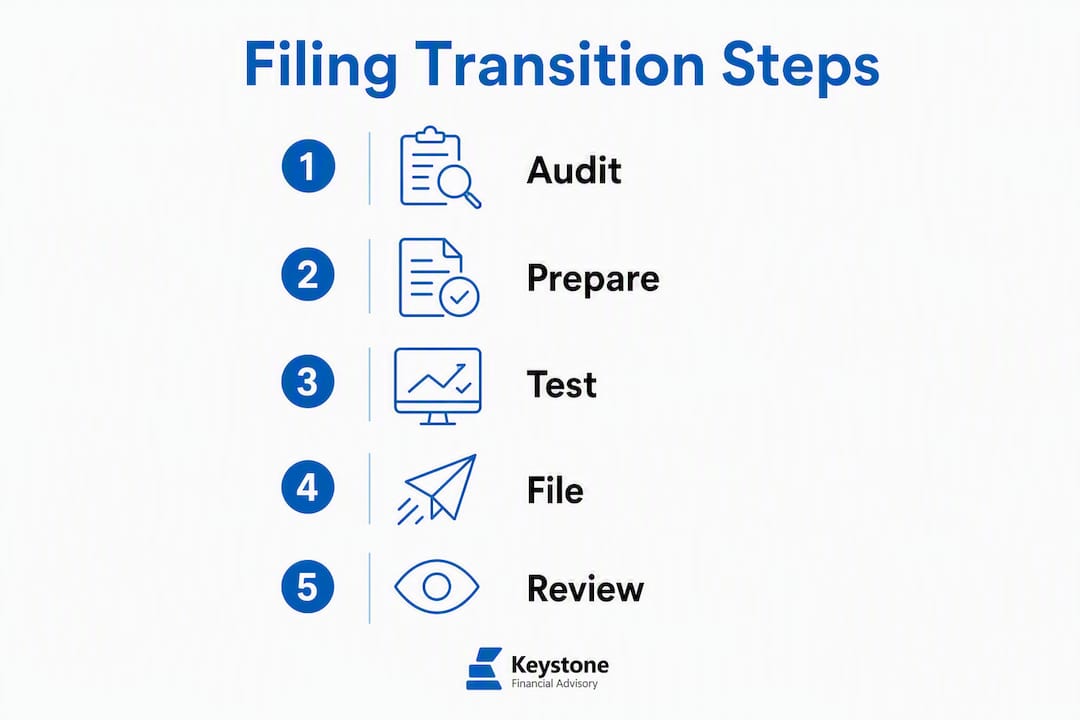
Treat this as a systems migration, not a once-a-year compliance task. The businesses that will struggle are those that leave it to the month before their filing deadline.

Phase | Timeframe | Key actions |
Now | Immediately | Audit bookkeeping quality; confirm chart of accounts mapping; verify presenter/credit account access; decide in-house vs outsource |
Configure | — | Migrate or configure software (Xero Tax, Sage, QuickBooks); run parallel iXBRL reports; train staff |
Test | 3 months out | Run end-to-end test filing; fix tag and mapping errors; reconfirm agent credentials |
Final check | 1 month out | Validate iXBRL output; confirm submission credentials; appoint an authorised agent if not already done |
Ongoing | Post-April 2028 | Quarterly iXBRL validation runs; version control of chart of accounts; documented filing responsibilities |
The most common cause of rejected filings is poor source bookkeeping and an incorrect chart of accounts mapping. Fixing this often requires reclassifying historic transactions before tagging can work cleanly. Start the audit now, not at year-end.
Confirming your presenter account credentials early also matters. Agent authentication and credit account access are a frequent source of last-minute delay when companies assume access is in place but find it has lapsed or was never properly configured.
Pro Tip: Use your software’s sandbox or test environment to run a trial iXBRL submission before your first live filing. Industry guidance recommends testing in vendor sandboxes to catch tagging errors before the mandatory deadline. A rejected live filing counts against your deadline; a failed test filing costs nothing.
For small companies, the typical migration involves a few days of bookkeeping review, chart of accounts reconfiguration, and one or two test runs, and selecting the right platform is crucial as explained in this accounting platform selection guide. Outsourcing the migration to an accountant familiar with iXBRL can compress that timeline significantly.
Which software and service routes are available?
Two broad routes exist: file in-house using commercial accounting software, or appoint a professional who files on your behalf as an authorised agent.
In-house software options that support iXBRL and UK filing include Xero Tax, Sage, and QuickBooks. Each generates iXBRL-tagged accounts from your bookkeeping data and submits directly to Companies House. The HMRC precedent with CT600 filings means most established UK accounting platforms already handle iXBRL for tax; the Companies House integration extends that capability to statutory accounts.
Xero Tax integrates bookkeeping and accounts preparation in one platform, with iXBRL output built in. Well-suited to startups and growing SMEs already using Xero for day-to-day bookkeeping.
Sage offers iXBRL-capable accounts production for a range of company sizes, with strong UK compliance features.
QuickBooks supports accounts preparation with iXBRL tagging, though the depth of integration varies by plan.
Managed service via an accountant is the lower-risk route for founders and small business owners who do not want to manage software configuration, tagging validation, and submission credentials themselves. An authorised agent handles the full process, from bookkeeping review through to live submission, and carries the technical responsibility for iXBRL accuracy.
KeystoneFA operates on Xero Tax and offers a fully managed filing service, covering iXBRL tagging, validation testing, and Companies House submission on your behalf. For a founder who wants compliance handled without building internal expertise, that is the practical route. You can review statutory accounts preparation guidance on the KeystoneFA site for context on what the process involves.
Should you file in-house or hire an accountant?
The honest answer depends on your internal capacity and your appetite for managing a technical process that has real legal consequences if it goes wrong.
DIY software filing suits you if you already have a bookkeeper or finance manager comfortable with your accounting platform, your chart of accounts is clean and consistently maintained, and you have time to run test filings and monitor for validation errors. The bookkeeping records underlying your accounts must be accurate before iXBRL tagging can work reliably.
Outsourcing makes more sense if your bookkeeping has gaps or inconsistencies, you have no internal resource to manage software configuration, or you simply do not want the liability of a rejected filing sitting with you personally.
Questions to ask any accountant or software vendor before committing:
Do you have direct experience producing and submitting iXBRL-tagged accounts to Companies House?
What is your testing process before live submission?
What is your SLA if a filing is rejected?
How is presenter/credit account access set up and maintained?
What are your fees and what is included in the support model?
Red flags to watch for: an accountant who cannot explain their iXBRL validation process, a vendor with no sandbox testing capability, and anyone quoting a fixed fee with no mention of what happens if a filing is rejected and needs to be corrected and resubmitted.
For staff involved in bookkeeping or accounts preparation, a short briefing on why chart of accounts accuracy matters for iXBRL tagging will reduce errors at source. You do not need to train them on the technical standard; you need them to understand that miscategorised transactions create tagging problems downstream.
Key takeaways
From 1 April 2028, every UK company must file accounts via commercial software in iXBRL format, with no exemptions and no paper or web filing route remaining for accounts.
Point | Details |
Confirmed deadline | 1 April 2028; all annual accounts must be filed via commercial software in iXBRL format. |
iXBRL tagging is mandatory | Software generates the tags; clean bookkeeping and correct chart of accounts mapping are prerequisites. |
Small company changes | Abridged accounts removed; P&L filing required, with an opt-out from public publication available. |
Start now | Audit bookkeeping, verify presenter account access, and run a test filing well before your deadline. |
KeystoneFA route | KeystoneFA is Xero Tax-ready and offers fully managed iXBRL tagging, validation, and Companies House filing. |
Why an integrated approach reduces your risk
The businesses that will have the smoothest transition are those that treat this as a bookkeeping quality project, not a filing format change. That is the core insight most commentary misses.
iXBRL tagging does not fix bad data. If your chart of accounts has been inconsistently applied, if transactions have been miscategorised, or if your year-end process relies on manual adjustments that never make it back into the ledger cleanly, the software will tag what it finds. What it finds will be wrong. The filing will be rejected, or worse, accepted with inaccurate data that creates a compliance problem later.
The businesses I see handle this well are those already running integrated bookkeeping and accounts preparation on a single platform. When the bookkeeping feeds directly into the accounts production tool, the tagging is a by-product of clean data rather than a separate exercise. That is exactly why KeystoneFA built its service around Xero Tax: the integration is not a feature, it is the risk management.
One client, a London-based product startup, came to KeystoneFA with two years of bookkeeping spread across spreadsheets and a disconnected bank feed. The migration took three weeks of reclassification work before the chart of accounts was clean enough to produce a reliable iXBRL output. After that, their first test filing passed first time. The lesson is not that migration is hard; it is that the earlier you start, the less painful it is.
KeystoneFA handles the transition for you
For founders and small business owners who want compliance managed rather than learned, KeystoneFA offers a direct route from where you are now to a confirmed, tested filing process before the April 2028 deadline.
[
](www.keystonefa.co.uk)
The service covers a compliance audit of your current bookkeeping and chart of accounts, migration to Xero Tax where needed, iXBRL tagging and validation testing, and Companies House filing on your behalf. Onboarding typically takes two to four weeks depending on the state of your existing records. You get a managed process, not a software subscription and a manual.
HMRC already requires iXBRL for corporation tax, so if you are filing CT600 returns, aligning your HMRC and Companies House workflows through a single platform removes duplication and reduces the risk of inconsistencies between your tax return and your statutory accounts.
Book a compliance review with KeystoneFA to confirm your current position and agree a migration plan before the deadline.
Useful sources
Using software to file your company’s information — GOV.UK
Changes to accounts — Changes to UK Company Law campaign site
Economic Crime and Corporate Transparency Act 2023 — legislation.gov.uk
Companies House accounts changes confirmed for April 2028 — ICAEW
Companies House to mandate filing by software — The Accountant
KeystoneFA — Accountants in London, UK
FAQ
When does software-only filing become mandatory?
From 1 April 2028, all UK companies and LLPs must file annual accounts using commercial software in iXBRL format. Web and paper filing routes for accounts will close on that date.
Are there any exemptions from the software-only requirement?
No. Every UK limited company and LLP is in scope, including dormant companies and overseas branches registered at Companies House.
What is iXBRL and why does it matter?
iXBRL is a machine-readable tagging format embedded in HTML accounts. Software generates the tags automatically from your bookkeeping data; manual tagging is not practical, which is why compliant accounting software is required.
What happens to small companies that currently file abridged accounts?
Abridged accounts are being removed. Small companies will need to file full accounts appropriate to their size, including a profit and loss account, though they can opt out of having the P&L published on the public register.
Can KeystoneFA handle the migration and filing on my behalf?
Yes. KeystoneFA is Xero Tax-ready and offers a fully managed service covering bookkeeping audit, iXBRL tagging, validation testing, and Companies House filing. Book a compliance review to get started.
Recommended