Limited Company Setup for UK Founders: Privacy, PSCs, First Year Costs

You can incorporate a private limited company today by filing online with Companies House for the standard digital fee, and the whole process usually takes under 24 hours once your paperwork is ready. Incorporation creates the legal company, but it also starts a clock: you must register for Corporation Tax with HMRC within three months of starting to trade. The rest of this guide covers exactly what you need before you file, what it costs, and what to do the moment your certificate lands.
TL;DR:
Filing online with Companies House typically costs £100, with same-day registration costing £156, and paper filing via IN01 costing £124 from February 2026.
You must register for Corporation Tax within three months of starting trading activities, which include buying, selling, or advertising, not just incorporation.
Proper identification for directors and people with significant control is mandatory, and privacy can be compromised if you use your home address as the registered office.
Mistakes like misaligned accounting periods or delayed tax registration can incur higher costs and delays later, so early setup accuracy is crucial.
Engaging a formation service can simplify the process, ensure correct documentation, and handle HMRC registration within the three-month trading window.
Table of Contents
What you need before you start your limited company setup
Get these pieces sorted before you open the Companies House form, and the whole limited company registration process takes minutes rather than a stop-start afternoon.
A company name that isn’t already taken and doesn’t breach the “sensitive words” rules; check availability on the Companies House register first.
A registered office address in the UK, which appears permanently on the public register, so weigh privacy carefully.
At least one director aged 16 or over, plus at least one shareholder (or guarantor if you’re forming a company limited by guarantee).
PSC details for anyone holding more than 25% of shares or voting rights, since this is a mandatory disclosure, not optional paperwork.
A statement of capital (share companies) or statement of guarantee, and a SIC code describing your trade.
A decision on articles: model articles suit most new companies; bespoke articles suit anyone with unusual shareholder arrangements.
Budget for the registration fee itself, and don’t forget the confirmation statement you’ll owe roughly a year later.
How to register your limited company step by step
Once your checklist is complete, the actual filing follows a fixed sequence. Miss a step and Companies House will simply reject the submission and send you back to the start.
Draft your memorandum of association. This is a short, one-off document confirming the initial subscribers agree to form the company; Companies House generates it automatically during online filing.
Choose your articles. Most founders adopt the model articles supplied free during online registration. If you’re filing the paper IN01 instead, you must attach your own memorandum and articles, since nothing is generated for you.
Complete the statement of capital or guarantee. List share classes, nominal values, and who holds what, or the guaranteed amount for a guarantee company.
Identify your PSCs. Anyone crossing the 25% ownership or voting threshold must be named, along with the nature of their control. Get this wrong and you risk a correction filing later, which delays your public record.
Appoint your directors. Record full names, dates of birth, nationality, and service address for each one, confirming each meets the minimum age of 16.
Verify your identity. Companies House now expects identity verification for directors and PSCs, either through the online service or via an authorised agent, generating a personal code tied to your filing.
Choose your route: online or paper IN01. Online is faster and cheaper. The IN01 form is still required for certain company types and for anyone who prefers a paper trail, but it takes considerably longer to process.
Submit and wait for your certificate of incorporation. This document confirms your company number and incorporation date, both of which you’ll need for tax registration.
Pro Tip: Line up your incorporation date with the start of a calendar month wherever possible. It makes setting your accounting reference date, and therefore your first Corporation Tax accounting period, far less fiddly than an incorporation that lands mid-month.
Registration routes, fees and timescales explained
Cost and speed depend entirely on which route you pick, and the three options aren’t close in price.
From 1 February 2026, Companies House fees are changing: the standard digital incorporation fee for a private limited company rises to £100, same-day digital registration costs £156, and paper filing via form IN01 costs £124.
Fee snapshot (effective 1 February 2026): Standard online: £100. Same‑day online: £156. Paper IN01: £124.
Standard digital: the cheapest and most common route, typically processed within 24 hours.
Same-day digital: worth the extra cost if you need a company number urgently, submitted before the daily cut-off; it’s the fastest legal way to secure a company today.
Paper IN01: slower and pricier than either digital option, but still necessary for a handful of company types Companies House won’t accept online.
If you use a formation agent or an accountant to handle filing on your behalf, expect a service fee on top of the Companies House charge itself, though this often buys you correct PSC and SIC coding from the outset, which is where most DIY filings stumble.
After registration: Corporation Tax and your statutory records
Your certificate of incorporation isn’t the finish line. Companies House notifies HMRC that your company exists, but that notification does not register you for Corporation Tax, and directors still have to do that themselves within three months of starting to trade.
“Starting to trade” means the point you begin buying, selling, advertising, or otherwise operating, not the incorporation date itself. You enrol via your HMRC business tax account, and HMRC typically posts an activation code within 10 working days to a UK address.
From here, a handful of ongoing obligations kick in:
File a confirmation statement at least once every 12 months, confirming your company details are still accurate.
Prepare and file annual accounts with Companies House and a Company Tax Return with HMRC.
Keep a statutory register of directors, shareholders, and PSCs from day one, alongside proper accounting records.
If turnover approaches the VAT threshold, sort out VAT registration before you’re forced into it retrospectively.
Most founders manage the first two steps alone; the accounting records are where an accountant earns their fee fastest.
Common pitfalls that cost founders time and money
The mistakes that trip up new directors are rarely dramatic, but they’re expensive to unwind.
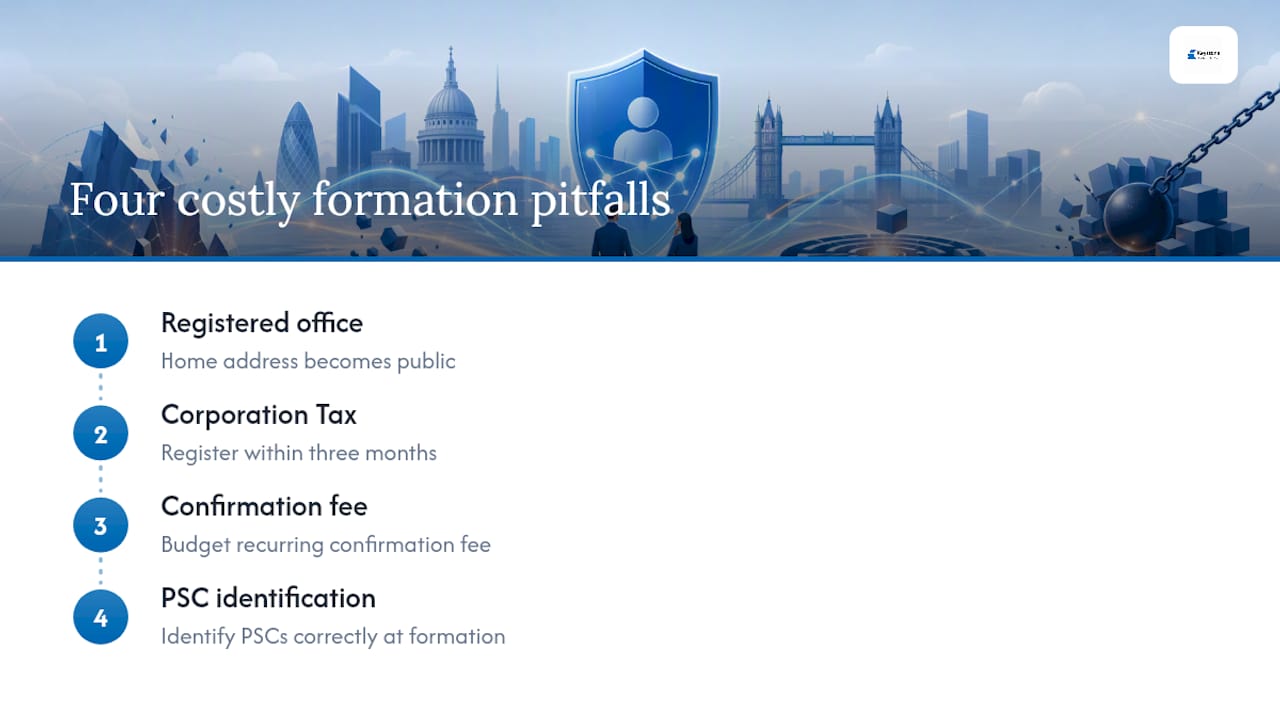
Using a home address as your registered office is the biggest privacy misstep. That address becomes permanently public, searchable by anyone, forever, unless you switch to a professional registered office service. Many founders also assume Companies House tells HMRC everything it needs, then miss the three-month Corporation Tax deadline entirely. Others underbudget for the recurring confirmation statement fee, which compounds fast once you’re running more than one entity. And sloppy PSC identification at formation means correction filings later, which slow down every future application involving that company.
Pro Tip: Set a calendar reminder for your Corporation Tax deadline the day your certificate of incorporation arrives, not the day you send your first invoice. By the time you remember, you’re often already close to the three-month cut-off.
Keystone’s practical notes on when to get help
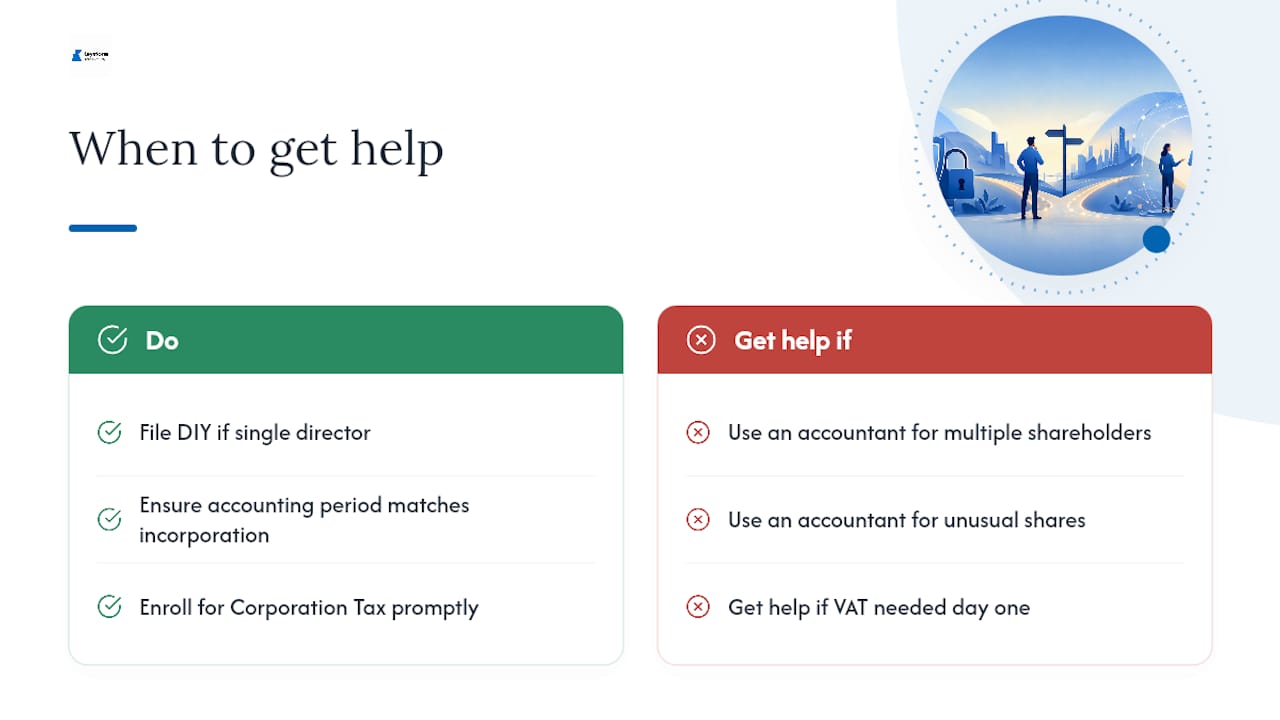
Most of the formation issues KeystoneFA resolves for clients come down to three things: a home address that shouldn’t be public, an accounting period misaligned with the incorporation date, and a missed Corporation Tax enrolment. DIY filing works well for straightforward single-director companies. Bring in an accountant at formation stage if you’re dealing with multiple shareholders, unusual share classes, or a trade that needs VAT registration from day one.
Why getting the setup right the first time actually matters
Correct formation isn’t paperwork for its own sake. A misaligned accounting period, an unverified PSC, or a missed HMRC deadline all cost real money to fix later, usually more than getting it right would have cost upfront. KeystoneFA typically starts an initial engagement by reviewing your incorporation documents and confirming your Corporation Tax and VAT position before touching the books. Diarise your three-month HMRC deadline and your confirmation statement date the moment your certificate arrives, and you’ll spend far less time firefighting in year one.
— Shoaib
Get your formation and first-year compliance sorted properly
An alternative to piecing formation together from a dozen GOV.UK tabs is to engage a service that handles company incorporation, provides a registered office address to keep your home address off the public register, enrols you for Corporation Tax within HMRC’s three-month window, and sets up your bookkeeping so your accounting records are compliant from the first transaction.
[
](www.keystonefa.co.uk)
Get in touch and we’ll scope your formation in one conversation: company structure, SIC code, share allocation, and whether VAT registration should happen now or later. You’ll get a clear timeline and your first deliverables, usually your certificate of incorporation and Corporation Tax enrolment confirmation, within days rather than weeks. If you’re also weighing up sole trader against limited company for your situation, or want to know what you can and can’t pay yourself from company funds, raise it in the same call. Start by visiting KeystoneFA to book your formation consultation.
Where to check the official forms, fees and deadlines
Companies House fee changes from 1 February 2026 — current incorporation fee schedule.
Register a private or public company (IN01) — the paper form and guidance.
Set up a limited company: step by step — GOV.UK’s full official checklist.
TradeTally’s UK sole trader and CIS checklist — useful if you’re comparing structures before you commit to incorporation.
Sources
FAQ
How much does it cost to set up a limited company in the UK?
From 1 February 2026, standard online incorporation costs £100, same-day digital registration costs £156, and paper filing via form IN01 costs £124.
Is it worth being a limited company in the UK?
It depends on your profit level, risk tolerance, and admin appetite; limited status offers liability protection and can be tax-efficient at higher profits, but it brings statutory filing duties a sole trader doesn’t have.
Can I set up a limited company myself?
Yes. Most founders with a simple single-director structure can file directly with Companies House online without an accountant, provided they’ve prepared their PSC, director, and share details correctly beforehand.
How much money do you need to earn to become a limited company?
There’s no minimum income requirement to incorporate. The decision usually turns on whether your profits are high enough that limited company tax treatment beats sole trader Income Tax and National Insurance, which is worth modelling before you file.
Recommended