Prepare now, UK SMEs: FRS 102 revenue recognition five step checklist

Revenue recognition under FRS 102 is moving to a five‑step model aligned with IFRS 15, replacing the risk‑and‑rewards approach in the current Section 23. The change takes effect for accounting periods beginning on or after 1 January 2026, with early adoption permitted if you apply all the Periodic Review 2024 amendments together. Your immediate task: pick a transition method and map which contracts fall inside the new rules before your next reporting period starts.
TL;DR:
Smaller businesses should focus on identifying key contracts affected by the new five-step model, especially bundles and ongoing service arrangements, before the 2026 deadline.
Transition choices between full retrospective restatement and cumulative catch-up impact the disclosure effort and comparability, with larger groups favoring full restatement and owner-managed firms often choosing a simpler catch-up approach.
Proper documentation of stand-alone selling prices, variable consideration testing, and contract grouping is crucial to avoid common implementation mistakes during the switch.
Companies should prioritize analyzing complex contract types like SaaS subscriptions and long-term service agreements, which are most likely to shift revenue recognition timing.
Working with specialists, such as KeystoneFA, can streamline the transition by handling contract review, impact quantification, and disclosure drafting alongside existing accounting functions.
Table of Contents
What is changing under FRS 102 revenue recognition rules?
The Financial Reporting Council’s Periodic Review 2024 rewrites Section 23 of FRS 102 to bring UK GAAP closer to IFRS 15, without forcing smaller preparers through the full weight of the international standard. The FRC’s own explainer frames this as alignment “where proportionate” rather than a wholesale copy of IFRS 15’s mechanics, which is why several practical shortcuts survive into the revised standard.
FRS 102 remains the core standard within UK GAAP, applying to entities that don’t use adopted IFRS, FRS 101, or FRS 105. If your company reports under FRS 102 now, the amendments apply to you regardless of sector, though the practical effect varies enormously depending on how your contracts are structured.
Three things matter most for UK preparers:
Scope: nearly every revenue contract with a customer is caught, though certain items (leases, insurance contracts, financial instruments) sit outside Section 23 and follow other sections.
Comparability: aligning with IFRS 15 principles means FRS 102 accounts should now sit closer to IFRS accounts for similar transactions, which matters if you’re benchmarked against IFRS reporters or seeking investment from funds that model both.
Complexity trade‑off: the FRC deliberately kept some of the old standard’s simpler mechanics for straightforward, single‑obligation contracts, so many small businesses will find the change is more about documentation than restated numbers.
The headline shift is conceptual as much as numerical. The old Section 23 asked “have risks and rewards transferred?” The new version asks “when does control transfer, and what performance obligations exist?” For a one‑off product sale, the answer rarely changes. For bundled software, construction, or subscription contracts, it often does.
How do you apply the five-step revenue model under FRS 102?
Section 23 now runs on the same five‑step logic as IFRS 15, but PwC’s analysis of the revised section notes it carries proportionate simplifications that make it more manageable than full IFRS 15 for FRS 102 preparers.
Identify the contract. A contract exists once both parties have approved it, rights and payment terms are identifiable, it has commercial substance, and collection is probable. Framework agreements without committed volumes usually fail this test until an order is placed.
Identify the performance obligations. Break the contract into distinct promises. A good is distinct if the customer can benefit from it on its own or with readily available resources, and if it’s separately identifiable from other promises in the contract. A software licence bundled with two years of mandatory support is rarely one obligation; it’s usually two, sometimes more.
Determine the transaction price. This includes fixed fees plus any variable consideration, but variable amounts are included only to the extent it’s “highly probable” the entity won’t have to reverse a significant portion of revenue later, a constraint ACCA’s factsheet singles out as one of the more consequential changes for UK preparers. Rebates, performance bonuses, and volume discounts all fall into this bucket.
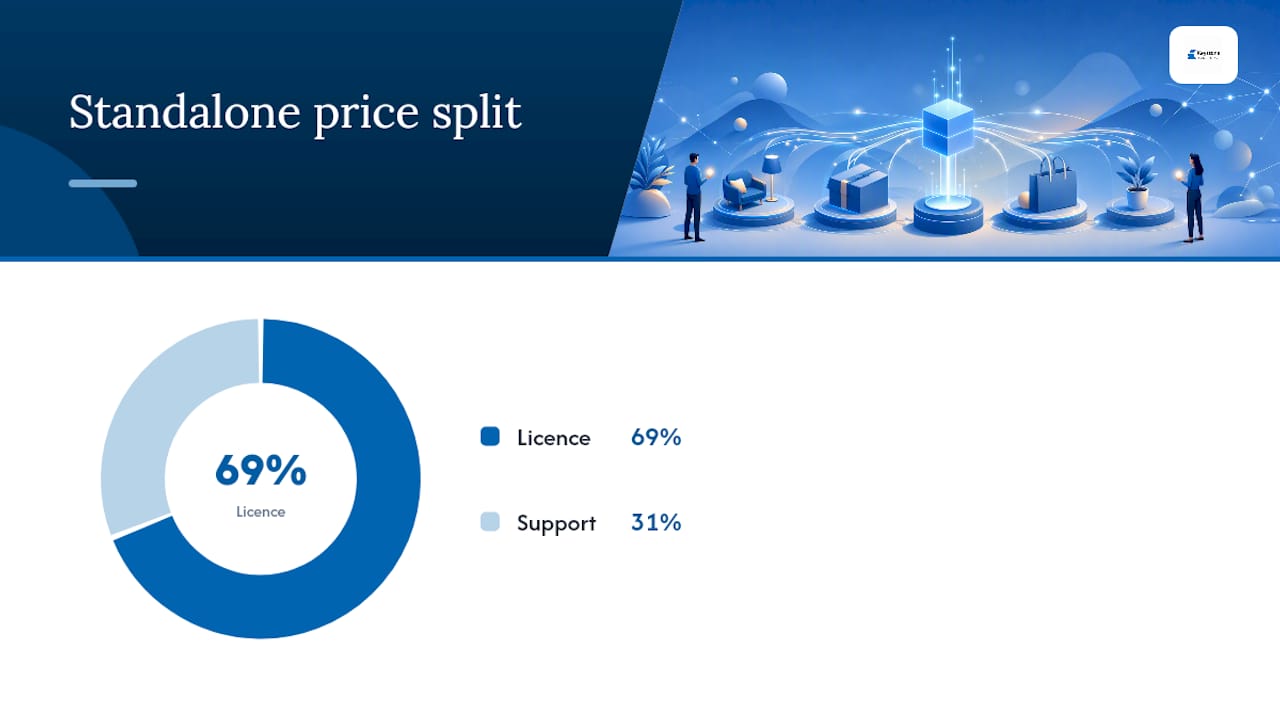
Allocate the price. Where a contract has multiple performance obligations, allocate the transaction price based on each obligation’s stand‑alone selling price (SSP). If you don’t sell an item separately, estimate SSP using adjusted market assessment, expected cost plus margin, or a residual approach for the rare items where SSP is highly variable or uncertain.
Recognise revenue. Revenue is recognised as each performance obligation is satisfied, either over time (where the customer simultaneously receives and consumes benefits, or you’re creating an asset with no alternative use and have an enforceable right to payment) or at a point in time (when control transfers). For licences, the distinction is between a right to access (over time, as the underlying IP changes) and a right to use (point in time, as it exists at grant).
A worked example makes step four concrete. Say a business sells a software licence plus one year of support for a bundled £12,000. Stand‑alone prices are £9,000 for the licence and £4,000 for support, totalling £13,000.
The discount embedded in the bundle (£1,000) is spread proportionately across both obligations rather than dumped entirely against the licence, which is the mistake that trips up a lot of preparers moving from the old model for the first time.
Which transition option should you choose, and what expedients apply?
You have two routes into the new standard, and the choice affects both your restated comparatives and your disclosure workload.
Full retrospective transition restates all prior periods presented as if the five‑step model had always applied. It gives the cleanest comparatives but demands the most rework, particularly for multi‑year contracts spanning the transition date.
Cumulative catch‑up (modified retrospective) applies the new model only from the date of initial application, recognising the cumulative effect of the change as an adjustment to opening reserves. Prior years aren’t restated, but you must disclose the nature and effect of the change in the year of adoption.
Several practical expedients soften the transition regardless of which route you pick, drawn from the transitional provisions guidance:
You don’t need to restate completed contracts that both began and ended within the same annual reporting period before the date of initial application.
For completed contracts with variable consideration, you can use the transaction price at the date the contract was completed rather than reconstructing it retrospectively.
Pre‑adoption contract modifications can be aggregated rather than accounted for individually, provided you apply this consistently across similar contracts.
Whichever expedient you use, apply it consistently to all contracts of a similar type and disclose that you’ve done so.
Pro Tip: If you’re part of a group that reports under IFRS at consolidated level, talk to the group reporting team before you pick a transition method. Choosing cumulative catch‑up at subsidiary level while the group restates fully under IFRS 15 creates a reconciliation headache that’s entirely avoidable with five minutes of coordination up front.
Groups with external investors tend to lean toward full retrospective transition because it gives lenders and investors a cleaner trend line. Smaller, owner‑managed businesses more often choose cumulative catch‑up simply because the restatement burden isn’t justified by the audience reading the accounts.
What does an FRS 102 implementation project actually look like?
Treat this as a project, not a bolt‑on to your usual year‑end close. The ICAEW’s implementation helpsheet sets out a sequence that holds up well in practice.
Plan and scope. Decide your transition date, assign ownership, and set a timetable that gives you at least one full reporting cycle before the effective date.
Identify contracts. Pull every revenue contract type your business uses, not just the largest by value. Smaller recurring contracts often reveal the same pattern issue repeated many times over.
Group similar contracts. Rather than analysing every contract individually, group them by structure (single delivery, multi‑element bundle, subscription, milestone‑based). Analyse one representative contract per group and extrapolate.
Apply the five‑step model to each group and note where the outcome differs from your current accounting.
Quantify the impact on opening reserves, current‑year revenue, and any covenant or KPI that references revenue.
Update controls, systems and disclosures to reflect the new recognition patterns on an ongoing basis.
Contract types that most commonly shift accounting pattern include software‑as‑a‑service subscriptions, construction and long‑term service agreements, and licences bundled with support or updates. One ICAEW article notes that many straightforward, single‑delivery contracts won’t change timing materially, but bundled arrangements with ongoing service elements often will. A detailed walk‑through for SaaS revenue recognition under the 2026 changes is worth reading if subscription billing is a meaningful part of your revenue.
On the systems side, check your billing engine’s ability to split invoiced amounts across performance obligations, confirm your revenue schedule (deferred income, contract asset, contract liability) can track partially satisfied obligations, and keep a documented rationale for every SSP estimate. If you’re mid‑migration on your accounting platform, it’s worth reviewing accounting software setup considerations before the transition date lands on top of a system change.
Pro Tip: Build your sample documentation as you go, not retrospectively. Auditors will want to see the reasoning behind SSP estimates and variable consideration judgements for the period under review, not a reconstruction built six months after the fact.
What must you disclose under the revised Section 23?
Disclosure expectations rise noticeably under the revised standard. The FRC’s explainer confirms preparers must disaggregate revenue into categories that reflect how economic factors affect its nature, amount, timing and uncertainty, typically linked to your reportable segments.
Disaggregated revenue: categories by product line, geography, or contract type, whichever best reflects the underlying drivers.
Performance obligation detail: typical timing of satisfaction, standard payment terms, and any significant refund or return obligations.
Transition disclosures: the transition method chosen, practical expedients applied, and the quantified effect on the opening balance in the year of adoption.
Draft these notes early rather than at final sign‑off. A statutory accounts template built around the old Section 23 headings won’t map cleanly onto the new disclosure set, and it’s worth reviewing your statutory accounts preparation approach alongside the transition project rather than after it.
What are the most common implementation mistakes?
Three errors show up repeatedly in early adopters’ working papers. The first is treating variable consideration as fully included without testing the “highly probable” threshold properly, effectively recognising revenue too early. The second is estimating stand‑alone selling price without a documented method, leaving auditors nothing to test. The third is forgetting that a right of return needs two entries, not one: a refund liability for the cash owed back, and a corresponding refund asset for the inventory you expect to recover.
Auditors will focus heavily on SSP estimation methodology, the evidence behind “highly probable” judgements on variable consideration, and whether contract grouping was applied consistently rather than selectively to smooth results.
Checklist item | Why it matters |
Transition method chosen and documented | Determines restatement scope and disclosure requirements |
Contracts identified and grouped by type | Enables consistent application of the five‑step model |
SSP estimation method documented per group | Gives auditors a testable basis for allocation |
Variable consideration tested against “highly probable” | Prevents premature revenue recognition |
Refund liability and refund asset both recognised where applicable | Avoids understating obligations on returns |
Disaggregated revenue note drafted | Meets FRC disclosure requirements |
Opening reserves adjustment calculated and reviewed | Supports transition disclosure and audit sign‑off |
How does KeystoneFA support the transition to Section 23?
KeystoneFA works with UK founders and growing businesses on exactly this kind of standard‑driven change, combining modern digital accounting tools with hands‑on technical review. Beyond the routine day‑to‑day bookkeeping, tax planning, and Companies House and HMRC compliance work, the team reviews contracts against the five‑step model, quantifies the transition impact, and drafts the disclosure notes your accounts will need.
A typical engagement runs through five stages: scoping your contract population, reviewing representative contracts by group, quantifying the numerical impact on reserves and current‑year revenue, drafting disclosures, and a final audit readiness check before your accounts go to the auditor. It’s the same structured approach used across Keystone’s broader compliance and reporting work, applied specifically to the mechanics of revised Section 23.
What this means for UK preparers over the next two years
Aligning with IFRS 15 should reduce diversity in how similar transactions get accounted for across UK businesses, but that benefit arrives with real short‑term cost. Preparers shouldn’t try to reanalyse every contract with equal intensity. Prioritise the contract types most sensitive to recognition timing, subscription and bundled arrangements especially, and the system changes that affect how recurring revenue gets tracked month to month.
Expect the first two adoption years to be dominated by auditor queries and investor questions about the transition’s numerical impact. That’s where most of the real work will land, not in the technical reading of the standard itself.
— Shoaib
Get help implementing the revised Section 23 revenue rules
If you’ve read this far and are wondering whether your contracts need reworking before 1 January 2026, KeystoneFA is built for exactly this kind of technical transition work, not just routine bookkeeping. Where a larger firm might hand you a lengthy memo and leave the quantification to your own finance team, KeystoneFA runs the contract review, the SSP estimation, and the disclosure drafting alongside your existing flexible accounting service, priced from £99 to £199 per month depending on scope.
[
](www.keystonefa.co.uk)
Every engagement is handled with the same confidentiality and professional independence you’d expect from any accounts preparation or audit readiness work, and nothing about the transition review changes that. If you want a bespoke implementation checklist for your own contract types rather than a generic one, get in touch through the KeystoneFA services page and we’ll scope it against your actual revenue mix before you commit to anything.
Sources
FAQ
Is FRS 102 part of UK GAAP?
Yes. FRS 102 is the principal standard within UK GAAP, applying to entities that don’t report under adopted IFRS, FRS 101, or FRS 105. The revised Section 23 revenue rules sit within this same UK GAAP framework.
What are the new revenue recognition rules in the UK?
The FRC’s Periodic Review 2024 introduced a five‑step revenue recognition model into Section 23 of FRS 102, aligning it with IFRS 15’s principles while keeping proportionate simplifications for smaller preparers. It takes effect for accounting periods beginning on or after 1 January 2026, with early adoption allowed.
How is revenue recognised under FRS 102?
Revenue is recognised by identifying the contract, identifying separate performance obligations, determining the transaction price, allocating that price across obligations using stand‑alone selling prices, and recognising revenue as each obligation is satisfied, either over time or at a point in time. Variable consideration is only included once it’s highly probable it won’t need reversing.
Is IFRS applicable in the UK?
UK companies can choose to apply adopted IFRS in their financial statements, and many listed groups do, but most private UK businesses report under FRS 102 instead. The revised Section 23 deliberately narrows the gap between the two frameworks without requiring FRS 102 preparers to adopt IFRS 15 in full.
Do all businesses need to apply the new five‑step model?
Any entity reporting under FRS 102 must apply the revised Section 23 for accounting periods beginning on or after 1 January 2026. Firms like KeystoneFA can help scope which contracts are materially affected, since many simple, single‑obligation sales won’t change in substance even though the underlying framework has.
Recommended