14 Day Confirmation Statement Filing: Fix ID Checks for UK Companies

File a confirmation statement (CS01) with Companies House within 14 days of your review period ending. Before you submit, check that directors, PSCs, registered office and share details are all current, and that every director has completed identity verification. Get any of this wrong and Companies House will simply reject the filing, so sequencing matters as much as the deadline itself.
TL;DR:
Directors, PSCs, and share details must be current and verified before filing, or the confirmation statement will be rejected.
Changes to directors, PSCs, or registered office must be submitted first with separate forms, not through the CS01.
Filing window is 14 days after the review period ends, which lasts 12 months from the previous statement or incorporation.
Online submission is faster and cheaper, but verification of personal codes is required for all directors before filing.
Missing the deadline risks legal penalties, account freezes, and potential strike-off, with restoration taking time and incurring extra costs.
Table of Contents
What is confirmation statement filing and when must you do it?
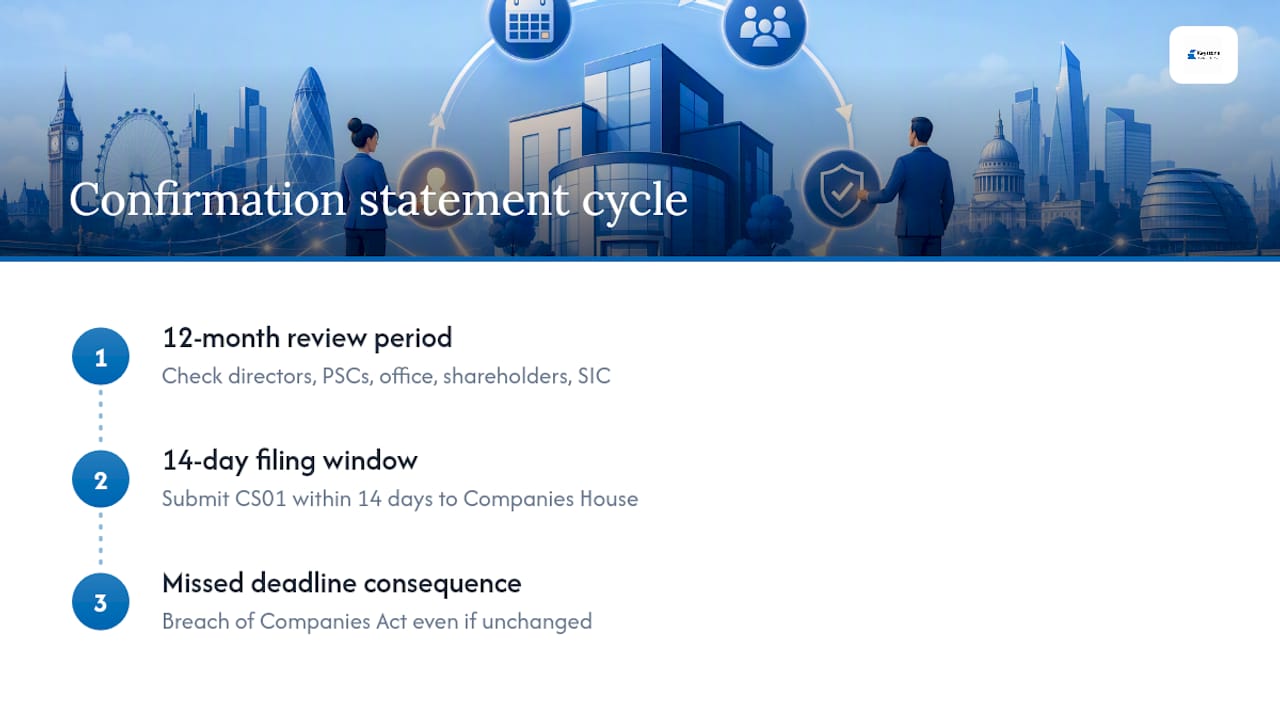
A confirmation statement filing is the annual check-in every UK company owes Companies House: confirming that the details on the public register (directors, PSCs, registered office, shareholders, SIC codes) are still accurate. Every company must submit one at least once every 12 months, and you have a 14-day window after the review period ends to get it in. Miss that window and you’re in breach of the Companies Act, even if nothing about your company has actually changed.
Since March 2024, the form also asks you to confirm your company’s intended activities are lawful and, for many companies, to supply a registered email address. It’s a small addition, but it catches out officers who assume the CS01 is still the same tick-box exercise it was five years ago.
Step-by-step: how to file a confirmation statement online
Most companies file through the Companies House online service, which is faster and cheaper than the paper route.
Log in with your company’s authentication code and select the correct company from your account.
Check the review period and confirmation date the service displays. This is fixed by law, not by you, so don’t try to guess it.
Work through each section: registered office address, officers, people with significant control (PSCs), statement of capital, shareholder details and SIC codes.
Confirm or amend each section. If something is wrong, you generally need to file the separate update form first (more on that below) rather than editing it here.
Pay and submit. The system will prompt you for payment before it accepts the filing.
Save your proof of submission, ideally as a PDF, in case a bank or investor ever asks for it.
Paper filing using the CS01 form still exists, but it’s now mostly reserved for specific circumstances such as company restoration, where the online service isn’t available. Companies House’s own guidance on filing your confirmation statement covers both routes in detail.
Pro Tip: Screenshot or download your confirmation before you close the browser tab. Companies House doesn’t always email a copy, and “I filed it” isn’t proof if a lender asks to see it.
What you must update before you confirm
Companies House won’t let you fix director, PSC or share changes inside the CS01 itself. Those go through their own forms first, and only once they’re accepted does your confirmation statement reflect reality. Filing the CS01 before these updates land is one of the most common causes of a rejected or inaccurate filing.
Check and file, in this order, wherever changes apply:
Director or secretary appointments and terminations, using AP01, TM01 or CH01 as appropriate.
PSC register changes, including new significant controllers or ownership shifts, which have separate filing rules and can block your CS01 if left outstanding.
Registered office address changes, if you’ve moved since the last statement.
Share allotments or transfers, reconciled against your statement of capital so the numbers match what Companies House already holds.
Sequencing this correctly, update forms first, confirmation statement second, saves a second submission and a second look from the registrar.
Identity verification: personal codes and what stops a filing
Identity verification is now a hard gate, not a formality. Companies House requires directors, and PSCs where applicable, to verify their identity and hold a personal code through GOV.UK One Login before certain filings, including the confirmation statement, will be accepted.
A few practical points worth knowing:
Every director named on the register typically needs their own personal code; one verified director doesn’t cover the company.
Verification can be done directly or through an authorised corporate service provider.
If a director is unresponsive, untraceable, or has died, don’t wait for the 14-day window to close before acting. Contact Companies House early and prepare supporting paperwork for the resignation or removal.
Pro Tip: If your company has a director who’s semi-retired or based overseas and rarely checks email, get their verification done now rather than at filing time. Chasing a personal code with three days left is a stressful way to spend a Tuesday.
Deadlines, review periods and fees explained
Your review period runs for 12 months, starting either from incorporation or from the date of your last confirmation statement. Once that period ends, you have exactly 14 days to file, no extensions, no grace period beyond that.
Filing early has a consequence worth knowing: submit before your review period ends and you reset the clock, moving your next review date forward. That can be useful if you want your statements to fall at a tidier point in your financial year, but it’s easy to do by accident if you file the moment you remember rather than checking the date first.
On fees, Companies House confirms online filing is quicker and cheaper than the paper CS01. Fee amounts do change from time to time, so check the current figure on GOV.UK before you pay rather than relying on what a previous filing cost.
Miss the deadline and here’s what happens
Failing to file isn’t a paperwork slip Companies House quietly overlooks. Under the Companies Act, it’s an offence, and the registrar can move towards striking your company off the register, with notice published in The London Gazette.
Before it gets that far, the practical damage usually starts:
Banks and payment providers running compliance checks can freeze or query accounts tied to a company showing overdue filings.
Procurement teams and larger clients often check the register before signing contracts, and an overdue confirmation statement reads as a red flag.
Company assets can, in the worst case, become the Crown’s property if strike-off completes and dissolution follows.
If you’ve already been struck off, administrative restoration is possible, but it takes time, involves a fee, and usually means catching up on every missed filing at once, not just the confirmation statement.
Pre-submission audit: catch mistakes before Companies House does
A five-minute check before you hit submit avoids most rejections. Run through this before every filing:
PSC register matches who actually controls the company today, not who controlled it last year.
Every director has a valid personal code and completed verification.
The registered email address on file is one someone actually checks.
Shareholder details and the statement of capital reconcile with any share transfers since the last statement.
SIC codes still describe what the company actually does.
The mistakes that trip people up are rarely dramatic. Relying on last year’s reminder email, informal share transfers that never made it onto paper, and lost authentication codes account for most of the rejected or delayed filings. A checklist for recording ownership changes properly, of the kind used in sectors where share structures shift often, is a useful model even outside that industry.
Pro Tip: Put your filing deadline in a calendar with a reminder 30 days out, not three. That gives you time to chase a missing personal code instead of panicking on day 12.
Keystone perspective: stop treating this as an annual scramble
Most of the confirmation statement problems we see aren’t really about the CS01 itself. They’re about registers that only get looked at once a year, when the reminder email lands. A director who left eighteen months ago is still listed. A share transfer happened over email and never got filed. Nobody updated the PSC register after a funding round.
None of that is a filing problem until deadline week, when it suddenly becomes one. KeystoneFA’s view is that statutory housekeeping works better as a running habit than an annual fire drill, filing changes as they happen rather than batching them into a rushed confirmation statement. For clients who’d rather not think about personal codes and review periods at all, that housekeeping, plus the actual CS01 filing, sits inside a standard compliance service rather than being a once-a-year scramble.
— Shoaib
How KeystoneFA handles your confirmation statement filing
Chasing personal codes for a director based abroad, reconciling a PSC register nobody has touched since last spring, working out whether your review period resets if you file early. It’s a lot of detail for something that’s meant to take fifteen minutes online.
[
](www.keystonefa.co.uk)
We handle the whole sequence for founders and small business owners: verifying identity, updating the statutory registers first, then filing the CS01 itself, so nothing gets rejected on a technicality. It’s built into ongoing compliance packages for clients who’d rather not track review periods themselves, and one-off filings are also available for companies that just need this year’s statement sorted properly. If your registers haven’t been touched since incorporation, or you’re not sure whether a share transfer ever got recorded, get in touch through KeystoneFA’s accounting services and we’ll tell you exactly what needs fixing before the 14-day clock starts.
Where to check the official rules yourself
Before filing, it’s worth reading the primary sources directly rather than relying on secondhand summaries. Companies House’s guidance on filing your confirmation statement covers the process end to end, the CS01 form itself is there if you need the paper version, and KeystoneFA’s note on Companies House’s move to software-only filing explains what’s changing on the technical side.
FAQ
How do I file my confirmation statement in the UK?
Log into the Companies House online service with your authentication code, review each section (officers, PSCs, registered office, shares, SIC codes), confirm they’re accurate, then pay and submit. Paper filing via the CS01 form is still available but mainly used for restoration cases.
What are the new rules for confirmation statements in the UK?
Since March 2024, companies must confirm their intended activities are lawful, and many must provide a registered email address. Identity verification through GOV.UK One Login is also now required for directors before certain filings, including the confirmation statement, will be accepted.
How much does it cost to file a confirmation statement in the UK?
Online filing is cheaper and quicker than paper filing, though the exact fee changes periodically, so check the current figure on GOV.UK before you pay.
What is the deadline for filing a confirmation statement?
You must file within 14 days of your review period ending, and that period runs for 12 months from incorporation or from your last confirmation statement date. Filing early resets the next review period, so check the date before submitting ahead of schedule.
Can I still file if a director hasn’t completed identity verification?
No. Companies House won’t accept a confirmation statement until the required personal codes and verification checks are supplied for directors and relevant PSCs, so unresolved verification is a common reason filings get blocked.
Recommended